
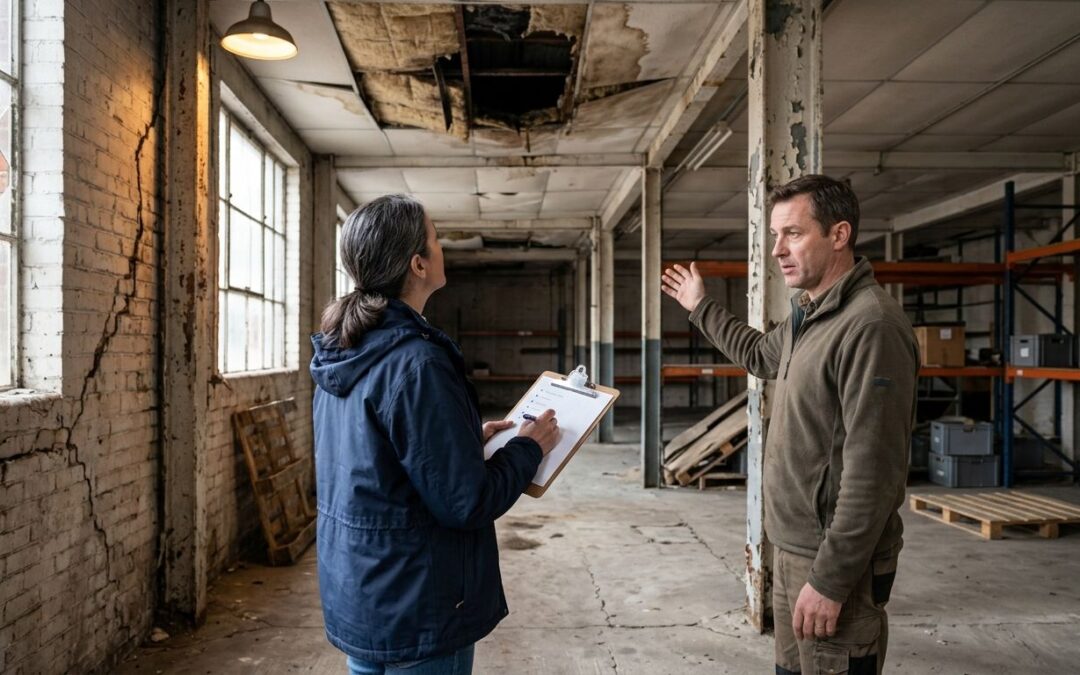
Genuine disrepair or active building work can bring your rateable value down, but the starting position in English and Welsh rating law is that every property is assumed to be in reasonable repair – so ordinary wear and tear, a leaking roof, or a broken heating system almost never qualifies on its own.
- Disrepair can reduce business rates, but only when repair would be uneconomic, not simply overdue.
- Newbigin v Monk (2017) confirmed a stripped-out building mid-redevelopment can be valued as it actually stands.
- Cosmetic damage or a temporarily broken system rarely moves the rateable value – the VOA assumes reasonable repair by law.
- A successful case needs a schedule of condition, dated photos and often a structural report through Check Challenge Appeal.
- Appeal My Rates UK reviews disrepair evidence on a no-win-no-fee basis before anything goes near the VOA.
Why this matters
Empty or half-gutted premises still generate a rates bill under the current list, sometimes for months while work drags on. Business owners assume that a building sitting behind hoardings with no roof, no wiring and no water automatically gets a lower valuation – it doesn't, unless someone actively tells the Valuation Office Agency (VOA) and proves it.
The legal test comes from Schedule 6 of the Local Government Finance Act 1988, which sets out the "reasonable repair" assumption used to value every non-domestic property in England and Wales. Get this wrong and you either pay rates on a building you can't use, or you submit weak evidence that gets rejected outright – which is exactly what the guide on why business rates appeals get rejected covers in more detail.
Can building work or disrepair reduce my business rates?
Yes, but the bar is higher than most owners expect. The VOA has to accept that the condition of the property makes it either uneconomic to repair or genuinely incapable of beneficial occupation – not just tired, dated or in need of maintenance.
The leading case is Newbigin (Valuation Officer) v S J & J Monk (2017), decided by the UK Supreme Court. It confirmed that a commercial building stripped back to a shell for redevelopment – no services, no ceilings, no floor coverings – should be valued in its actual condition at the relevant date, not as if it were still a finished office. That ruling still shapes how disrepair and redevelopment cases are argued in 2026.
| Condition of the property | Typical effect on rateable value | What the VOA needs to see |
|---|---|---|
| Cosmetic wear (peeling paint, worn carpets, an outdated kitchen) | No reduction | Nothing – this falls inside the reasonable repair assumption |
| Serious but repairable disrepair (leaking roof, failed boiler, damp) | Rarely reduced unless repair cost is disproportionate to value | Repair quotes showing cost versus benefit |
| Structural strip-out or active redevelopment (no services, no floors, planning consent for works) | Can be reduced substantially, sometimes to a nominal figure | Schedule of condition, photos, planning permission, contractor programme |
| Property incapable of any beneficial occupation | Can be removed from the rating list entirely | Evidence occupation is physically impossible, not just inconvenient |
Why most disrepair claims get rejected
- The reasonable repair assumption always applies first. Unless you can displace it with evidence, the VOA values the building as if repaired.
- Cost of repair versus benefit matters more than the damage itself. A cracked window costing £200 to fix won't move a six-figure rateable value.
- Temporary problems don't count. A boiler out for three weeks while a part is ordered isn't disrepair in rating terms – it has to reflect the state of the building on the relevant valuation date.
- Deliberate damage gets scrutinised. Since Newbigin v Monk, the VOA and local authorities watch closely for landlords stripping out buildings purely to cut a rates bill rather than for a genuine redevelopment.
- Continued occupation undermines the claim. If staff, stock or equipment are still using the space, arguing it's incapable of beneficial occupation is a hard sell.
- Missing paperwork sinks strong cases. A verbal description of damage carries far less weight than a dated schedule of condition or a structural engineer's report.
What counts as "building work" for a rates reduction
Redevelopment cases are treated differently from ordinary disrepair. If a property has planning permission for change of use, is being stripped of mechanical and electrical services, or has structural works underway that make normal trading impossible, that's a stronger platform for a Material Change of Circumstances (MCC) case than a general complaint about condition.
The first practical step is checking how the property is currently recorded, which starts with the VOA Check stage of Check Challenge Appeal. Getting the factual details right at Check – floor areas, description, current use – avoids a Challenge being knocked back on a technicality before the disrepair argument is even considered.
Rateable value itself is built from floor area, use class and local rental evidence, so it helps to understand how rateable value is calculated before arguing that disrepair should pull it down. A surveyor working on a no-win-no-fee basis will typically assess whether the condition evidence is strong enough before any Challenge goes in, rather than submitting a case that's likely to be rejected.
“If the building is genuinely unusable rather than just rundown, that difference is worth pursuing with the VOA – if it isn’t, a disrepair challenge usually wastes months.”
Get your disrepair case reviewed
A surveyor checks your evidence before anything goes to the VOA – no win, no fee.
Does the VOA assume my property is in good repair?
Yes, the VOA assumes reasonable repair by default under Schedule 6 of the Local Government Finance Act 1988. You have to actively displace that assumption with evidence showing repair is uneconomic or occupation is genuinely impossible – the assumption doesn't shift on its own just because a property looks tired.
What did Newbigin v Monk actually decide?
Newbigin v Monk, decided by the Supreme Court in 2017, held that a building stripped to a shell for redevelopment should be valued as it actually exists at that point, not as though the previous fit-out were still in place. It remains the reference case for redevelopment and strip-out arguments in 2026, though the VOA applies it narrowly to genuine works rather than cosmetic neglect.
Can my rateable value be reduced to nil during redevelopment?
Rateable value can be reduced to a nominal figure or removed from the list entirely during genuine redevelopment, but only where the property is provably incapable of beneficial occupation – no services, no safe access, structural works in progress. A building that's simply empty and unmaintained doesn't meet that bar on its own.
FAQ
Can disrepair reduce business rates in 2026?
Disrepair can reduce business rates in 2026, but only when repair would be uneconomic or the building can’t be occupied – ordinary wear and tear or minor damage doesn’t qualify under the reasonable repair assumption.
Does building work automatically lower my rateable value?
No, building work only lowers rateable value when it removes services, structure or usability to the point the property can’t function – cosmetic refurbishment or routine repairs make no difference.
What evidence do I need for a disrepair-based rates challenge?
A dated schedule of condition, photographs, repair cost estimates and, for structural cases, an engineer’s report are the core evidence the VOA expects before it will consider reducing a rateable value for disrepair.
Is a leaking roof enough to reduce my business rates?
A leaking roof alone is rarely enough – the VOA looks at whether repair cost is disproportionate to the value gained, not just whether a fault exists.
How long does a disrepair-based Check Challenge Appeal take?
Timescales vary by case complexity and VOA workload, and there’s no fixed deadline published for disrepair-specific challenges – tracking progress through each Check Challenge Appeal stage is the only reliable way to know where a case stands.
Can a landlord strip out a building just to cut business rates?
Deliberately stripping a building to reduce rates without genuine redevelopment intent is scrutinised closely by the VOA following Newbigin v Monk, and claims that look engineered rather than genuine are more likely to be challenged or rejected.
Does an empty, unmaintained shop qualify for a disrepair reduction?
An empty shop that’s simply unmaintained rarely qualifies – the disrepair has to make repair uneconomic or occupation impossible, not just mean the unit looks neglected.
Who decides if disrepair reduces my rateable value?
The Valuation Office Agency decides through the Check Challenge Appeal process, weighing the evidence submitted against the statutory reasonable repair assumption set out in the Local Government Finance Act 1988.
One last thing
The detail most owners miss is timing: disrepair or redevelopment evidence has to reflect the condition of the property on the relevant valuation date, not its condition when you finally get round to submitting a Challenge months later. Photograph and date everything as soon as work starts or damage occurs – evidence gathered retrospectively carries far less weight with the VOA than a contemporaneous record.
Related guides
- How to track your business rates appeal case status
- Can I switch business rates consultants during an appeal?
- Do I need to tell my landlord about a business rates appeal?
- Can I get business rates relief backdated on a new lease?
- What happens to your refund after a successful business rates appeal
