

A business rates appeal takes 15 months on average, ranging from 12 to 36 months, in 2026, measured from the date you submit a Check to the date the Valuation Office Agency (VOA) confirms a new rateable value. The clock doesn't start ticking the way most business owners expect, either: cases that stall at Check stage or get referred to the Valuation Tribunal for England routinely add 12 months or more on top of that estimate.
- A business rates appeal typically takes 12 to 18 months when it resolves at Check or Challenge stage in 2026.
- Cases referred to the Valuation Tribunal for England can run 2 to 3 years from the original Check submission.
- The VOA targets an 18-month decision on a Challenge; there’s no fixed deadline for the initial Check.
- A slow appeal doesn’t cost you money while it’s pending — successful reductions are backdated to the effective date.
Why this matters
A rates bill keeps arriving at the current figure for every month your case is open — the reduction only lands once the VOA or a tribunal confirms it. That's fine for cash flow because the eventual credit is backdated, but it's a problem for budgeting if you're relying on the saving to land inside this financial year rather than next.
Most ratepayers who track their appeal case status find the delay sits in one of two places: a slow VOA queue at Challenge stage, or a Check that was submitted with incomplete property facts and bounced back for correction. Both are avoidable with the right paperwork upfront.
How long does a business rates appeal take?
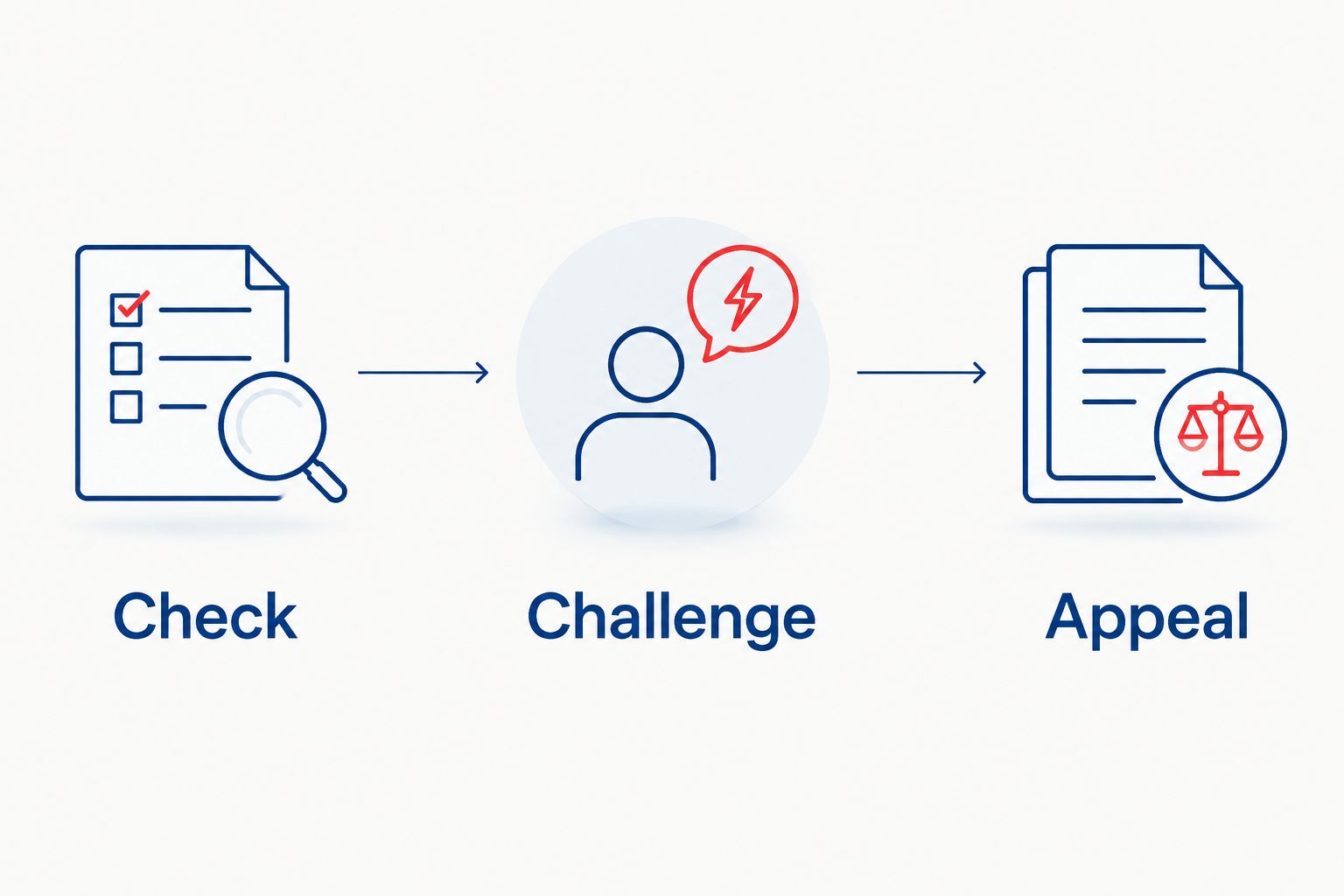
The process runs through up to three stages, and each one has its own pace:
| Stage | Typical timeframe | What happens |
|---|---|---|
| Check | Up to 12 months to submit and validate | You confirm the property facts the VOA holds are correct |
| Challenge | Up to 18 months for a VOA decision | You submit evidence disputing the rateable value |
| Valuation Tribunal appeal | 12 months or more for a hearing | An independent tribunal rules if Check and Challenge don't resolve it |
Most cases that succeed do so at Challenge stage without ever reaching a tribunal. A properly evidenced Check submitted through the correct Government Gateway workflow moves faster than one that gets kicked back for missing floor plans or lease details, so the paperwork you send in week one shapes the timeline more than anything that happens after month six.
Check stage: up to 12 months
There's no statutory deadline forcing the VOA to respond to a Check by a set date. Straightforward cases with clean property facts often clear in a few months; anything involving a recent lease change, a split site or a disputed floor area tends to sit closer to the 12-month mark.
You can move to the Challenge stage once you receive a Check decision. Submitting accurate rateable floor areas, lease dates and use classes at this point is the single biggest lever you have over the whole timeline — errors here are what cause most delays later.
Challenge stage: up to 18 months for a VOA decision
This is where the actual argument happens: you submit comparable evidence and a case for a lower rateable value, and the VOA has an internal target of deciding within 18 months of receiving a valid Challenge. Complex commercial properties, multi-site portfolios and cases with disputed comparables tend to run the full 18 months; simpler single-unit retail or office challenges can settle well inside that window.
A weak or thin evidence pack at this stage is the most common reason a case drags to the full 18 months rather than settling early. Strong comparable evidence, submitted correctly the first time, gets negotiated faster than evidence that has to be revised and resubmitted.
Valuation Tribunal appeal: 12 months or more for a hearing
If the VOA and the ratepayer can't agree at Challenge stage, either side can refer the case to the Valuation Tribunal for England. This is the exception, not the rule — most ratepayers never reach it — but when a case does escalate, tribunal scheduling backlogs mean a wait of 12 months or more for a hearing date is common, pushing total case length toward the 2-to-3-year range.
Why timelines vary
Six factors decide whether your case lands near 12 months or drags toward 3 years:
- Property complexity — a single retail unit moves faster than a multi-site logistics portfolio or a data centre with bespoke plant valuations
- Quality of comparable evidence — a thin evidence pack gets sent back for revision; a strong one gets negotiated first time
- Whether the billing authority disputes the case — councils that contest a Check add a review cycle
- VOA regional caseload — some regional offices carry heavier backlogs than others at any given time
- Whether a site inspection is needed — physical inspections add scheduling time neither side controls
- Escalation to the Valuation Tribunal — this is the single biggest driver of a case running past 18 months
Get a specialist handling the timeline
RICS-qualified surveyors, no-win-no-fee, no money upfront.
Related questions
Can a business rates appeal be rejected?
Yes — a Check or Challenge can be rejected if the evidence doesn't support a lower rateable value, or if the submission is incomplete. A rejection at Challenge stage is one of the most common reasons a case that looked like it would settle in 12 months instead runs toward 18.
Is a business rates appeal worth it in 2026 if it takes this long?
For most ratepayers with a genuine over-assessment, yes — because any reduction is backdated to the effective date of the Check, the 12-to-18 month wait doesn't cost you the saving, it just delays when the credit lands.
How do I speed up a business rates appeal?
Submit complete, accurate property facts at Check stage and strong comparable evidence at Challenge stage the first time. Cases that get sent back for missing information are the ones that end up running closer to 36 months.
FAQ
How long does a business rates appeal take on average?
A business rates appeal takes 12 to 18 months on average when it resolves at Check or Challenge stage in 2026. Cases that escalate to the Valuation Tribunal for England can take 2 to 3 years in total.
How long does the Check stage take?
The Check stage takes up to 12 months, though there’s no statutory deadline forcing the VOA to respond by a fixed date. Straightforward cases with clean property facts often clear faster.
How long does the Challenge stage take?
The Challenge stage takes up to 18 months, which is the VOA’s internal target for deciding a validly submitted Challenge. Complex or multi-site cases tend to run the full 18 months.
How long does a Valuation Tribunal appeal take?
A Valuation Tribunal appeal adds 12 months or more on top of the Check and Challenge stages, mainly due to hearing scheduling backlogs. Most cases never reach this stage.
Do I get backdated relief if my appeal takes a long time?
Yes, a successful appeal is backdated to the effective date of the Check, not the date it’s decided. A slow appeal delays the credit, but it doesn’t reduce the amount owed to you.
Can a business rates appeal be rejected?
Yes, a Check or Challenge can be rejected if the evidence doesn’t support the claimed rateable value or the submission is incomplete. Rejections at Challenge stage are a common cause of cases running past 18 months.
What slows down a business rates appeal the most?
Incomplete property facts at Check stage and thin comparable evidence at Challenge stage cause the most delay. Escalation to the Valuation Tribunal adds the largest single chunk of time, 12 months or more.
Is it worth appealing if the process takes over a year?
Yes for most genuinely over-assessed properties, because the eventual reduction is backdated to the Check date regardless of how long the decision takes. The wait affects timing, not the size of the saving.
One last thing
The part most ratepayers miss: a slow appeal in 2026 doesn't mean a smaller saving. Because reductions are backdated to the effective date once an appeal succeeds, the 12-to-36-month range in this guide is a wait for confirmation, not a countdown on how much you'll get back. The property owners who lose out are the ones who never submit a Check at all, not the ones whose case takes 18 months to clear.
Related guides
- Can a business rates appeal be rejected?
- Is a business rates appeal worth it?
- Refunds after a successful business rates appeal
