

Car dealership business rates appeals challenge the rateable value the Valuation Office Agency has set on your showroom, workshop and forecourt, with the aim of cutting the rates bill a dealership pays for space that often gets banded like ordinary retail floor when it isn't. Showrooms, service bays and forecourt hardstanding are usually valued on different bases, and dealerships that appeal them as one blended figure leave money on the table every year the 2026 rating list stays in force.
- Car dealerships appealing business rates should challenge showroom, workshop and forecourt valuations separately, not as one blended figure.
- The 2026 rating list took effect on 1 April 2026 – check your current rateable value against it before you decide to appeal.
- EV charging bay additions and workshop conversions can trigger a Material Change of Circumstances case worth checking on its own.
- Appeal My Rates UK reviews dealership cases on a no-win-no-fee basis, so a free check carries no upfront cost.
Why this matters for car dealerships and showrooms
A dealership site usually mixes three or four rateable uses under one roof line: showroom retail floor, workshop or bodyshop bays, parts storage, and open or covered forecourt display. The Valuation Office Agency values each of these differently, and a valuation drawn up years ago on a smaller showroom or a different bay count doesn't automatically update itself when you extend, convert or rebrand.
The current 2026 rating list came into force on 1 April 2026, based on rents and values as at the antecedent valuation date. If your dealership's rateable value still reflects an older floor plan or an assessment drawn up before a franchise rebrand, workshop expansion or forecourt resurfacing, you're paying rates on a property that no longer exists as valued.
A RICS chartered surveyor working under the RICS Code of Practice and IRRV standards can read a Detailed Valuation and spot where the banding doesn't match the site. That's a different skill from reading a bill and guessing it looks high.
How to appeal business rates for a car dealership
The steps below run manual and free first, then bring in professional review once you know where the case actually is.
Check your current rateable value and valuation basis
Start with what the VOA already has on file before you touch anything else.
- Look up your rateable value on the VOA's free find-a-rateable-value service using your postcode.
- Note the valuation method applied – showroom floor, workshop bays and forecourt hardstanding are usually measured and rated separately.
- Check the effective date against the 2026 rating list start of 1 April 2026 to see how old the underlying data is.
- Request the Detailed Valuation if it's available, so you can see the rate applied per square metre for each area.
- Compare against a neighbouring dealership's published rateable value where the VOA list shows one.
Measure your showroom, workshop and forecourt areas
Most dealership disputes start with a floor plan that no longer matches the building.
- Remeasure showroom retail floor, workshop or bodyshop bays, parts storage and covered forecourt display separately.
- Check whether an EV charging bay or valeting bay area is being taxed under the wrong use class.
- Confirm the VOA's recorded floor plan matches what's actually built, including any extensions or partition changes.
- Flag mothballed or unused workshop bays that shouldn't be carrying full rateable value.
- Note any open hardstanding used purely for vehicle storage rather than customer-facing display – it's often valued differently to showroom frontage.
Compare against comparable dealership assessments
A rateable value only holds up if it lines up with genuinely comparable sites.
- Search the VOA's local rating list for other dealerships of a similar size and franchise type in your area.
- Note the rate per square metre they're carrying for showroom and workshop space.
- Check whether any of them have recently had their assessments reduced following an appeal.
- Rule out sites that aren't actually comparable – a city-centre showroom and an out-of-town megasite rarely share a valuation basis.
Get a RICS chartered surveyor to check the case
Once you've got a manual read on the numbers, a professional check tells you whether there's a real case or just a hunch.
- A RICS surveyor working to the RICS Code of Practice reviews comparable rental evidence, not just the headline rateable value.
- Checking a consultant's RICS credentials before you hand over a case protects you from agents who aren't regulated.
- Appeal My Rates UK reviews dealership cases on a no-win-no-fee basis, so the check itself doesn't cost you anything upfront.
- A surveyor can also flag whether a Material Change of Circumstances case applies separately from a general appeal – useful if you've added EV bays or converted a bodyshop.
Get your dealership’s rates checked
A free review of your showroom, workshop and forecourt valuation, no upfront cost.
Submit a Check case through the Government Gateway
Once there's a case, the formal route starts with the Check stage on the VOA's system.
- Register or log into the Government Gateway account linked to your business rates.
- Submit factual corrections first – floor areas, use classes, rateable date errors.
- Attach measurement evidence and comparable data gathered in the earlier steps.
- Keep a copy of everything submitted; the VOA can take months to respond and records go missing.
Track your case and prepare for the Challenge stage
A submitted Check isn't the end of the process – it's the start of the paper trail.
- Log dates for every submission and VOA response so you know when statutory deadlines apply.
- Move to a Challenge if the Check response doesn't reflect the factual corrections you submitted.
- Keep the local council rates team informed once a case is live, since billing doesn't automatically pause.
- Escalate to the Valuation Tribunal for England only if Challenge negotiations stall without agreement.
Options for car dealerships appealing business rates
| Option | Best for | Key limitation |
|---|---|---|
| DIY appeal (manual) | Owner-operators comfortable reading VOA valuation notices and floor plans | No representation if the council or VOA disputes your evidence |
| General business rates agent | Groups wanting quick handling of routine banding queries | Not always RICS-regulated, no Code of Practice protection |
| RICS chartered surveyor (Appeal My Rates UK) | Multi-bay dealerships with mixed showroom, workshop and forecourt use | Works no-win-no-fee, so review depends on VOA and Valuation Tribunal case load |
| National consultancy (e.g. Knight Frank) | Very large multi-site dealership groups wanting one national contract | Typically fee-based regardless of outcome, less local market granularity |
Verdict: a RICS chartered surveyor is the strongest choice for a dealership with more than one rated use on site – the showroom-workshop-forecourt split is exactly where general agents miss detail a specialist catches.
“A forecourt display bay is not a showroom, and valuing it like one costs a dealership money every year the 2026 list stands.”
Common mistakes car dealerships make on rates appeals
- Treating forecourt hardstanding the same as showroom floor. Open display bays and covered canopy areas usually carry a different rate per square metre than glazed showroom frontage – appealing them as one figure weakens the case.
- Ignoring reclassification after EV or workshop conversion work. Adding EV charging bays or converting a bodyshop without notifying the VOA leaves the old use class – and the old rateable value – in place.
- Missing split-assessment opportunities on multi-brand sites. Dealerships running separate showrooms for different franchises under one rateable value often qualify for a split assessment that isn't automatic.
- Letting franchise rebrands go unrecorded. A new frontage or signage change after a franchise switch doesn't update the VOA record on its own – the old floor plan and valuation basis can sit unchanged for years.
- Assuming a submitted Check case is the whole process. Cases stall at the VOA end when nobody tracks deadlines through Challenge and, where needed, Appeal.
FAQ
Can a car dealership appeal its business rates in 2026?
Yes, dealerships can appeal under the current 2026 rating list, which took effect on 1 April 2026. The strongest cases challenge showroom, workshop and forecourt valuations separately rather than as one combined figure.
How is rateable value calculated for a car showroom?
Showroom floor is usually valued on a rental comparison basis against similar retail-facing units, while workshop bays and forecourt hardstanding are often valued using different rates per square metre. A Detailed Valuation from the VOA shows exactly which method applied to your site.
Does forecourt hardstanding get valued separately from the showroom?
Often, yes. Open display forecourt, covered canopy display and glazed showroom frontage frequently carry different rates per square metre, and dealerships that lump them together in an appeal typically undervalue their case.
Is a business rates appeal worth it for a small independent dealership?
It depends on how the current valuation compares to similar sites and how old the underlying floor plan is. A free check against comparable dealership assessments answers this before you commit to a formal case.
How long does a car dealership rates appeal take?
Timelines vary by case complexity and VOA workload. Most cases resolve at the Check or Challenge stage; escalation to the Valuation Tribunal for England is the exception, not the norm, and adds time.
What happens to my business rates if I install EV charging bays?
Adding EV charging bays can change the use class of that part of the site and may support a Material Change of Circumstances case. It’s worth checking separately from a general rateable value appeal.
Can a business rates consultant guarantee a reduction for a dealership?
No reputable RICS-regulated surveyor guarantees a specific reduction, since the outcome depends on comparable evidence and the VOA’s response. A no-win-no-fee arrangement means you only pay when a reduction is agreed.
What’s the difference between the Check, Challenge and Appeal stages?
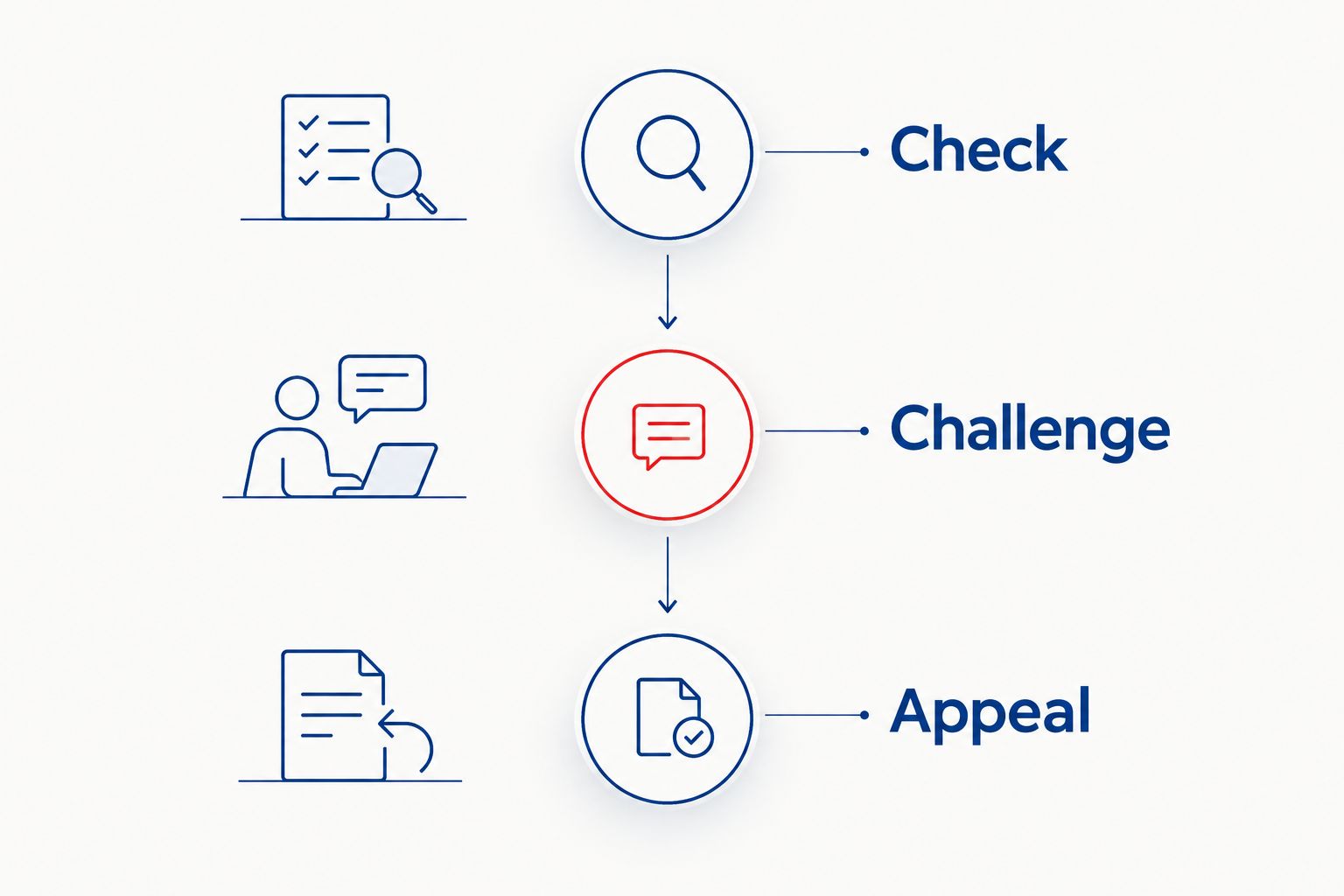
Check corrects factual errors on the VOA record, Challenge argues the valuation itself with comparable evidence, and Appeal escalates an unresolved Challenge to the Valuation Tribunal for England. Most dealership cases settle before reaching Appeal.
One last thing
The detail that trips up most dealership appeals isn't the rateable value figure – it's the floor plan behind it. A showroom extension, a converted bodyshop bay or a resurfaced forecourt from three or four years ago can sit unrecorded on the VOA's system while the 2026 rating list keeps charging rates on the old layout. Pull your Detailed Valuation before anything else; it tells you in minutes whether your case is about the number or about the building.
Related guides
- Is a business rates appeal worth it in 2026?
- Reducing business rates for petrol stations and forecourts
