

To appeal a business rates demand notice, use it to identify what is wrong before you contact anyone: the council handles billing and relief, while the Valuation Office Agency (VOA) handles the rateable value in England and Wales. Instead of sending every objection to the council, match the disputed item to the right route and keep the notice as your starting record.
- To appeal a business rates demand notice, first separate council billing errors from VOA valuation issues.
- The notice identifies the property, billing period, rateable value and amounts you need to check.
- Appeal My Rates UK is best for business owners who want a rating surveyor to handle a valuation challenge or council dispute.
- Keep paying or agree payment arrangements with the council while the issue is reviewed; a challenge does not itself cancel the bill.
Why this matters
A demand notice is a bill, not the valuation decision. It shows how the council has calculated what it says you owe. If the rateable value or property entry is wrong, correcting the council's arithmetic will not fix the underlying valuation. If the valuation is right but relief or a payment has been missed, a valuation challenge will not correct the council's account.
For a valuation issue in England, the Government Gateway to a submitted VOA Check workflow explains the separate submission route. Wales also uses the VOA for valuations, but its challenge procedure differs from England's. Check which country the property is in before following a process guide. In 2026, keep the demand notice and any revised notice together so you can see exactly what changed.
Before you start
- Get the complete demand notice and account history. Keep every page, the account reference, any revised notices and a record of payments. A cropped balance alone will not show how the council calculated the charge.
- Get access to the valuation record. Record the property address and rateable value shown for the entry, then gather documents relevant to your objection, such as a lease, floor plan, occupation dates or council correspondence. Use only evidence that addresses the point you dispute.
- Check who has authority to act. The ratepayer or an authorised representative needs to use the relevant process. The mid-setup trap is treating a council billing query as if it were a VOA valuation challenge: contacting one body does not automatically open a case with the other.
Read the notice and isolate the disputed item
A demand notice can contain a correct rateable value and an incorrect bill, or the reverse. Mark the item you dispute before drafting an explanation. That makes it easier to send the right evidence to the right body.
- Find the property and account details. Check the address, property description, ratepayer name, account reference and billing period against your records. Record the reference exactly as printed so the council can identify the account.
- Find the rateable value. Compare the figure on the notice with the VOA's entry for the property. Do not treat a disagreement about the amount payable as proof that the rateable value is wrong: the council applies its billing calculation to that value.
- Mark each charge, credit and payment you question. Separate an apparently missing relief or payment from a dispute about the property itself. If you have more than one notice, compare the dates and figures on each rather than assuming the newest notice explains the change.
- Write a one-sentence problem statement. For example, identify whether the account names the wrong property, the council has not shown a payment, or the VOA entry does not reflect the space you occupy. State what your documents show without guessing at a revised valuation.
Expected result: you have the notice reference, the disputed line or property detail, and a clear account of why it appears wrong. In 2026, that short record is more useful than a general request to reduce your rates.
Check the valuation entry and evidence
Use this unit when you dispute the rateable value, the property description or whether space should be assessed together or separately. The notice points you to the entry, but it does not replace the evidence needed to change that entry. Appeal My Rates UK handles valuation challenges and property splits or mergers for business owners in England and Wales.
- Identify the VOA entry for the exact property. Check the address and description against the demand notice. A mismatch is a question to resolve, not evidence that either record is automatically wrong.
- Define the physical or valuation issue. Note the area, use or layout you say is recorded incorrectly. For a split or merger, identify the spaces involved and how they are occupied; do not simply ask for the bill to be divided.
- Attach evidence to each point. Use a plan to explain a layout issue, occupation records to explain who used a space, or dated records to explain a relevant change. Label what each document proves.
- Choose the procedure for the property's country. In England, the VOA's Check, Challenge, Appeal process governs challenges to the rating list. In Wales, follow the applicable proposal and appeal process rather than copying England's steps. Check the current official instructions before submitting, including who can act and what the submission requires.
Expected result: your valuation issue is tied to the correct property entry and supported by documents relevant to that issue. If you need the England-specific sequence, read the VOA Check, Challenge, Appeal guide for 2026 before filing.
The sequence is simple to remember: read the notice, check the entry, choose the route and keep records. Do not skip the entry check merely because the amount on the bill looks wrong.
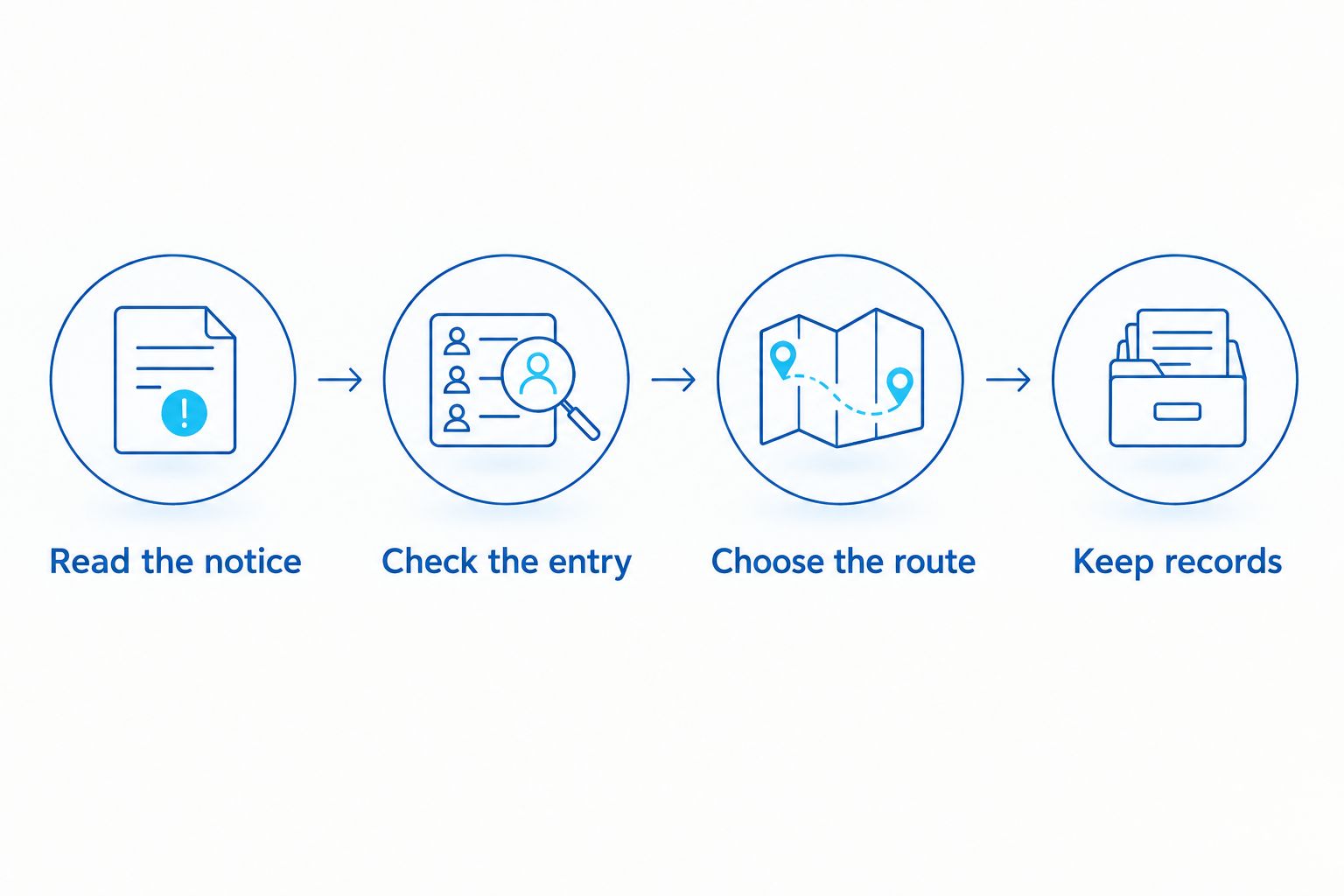
Send the issue to the right body
A clear submission identifies the notice, explains the disputed item and asks for a specific correction or review. Keep the council and VOA strands separate even when the same property documents support both.
- Send billing questions to the council named on the notice. Quote the account reference and identify the period and charge you dispute. Ask the council to explain its calculation or review the relevant relief, payment, liability or account detail. Keep a copy of what you send.
- Send valuation issues through the applicable VOA process. Identify the property entry and the evidence supporting your position. Follow the England or Wales procedure for that entry; an email to the council is not a substitute for a valuation submission.
- Ask about payment while the issue is open. A dispute does not by itself suspend the demand notice. If you cannot pay as billed, contact the council about the account rather than withholding payment without an arrangement.
- Record each response and revised document. Note the case reference, the body that issued it and the issue it addresses. Compare any revised demand notice with the original to see whether the change you requested appears on the account.
Expected result: the correct body has your evidence, and you can track the billing account separately from the valuation case. A VOA change and an updated council bill are connected steps, not the same document.
Check relief or payments without challenging the valuation
Use this variant when the VOA entry looks right but the council's demand notice does not reflect your records. A business can have a valid rateable value and still need a correction to its billing account.
- Identify the missing or incorrect account item. Point to the billing period and the relief, payment, credit or liability detail in question. Use the notice's account reference in every message.
- Gather the matching records. Provide payment evidence, occupancy documents or earlier council correspondence as relevant. Explain the connection between each document and the correction you seek.
- Ask the council for a written account review. Request an explanation of its decision and, if the account changes, a revised demand notice. Do not submit a VOA valuation challenge solely to recover a payment the council has not recorded.
- Compare the response with the new notice. Check the property, period and account entries again. Keep both versions; the revised notice shows what the council has actually changed.
Expected result: the council has either corrected the account or given you a decision you can address directly. In 2026, the distinction still matters: a billing correction does not establish that the property's rateable value has changed.
Troubleshooting
- The notice and VOA entry show different details. Check that you have matched the exact property and current entry before submitting anything. Send the council a query about the notice and use the applicable VOA route if the valuation entry itself is wrong.
- You have sent a valuation complaint to the council but have no VOA case. Use the relevant VOA process to raise the valuation issue. Keep the council informed about the billing account, but do not assume the council has filed the valuation challenge for you.
- You have filed a valuation challenge but the bill has not changed. Check the status and outcome of the valuation case. If the entry changes, ask the council how the change will be reflected in your account; do not assume a submission alone produces a revised bill.
- The property has been split, merged or altered. Identify which spaces and occupation arrangements the existing entry covers. Provide plans and dated supporting records where relevant, then ask for the property entry to be considered through the correct valuation process.
- You cannot find an old notice or payment record. Ask the council for the account documents or transaction information needed to identify the disputed period. Avoid stating that a credit is missing until you have checked the account history.
Customize your case record
Keep one file for the council account and another for the valuation entry. Put the demand notices, payment records and council replies in the account file; put property plans, occupation evidence, VOA correspondence and case decisions in the valuation file. Where a document matters to both, save it in both files and explain its purpose in each submission.
For a single property, a short issue log can list the disputed item, the body responsible, the evidence sent and the response received. For multiple properties, keep a separate log for each account and VOA entry. This prevents a reply about one address from being mistaken for a decision about another.
Appeal My Rates UK is best for business owners who want a rating surveyor to handle a valuation challenge or a dispute with the council's rates team. Let us handle your case if you need help deciding what the notice can prove and where the challenge belongs. Most of our work is no win, no fee, but some instructions carry fixed fees. Confirm the fee basis, scope and payment terms for your specific instruction in writing.
Discuss your demand notice
Explain the disputed item and ask which route fits your case.
FAQ
Can I appeal a business rates demand notice to the VOA?
Challenge the rateable value or property entry through the applicable VOA process, not by appealing the council’s bill to the VOA. Send questions about charges, relief and payments to the council named on the demand notice.
Does a business rates appeal stop me paying the demand notice?
No, raising a valuation or billing dispute does not itself cancel the amount demanded. Contact the council about payment arrangements while the issue is being reviewed.
What evidence should I keep from a business rates demand notice?
Keep the complete notice, its account reference, billing period and any revised versions. Add the documents that support the specific issue you are raising, such as payment records or property plans.
Is the business rates challenge process the same in England and Wales?
No, the procedure for challenging a valuation entry differs between England and Wales. Identify where the property is and follow the applicable official process before submitting.
Who fixes a missing business rates payment or relief on my bill?
The billing council handles payments and relief shown on the demand notice. Give it the account reference, disputed period and supporting records, then ask for its decision in writing.
Can a demand notice prove that my rateable value is wrong?
No, a demand notice shows the value used to calculate the bill but does not by itself establish a valuation error. Compare it with the property entry and gather evidence about the detail you dispute.
Can Appeal My Rates UK help with a split or merged property?
Yes, Appeal My Rates UK handles property splits and mergers as part of its rating surveyor services. Explain which spaces are involved and confirm the scope, fee basis and payment terms for your instruction in writing.
One last thing
Keep the original demand notice even after a corrected one arrives. The two notices show whether the council changed the property details, the billing calculation or neither. That comparison tells you whether the issue is resolved or whether a separate valuation question remains. In 2026, Appeal My Rates UK can help you identify that distinction and fight your case for you without treating every high bill as the same kind of appeal.
Related guides
- How to calculate your rateable value manually
- Can business rates relief be backdated on a new lease?
- Refund after a successful business rates appeal
