
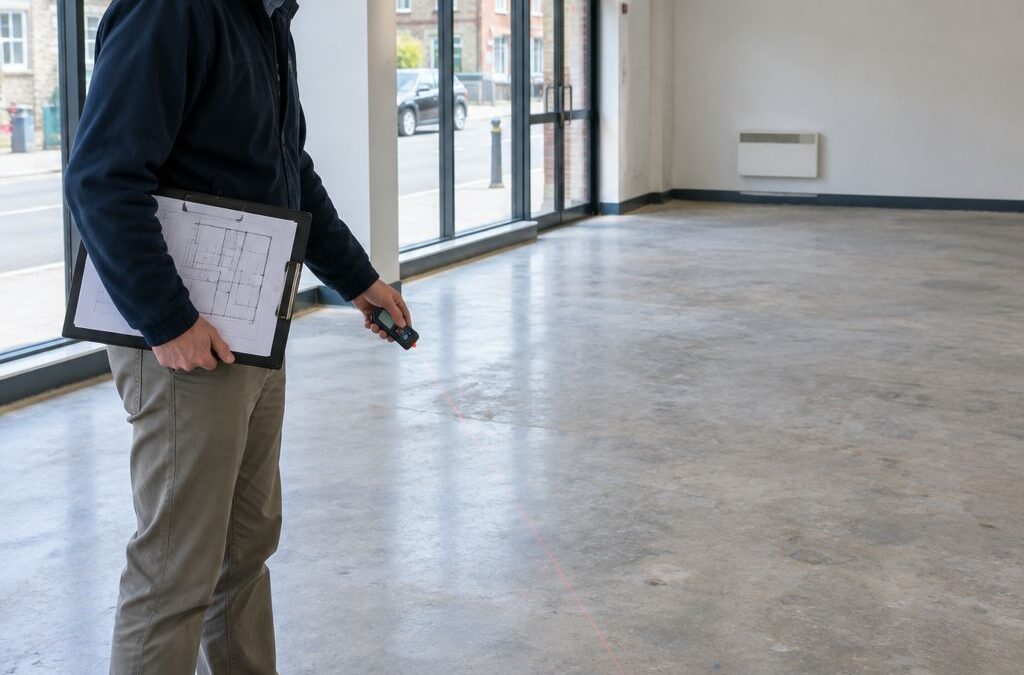
A floor area survey checks the measurements behind your business rates bill against the space your business actually occupies — and where the recorded figure is wrong, correcting it can cut your rateable value and your 2026-27 bill. This workflow takes you from the tape measure to a corrected rating list entry, step by step.
- The Valuation Office values most premises on floor area — wrong measurements mean the wrong bill.
- Measure to RICS standards: NIA for shops and offices, GIA for warehouses and factories.
- Correct the facts with a check case in your business rates valuation account.
- Rateable value below £51,000 drops the multiplier from 48p to 43.2p in 2026-27.
- Appeal My Rates UK surveys, evidences and submits the case for you.
Why this matters
The Valuation Office Agency (VOA) calculates your rateable value from the factual details it holds about your property: floor area, number of floors, and the facilities on site. It usually measures using either the net internal area (NIA) method or the gross internal area (GIA) method, both based on the RICS Code of measuring practice.
If the recorded floor area is larger than the space you really occupy, your rateable value is built on floor space that is not there, and your bill follows it. In 2026-27 that bill is the rateable value multiplied by 48p for most properties valued at £51,000 or more, or 43.2p below £51,000. Corrections work in both directions, so measure honestly before you submit anything.
Before you start
- A business rates valuation account on GOV.UK, signed in with Government Gateway, with your property added to it.
- A floor plan and measurements taken to the RICS standard that applies to your property type (see step 1).
- Your lease or ownership details, so the extent you occupy is clear.
The gotcha most owners miss: the VOA compares your submission against its own recorded measurements and can inspect the property. Knowingly submitting false information can lead to a penalty, so the survey needs to be accurate and defensible, not optimistic.
Step 1: Measure the property to the right standard
The VOA measures shops, offices and similar premises on a net internal area (NIA) basis — the usable floor space inside the external walls. Warehouses, factories and industrial buildings are usually measured on a gross internal area (GIA) basis, which includes columns, lift shafts and other internal structures.
Measure each floor separately and record the basis you used. Work from external walls inward where access allows, and photograph anything unusual: mezzanines, loading canopies, areas you cannot use. Your survey should produce one floor area figure per floor and a total, in square metres — the unit the rating list uses.
Expected result: a written survey with a total floor area figure and the measurement standard named.
Step 2: Compare your survey with the rating list
Open your property in your business rates valuation account and read the recorded factual details: floor area, storeys, and site facilities. Put your survey figure beside the recorded one.
- A small gap can come from a different measurement method, so confirm you used NIA or GIA as the VOA did.
- A larger gap points to a real error, such as a mezzanine counted twice, a shared area included, or an extension that no longer exists.
- Check the description of the property and any site facilities too, because errors there change the value as well.
Expected result: a short written comparison showing recorded area, surveyed area and the difference for each floor.
Step 3: Raise a check case to correct the facts
Submit a check case through your business rates valuation account, attaching your survey and explaining what is wrong with the recorded details. If you cannot submit it through the account, email ccaservice@voa.gov.uk or contact the VOA to raise it manually.
The VOA reviews the factual details and updates them where your evidence supports the change. A corrected floor area flows into the rateable value calculation, and your council rebills your account from the date the change takes effect.
Expected result: a check case reference number and, later, a VOA decision letter.
Step 4: Challenge the value if the facts were right
A check case only fixes facts. If your measurements match the record but the rateable value still looks wrong against rents for comparable properties, the next step is a formal challenge of the valuation itself, started in the same account. If the VOA has not replied within 18 months of your challenge, you can take the case to the Valuation Tribunal.
Challenging carries risk: a review can increase a valuation as well as reduce it, so weigh your evidence before you commit. The VOA check workflow through Government Gateway covers the sign-in and submission mechanics in detail.
The same survey, reused: when the property changes
If you split, merge or partly vacate a property, the survey you already hold becomes the evidence for the new assessment too. Send updated plans to the VOA when the physical change happens rather than waiting for the next billing run — the effective date of the change decides what you pay from then on.
Troubleshooting
- The VOA disagrees with your survey. Ask which standard and which parts of the building it measured; a method difference is often settled by re-inspection, not argument.
- You measured to the wrong standard. Re-cut the survey to NIA or GIA as appropriate and resubmit; never argue a net figure against a gross record.
- The facts were corrected but the bill did not move. Corrections change the rateable value; the council applies it from the effective date. Check the rebill, not the current instalment.
- The value is wrong but the facts are right. That is a challenge, not a check — see step 4.
- You are close to a threshold. In 2026-27 the multipliers change at rateable values of £51,000 and £500,000 (50.8p applies from £500,000), so a corrected area that crosses a threshold changes the rate in the pound as well as the value.
What to do next
A floor area correction is one of the few business rates wins you can prove with a tape measure, but the submission still has to be built properly — the wrong standard, an unsupported figure or a badly framed case can cost you the correction. Appeal My Rates UK is a firm of professional rating surveyors. Let us handle your case: we assess it free before quoting, and we confirm the fee basis and payment terms in writing, because they depend on the instruction and can include VAT. Contact us for a free case assessment.
FAQ
Can wrong floor area affect my business rates?
Yes. The VOA calculates your rateable value from recorded floor area, so an overstated measurement inflates your bill. A survey proving the real area supports a check case to correct it.
What is the difference between NIA and GIA?
Net internal area (NIA) measures usable floor space and applies to shops and offices. Gross internal area (GIA) includes columns and internal structures and applies to warehouses and factories. Using the wrong standard produces a false comparison.
How do I correct my property details with the VOA?
Raise a check case in your business rates valuation account with your evidence attached. If the account will not accept the submission, email ccaservice@voa.gov.uk to raise it manually.
How long does a check case take?
Timescales depend on the case. If the VOA has not replied within 18 months of a challenge, you can appeal to the Valuation Tribunal.
Will I get a refund if the recorded area was wrong?
A corrected rateable value applies from the effective date of the change, and your council rebills the account. Overpaid amounts from that point are reclaimed through your council.
Can a floor area correction increase my bill?
Yes. If the survey shows the recorded area is understated, correcting it raises the rateable value. Commission the survey knowing it may cut both ways.
One last thing
The 2026 revaluation produced a new rating list, which makes it a sensible moment to check what the VOA holds about your property. If your 2026-27 bill looks heavy for the space you occupy, compare the recorded floor area with your own measurements before anything else.
Related guides
- How long does a business rates appeal take?
- How are factories valued for business rates?
- Business rates appeals for car dealerships and showrooms
- Can I still appeal after paying my business rates bill in full?
