
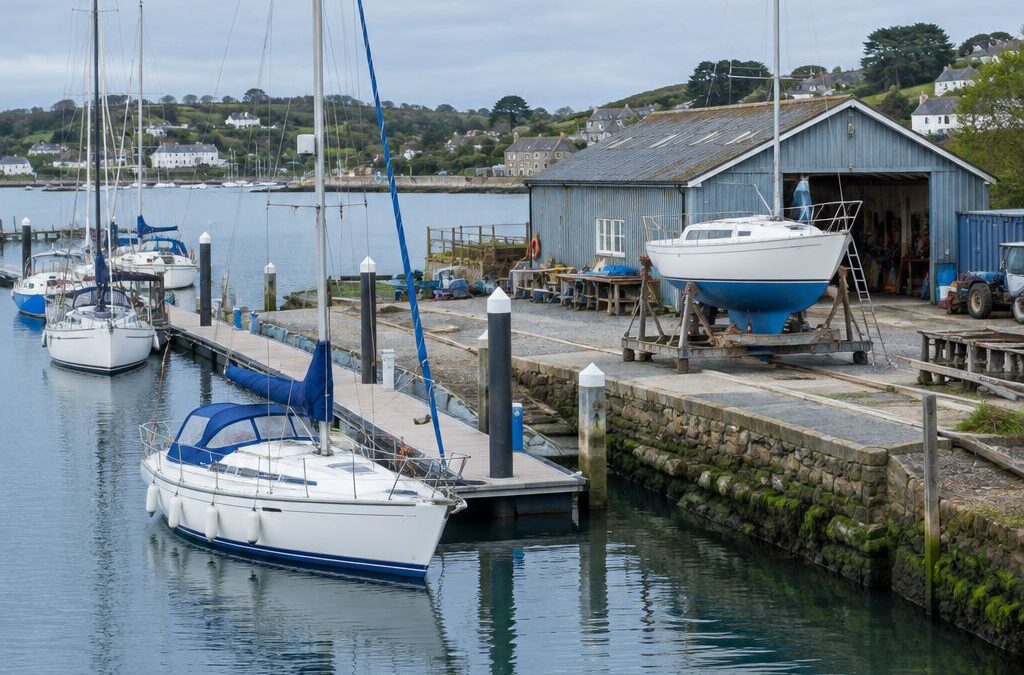
Business rates for marinas and boatyards are the non-domestic rates charged on the buildings, hardstanding and non-exempt moorings that make up a commercial waterside site — and 2026 has rewritten what a typical marina pays. From 1 April 2026 the Treasury reversed course and let qualifying marinas use the lower retail, hospitality and leisure (RHL) multipliers, even as the revaluation lifted rateable values across the sector.
- Marinas with a rateable value under £500,000 now qualify for the lower RHL multipliers in England.
- 2026-27 England rates: 38.2p small RHL, 43p standard RHL, 48p standard non-RHL.
- Marina rateable values rose about 23% on average at the 2026 revaluation.
- Swinging moorings are exempt from rating; buildings and slipways are not.
- Wrong valuations can be challenged through Check, Challenge, Appeal in England and Wales.
Why business rates matter for marina operators
A marina's rates bill is built from its rateable value (RV) — the Valuation Office Agency's (VOA) estimate of annual rental value — multiplied by the government's rate. The 2026 revaluation reset every non-domestic RV in England and Wales on 1 April 2026, and marinas were hit hard: average marina rateable values rose by around 23%, adding roughly £5.8 million of rateable value across the sector. Whether your bill rises or falls now turns on two things: the accuracy of your new RV and which multiplier applies to it.
The 2026 U-turn: marinas now qualify for the RHL multipliers
When the new five-multiplier system was first legislated, marinas were expressly excluded from the lower RHL multipliers and would have paid the higher standard non-RHL rate. After a campaign backed by British Marine, the Treasury amended the Statutory Instrument in early 2026 and removed marinas from the exclusion list, recognising them as part of the UK's leisure economy rather than transport infrastructure.
The practical result in England: a marina that
- has a rateable value below £500,000, and
- is wholly or mainly used for leisure or recreational purposes,
qualifies for the lower RHL multipliers. Riverboat-related properties stay excluded only where they are wholly or mainly used for public transport; recreational and leisure riverboat operations remain eligible.
Which multiplier applies in 2026-27?
England moved to five multipliers on 1 April 2026. For 2026-27 they are:
| Multiplier | Rateable value | 2026-27 rate |
|---|---|---|
| Small business RHL | under £51,000 | 38.2p |
| Standard RHL | £51,000 to £499,999 | 43.0p |
| Small business (non-RHL) | under £51,000 | 43.2p |
| Standard (non-RHL) | £51,000 to £499,999 | 48.0p |
| High value (all property types) | £500,000 and over | 50.8p |
A qualifying marina with a £300,000 RV pays 43.0p instead of 48.0p — a £15,000 a year difference on the same value. Eligibility is not automatic: mixed-use sites that blend berthing with boat sales, chandlery, hospitality and boatyard services need the use split checked before assuming the RHL rate applies. Large marinas with an RV of £500,000 or more get no RHL benefit at all and pay the 50.8p high-value multiplier.
Wales runs its own separate relief arrangements; check the current Welsh position for sites there rather than assuming the English multipliers carry over.
What is rateable on a marina site — and what is exempt
Not everything on the water counts. The rating treatment splits the site:
- Swinging moorings are exempt. Moorings are exempt from rating under Schedule 5 of the Local Government Finance Act 1988, so a hereditament consisting of moorings is exempt to that extent.
- Buildings and infrastructure are rateable. Offices, crew rooms, workshops, chandlery retail space, showers, slipways, hoists, hardstanding and car parks all form part of the assessment.
- Berths and pontoons are generally rateable where they form part of the commercial hereditament; how the VOA has split exempt moorings from rateable berthage is a common source of error.
- Sub-let elements — a waterside café or boat dealership on site may sit in its own assessment, and the split should match reality.
Boatyard and boat-storage premises are usually valued as industrial or warehouse-type property, which matters for the empty-property rules below.
Empty periods: the 3 and 6-month clocks
Winter lay-up and vacant boatyard space create empty-rates exposure:
- Most empty non-domestic property keeps 3 months of empty property relief before full rates become payable.
- Industrial and warehouse property keeps 6 months — the category most boatyard and storage premises fall into.
- Empty property with a rateable value under £2,900 stays exempt while it remains empty.
- In England, since 1 April 2024 a new empty-period entitlement only resets after 13 continuous weeks of occupation — a short summer lets period does not restart the clock.
Challenge a wrong valuation through Check, Challenge, Appeal
Both England and Wales use the Check, Challenge, Appeal (CCA) process for the current rating list — Wales adopted the same process on 1 April 2023.
- Check — ask the VOA to confirm the facts behind the assessment: site measurements, the split between exempt moorings and rateable berthage, and the rental evidence used.
- Challenge — propose a corrected value backed by evidence: comparables from similar waterside sites, plans, and the actual use split across the marina.
- Appeal — if the challenge fails, take the case to the Valuation Tribunal for England or the Valuation Tribunal for Wales.
Deadlines are strict and a weakly evidenced challenge leaves the original value standing. Appeal My Rates UK assesses each case free before quoting, so you know whether the numbers justify a challenge at all.
Common mistakes marina and boatyard operators make
- Missing the RHL eligibility. Operators who budgeted on the old exclusion rules may now qualify for 43p instead of 48p — an unclaimed difference that compounds every year.
- Accepting a revaluation rise without checking it. The ~23% average rise for marinas hides a wide range; site-specific errors in measurement or use splits are common.
- Treating all moorings as rateable. Exempt swinging moorings left inside the assessment inflate the bill.
- Ignoring the empty-rates reset. A short seasonal letting that fails the 13-week rule leaves the boatyard exposed after the relief period ends.
- Leaving mixed uses unsplit. Chandlery, hospitality and workshop space valued on the wrong basis moves the whole assessment.
Fees, in plain terms
Most of our work is no win, no fee, but some instructions carry fixed fees. The fee basis and payment terms depend on the specific instruction, and Appeal My Rates UK confirms them in writing before any work starts. Every case is assessed free before a quote is given.
Let us handle your case: start with a free assessment.
FAQ
Do marinas pay the lower RHL business rates multiplier in 2026-27?
Qualifying marinas in England with a rateable value below £500,000 that are wholly or mainly used for leisure or recreation now pay the RHL multipliers — 43.0p from £51,000 to £499,999. The Treasury removed marinas from the exclusion list in early 2026.
Are moorings exempt from business rates?
Yes. Moorings are exempt from rating under Schedule 5 of the Local Government Finance Act 1988, so a hereditament is exempt to the extent it consists of moorings. Buildings, slipways and hardstanding remain rateable.
How did the 2026 revaluation affect marina rateable values?
Average marina rateable values rose by around 23% at the 2026 revaluation, adding roughly £5.8 million of rateable value across the sector. Individual sites vary widely, so check your own entry.
What are the 2026-27 business rates multipliers in England?
Five multipliers apply from 1 April 2026: 38.2p small business RHL, 43.0p standard RHL, 43.2p small business, 48.0p standard, and 50.8p for properties of £500,000 and over.
How long can an empty boatyard stay rates-free?
Industrial and warehouse property keeps 6 months of empty property relief; most other property keeps 3 months. After that, full rates apply. In England, the entitlement only resets after 13 continuous weeks of occupation.
Can I appeal my marina’s rateable value?
Yes. Both England and Wales use the Check, Challenge, Appeal process for the current rating list, ending at the Valuation Tribunal for England or Wales if a challenge fails.
One last thing
The single most valuable check for a marina operator in 2026 is the split: what the VOA's assessment counts as exempt moorings, what it counts as rateable berthage, and what it assumes about the café, chandlery and workshop space. Any line of that split that does not match the site plan is money on the table for the whole of the 2026 list.
Related guides
- Business rates explained
- Can I appeal business rates on a mixed-use property?
- How long does a business rates appeal take?
- Best business rates relief schemes for small businesses in 2026