
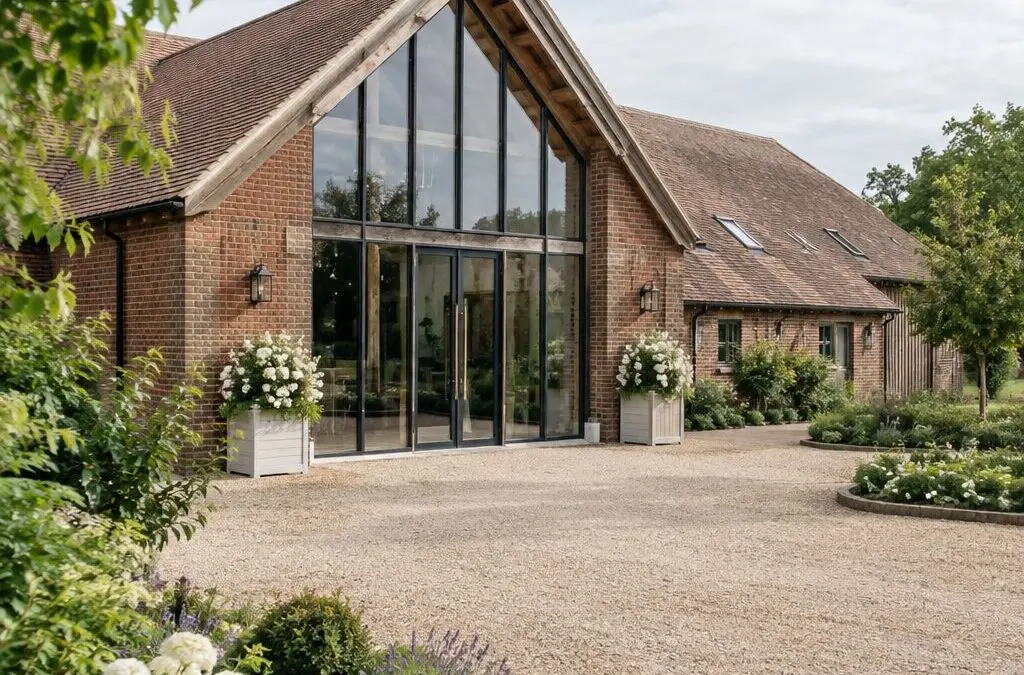
Business rates for wedding venues are the non-domestic rates charged on the barns, country houses, marquees grounds and function spaces that host ceremonies and receptions — and from 1 April 2026 the rules that set the bill changed more in one year than in the previous decade. Qualifying venues in England now pay the permanent retail, hospitality and leisure (RHL) multipliers instead of the old annual relief scheme, while the 2026 revaluation reset every rateable value in England and Wales.
- Venues used wholly or mainly for hospitality or leisure with an RV under £500,000 qualify for the lower RHL multipliers in England.
- 2026-27 England rates: 38.2p small RHL, 43p standard RHL, 48p standard non-RHL, 50.8p over £500,000.
- The 2026 revaluation rewrote every rateable value from 1 April 2026.
- The old 40% RHL relief ended on 31 March 2026 — there is no cash cap on the new multipliers.
- Wrong valuations can be challenged through Check, Challenge, Appeal in England and Wales.
Why business rates matter for wedding venue operators
A venue's bill is its rateable value (RV) — the Valuation Office Agency's (VOA) estimate of annual rental value — multiplied by the government's rate. Two changes landed at once on 1 April 2026: the revaluation rewrote every RV in England and Wales, and the temporary 40% RHL relief (capped at £110,000 per business in 2025-26) was replaced by permanent lower multipliers with no cash cap. A venue that budgets on last year's numbers is budgeting on a system that no longer exists.
Which multiplier applies in 2026-27?
England moved to five multipliers on 1 April 2026. For 2026-27 they are:
| Multiplier | Rateable value | 2026-27 rate |
|---|---|---|
| Small business RHL | under £51,000 | 38.2p |
| Standard RHL | £51,000 to £499,999 | 43.0p |
| Small business (non-RHL) | under £51,000 | 43.2p |
| Standard (non-RHL) | £51,000 to £499,999 | 48.0p |
| High value (all property types) | £500,000 and over | 50.8p |
The lower RHL multipliers apply to occupied properties used wholly or mainly for in-person retail, hospitality or leisure provided to visiting members of the public, with a rateable value below £500,000. Hotels and guest houses are named among the qualifying uses, and a wedding venue operated as a hospitality or leisure destination can qualify on the same test — but eligibility always turns on the facts of the specific hereditament: how the space is used across the year, whether the public visits, and how the VOA has described the property.
Three checks settle the question for most venues:
- Use test — is the property occupied and used wholly or mainly for in-person hospitality or leisure to visiting members of the public? A venue hosting only private hire events is assessed differently from one that also runs restaurant days, tours or open events.
- Value test — the RHL benefit applies below £500,000 RV. A large estate venue above that threshold pays the 50.8p high-value multiplier with no RHL reduction at all.
- No cash cap — unlike the 2025-26 relief, every qualifying hereditament gets the lower multipliers, including all the venues in a multi-property group.
Wales runs its own separate relief arrangements; check the current Welsh position rather than assuming the English multipliers carry over.
How a wedding venue's rateable value is built
The VOA values most function and events property on its rental value at the antecedent valuation date — 1 April 2024 for the 2026 list. The entry on the rating list should reflect:
- Floorspace and configuration — the licensed function space, back-of-house kitchens, bridal suites, offices and storage each carry weight.
- Grounds and parking — gardens, car parks and marquee paddocks used with the venue are usually part of the assessment.
- Trading position — the evidence base looks at the rent the property could command; venues with catering, bar and accommodation attached are worth more than bare halls.
- Description accuracy — a venue recorded as a general events hall when it operates as a serviced hospitality business can be valued on the wrong basis entirely.
Empty periods: the 3-month clock
Seasonal venues are exposed between wedding seasons:
- Most empty non-domestic property keeps 3 months of empty property relief; after that, full rates become payable even with nobody trading.
- Empty property with a rateable value under £2,900 stays exempt while it remains empty.
- In England, since 1 April 2024 a new empty-period entitlement only resets after 13 continuous weeks of occupation — a single weekend booking does not restart the clock.
- A venue undergoing genuine redevelopment can support an exemption, but only with the right evidence secured before works start.
Challenge a wrong valuation through Check, Challenge, Appeal
Both England and Wales use the Check, Challenge, Appeal (CCA) process for the current rating list — Wales adopted the same process on 1 April 2023.
- Check — ask the VOA to confirm the facts behind the assessment: the floorspace, the grounds included, the description of use and the rental evidence.
- Challenge — propose a corrected value backed by evidence: comparable venues, plans, and trading records that show how the property is actually used.
- Appeal — if the challenge fails, take the case to the Valuation Tribunal for England or the Valuation Tribunal for Wales.
Deadlines are strict, and a challenge on weak evidence leaves the original value standing. Appeal My Rates UK assesses each case free before quoting, so you know whether the numbers justify a challenge at all.
Common mistakes wedding venue operators make
- Assuming the old 40% relief still applies. It ended on 31 March 2026; qualifying venues now get the lower multipliers instead, on a different test.
- Missing the RHL qualification entirely. A venue that qualifies pays 43.0p rather than 48.0p from £51,000 to £499,999 — on a £250,000 RV that is £12,500 a year.
- Budgeting past the £500,000 cliff. Large estate venues at £500,000 or more pay 50.8p on the whole value, with no RHL benefit — the threshold deserves checking before expansion works are planned.
- Accepting the revalued entry unchecked. The 2026 list rebuilt every value from fresh evidence; last year's appeal result says nothing about the new entry.
- Ignoring empty-season exposure. The 13-week reset rule catches venues that open briefly over the quiet months.
Fees, in plain terms
Most of our work is no win, no fee, but some instructions carry fixed fees. The fee basis and payment terms depend on the specific instruction, and Appeal My Rates UK confirms them in writing before any work starts. Every case is assessed free before a quote is given.
Let us handle your case: start with a free assessment.
FAQ
Do wedding venues qualify for the lower RHL multipliers in 2026-27?
A wedding venue in England with a rateable value below £500,000 qualifies when it is occupied and used wholly or mainly for in-person hospitality or leisure to visiting members of the public. Eligibility depends on the facts of the specific property.
What are the 2026-27 business rates multipliers in England?
Five multipliers apply from 1 April 2026: 38.2p small business RHL, 43.0p standard RHL, 43.2p small business, 48.0p standard, and 50.8p for properties of £500,000 and over.
What happened to the 40% retail, hospitality and leisure relief?
The temporary RHL relief, worth 40% up to a £110,000 cash cap in 2025-26, ended on 31 March 2026. It was replaced from 1 April 2026 by permanent lower multipliers for qualifying properties below £500,000, with no cash cap.
My venue’s rateable value is over £500,000 — what do I pay?
Properties at £500,000 and over pay the 50.8p high-value multiplier in 2026-27 and get no RHL reduction. Challenging the rateable value itself is the main route to reducing the bill.
How long can an empty wedding venue stay rates-free?
Most empty non-domestic property keeps 3 months of relief before full rates apply. In England, the entitlement only resets after 13 continuous weeks of occupation.
Can I appeal my wedding venue’s rateable value?
Yes. Both England and Wales use the Check, Challenge, Appeal process for the current rating list, ending at the Valuation Tribunal for England or Wales if a challenge fails.
One last thing
The most valuable hour for a venue operator in 2026 is spent on two lines: the use description on the rating list entry and the £500,000 threshold. The first decides whether the 43.0p multiplier applies; the second decides whether the venue keeps any RHL benefit at all. Both are checkable before the next instalment falls due — and both are challengeable when they are wrong.
Related guides
- Business rates explained
- Pubs and live music venue relief: how the 15% discount works in 2026-27
- Can I appeal business rates on a mixed-use property?
- How long does a business rates appeal take?