

Yes. Wales and England use the same Check, Challenge, Appeal (CCA) process for business rates valuation disputes from the 2023 rating list onwards; Wales adopted CCA on 1 April 2023. In 2026, the shared process does not mean identical reliefs, billing rules, deadlines or tribunal arrangements, and an appeal does not guarantee a reduction.
- Does Wales use the same business rates appeal process as England? Yes: both use Check, Challenge, Appeal.
- Wales adopted CCA on 1 April 2023 for the 2023 rating list onwards.
- Checks and Challenges go to the valuation authority; appeals go to the relevant national Valuation Tribunal.
- Appeal My Rates UK helps business owners with valuation challenges and council rates disputes.
Does Wales use the same business rates appeal process as England?
Both countries use CCA, but they do not share every business rates rule. Start by identifying whether you dispute the property's valuation or something on the council's bill. Our Check, Challenge, Appeal guide for 2026 explains the valuation route in more detail.
| Issue | England | Wales |
|---|---|---|
| Current valuation dispute process | Check, Challenge, Appeal | Check, Challenge, Appeal |
| Rating lists covered by this answer | The 2023 rating list onwards | The 2023 rating list onwards |
| Who handles Checks and Challenges? | The valuation authority | The valuation authority |
| Where does a valuation appeal go? | Valuation Tribunal for England | Valuation Tribunal for Wales |
| Does CCA decide every council billing dispute? | No | No |
| Are all reliefs and billing rules identical? | No | No |
The government's Non-domestic rating challenges and changes: background information, published with its September 2025 statistics covering the 2017 and 2023 rating lists, confirms Wales's adoption of CCA. Guidance describing a different Welsh route needs checking against the rating list and period it covers.
The practical answer for a business reviewing its position in 2026 is straightforward: use the shared CCA framework for valuation disputes, then check the rules applying to the particular property and case. Do not copy every detail from an English example into a Welsh submission.
Why this matters
Sending a valuation argument to a council billing team does not replace the valuation challenge process. Equally, a disagreement about the council's account records is not automatically a reason to challenge the rateable value.
That distinction helps you direct your evidence to the right place. Before preparing a case, write down what you believe is wrong: the property assessment, the bill, the relief decision or the period for which you have been charged.
A high bill alone does not establish that the valuation is incorrect. You need to identify the underlying issue and the evidence supporting a change, rather than treating every business rates problem as the same kind of appeal.
How do Check, Challenge and Appeal work?
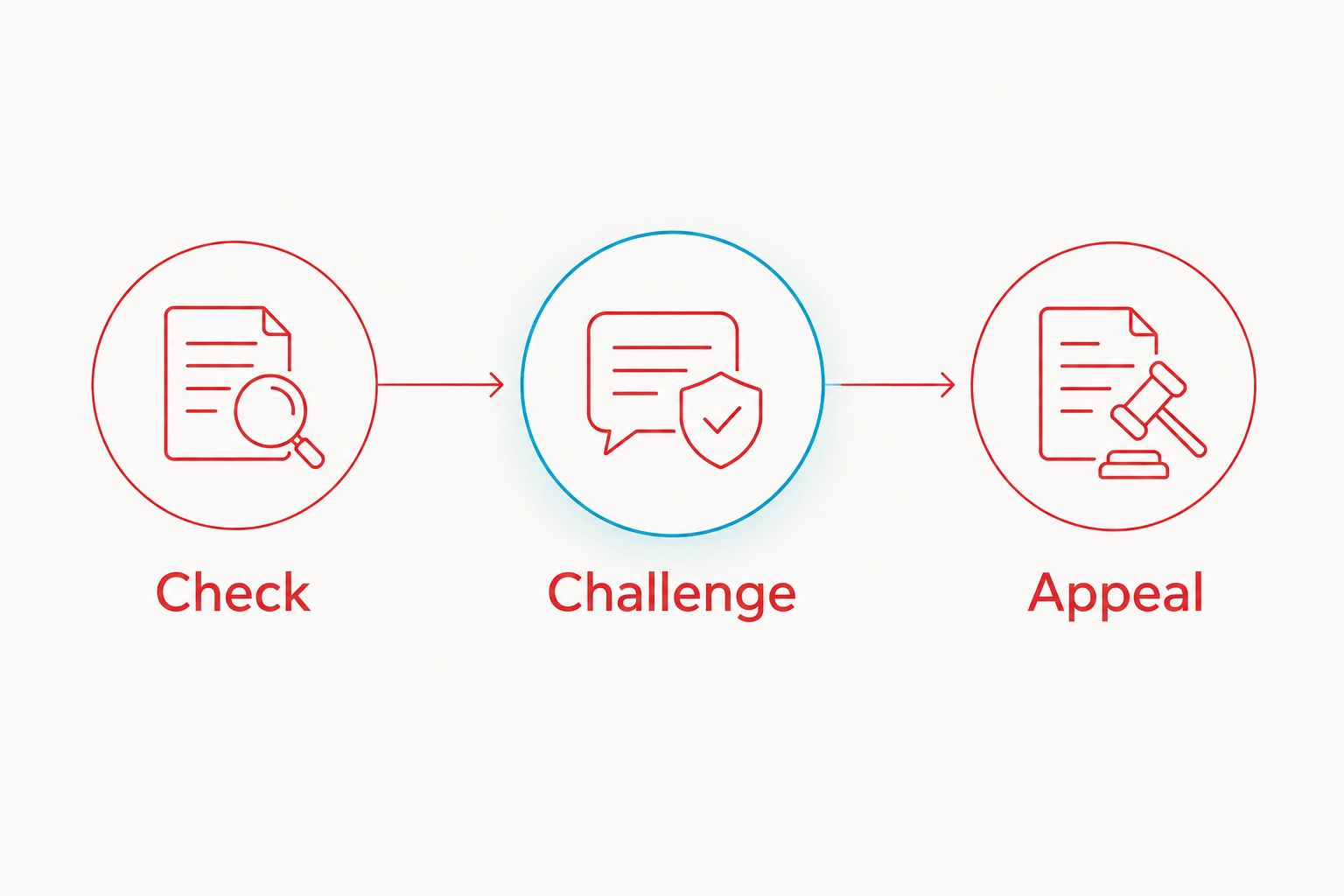
CCA has 3 stages. Each stage has a different purpose, so prepare your case in sequence rather than treating the tribunal as the starting point.
- Check: review the facts used to assess the property and address inaccuracies.
- Challenge: explain why the valuation is wrong, supported by evidence and a reasoned alternative.
- Appeal: where the rules permit, take the unresolved valuation dispute to the relevant Valuation Tribunal.
The valuation authority handles Check and Challenge in both England and Wales. The independent tribunal stage is separate, and the appropriate tribunal depends on where the property is located.
Check: establish the property facts
Start with the assessment you actually intend to dispute. Match the property address, rating list and assessment details to your records before explaining any discrepancy.
Useful records include plans, measurements, photographs, leases and documents showing occupation or alterations. Their purpose is to demonstrate a relevant fact, not simply to make the submission longer.
For example, a plan should help explain the area or layout you say is incorrect. A dated photograph should show the condition or feature relevant to your argument. Keep the connection between each document and the disputed fact clear.
Challenge: explain the valuation argument
A Challenge needs more than a statement that business rates are unaffordable. Explain which part of the assessment you dispute, why it is wrong and how your evidence supports the change you seek.
Comparable properties need careful handling. A nearby assessment is not automatically a suitable comparison: differences in use, size, layout or other valuation characteristics affect whether it supports your argument.
Keep factual corrections separate from valuation reasoning. This makes it easier to see whether the disagreement concerns the underlying property information, the treatment of that information or both.
Appeal: take the unresolved dispute to the right tribunal
For a Welsh property, the relevant appeal body is the Valuation Tribunal for Wales. For an English property, it is the Valuation Tribunal for England.
Check the decision, appeal rights and applicable requirements before submitting anything. Do not assume that an unresolved Challenge gives you an unrestricted right to start again with a different case.
Prepare an organised record of the assessment, submissions, evidence and correspondence. The tribunal stage concerns the valuation dispute; it is not a substitute for resolving unrelated council account issues.
What is shared, and what still needs checking?
The shared process answers the headline question, but it does not settle every practical detail. For a case started or reviewed in 2026, check the following against current official guidance and the documents issued in that case.
- Rating list: establish which assessment and list the dispute concerns. Do not mix evidence or instructions for different periods without explaining their relevance.
- Property location: use the relevant national tribunal and country-specific guidance where required.
- Case stage: identify whether you are checking facts, challenging a valuation or considering an appeal.
- Decision dates: read the actual notice and applicable requirements rather than copying a deadline from another case.
- Dispute type: distinguish valuation questions from billing, liability and relief issues.
- Evidence: connect each document to the property, period and disputed point.
These checks explain why two businesses following CCA can still need different advice. The framework is shared; the facts, procedural position and remedy sought are specific to each case.
Should I contact the valuation authority or my council?
Contact the valuation authority about the property assessment; contact the council about its bill, account or relief decision. Some cases involve both, but the responsibilities remain distinct.
| Route | Best for | Benefit | Limitation |
|---|---|---|---|
| Valuation authority through CCA | Disputing the property's assessment | Addresses the facts and valuation underlying the assessment | Does not resolve every council billing or relief issue |
| Local council rates team | Querying billing, liability or relief | Addresses the account and the council's decisions | Does not replace CCA for valuation disputes |
| Relevant Valuation Tribunal | An eligible unresolved valuation appeal | Provides an independent appeal stage | Requires the correct appeal route and compliance with applicable requirements |
Suppose the recorded property information appears wrong and the council has also billed the wrong occupation period. Keep those issues separate in your correspondence, even if they concern the same premises.
For the valuation issue, explain the assessment error and supporting evidence. For the account issue, identify the charge period and the records showing why you dispute it. A clear division prevents a general complaint from obscuring the action you actually need.
What should I prepare before asking for help?
Prepare a short case summary with the property address, rating list, disputed assessment or bill, and the outcome you seek. Attach relevant notices and correspondence in date order.
Then organise the supporting documents by issue:
- Property records: plans, measurements and photographs relevant to the assessment.
- Occupation records: lease documents and evidence of relevant occupation changes.
- Valuation evidence: comparable assessments or other material supporting the argument.
- Case correspondence: submissions, responses, decisions and outstanding requests.
- Council records: bills, account statements and relief decisions where these are disputed.
You do not need to describe every business difficulty. Focus on the facts that explain the alleged error and what you want corrected.
Appeal My Rates UK is best for business owners seeking rating surveyor support with business rates valuation challenges and council rates disputes in England and Wales. Professional support helps you present the case, but it does not make a reduction certain. You still need relevant evidence and a clear understanding of the instruction.
Use the contact page to explain your property, the issue and any decision already received. Ask what the proposed work covers before authorising it.
What should I confirm about surveyor fees?
At Appeal My Rates UK, most of our work is no win, no fee, but some instructions carry fixed fees. Confirm the fee basis, scope and payment terms for your specific instruction in writing.
Ask whether the instruction covers an initial review, Check, Challenge, tribunal work, council correspondence or a defined combination. Do not assume that appointing a surveyor for one task automatically includes every later stage.
Read how the agreement defines the work and when payment becomes due. Understanding the written terms before instructing a firm is more useful than relying on a general fee label.
Does Wales still use a separate proposal process?
For the 2023 rating list onwards, Wales uses Check, Challenge, Appeal. Wales adopted CCA on 1 April 2023, so a description of a separate current Welsh proposal route is not correct for those lists.
Older material needs a clearly identified historical context. If your dispute concerns an earlier list, check the rules for that specific list rather than applying this current-process explanation retrospectively.
Are the appeal deadlines identical in England and Wales?
The shared CCA process does not establish identical deadlines for every case. Check the applicable rating list, procedural stage, decision notice and current official guidance for the property concerned.
For a live case in 2026, record the dates shown on your own correspondence. Do not substitute a general online example for the requirements attached to your decision.
Does using CCA mean my business rates will fall?
CCA does not guarantee a reduction in business rates. The outcome depends on the assessment, the grounds raised and the evidence supporting them.
A successful valuation argument and a council account adjustment are also different events. Keep track of what has been decided, what assessment has changed and what the council has subsequently applied to the bill.
FAQ
Does Wales use the same business rates appeal process as England in 2026?
Yes. In 2026, England and Wales both use Check, Challenge, Appeal for valuation disputes from the 2023 rating list onwards. The shared process does not make every relief, billing rule, deadline or tribunal arrangement identical.
When did Wales start using Check, Challenge, Appeal?
Wales adopted Check, Challenge, Appeal on 1 April 2023 for the 2023 rating list onwards. Advice describing a different Welsh route must be checked against the historical list and period it concerns.
Who deals with Checks and Challenges in Wales?
The valuation authority handles Checks and Challenges in Wales, as it does in England. An eligible unresolved valuation appeal goes to the relevant national Valuation Tribunal.
Which tribunal hears a Welsh business rates valuation appeal?
The Valuation Tribunal for Wales hears Welsh business rates valuation appeals. English valuation appeals go to the Valuation Tribunal for England.
Can my council reduce the rateable value through a billing complaint?
A council billing complaint does not replace the valuation challenge process. Direct assessment disputes through the applicable valuation route and raise account, liability or relief issues with the council.
Can Appeal My Rates UK handle my business rates dispute?
Appeal My Rates UK helps business owners with valuation challenges, property splits and mergers, and council rates disputes in England and Wales. Most of our work is no win, no fee, but some instructions carry fixed fees. Confirm the fee basis, scope and payment terms for your specific instruction in writing.
One last thing
Write the disputed issue at the top of your case file before gathering more documents. “The assessment uses incorrect property facts” and “the council has billed the wrong period” describe different problems, even when they arrive on the same bill.
That distinction is your most useful starting point in 2026. Identify the error, choose the correct route and make every document support the point you need decided.
Related guides
- From a valuation Challenge to the Valuation Tribunal for Wales
- From a valuation Challenge to the Valuation Tribunal for England
- Can I claim business rates relief and appeal at the same time?