
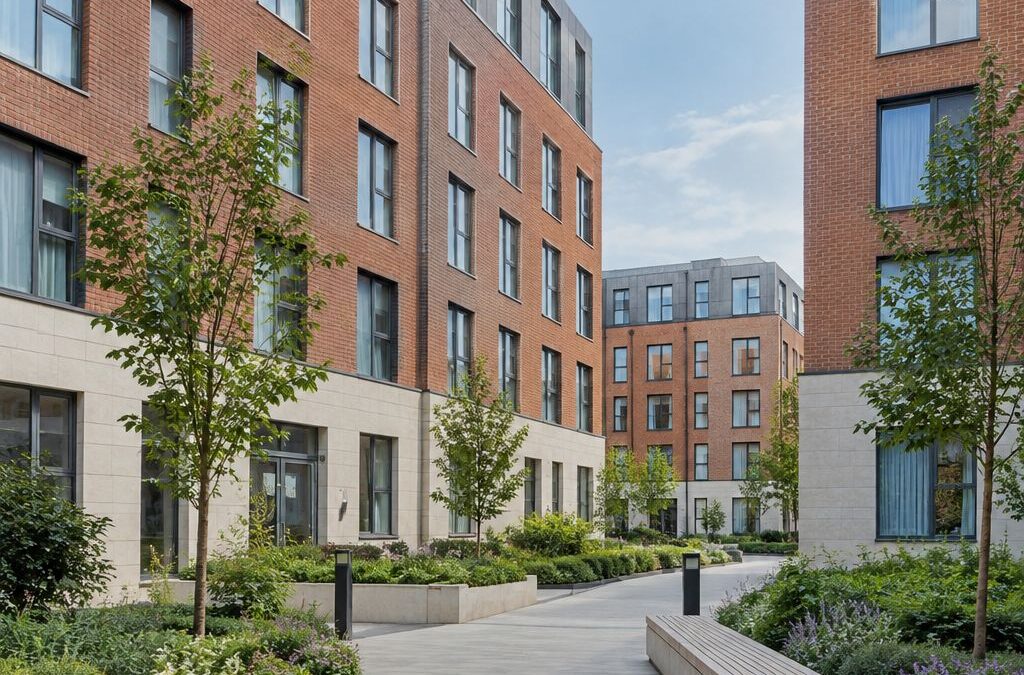
Student accommodation business rates are the non-domestic rates charged on private purpose-built student accommodation (PBSA) blocks, large student HMOs and other commercial student lets in England and Wales — while university-owned halls sit outside the system altogether. This guide shows you which regime your building falls under, what the 2026-27 multipliers mean for your bill, and how to challenge a valuation that does not match your property.
- University halls of residence are exempt from business rates; private PBSA blocks are rateable.
- England 2026-27 multipliers: 43.2p under £51,000 RV, 48p from £51,000, 50.8p over £500,000.
- The 2026 revaluation rewrote every rateable value from 1 April 2026 — check yours before paying.
- Empty student blocks keep relief for 3 months, then full rates apply.
- Wrong valuations can be challenged through Check, Challenge, Appeal in England and Wales.
Why business rates matter for student accommodation operators
A single PBSA block can carry a rateable value in the hundreds of thousands of pounds, and the 2026 revaluation reset every non-domestic assessment in England and Wales from 1 April 2026. If the Valuation Office Agency (VOA) has recorded the wrong number of rooms, the wrong communal space, or the wrong rental evidence, you pay for that error every single month of the rating list. Operators who check their assessments early have the best chance of correcting them before the bill compounds.
Which regime does your building fall under?
Student accommodation splits into three very different rating treatments, and the difference decides everything else.
- University-owned halls of residence — halls provided by a university or other education institution for its students are exempt from business rates. The government has repeatedly confirmed it has no plans to bring student accommodation into the business rates system, so this exemption is settled law, not a loophole.
- Private purpose-built student accommodation (PBSA) — commercially operated blocks are rateable non-domestic property. The VOA typically values them by reference to the number of student rooms, the standard of the accommodation and the income the block can produce. Anything ancillary — gyms, laundries, reception space — forms part of the same assessment.
- Large student HMOs and off-street lets — a genuine shared house occupied only by full-time students is normally council tax territory, with students exempt. But a property let as commercial student accommodation on the right terms can be moved onto business rates, and the boundary is a live dispute in many university towns.
Getting this classification wrong in either direction is expensive: paying business rates on a building that should be exempt, or assuming an exemption that the council then backdates. If your block sits near the boundary, get the position checked before the next instalment is due.
Find your rateable value on the rating list
Your rateable value (RV) is the VOA's estimate of the annual rent your property could command, and it is the number your bill is built from. Every non-domestic property in England and Wales carries an entry on the rating list, and the 2026 list took effect on 1 April 2026.
Check the entry for:
- Description — it should reflect how the block is actually used and configured.
- Floor area and room count — the number of student rooms drives most PBSA valuations; a miscount moves the whole value.
- Effective date — the date the current value applies from; after a revaluation it is 1 April 2026.
- Split or combined entries — blocks reconfigured between uses sometimes carry duplicated or overlapping assessments.
Which multiplier applies in 2026-27?
England moved to five multipliers on 1 April 2026. For 2026-27 they are:
| Multiplier | Rateable value | 2026-27 rate |
|---|---|---|
| Small business (non-RHL) | under £51,000 | 43.2p |
| Standard (non-RHL) | £51,000 to £499,999 | 48.0p |
| High value (non-RHL) | £500,000 and over | 50.8p |
| Small business RHL | under £51,000 | 38.2p |
| Standard RHL | £51,000 to £499,999 | 43.0p |
The lower retail, hospitality and leisure (RHL) multipliers apply to occupied properties used wholly or mainly for in-person retail, hospitality or leisure to visiting members of the public. Private student accommodation is not one of the uses named in that qualifying list, so most PBSA operators should expect the standard multipliers of 43.2p and 48p. On a £400,000 rateable value, the difference between the standard multiplier and a wrong assumption is roughly £19,200 a year — which is why the qualification question deserves a direct check rather than a guess.
Small blocks with a rateable value under £12,000 in England can also qualify for small business rate relief, which reduces the bill further, tapering out by £15,000.
Empty periods: the 3-month clock
Vacancy between academic years or between operators is where student accommodation bills go wrong.
- Most empty non-domestic property keeps 3 months of empty property relief; after that, full rates become payable even though nobody is trading.
- Empty property with a rateable value under £2,900 stays exempt while it remains empty.
- In England, since 1 April 2024 a new empty-period entitlement only resets after the property has been occupied for at least 13 continuous weeks — a short summer let is not enough to restart the clock.
- Plans to refurbish do not pause the charge; a redevelopment can support an exemption, but only with the right evidence before the works start.
Challenge a wrong valuation through Check, Challenge, Appeal
Both England and Wales use the Check, Challenge, Appeal (CCA) process for the current rating list — Wales adopted the same process on 1 April 2023. You do not need a different route for a Welsh block.
- Check — ask the VOA to confirm the facts behind the assessment: the room count, the floor areas, the rental evidence.
- Challenge — propose a corrected value backed by evidence: rents from comparable blocks, plans, and records of what the property actually is.
- Appeal — if the challenge fails, take the case to the Valuation Tribunal for England or the Valuation Tribunal for Wales.
Deadlines are strict, and a challenge made on weak evidence can leave the original value standing. Appeal My Rates UK assesses each block free before quoting, so you know whether the numbers justify a challenge at all.
Your options compared
| Option | Best for | Key limitation |
|---|---|---|
| Do it yourself | Single small block, obvious factual error | Strict deadlines; VOA can use your own submissions against you |
| Specialist rating surveyor | PBSA blocks, borderline classification, empty-period disputes | Fee terms vary — confirm them in writing first |
| Large national consultancy | Multi-site portfolios with other property types | Smaller student portfolios rarely get priority attention |
Common mistakes student accommodation operators make
- Assuming student use means exemption. Only university-provided halls are exempt; a private block with an exemption assumption on file is usually accruing a large back bill.
- Ignoring the revaluation. The 2026 list rewrote values from 1 April 2026; last year's appeal result says nothing about the new entry.
- Missing the empty-period reset. A short summer occupation that fails the 13-week rule leaves the building exposed to full empty rates.
- Accepting the recorded room count. Room miscounts are the most common factual error in PBSA assessments.
- Paying an RHL multiplier that does not apply — or missing one that does. Check the qualifying list before you budget either way.
Fees, in plain terms
Most of our work is no win, no fee, but some instructions carry fixed fees. The fee basis and payment terms depend on the specific instruction, and Appeal My Rates UK confirms them in writing before any work starts. Every case is assessed free before a quote is given.
Let us handle your case: start with a free assessment.
FAQ
Are student halls of residence exempt from business rates in 2026?
Halls provided by a university or other education institution for its students are exempt from business rates. Private purpose-built student accommodation is rateable and should expect the standard multipliers.
What is the business rates multiplier on a private student accommodation block in 2026-27?
In England, 43.2p for rateable values under £51,000, 48.0p from £51,000 to £499,999, and 50.8p at £500,000 and over. Private student accommodation does not generally qualify for the lower RHL multipliers.
Do students pay council tax or business rates?
Full-time students are exempt from council tax on the homes they occupy. Business rates are a separate charge on the property owner or operator, and they apply to private commercial student accommodation.
How long can an empty student block stay rates-free?
Most empty non-domestic property keeps 3 months of relief; empty property with a rateable value under £2,900 stays exempt while empty. After the relief period, full rates apply even with no occupier.
Can I appeal my student accommodation rateable value?
Yes. Both England and Wales use the Check, Challenge, Appeal process for the current rating list, ending in the Valuation Tribunal for England or Wales if the challenge fails.
Has the 2026 revaluation changed student accommodation values?
The 2026 revaluation reset every non-domestic rateable value in England and Wales from 1 April 2026, including student accommodation. Check the new entry before paying the 2026-27 bill.
Do I get small business rate relief on a small student HMO?
If the property is on the business rates list with a rateable value under £12,000 in England, it can qualify for full small business rate relief, tapering out by £15,000.
One last thing
The most profitable hour for a student accommodation operator in 2026 is the one spent comparing the VOA's recorded room count with your own floor plans. When the two disagree, the correction applies back to 1 April 2026 — and every month of waiting is a month of overpayment.
Related guides
- Business rates explained
- Can I appeal business rates on a mixed-use property?
- How long does a business rates appeal take?
- Best business rates relief schemes for small businesses in 2026