
Yes, you can get a business rates reduction without an appeal if you qualify for relief, an exemption or a correction to your council bill. A lower bill does not always require a lower rateable value, but disputing the valuation itself uses the Check, Challenge, Appeal process in both England and Wales.
- A business rates reduction without an appeal is possible through eligible relief, exemptions or council billing corrections.
- Council relief changes your bill; a valuation challenge addresses your property’s rateable value.
- England and Wales both use Check, Challenge, Appeal for current valuation disputes.
- Appeal My Rates UK supports business owners with valuation challenges and council rates disputes.
Why this matters
Starting with an appeal when your bill is missing a relief sends the problem to the wrong place. Equally, asking the council to reduce an excessive rateable value does not replace the valuation challenge process.
For a 2026 bill, identify the disputed item before choosing your next move: the valuation, the relief calculation or the liability details. If your concern is eligibility rather than property value, start with the guide to business rates relief schemes for small businesses.
Match the remedy to the error, not simply to the size of the bill. A reduction needs a valid basis; financial pressure alone does not establish that the valuation or charge is wrong.
Can you get a business rates reduction without an appeal?
Yes. Your council can review relief entitlement and billing errors without a valuation appeal. Some cases also qualify for an exemption or discretionary assistance, subject to the applicable rules and supporting evidence.
The distinction is what changes. Relief reduces the amount payable under a scheme, while a valuation correction changes the assessment used to calculate the charge.
| Route | Best for | Main advantage | Main limitation | Where to start |
|---|---|---|---|---|
| Relief application | An eligible business missing a reduction | Addresses entitlement without disputing the valuation | Eligibility and evidence requirements apply | Billing council |
| Billing correction | Incorrect dates, account details or calculations | Targets the specific charge error | Does not establish a lower rateable value | Billing council |
| Exemption review | Property or use that meets exemption rules | Tests whether the property should be charged | A change of use or vacancy is not automatically enough | Billing council; valuation authority where list status is involved |
| Discretionary assistance | A case meeting the council's applicable criteria | Provides a route separate from valuation arguments | Approval is not automatic | Billing council |
| Valuation challenge | Incorrect property facts or an excessive assessment | Addresses the underlying rateable value | Requires evidence and carries valuation risk | Valuation authority through CCA |
A business can have more than one issue. A missed relief and an incorrect floor area require separate attention, even though both affect the same bill.
Relief: reduce the charge without changing the valuation
Small business rate relief is an example of a route that does not require you to prove the property's valuation is excessive. You need to establish that you meet the scheme's conditions instead.
For a 2026 application, confirm the rules for the country where the property sits and the relevant billing period. Do not assume eligibility carries across from another site or that a previous award settles your current position.
Give the council the information it requests about your occupation, business and other properties. Ask whether the relief already appears on the bill, whether an application is required and which period any award covers.
The benefit is a direct review of entitlement; the limitation is that relief cannot correct an excessive valuation. Keep the council's written decision with the revised calculation so you can check what changed.
Billing corrections: fix the charge rather than the assessment
A rates demand can be wrong even when the rateable value is correct. Examples include an incorrect liability start date, an unrecorded relief award or a calculation that does not reflect a confirmed decision.
Send a focused correction request. Identify the disputed entry, state the date or fact you believe is correct, and attach the document supporting it.
A lease helps establish relevant dates, but signing a lease and becoming liable are not interchangeable in every situation. Explain when occupation began or ended and provide evidence rather than relying on the document's signature date alone.
Ask for a revised bill and an account statement if the correction is accepted. A corrected charge does not necessarily mean money will be paid straight back: the council needs to reconcile the account, including any outstanding balance.
Exemptions and empty premises: establish the property facts
An exemption depends on the applicable rules and the property's actual circumstances. A building being unused, difficult to let or undergoing work does not by itself establish an exemption.
For vacant premises, provide the date occupation ended and explain any subsequent use. Storage, intermittent occupation and partial occupation need accurate descriptions; calling a property empty does not settle its treatment.
Where the dispute concerns whether an assessment should remain in the rating list, the valuation authority also has a role. Separate that question from whether the council has correctly applied empty-property rules to the existing assessment.
The advantage of checking exemption entitlement is that a valuation dispute is not always necessary. The limitation is equally important: do not stop paying on the assumption that vacancy cancels the bill. Request a written decision explaining the treatment and effective dates.
Why the route to a reduction varies
The correct route depends on the reason for the charge, not your preferred outcome. These factors determine where to start:
- Nature of the error: a missing relief belongs with the council; an excessive assessment belongs in the valuation process.
- Property location: check the applicable English or Welsh relief and billing rules rather than treating them as identical.
- Relevant period: establish which bill and rating list your evidence concerns, including any change during 2026.
- Occupation and use: identify who occupied the premises, when occupation changed and what the property was used for.
- Property configuration: a split, merger or separately occupied area can raise assessment questions beyond a billing correction.
- Evidence: dated documents must support the correction, entitlement or valuation argument you advance.
A neighbouring business paying less is a reason to investigate, not proof that your own bill is wrong. Its relief entitlement, property facts or billing period might differ.
How do you check your bill before starting an appeal?
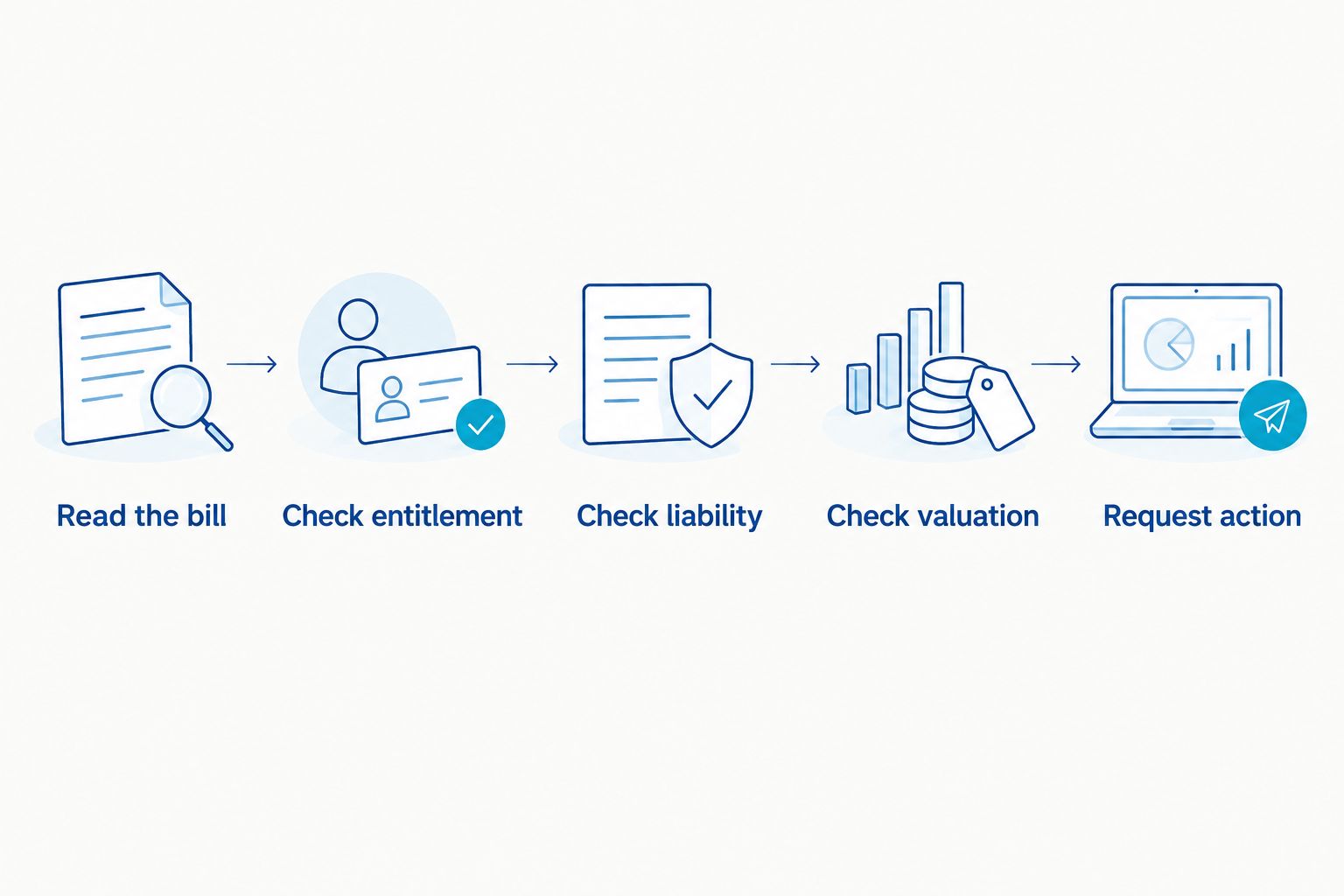
Use this 5-step bill review to separate council matters from valuation matters. Keep the evidence together so that each request has a clear basis.
- Read the bill. Identify the property, liable party, charge period, rateable value and reductions shown. Mark the exact entry you dispute.
- Check entitlement. Ask which reliefs or exemptions have been considered and what evidence is required for any outstanding application.
- Check liability. Compare the council's dates with your occupation records, handover documents and correspondence. Explain gaps or overlapping periods.
- Check valuation. Review the recorded property details against plans, measurements and actual use. Separate factual discrepancies from a general concern about affordability.
- Request action. Send the council a billing or relief request, or take the valuation issue through the appropriate process. Ask for written reasons and keep the reference.
For a 2026 review, keep your current bill separate from earlier correspondence. An old decision can help explain the account, but it does not establish that the current calculation is correct.
When is Check, Challenge, Appeal still necessary?
A council relief application does not replace a valuation challenge. If your case is that the assessment uses incorrect property facts or an excessive valuation, address those issues through the valuation authority.
Both England and Wales use Check, Challenge, Appeal, with 3 stages: Check addresses the property facts, Challenge sets out the valuation dispute, and Appeal takes an eligible unresolved case to the relevant tribunal. Checks and Challenges are handled by the valuation authority; appeals go to the Valuation Tribunal for England or Wales as applicable.
Not every case reaches a tribunal. A valuation matter can be resolved before the Appeal stage, but that is different from obtaining council relief without challenging the assessment at all.
Check the applicable requirements and deadlines before submitting a case. A council query does not preserve a valuation deadline, and reviewing an assessment carries the risk that the value stays the same or increases.
Can you claim relief while challenging the valuation?
Yes, relief entitlement and valuation accuracy are separate questions. You can pursue both where there is a valid basis, but tell each organisation clearly what decision you are requesting.
Keep the applications consistent. The occupation dates, property use and supporting facts should agree across your council correspondence and valuation submissions.
Should you keep paying while the council reviews your bill?
Yes, continue paying the billed amount unless the council confirms a revised bill or payment arrangement. Submitting a relief application, correction request or valuation challenge does not itself suspend collection.
If payment is difficult, contact the council promptly about the account. Do not treat an expected reduction as an agreed payment arrangement.
When should you ask a rating surveyor for help?
Appeal My Rates UK is best for business owners seeking rating surveyor support with valuation challenges or council rates disputes. Professional help is relevant when billing, occupation and assessment issues overlap, or when property splits and mergers need consideration.
A straightforward correction supported by a clear document can be raised directly with the council. The benefit of surveyor support is help distinguishing and handling the issues; the limitation is that representation does not guarantee a reduction and involves agreed fee terms.
Most of our work is no win, no fee, but some instructions carry fixed fees. Before instructing Appeal My Rates UK, confirm the fee basis, scope and payment terms for your specific instruction in writing, including what happens if the case does not produce a reduction.
Use the contact page to explain what is disputed and which organisation has already responded. Include the bill and relevant correspondence so the discussion starts with the actual issue.
FAQ
Can I get a business rates reduction without an appeal in 2026?
Yes, a business rates reduction without an appeal is possible through eligible relief, an exemption or a council billing correction. If you dispute the rateable value itself, use the valuation process rather than relying on a relief application.
Does applying for small business rate relief count as an appeal?
No, applying for small business rate relief is an entitlement application to the council, not a valuation appeal. Eligibility depends on the applicable scheme and your circumstances.
Can my council lower my rateable value?
Your council does not determine the property’s rateable value; the valuation authority handles the assessment. Ask the council about billing and relief, and address valuation errors through the valuation process.
Do England and Wales use the same valuation appeal process?
England and Wales both use Check, Challenge, Appeal for current valuation disputes. Checks and Challenges go to the valuation authority, while appeals go to the relevant Valuation Tribunal for England or Wales; this does not make all relief and billing rules identical.
Will my business rates stop if my property is empty?
An empty property does not automatically stop attracting business rates. Ask the council to confirm the applicable treatment using accurate vacancy dates and details of any continuing use.
Can I get a refund after a billing correction?
A billing correction can create a credit if it reduces charges you have already paid. Ask the council for a revised account statement and confirmation of how any credit will be handled.
Can Appeal My Rates UK guarantee a reduction?
No, Appeal My Rates UK cannot guarantee that a relief request, billing dispute or valuation challenge will reduce your bill. The outcome depends on entitlement, evidence and the relevant decision.
One last thing
A lower rateable value and a lower bill are not the same outcome. Before accepting a proposed solution, ask what changes: your valuation, your relief entitlement, your liability period or the council's calculation.
For your 2026 account, request the revised bill as well as the decision letter. That final check shows whether the agreed change has reached the amount you are actually being asked to pay.
Related guides
- Can I claim business rates relief and appeal at the same time?
- Claim a business rates refund from the council
- Is a business rates revaluation automatic or do I request it?