

If you're comparing business rates consultants ranked by fee terms in 2026, no win, no fee is the best overall model for most single-site businesses, a capped success fee fits multi-site portfolios, and fixed-fee billing suits narrow cases with a clearly defined scope.
- No win, no fee ranks best overall for business rates consultant fee terms in 2026 because it removes upfront risk.
- Most Appeal My Rates UK work is no win, no fee; some instructions carry a fixed fee. Ask which applies to your case.
- A capped success fee gives multi-site businesses a firm ceiling on total costs.
- Fixed and time-based fees put more financial risk on the business challenging its valuation.
- Compare exit terms, backdated savings and the definition of success before signing.
Why this matters
The headline fee never tells you the full cost. You also need to know what counts as a successful result, which savings enter the calculation, when payment becomes due and whether you can leave without triggering another charge.
Appeal My Rates UK handles business rates valuations, appeals, property splits and mergers, and disputes with local council rates teams. Most of its work is no win, no fee, but some instructions are charged at a fixed fee. Ask for the fee basis, scope and payment terms for your case in writing.
Appeal My Rates UK is an option for business owners in England and Wales comparing result-based and fixed-fee business rates advice. Most of its work is no win, no fee, but fixed fees apply to some instructions. The ranking below compares fee models, not a promise that every case is offered on the same terms.
What makes the best business rates consultant fee terms
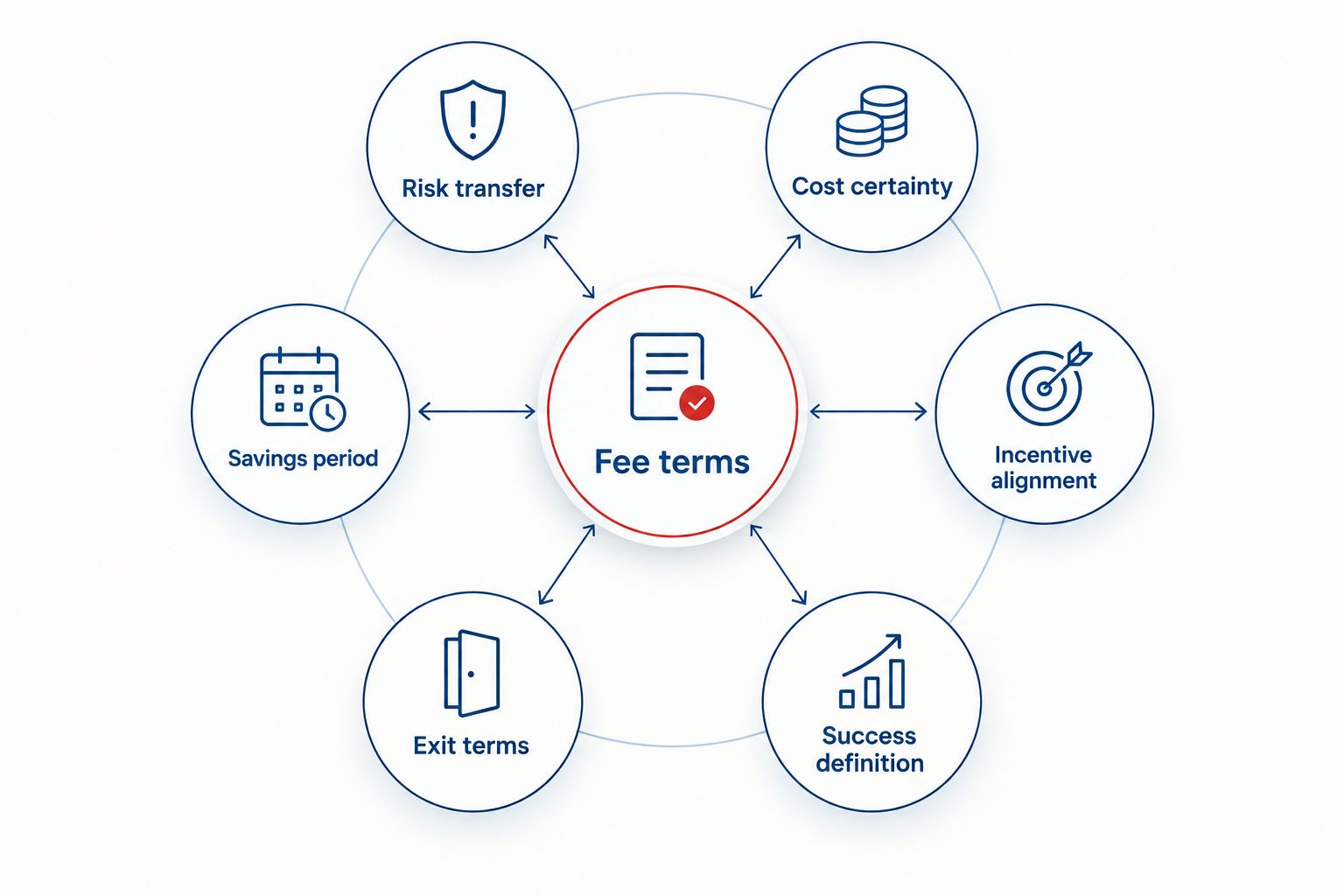
Use these six criteria before comparing proposals:
- Risk transfer: Who pays if the valuation challenge produces no reduction?
- Cost certainty: Does the agreement state a maximum total fee?
- Incentive alignment: Is payment tied to a confirmed result?
- Definition of success: Does success mean a lower rateable value, a lower bill, a refund or another outcome?
- Exit terms: What happens if you end the instruction or switch consultant?
- Savings period: Does the calculation include refunds, current-year savings or later billing periods?
A percentage can look low but produce a large invoice if it applies across several billing periods. A fixed fee can look simple but still be poor value if it is payable when the case fails. Compare the complete calculation, not one figure taken from the proposal.
Business rates consultants ranked by fee terms: at a glance
| Rank | Fee type | Best for | Standout feature | Key limitation |
|---|---|---|---|---|
| 1 | No win, no fee | Single-site businesses avoiding upfront risk | Payment depends on a successful result | The success calculation still needs close review |
| 2 | Capped success fee | Multi-site and portfolio instructions | Total fee has an agreed ceiling | A high or unclear cap offers little protection |
| 3 | Fixed fee per property | Narrow cases with a defined scope | Cost is known before work starts | Payment may remain due if the case fails |
| 4 | Hourly or day-rate billing | Complex advisory and dispute work | Charges reflect time spent | Final cost is uncertain without a cap |
| 5 | Unconditional upfront fee | Businesses accepting all financial risk | Payment terms are simple | Payment is disconnected from the outcome |
1. No win, no fee: best for avoiding upfront risk
Under this model, the consultant's right to payment depends on the result defined in the agreement. You do not fund the case before work begins, which protects cash flow and places the initial risk with the consultant.
The definition of a win is crucial. A reduction in rateable value does not always produce the same billing outcome, so the agreement should explain exactly which confirmed result triggers payment.
No win, no fee pros:
- No upfront payment before the case starts
- Consultant and client both benefit from a successful outcome
- Easier to assess risk before authorising work
- Suitable when the likely result is not yet certain
No win, no fee cons:
- The fee calculation may cover more than one billing period
- A result can trigger payment even when the immediate cash benefit is limited
- Exit clauses can preserve a future fee after the instruction ends
No legitimate consultant can promise that a challenge will succeed. Read this guide before accepting any claim that a firm can guarantee a business rates reduction.
Verdict: Buy. No win, no fee is the strongest default for a single-site business comparing consultants in 2026.
2. Capped success fee: best for multi-site portfolios
A capped success fee keeps the result-based structure but adds a maximum total charge. This matters when several properties are under review because separate successful outcomes can otherwise create a much larger combined fee.
The cap must be written as a firm monetary ceiling or an equally clear calculation. Wording such as subject to review or fees agreed later does not create useful cost certainty.
Capped success fee pros:
- Preserves the no-result, no-fee incentive
- Sets a ceiling across multiple properties
- Makes portfolio budgeting clearer
- Reduces the risk of fees increasing with every successful site
Capped success fee cons:
- A cap provides little value if it is set too high
- The contract may exclude some work from the stated ceiling
- Separate instructions can sometimes carry separate caps
Verdict: Buy for multi-site cases, but only when the agreement defines one clear ceiling and identifies every property covered.
3. Fixed fee per property: best for a narrow scope
A fixed fee gives you one agreed charge for defined work on a property. It fits a case where the issue, deliverables and stopping point can all be described before the consultant begins.
The main trade-off is outcome risk. Unless the agreement says otherwise, the fixed fee can remain payable even when the valuation stays unchanged.
Fixed fee pros:
- Known cost for the work listed in the instruction
- No percentage applied to a large refund or saving
- Straightforward comparison when competing proposals cover the same tasks
Fixed fee cons:
- You can pay even if the challenge fails
- Extra work may fall outside the original scope
- Comparing fixed quotes is misleading when deliverables differ
Ask whether the fee includes evidence review, submissions, discussions with the Valuation Office Agency and later appeal work. A low fixed fee covering only the first stage is not directly comparable with a wider instruction.
Verdict: Hold. Choose a fixed fee only when the scope and unsuccessful-outcome terms are explicit in 2026.
4. Hourly or day-rate billing: best for complex disputes
Time-based billing charges for work completed rather than the result achieved. It can fit complicated instructions involving valuation advice, property splits or mergers, disrepair evidence, council disputes or work that cannot be scoped accurately at the start.
Cost control must come from the contract. Set an approval point for additional work and require written notice before the consultant exceeds the agreed time allowance.
Hourly or day-rate pros:
- Can cover advisory work without forcing it into a success-fee model
- Suitable when the required work is uncertain
- Itemised time records can show where effort was spent
Hourly or day-rate cons:
- Total cost remains uncertain without a ceiling
- You carry the cost if the case produces no saving
- Longer cases create larger fees regardless of outcome
Verdict: Wait. Accept time-based billing only with a written limit, clear rates and approval controls.
5. Unconditional upfront fee: best avoided
An unconditional upfront fee is payable before the outcome is known and normally remains with the consultant if the case fails. It separates payment from success and leaves the business carrying the financial risk from the start.
Do not assume that upfront payment guarantees faster handling or a better result. The written scope must state what the payment buys, whether any part is refundable and which later fees can still apply.
Upfront fee pros:
- The payment date is clear
- It can cover a defined piece of advisory work where no appeal outcome is promised
Upfront fee cons:
- Payment is not tied to a reduction or refund
- The business funds the risk before evidence is assessed
- Further charges may still apply later
- Recovering money after a service dispute can become a separate problem
Verdict: Skip for an outcome-based valuation challenge. In 2026, an unconditional upfront charge ranks last because it gives you the least protection.
“The safest fee term ties payment to a defined result and puts the full calculation in writing before work begins.”
Clauses to compare before signing
A fee label is only the start. Review the agreement line by line and get written answers to these questions:
- What result triggers the fee? Identify whether it is a changed rateable value, an amended bill, a refund or another event.
- Which periods count? Check whether the calculation covers historic refunds, the current billing period and later savings.
- What happens if the value rises? An appeal can produce an unfavourable outcome, so ask how that affects fees and responsibility.
- Can you approve extra work? Fixed and time-based instructions should require consent before further charges arise.
- What happens when you leave? Check notice requirements, cancellation charges and fees linked to a later decision.
- Who handles the case? Confirm the service described in the proposal and the stages included in the instruction.
Do not rely on a telephone explanation that conflicts with the written terms. Ask for the agreement to be amended before signing rather than assuming the verbal version will control the invoice.
Compare your fee terms
Ask Appeal My Rates UK whether your case is offered on a no-win-no-fee or fixed-fee basis, and request the terms in writing.
How we ranked the fee models
The ranking applies the same six checks to every model: risk transfer, cost certainty, incentive alignment, definition of success, exit terms and the savings period used for calculation.
No win, no fee ranks first because payment depends on an agreed result and no money is due upfront. A capped success fee follows because it adds a ceiling that can protect larger portfolios. Fixed and time-based billing place more outcome risk on the client, while an unconditional upfront fee provides the weakest link between payment and success.
This ranking does not make every result-based agreement fair. A poorly drafted no win, no fee contract can still create unexpected charges. The exact wording decides whether the model works in your favour.
Which fee term should you choose?
Choose no win, no fee if you have one property and want the consultant to carry the initial financial risk. Appeal My Rates UK offers no-win-no-fee terms for most work, but may quote a fixed fee for some cases. Confirm which terms apply before instructing the firm.
Choose a capped success fee when several properties are included and you need a maximum total cost. Choose a fixed fee only when the issue and deliverables are narrow enough to define precisely. Use hourly or day-rate billing for complex advisory work, subject to a written limit.
Avoid an unconditional upfront fee for an outcome-based challenge. That model asks you to pay before you know whether the consultant can secure any change.
FAQ
What’s the best business rates consultant fee arrangement in 2026?
No win, no fee is the best default for most single-site businesses in 2026 because no payment is due upfront and the fee depends on a defined result. Check how the agreement defines success and calculates savings before signing.
Is no win, no fee better than a fixed fee?
No win, no fee is better when you want protection from paying for an unsuccessful outcome. A fixed fee can work when the scope is narrow and you accept responsibility for the fee regardless of the result.
How much does a business rates consultant cost?
The cost depends on the consultant’s written fee model and the result or work covered. Request the complete calculation, applicable periods and maximum possible charge rather than comparing headline percentages alone.
Can a consultant charge fees on a backdated refund?
A consultant can calculate a fee using a backdated refund if the signed agreement clearly includes it. Check whether refunds and future savings are both included before authorising the work.
Can a business rates consultant guarantee a reduction?
No consultant can guarantee that a valuation challenge will produce a reduction. The evidence, valuation facts and decision-making process determine the outcome, not the fee model.
Can I switch business rates consultants during an appeal?
You can switch, but the existing agreement may preserve fees, notice requirements or payment rights for work already completed. Review the exit clause before appointing another consultant.
Should multi-site businesses accept a percentage fee?
A percentage fee can suit a multi-site business when it includes a clear total cap. The agreement should identify every property covered and explain whether excluded work attracts separate charges.
What does no win, no fee mean for Appeal My Rates UK?
Most Appeal My Rates UK work is no win, no fee, but some instructions carry a fixed fee. Your written agreement should state which model applies, the scope, the calculation and when payment is due.
One last thing
Ask each consultant to show the fee calculation using the same hypothetical outcome. That simple comparison exposes differences in savings periods, refund treatment, caps and extra charges that a headline percentage hides. If the consultant cannot explain the calculation plainly in 2026, do not sign the agreement.
Related guides
- Can I switch business rates consultants during an appeal?
- Choose a business rates service for multiple sites
- Check a business rates consultant's RICS credentials
