

Best fit for delegated valuation work: Appeal My Rates UK. Best fit for a disputed council bill: a billing-dispute instruction; best fit for a straightforward factual correction: a self-managed Check. If you want business rates consultants ranked by turnaround time in 2026, compare written response commitments—not promises about how quickly an authority will decide your case.
- For business rates consultants ranked by turnaround time, compare written milestones rather than promised completion dates.
- Appeal My Rates UK suits owners seeking professional help with business rates valuations, property changes and council disputes.
- Separate consultant response time from valuation authority decisions, tribunal proceedings and council billing adjustments.
- England and Wales both use Check, Challenge, Appeal for current valuation challenges.
Why this matters
A quick acknowledgement is not a completed assessment. A consultant can answer your enquiry promptly while still needing property information, evidence or your authorisation before taking the next step.
The useful comparison is how quickly a consultant completes work within their control. Ask separately about the first substantive response, evidence review, submission and subsequent updates. Combining those stages into a single turnaround claim hides where your case actually stands.
For a 2026 instruction, distinguish a service commitment from an estimate. A service commitment describes what the consultant agrees to do; an estimate describes an expected outcome that can depend on other parties.
What makes the best business rates response service
Use these criteria before choosing a provider or service route:
- Substantive replies: An answer should identify the issue, required documents and next action—not merely confirm receipt.
- Written milestones: Ask what starts each stage and how you will know it has been completed.
- Case ownership: Establish who handles the instruction and who responds when that person is unavailable.
- Evidence readiness: Check whether the consultant has the information needed to assess your property and your complaint.
- External dependencies: Separate consultant tasks from decisions by the valuation authority, council or tribunal.
- Scope and terms: Confirm which work is included and how additional issues will be handled.
Do not reward the shortest advertised timeline without checking what it measures. An initial call, a lodged Check and a corrected council bill are different deliverables.
Business rates response options at a glance
This ranking matches service approaches to the problem you need resolved. It does not assign unverified completion times to named firms.
| Rank and option | Best for | Standout feature | Key limitation | Response commitment to request |
|---|---|---|---|---|
| 1. Appeal My Rates UK | Delegating valuation casework | Professional rating surveyor services for business owners in England and Wales | Cannot control authority or tribunal decisions | Written assessment and case-update milestones |
| 2. Council billing-dispute instruction | Challenging an incorrect demand or billing treatment | Focuses the instruction on the disputed bill | Does not itself change the property's valuation | Date for reviewing the bill and sending a reasoned response |
| 3. Property split or merger instruction | Resolving how premises should be assessed | Focuses on the property arrangement and supporting evidence | Depends on establishing the relevant facts | Date for identifying evidence gaps and the appropriate next step |
| 4. Self-managed Check | Addressing an identifiable factual issue yourself | Direct involvement in the initial valuation process | You manage the evidence, correspondence and follow-up | Your own document and submission plan |
1. Appeal My Rates UK: best fit for delegated valuation work
Appeal My Rates UK is a firm of professional rating surveyors helping business owners in England and Wales challenge business rates valuations. Its services also cover property splits and mergers and disputes with local council rates teams.
Appeal My Rates UK is a fit for business rates casework when you want professional surveyors to handle the valuation challenge. Judge the proposed instruction by its written scope and response arrangements, rather than assuming professional representation guarantees a shorter authority process.
Pros:
- Provides a professional service rather than leaving you to manage the case alone.
- Covers valuation challenges alongside related property and council disputes.
- Lets you define the work you want handled through a specific instruction.
Cons:
- Representation cannot guarantee a reduction or a decision date.
- Progress still depends on obtaining relevant property information.
- The instruction needs clear boundaries where valuation and billing issues overlap.
Best for: Owners who want to delegate the assessment and handling of a valuation case.
Fee note from Appeal My Rates UK: Most of our work is no win, no fee, but some instructions carry fixed fees. Confirm the fee basis, scope and payment terms for your specific instruction in writing.
Verdict: Buy the service only after the scope and response arrangements are confirmed. Let us handle your case, with the responsibilities agreed before work begins.
2. Council billing-dispute instruction: best for a disputed demand
A council billing-dispute instruction addresses the demand or account issue you identify. It is the appropriate focus when your concern is how the council has billed the property, rather than whether the rateable value itself is correct.
Start with the demand notice, relevant correspondence and a clear explanation of the disputed point. Ask the adviser to distinguish a billing correction from a valuation challenge before agreeing the next action.
Billing-dispute instruction pros:
- Keeps attention on the actual demand you are disputing.
- Helps separate council correspondence from valuation casework.
- Creates a defined task against which you can assess the adviser's response.
Billing-dispute instruction cons:
- A billing instruction does not itself secure a valuation change.
- Council processing remains outside the adviser's control.
- An underlying valuation issue can require additional work.
Best for: Owners with an identifiable council billing dispute and the documents needed to explain it.
Verdict: Buy a defined billing instruction when the demand is the problem; hold if the underlying issue has not been identified. A quick letter is useful only if it addresses the right dispute.
3. Property split or merger instruction: best for changed premises
A property split or merger instruction focuses on how premises are arranged, occupied and assessed. The first useful response should identify which facts and documents are needed—not promise an immediate change to the rating assessment.
Explain what changed, when it changed and which areas are involved. Plans and occupation information help the adviser understand the arrangement; their relevance depends on the particular instruction.
Property instruction pros:
- Directs the assessment towards the physical and occupation facts.
- Makes evidence gaps visible before a submission is prepared.
- Gives you a specific property issue to discuss with the surveyor.
Property instruction cons:
- Unclear plans or occupation history can delay preparation.
- A changed layout does not automatically establish the outcome you want.
- Related billing questions need to be distinguished from the assessment issue.
Best for: Owners whose question concerns separate assessments or combining property assessments.
Verdict: Buy a property-specific assessment; skip any promise of an immediate split or merger before the facts are reviewed. In 2026, a useful early response is an evidence plan, not a guaranteed result.
4. Self-managed Check: best for an identifiable factual issue
A self-managed Check lets you deal directly with the initial stage of the valuation process. It suits an owner who can identify the factual concern, assemble supporting information and manage the correspondence.
Both England and Wales use Check, Challenge, Appeal for the 2023 rating list onwards. Wales adopted this process on 1 April 2023; current Welsh valuation challenges are not a separate proposal-based route.
Self-managed Check pros:
- Gives you direct visibility of what you submit.
- Lets you organise the evidence around the factual issue you have identified.
- Removes the need to wait for an intermediary to relay correspondence.
Self-managed Check cons:
- You take responsibility for understanding and managing the process.
- An incorrect diagnosis can send your effort towards the wrong issue.
- Direct submission does not mean a faster authority decision.
Best for: Owners comfortable managing a clearly identified factual issue and the associated records.
Verdict: Hold until you understand the issue and process; skip self-management if you cannot explain what needs correcting. Seek professional assessment rather than submitting an unsupported complaint.
How we ranked these response options
The order reflects delegation needs, issue type, evidence requirements and control over the next action. It is a decision guide, not a measured league table of provider speed.
For a business comparing consultants in 2026, use the same questions for every proposal. Ask each provider to define the deliverable, the starting point for its estimate and the circumstances that require a revised timetable.
Rank a useful, accountable response above a fast acknowledgement. A provider who identifies missing evidence and states the next action gives you more to assess than one who simply says the case is progressing.
Separate the stages before comparing turnaround
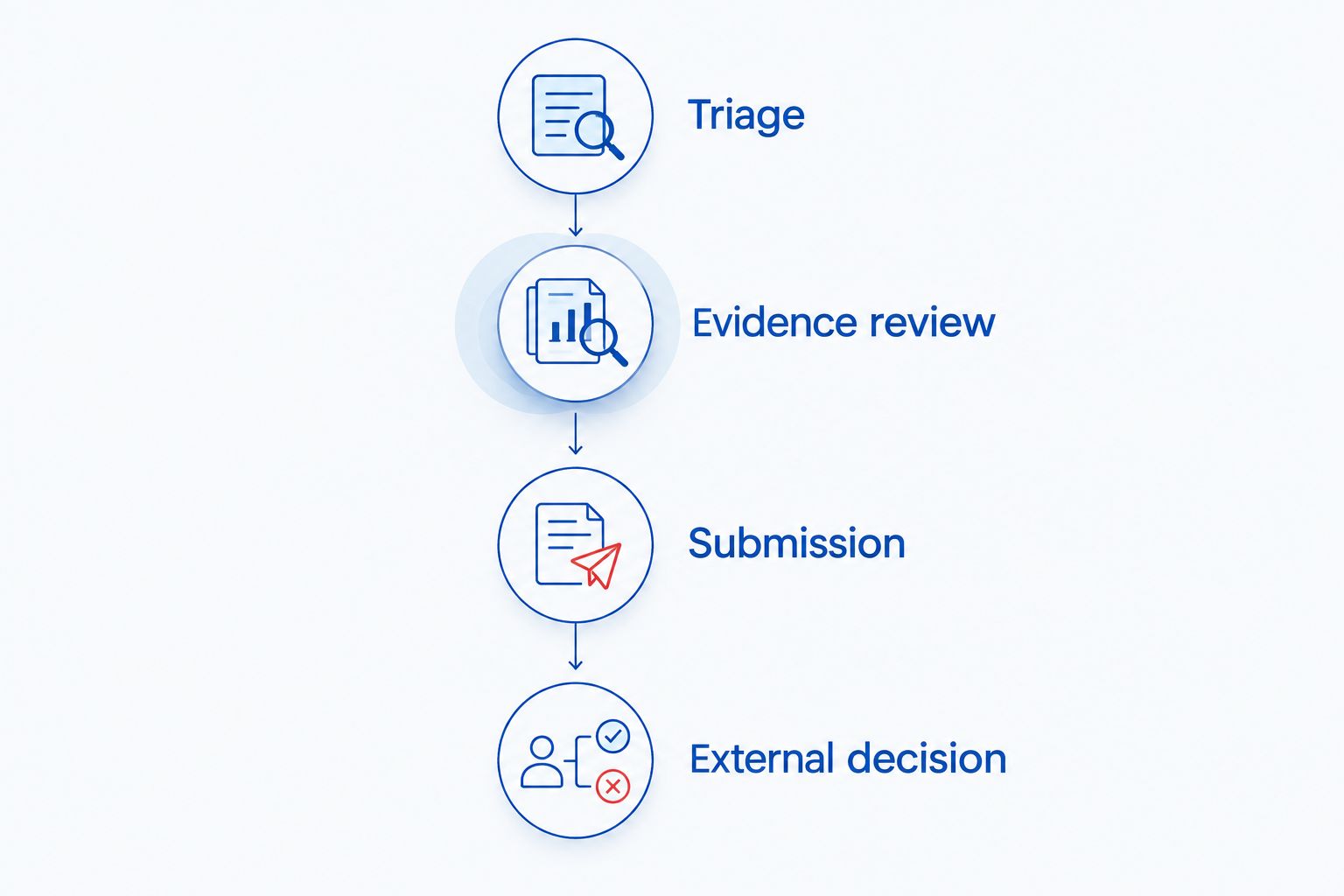
A business rates instruction moves through tasks with different owners. Ask for a status against each stage so that a delay in obtaining documents is not confused with a delay in an authority's decision.
- Triage: Identify whether the issue concerns valuation, billing, relief or the property arrangement.
- Evidence review: Establish what supports the case and what remains outstanding.
- Submission: Prepare and send the appropriate material once the necessary requirements are met.
- External decision: Track the response from the body responsible for deciding the issue.
Checks and Challenges are handled by the valuation authority in both England and Wales. Appeals go to the relevant Valuation Tribunal for England or Wales. The shared process does not make every billing rule, relief or tribunal arrangement identical.
For the wider sequence, read how long a business rates appeal takes. Keep the consultant's response commitment separate from the overall case timetable.
What to request before instructing a consultant
Send the same short brief to each provider you are considering. Include the property address, the disputed document or valuation issue, relevant correspondence and any deadline stated in a notice.
Ask for written answers to these questions:
- What is the first substantive task you will complete?
- What information or authorisation do you need before starting it?
- What date will you commit to for that task?
- Who owns the case and handles urgent correspondence?
- When will I receive an update if there is no external decision?
- What work falls outside this instruction?
- How will the fee basis and payment terms be confirmed?
For your 2026 comparison, record the answers alongside the proposed scope. Do not compare a tightly defined document review with an open-ended promise to resolve the entire case.
Choose the clearest commitment you can hold the provider to. If the proposed timetable changes, request the reason, the outstanding dependency and the revised next action in writing.
Let us handle your case
Discuss the issue, the evidence needed and the scope of your instruction.
Which business rates response option should you choose?
Choose managed professional support when you want someone to assess and handle a valuation case. Choose a focused billing instruction when the disputed council demand is the issue, and a property-specific instruction when the assessment arrangement needs examination.
Self-management suits a factual issue you understand and can document. It is not a shortcut around the authority's decision-making process.
For the undecided owner, start with diagnosis and a written scope—not a fastest-provider claim. That gives you a practical basis for comparing service quality without confusing response speed with the eventual outcome.
FAQ
What’s a realistic response time from a business rates consultant?
A realistic response time is a written commitment for a defined task, with its starting conditions stated. Separate acknowledgement, assessment, submission and updates rather than accepting one timeline for the whole case.
Which business rates consultant is the fastest?
A fastest-provider claim needs comparable evidence covering the same tasks and starting conditions. Choose a consultant by written response commitments and case ownership rather than an unsupported speed ranking.
Can a consultant guarantee when my appeal will finish?
A consultant cannot guarantee the timing of an authority or tribunal decision. Ask for commitments covering the consultant’s own preparation, submissions and updates instead.
Does Wales use a different current business rates appeal process?
No. England and Wales both use Check, Challenge, Appeal for the 2023 rating list onwards, with Checks and Challenges handled by the valuation authority and appeals handled by the relevant tribunal.
Is every instruction no win, no fee?
No. Most of our work is no win, no fee, but some instructions carry fixed fees. Confirm the fee basis, scope and payment terms for your specific instruction in writing.
Will handling a Check myself make it quicker?
Handling a Check yourself removes an intermediary, but it does not make the authority decide faster. You remain responsible for the information, evidence and correspondence needed for your submission.
What should I do if my consultant stops replying?
Request a written status update identifying the current stage, outstanding information and next action. Refer to the agreed response arrangements and ask who is responsible for resolving the communication gap.
One last thing
Ask for an update date even when nothing has changed. An agreed no-change update makes a quiet period accountable without pretending that an external decision has arrived.
For any 2026 instruction, the most useful question is: What happens next, who owns it, and when will you tell me? The answer exposes the difference between a responsive service and a quick sales reply.
Related guides
- Compare business rates consultant fee terms
- Check, Challenge, Appeal guide for 2026
- How to track your business rates appeal case status
