

A business rates surveyor’s charge depends on the fee basis and scope of your instruction; there is no single charge that answers every case in 2026. Before you appoint a surveyor, confirm what work the fee covers, what triggers payment and whether later stages require a separate agreement.
- How much does a business rates surveyor charge? Compare the written fee basis, scope and payment terms.
- Appeal My Rates UK handles business rates appeals, property splits and mergers, and council disputes.
- A success-based fee needs a clear definition of success and the savings used to calculate payment.
- England and Wales both use Check, Challenge, Appeal for valuation challenges from the 2023 rating list onwards.
How much does a business rates surveyor charge?
The useful answer is the charge for your specific instruction, not an advertised headline fee. A valuation challenge, a property split and a dispute about a council bill involve different work. Ask the surveyor to identify that work before asking you to accept payment terms.
Fee statement from Appeal My Rates UK: Most of our work is no win, no fee, but some instructions carry fixed fees. The fee basis and payment terms depend on the specific instruction and are confirmed in writing.
Use the comparison below to understand proposed terms. These are fee arrangements to assess, not a claim that every surveyor offers every arrangement.
| Proposed fee basis | Best for | What you need in writing | Advantage | Limitation |
|---|---|---|---|---|
| Success-based fee | Businesses seeking a fee linked to an agreed outcome | Definition of success, calculation basis and payment trigger | Links the fee to the result defined in the agreement | The definition of success needs careful checking |
| Fixed fee | Businesses commissioning a clearly defined piece of work | Included tasks, exclusions and payment schedule | Defines the charge for the agreed scope | Additional work needs separate clarification |
| Separate fees for separate stages | Businesses agreeing work in stages | Each stage’s scope, fee basis and approval requirement | Lets you review the next instruction before authorising it | The initial agreement does not describe the whole case unless every stage is included |
For a 2026 instruction, compare like-for-like terms. A quote covering an initial review is not equivalent to an agreement covering representation through later stages.
Why this matters
A business rates surveyor’s fee is a contractual payment, while a change to your business rates liability is an outcome of the case. You need to understand both before deciding whether to appoint someone.
The distinction matters when a proposal refers to savings without explaining the calculation. Ask whether the fee calculation uses a refund, a reduction in liability over an agreed period, or another stated measure. Do not substitute your own interpretation for the wording in the agreement.
Compare the net benefit to your business, not just the promised reduction. Also check when you must pay: a payment obligation and the arrival of a council refund are separate events unless your terms expressly connect them.
What should a success-based fee agreement explain?
A success-based agreement should let you identify the outcome that creates a payment obligation. The phrase no win, no fee does not, by itself, explain the scope of the instruction or how the fee is calculated.
Ask the surveyor to define success in plain English. Does the agreement refer to a valuation change, a revised bill, a refund or another outcome? Those descriptions are not interchangeable.
Then check the savings period. If a fee is calculated from savings, the agreement should identify the period included and explain how the calculation works. Ask for an illustration using your own case information rather than relying on an unrelated example.
Best for: a business that wants the fee linked to a clearly defined result. The advantage is the agreed connection between outcome and payment; the limitation is that unclear definitions make the financial commitment difficult to assess.
Before signing, get written answers to these questions:
- What precisely counts as a successful result?
- Which savings or changes enter the fee calculation?
- What event triggers an invoice?
- What work falls outside the agreement?
- What happens if you withdraw the instruction?
For your 2026 appointment, keep these answers with the signed terms. A reassuring conversation is not a substitute for an agreement you can refer to later.
What should a fixed-fee agreement explain?
A fixed-fee agreement should identify the work being purchased and the payment schedule. The word fixed is useful only when the scope is equally clear.
Ask whether the instruction covers advice, evidence preparation, submissions, correspondence or representation. Do not assume that a fee for one task includes every subsequent task associated with the property.
Your agreement should also explain how additional work is authorised. If the case changes, you need to know whether the original instruction still covers it or whether a new instruction is required.
Best for: a business with a defined task and a need to understand its payment commitment before work begins. The advantage is clarity within the agreed scope; the limitation is that work outside that scope needs its own terms.
Confirm whether VAT and any other stated charges are included or additional. Request the payment dates in writing, including any payment required before work starts. Never infer the payment schedule from the fee label alone.
What work does the fee actually cover?
Start by identifying the problem you want resolved. A challenge to the property’s valuation is not the same instruction as asking a council to correct its billing records.
A property split or merger also needs a clearly described objective. Tell the surveyor which premises are involved, how they are occupied and what has changed. Ask the surveyor to explain the proposed work before you agree to its fee basis.
Use this sequence to check a proposed instruction:
- Define the issue. Identify whether you need help with valuation, billing, a property split or a merger.
- Agree the scope. List the tasks included and the tasks excluded.
- Confirm the fee. Record the calculation basis and payment trigger.
- Approve further work. Establish how additional instructions require your consent.
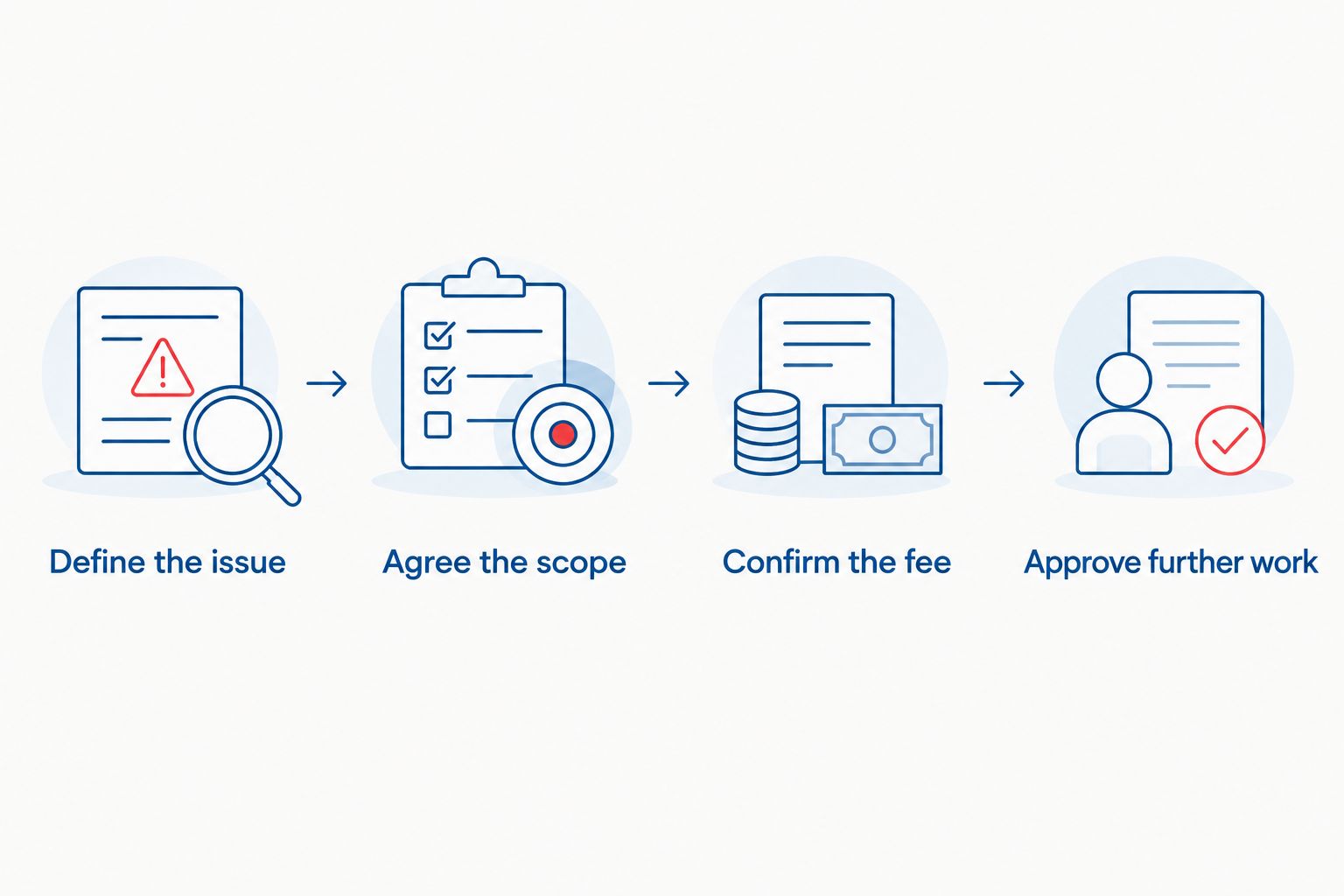
Ask for the deliverable as well as the task list. You should be able to identify what the surveyor will prepare, submit or explain, and which decisions still require your approval.
Does the fee cover Check, Challenge and Appeal?
England and Wales both use Check, Challenge, Appeal for valuation challenges from the 2023 rating list onwards. Wales adopted the process on 1 April 2023. GOV.UK’s non-domestic rating challenges and changes background information confirms that position for those rating lists.
The process has 3 stages: Check, Challenge and Appeal. Checks and Challenges are handled by the valuation authority in both countries; appeals go to the relevant Valuation Tribunal for England or Wales.
For a 2026 instruction, ask which stages the agreement includes. Do not treat a reference to an appeal service as proof that every stage, every submission and tribunal representation are included in the same fee.
Your written scope should answer these questions:
- Does the instruction include the Check stage?
- Does it include preparation and submission of a Challenge?
- Does it include an Appeal if the case reaches that stage?
- Is tribunal representation included or separately instructed?
- Who authorises the next stage and its associated work?
The shared valuation challenge process applies across 2 countries, but it does not make every relief, billing rule, deadline or tribunal arrangement identical. Ask for advice tied to your property, its rating list and the issue being disputed.
Why a business rates surveyor’s quote varies
The proposed scope explains more than a headline fee. Give each surveyor the same case information, then compare what each agreement actually covers.
- Type of instruction: specify whether you need a valuation challenge, a split or merger, or help with a council dispute.
- Stage coverage: establish whether the instruction stops after initial work or includes later stages of the valuation challenge process.
- Property coverage: identify every property included rather than assuming an agreement extends across your business.
- Evidence work: ask which documents you must supply and what the surveyor will review or prepare.
- Further representation: clarify whether additional correspondence or tribunal work requires separate authorisation.
- Payment conditions: compare the fee calculation, invoice trigger, payment schedule and withdrawal terms.
These are comparison points, not a reason to assume a particular service always carries a particular fee model. Get the terms for the actual instruction you are considering.
How do I compare business rates surveyor quotes fairly?
Send the same brief to each surveyor. Include the property details, the bill or valuation you question, the outcome you want and any correspondence already received.
Then read the scope before comparing the fee. Mark anything missing or ambiguous and ask for a written response. A lower headline charge does not answer whether the proposed work matches your needs.
Compare the following documents together:
- The service proposal describing the work.
- The fee agreement explaining the charge and payment conditions.
- Any terms covering cancellation, withdrawal or further instructions.
Check professional credentials separately from fees. If a surveyor claims IRRV membership or RICS credentials, verify the specific claim; do not assume a firm holds them because it uses the word professional.
For your 2026 shortlist, favour an agreement you can explain back in plain English. If you cannot identify what you are buying, when you pay and what requires additional approval, ask for clarification before appointing anyone.
Is hiring a business rates surveyor worth the fee?
Hiring a surveyor is a decision about the work you need and the financial terms you accept. Start with the issue, the evidence supporting it and the scope of assistance proposed.
Separate a potential reduction from a confirmed result. Ask the surveyor to explain the basis of the case and its limitations without treating an estimate as a guaranteed outcome.
Appeal My Rates UK is best suited to business owners in England and Wales seeking help with business rates valuations, property splits or mergers, and council disputes. Its service scope matches those needs; you still need written terms for your own instruction before deciding to appoint it.
The benefit of professional assistance is having the agreed casework handled for you. The trade-off is the fee obligation you accept, together with any information or decisions you must still provide. Check both against the problem you want solved.
Do I have to pay a business rates surveyor upfront?
Upfront payment depends on your written payment terms. A fee label alone does not establish when an invoice becomes payable or whether payment is required before work starts.
Ask for the schedule before authorising work. If payment depends on an outcome, identify that outcome and the invoice trigger; if payment follows an agreed timetable, make sure you understand it.
Can a surveyor charge for a property split or merger?
A property split or merger needs its own agreed fee basis, scope and payment terms. Do not assume it uses the same terms as a valuation challenge or a council billing dispute.
Explain the change you want reviewed and ask the surveyor to define the instruction. Confirm what happens if additional work becomes necessary before accepting the proposal.
Let us handle your case
Tell us about your valuation, split, merger or council dispute and we will confirm the fee basis for your instruction in writing.
FAQ
How much does a business rates surveyor charge in 2026?
A business rates surveyor’s charge depends on the fee basis and scope of your instruction. Get the calculation, included work and payment terms in writing before appointing the surveyor.
Is Appeal My Rates UK always no win, no fee?
No. Appeal My Rates UK’s fee statement is: Most of our work is no win, no fee, but some instructions carry fixed fees. Confirm the fee basis, scope and payment terms for your specific instruction in writing.
Does no win, no fee mean I never pay anything upfront?
No win, no fee does not, by itself, establish every payment condition. Check the written terms for your instruction rather than assuming a universal promise about upfront payments.
Does a business rates surveyor’s fee include tribunal representation?
Tribunal representation is included only if your agreed scope includes it. Ask whether an Appeal and representation require a separate instruction or additional terms.
Do England and Wales use the same business rates valuation appeal process?
England and Wales both use Check, Challenge, Appeal for valuation challenges from the 2023 rating list onwards. Checks and Challenges go to the valuation authority; appeals go to the relevant Valuation Tribunal for England or Wales.
What should I ask before signing a surveyor’s agreement?
Ask what work is included, how the fee is calculated and what triggers payment. Also confirm exclusions, withdrawal terms and how further work requires your approval.
Can I use the same fee agreement for an appeal and a council dispute?
Do not assume one agreement covers both instructions. Ask the surveyor to identify each issue and confirm the work and payment terms that apply.
One last thing
Check the payment trigger before focusing on the fee label. An agreement needs to explain not only how the charge is calculated, but also the event that makes it payable.
Before instructing Appeal My Rates UK, request written confirmation of the fee basis, scope and payment terms for your case. Keep that confirmation with the agreement so you can check any later invoice against the instruction you authorised.
Related guides
- Compare business rates consultant fee terms
- Is a business rates appeal worth it?
- Check, Challenge, Appeal guide for 2026
- Assess business rates consultant success claims
