

Best starting point: a rating surveyor who checks the valuation evidence before recommending a challenge. Appeal My Rates UK is a suitable choice for gym and leisure centre operators seeking help with valuation challenges, property splits or mergers, and council rates disputes; choose the instruction that matches your problem.
- The best business rates consultants for gyms and leisure centres separate valuation errors from billing problems.
- Appeal My Rates UK handles valuation challenges, property splits and mergers, and council rates disputes.
- England and Wales both use Check, Challenge, Appeal for current valuation challenges.
- Confirm the evidence, scope, fee basis and payment terms before appointing a consultant.
Why this matters
A gym’s rates bill and its rateable value are not the same thing. The valuation authority deals with the property assessment; the council deals with the bill and relief applications. Sending a billing complaint through a valuation challenge does not address the underlying billing issue.
For your 2026 review, start by identifying what you dispute: the property facts, the valuation, the assessment boundary or the council’s calculation. A useful consultant explains the distinction before asking you to sign. The business rates guide for gyms and leisure centres provides the property-specific starting point.
This guide ranks appointment options by the problem they address, rather than presenting an unsupported league table of firms. A valuation instruction, a property split review and a billing dispute need different evidence and clearly defined work.
What makes the best business rates consultant?
Judge a proposed appointment against these criteria before comparing promises:
- Problem diagnosis: identifies whether the issue concerns valuation, occupation, property boundaries, relief or billing.
- Property evidence: asks for plans, leases, occupation dates and the assessment details rather than relying on the headline bill.
- Valuation reasoning: explains why the current assessment is disputed and what supports the proposed correction.
- Process knowledge: distinguishes Check, Challenge and Appeal, including who handles each stage.
- Written scope: states whether the instruction includes initial review, submissions, council correspondence and tribunal representation.
- Clear terms: explains the fee basis, payment triggers, exclusions and what happens if you end the instruction.
Professional credentials also need checking. If a consultant claims RICS or IRRV membership, verify the individual’s stated status rather than treating a logo as proof. Ask which professional standards apply to the instruction and how complaints are handled.
Appointment options at a glance
| Ranked option | Best for | Main purpose | Key limitation |
|---|---|---|---|
| Rating surveyor valuation review | A disputed property assessment | Tests property facts and valuation evidence | A lower bill is not guaranteed |
| Property split or merger review | Separately occupied or combined areas | Examines assessment boundaries and occupation | A new layout alone does not establish the rating outcome |
| Council billing dispute support | An incorrect demand or account history | Addresses the council’s calculation and records | Does not itself change the rateable value |
| Self-managed initial review | Organised operators identifying the issue | Collects records and separates questions | You remain responsible for submissions and deadlines |
1. Rating surveyor review: best for a disputed valuation
Best for: gym and leisure centre operators who believe their property assessment is wrong. Appeal My Rates UK provides business rates valuation challenge services in England and Wales. The first useful question is not how much you hope to save, but which part of the assessment your evidence contradicts.
Ask the consultant to explain the valuation basis used for your property. Do not assume a fitness studio, a converted warehouse gym and a purpose-built leisure centre should all be assessed through an identical calculation.
What the valuation review should check
The review should reconcile the assessment with the premises you occupy. That means checking the recorded description, areas, facilities, relevant dates and supporting valuation information.
For a 2026 instruction, ask which rating list the advice concerns. If the dispute covers an earlier period as well, require the consultant to distinguish the assessments and explain the scope for each period. A current valuation review does not automatically address every historic bill.
Valuation review pros:
- Puts property evidence ahead of a promised reduction.
- Separates factual corrections from valuation arguments.
- Gives you a reasoned basis for deciding whether to proceed.
Valuation review cons:
- The evidence can support the existing assessment rather than a reduction.
- Reviewing the valuation does not resolve unrelated council account errors.
Verdict: Buy — appoint for a defined valuation issue, not a guaranteed saving.
2. Split or merger review: best for changed occupation
Best for: operators whose gym shares premises, sublets space or has expanded into adjoining accommodation. A property split or merger review examines what is occupied, by whom, and how the areas relate to one another. It is not simply a request to divide a bill.
Examples worth examining include a separately occupied treatment room, a concession area or adjoining premises brought into a gym’s operation. These are reasons to investigate the assessment, not proof that a split or merger must follow.
What the property review should check
Ask the adviser to compare the lease documents, floor plans, access arrangements and actual occupation. Dates matter: a plan showing today’s layout does not establish when an earlier occupation arrangement began.
The consultant should explain the proposed assessment boundaries and why they follow from the facts. Also ask how a change would affect the records held by the valuation authority and the council; those are connected tasks, not interchangeable ones.
Split or merger review pros:
- Focuses on who occupies each part of the property.
- Brings plans and occupation records into the same review.
- Addresses a different question from whether the overall valuation is excessive.
Split or merger review cons:
- A lease description alone does not settle the rating treatment.
- Altering assessment boundaries does not guarantee a lower combined liability.
Verdict: Buy — commission a boundary review when occupation evidence supports the question.
3. Council dispute support: best for a billing problem
Best for: operators disputing a council demand, liability period, relief decision or account adjustment. Council dispute support focuses on the bill and the records behind it. An accurate valuation can still sit alongside a disputed demand.
Keep 2 separate questions in your instructions: is the property assessment correct, and has the council billed the account correctly? A consultant should explain which question each piece of correspondence addresses.
What the billing review should check
Provide the demand notice, account history, relevant occupation dates and earlier council correspondence. If your concern is a backdated charge, ask for a timeline showing the period billed and the evidence supporting your objection.
For a 2026 bill, require the adviser to identify the applicable year and country before discussing relief or multiplier treatment. Shared valuation appeal procedures do not make every billing rule identical across England and Wales.
Council dispute support pros:
- Directs the complaint to the body responsible for the bill.
- Creates a clear account chronology.
- Keeps billing corrections distinct from valuation arguments.
Council dispute support cons:
- A billing correction does not establish that the valuation is wrong.
- A valuation reduction does not resolve every disagreement about occupation or relief.
Verdict: Buy — use billing support when the council’s demand is the disputed document.
4. Self-managed review: best for identifying your next step
Best for: organised operators gathering records before deciding whether to appoint a surveyor. A self-managed review lets you establish what the assessment says, what the bill covers and where the apparent discrepancy lies. It is preparation, not a substitute for specialist valuation reasoning.
Start with 3 document groups: valuation records, property records and billing records. Keep dated correspondence with the relevant group so you can explain the issue without repeatedly reconstructing it.
What you should check yourself
Compare the property address and description across your records. Mark any disputed area, occupation date or account entry, then write down the evidence supporting the correction you want.
Do not treat another gym’s lower bill as a complete valuation argument. Ask whether the properties and assessments are genuinely comparable before drawing a conclusion.
Self-managed review pros:
- Helps you describe the problem clearly.
- Organises evidence for a later professional instruction.
- Shows whether your question concerns valuation or billing.
Self-managed review cons:
- You remain responsible for procedural requirements and deadlines.
- Finding a discrepancy does not establish the correct valuation treatment.
Verdict: Hold — gather the records, then decide whether specialist representation is needed.
How Check, Challenge, Appeal works
England and Wales both use Check, Challenge, Appeal for valuation challenges from the 2023 rating list onwards. Wales adopted the process on 1 April 2023. A consultant advising in 2026 should not describe current Welsh cases as following a separate proposal-based route.
The process has 3 stages:
- Check: establish and correct the property facts through the valuation authority’s process.
- Challenge: present the disputed valuation and supporting evidence to the valuation authority.
- Appeal: take an eligible unresolved dispute to the relevant Valuation Tribunal for England or Wales.
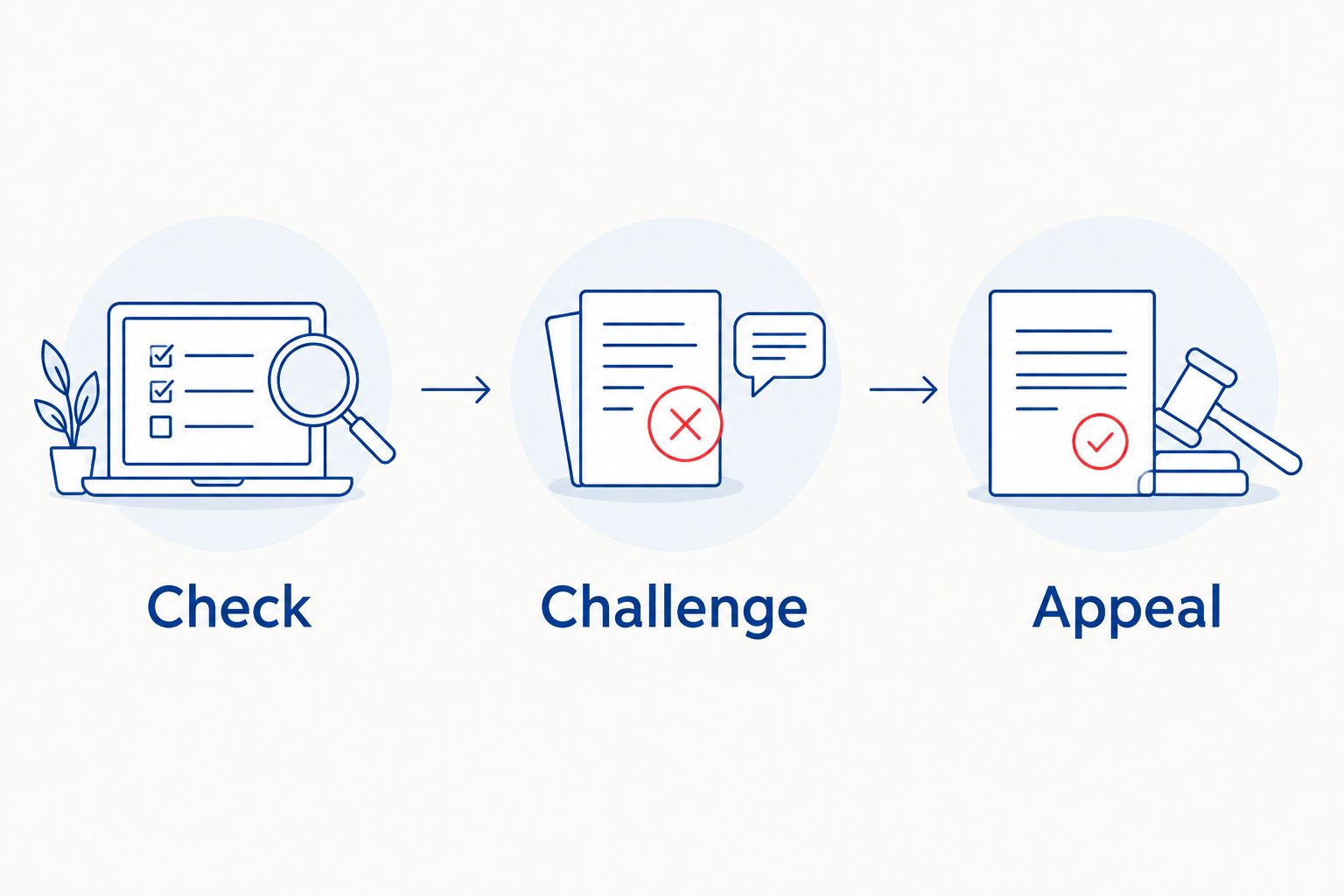
Ask your consultant which stage the instruction covers and what must happen before the next stage becomes available. A council billing complaint is not one of these valuation stages. Tribunal representation should also be addressed expressly in the engagement terms rather than assumed.
Agree the instruction before the work starts
Most of our work is no win, no fee, but some instructions carry fixed fees.
For an Appeal My Rates UK instruction, confirm the fee basis, scope and payment terms for your specific case in writing. Do not assume that valuation challenges, splits, mergers and council disputes all use the same arrangement.
Before signing, ask:
- What property, assessment period and issue does the instruction cover?
- What event triggers a payment obligation?
- How is any result-based fee calculated?
- Are council corrections and tribunal work included?
- What happens if the evidence does not support proceeding?
- What are the cancellation and termination terms?
Written answers make appointments comparable. A reassuring phone call does not replace clear engagement terms.
How these options are ranked
The order reflects the problem each appointment solves, not measured firm performance. Valuation review comes first for a disputed assessment; split or merger work addresses occupation boundaries; council support addresses billing; self-managed review helps organise an unresolved question.
Use the same criteria for every proposal: diagnosis, evidence, process knowledge, scope and terms. Reject a recommendation that cannot explain why the proposed route fits your documents.
Which consultant should you choose?
Appeal My Rates UK is a suitable choice for gym and leisure centre operators needing valuation challenge, split or merger, or council dispute support in England and Wales. Choose the instruction only after the underlying issue is clear.
If you are undecided in 2026, begin with the assessment, latest demand and occupation records. Ask for an explanation of the disputed point and the proposed next step. A reasoned decision not to challenge is more useful than an unsupported promise of a reduction.
FAQ
Who are the best business rates consultants for gyms and leisure centres?
Choose a consultant who identifies whether your problem concerns valuation, occupation boundaries or council billing. Appeal My Rates UK provides valuation challenge, property split and merger, and council dispute services in England and Wales; confirm the scope for your case in writing.
What should a consultant check before challenging my gym’s valuation?
A consultant should check the assessment details against property evidence and explain the disputed valuation point. Relevant records include plans, leases, occupation dates and the information supporting the existing assessment.
Do England and Wales use the same valuation appeal process?
Yes. Both use Check, Challenge, Appeal from the 2023 rating list onwards, with Wales adopting it on 1 April 2023. Checks and Challenges go to the valuation authority, while appeals go to the relevant Valuation Tribunal for England or Wales.
Can a separately occupied treatment room justify a property split?
Separate occupation is a reason to investigate the assessment boundaries, not proof that a split must follow. The review should examine actual occupation, access, plans, agreements and relevant dates.
Does a business rates consultant guarantee a reduction?
No. A consultant should assess the evidence and explain the grounds for proceeding, rather than guarantee a lower valuation or bill. The review can find that the existing assessment is supported.
Is all your work no win, no fee?
Most of our work is no win, no fee, but some instructions carry fixed fees. Confirm the fee basis, scope and payment terms for your specific instruction in writing before work starts.
Should I challenge the valuation if my council bill looks wrong?
First establish whether the error concerns the valuation or the council’s billing records. A disputed liability period or account calculation needs attention through the council; it does not by itself establish grounds for a valuation challenge.
One last thing
Ask your adviser to finish this sentence before you appoint: The document that supports your case is… A plan, occupation record, valuation comparison or account entry gives the review a starting point. A large bill alone does not identify what needs correcting.
Related guides
- Compare business rates consultant fee terms
- How Check, Challenge, Appeal applies to property splits
- Can you claim relief and appeal at the same time?