

An empty listed building in England or Wales is generally exempt from business rates while it remains unoccupied; an occupied listed building is not exempt simply because it is listed. For a business rates exemption, listed buildings must meet the relevant empty-property conditions, and the council needs evidence of the listing, the property covered and the vacancy dates. This guide explains what to check in 2026, how to request the exemption and when a valuation challenge is a separate issue.
- For a business rates exemption, listed buildings generally qualify while empty, not simply because they have listed status.
- Your council handles empty-property exemptions; a valuation challenge addresses a different question.
- Match the statutory listing to the exact property on your business rates bill.
- Appeal My Rates UK helps business owners with rating valuations and council rates disputes.
Why this matters
A listed building can remain on the rating list even when no empty-property rates are payable. Exemption from payment and removal from the rating list are different outcomes. Confusing them sends your request to the wrong place and leaves the billing issue unresolved.
Start with the reason for the bill, not an assumption that every historic property qualifies. The guide to empty shop business rates reduction options explains the wider distinction between vacancy, relief and valuation issues.
How do business rates exemptions work for listed buildings?
The key test is whether the relevant listed property is unoccupied and falls within the statutory exception from empty-property rates. Official business rates guidance for England and Wales identifies listed buildings among the properties exempt while empty. Your council administers the exemption on the rates account.
For your 2026 bill, establish the property's actual occupation status and the dates covered. Listing alone does not remove the liability of a business trading from the premises.
| Property situation | What listed status means | Next action | Important limitation |
|---|---|---|---|
| Wholly empty listed property | Generally exempt from empty-property rates while unoccupied | Give the council listing evidence and vacancy dates | The evidence must cover the rated property |
| Occupied listed property | No blanket exemption solely because it is listed | Check applicable reliefs and valuation accuracy | Heritage status does not cancel occupied rates |
| Partly occupied listed building | Empty-building treatment cannot be assumed for the whole assessment | Establish the occupied area and rating boundaries | An unused floor is not automatically a separate exempt property |
| Empty property in a conservation area, but not listed | Conservation-area status alone does not establish the listed-building exemption | Check ordinary empty-property rules | Historic appearance is not proof of statutory listing |
The empty listed-building exemption is not merely an extension of the ordinary initial vacancy period. In England, ordinary empty-property relief normally lasts 3 months, or 6 months for qualifying industrial premises; listed buildings have a separate exception while empty. Those periods describe England's ordinary rules, not a universal timetable for every Welsh property or every exemption.
Empty listed buildings: establish the exemption
Best for: owners or other liable parties dealing with a genuinely unoccupied listed property. The advantage is that qualifying listed premises are not restricted to the ordinary initial empty-property relief period. The limitation is that entitlement depends on the facts throughout the claimed period.
Send the council evidence identifying the statutory listing and the exact rated premises. A listing address and a rates account address do not always use identical wording, so explain any difference rather than leaving the council to infer the connection.
You should also identify when occupation ended and who held the relevant interest afterwards. A tenant leaving, handing back keys and ending a lease are separate events; the documents need to show which happened and when.
An exemption does not resolve every dispute about who is liable. Ask the council to confirm both the exemption period and the person or organisation recorded on the account.
Occupied listed buildings: check relief and valuation separately
Best for: businesses still trading from listed premises. Occupied properties need an assessment of available reliefs and the accuracy of their valuation, not an empty-building claim based on heritage status.
Listing restrictions can be relevant to how a property functions and is valued, but listing is not proof that the rateable value is wrong. A sound valuation case explains the property's actual characteristics and supports the claimed effect with evidence.
The benefit of separating these questions is clarity: a relief request addresses eligibility, while a valuation challenge addresses the assessment. The limitation is that neither route guarantees a reduction, and an occupied property does not inherit the empty-building exemption.
For a 2026 review, keep your occupation evidence, relief correspondence and valuation documents together but label them separately. That makes it clear which decision you want changed.
Partly occupied listed buildings: check the assessment boundaries
Best for: owners and occupiers with unused floors, wings or separately let units. Before claiming an exemption, establish whether the empty space forms its own rating assessment or sits inside a larger occupied assessment.
A locked upstairs room does not establish that the whole rated property is empty. Equally, a separately assessed vacant unit needs its own examination of listing coverage, occupation and liability.
The advantage of checking the assessment boundaries is that you address the correct property. The limitation is that a split or alteration to the rating list is a valuation matter, not something established merely by labelling rooms as unused.
Show the council a plan marking occupied and vacant areas. Explain access arrangements, business use and any separate lettings without assuming that your lease plan automatically determines the rating assessment.
Why listed-building exemption decisions vary
The outcome turns on evidence about the property and the claimed period, not how old or architecturally impressive it looks.
- Statutory listing: provide the official listing record rather than a sales description calling the building historic.
- Extent of the listing: establish whether the rated premises fall within the listed property; do not assume every neighbouring structure qualifies.
- Actual occupation: describe trading, storage and other use accurately. A building closed to customers is not necessarily unoccupied.
- Vacancy dates: support the beginning and end of the claimed period with records, not an approximate recollection.
- Rating boundaries: identify whether your claim concerns the whole assessment or only part of it.
- Liability records: explain changes of tenant, lease arrangements or ownership that affect the account.
These factors give the council a factual basis for deciding your request. They also expose disagreements early: a dispute about occupation requires different evidence from a dispute about whether the listed address covers the billed unit.
How to request the exemption from your council
Use a written request that identifies the account, the property and the period. For a 2026 application, retain a complete copy of your submission and every attachment.
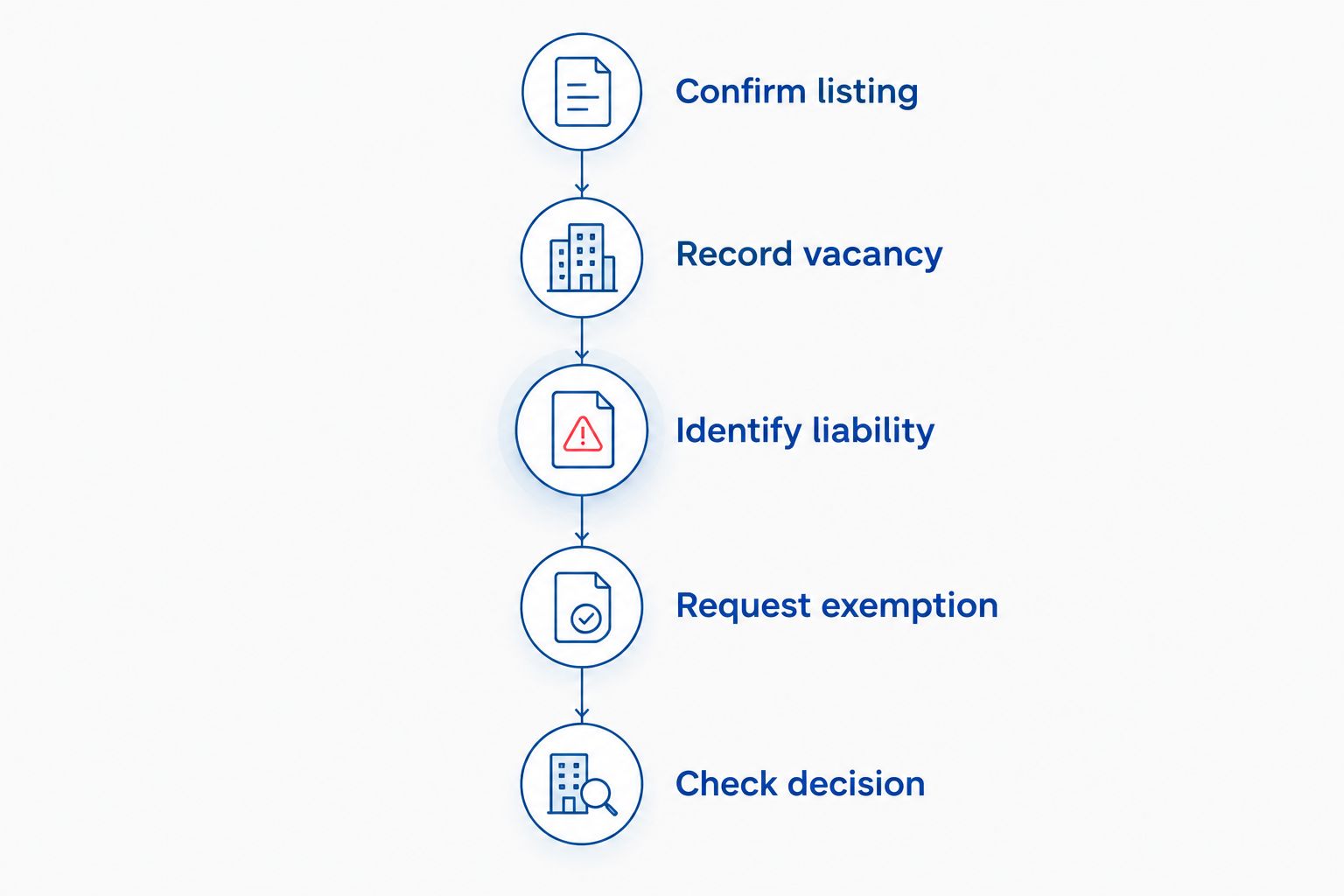
- Confirm listing. Obtain the statutory listing record and match it to the premises on the rates bill. Highlight address differences and include a plan where needed.
- Record vacancy. Set out when occupation ended and what happened afterwards. Include relevant lease, handover or inspection documents that support the dates.
- Identify liability. State who you believe was responsible for rates during the period and explain any change. Do not treat vacancy as proof that liability transferred.
- Request exemption. Ask the council to apply the empty listed-building exemption for the specified period. Explain any continuing use rather than omitting it.
- Check decision. Request written confirmation of the period accepted and check the revised account. If the request is refused, ask for the factual and legal reasons.
A useful submission lets the council follow the sequence from the listing record to the rated premises and then to the vacancy period. A large collection of unrelated photographs is less useful than a clear timeline supported by identifiable documents.
Keep dealing with your rates bill while the request is considered. Do not assume that submitting evidence suspends payment or recovery action; ask the council how it will handle the disputed amount and obtain its response in writing.
What if the council refuses the exemption?
Ask the council to identify exactly what it disputes. The issue might be the listing coverage, the occupation dates, the use of the premises or the identity of the liable party.
Respond to that reason with targeted evidence. If the council says the premises remained occupied, sending another copy of the listing entry does not answer its objection.
A refusal of an exemption is not automatically a reason to start a valuation appeal. First distinguish a dispute about the bill from a dispute about the rating-list entry, then seek advice on the correct route for the decision involved.
Appeal My Rates UK provides business rates support for owners facing valuation and council billing disputes. The service covers rating valuations, property splits and mergers, and disputes with council rates teams; it does not make listing alone a guarantee of exemption.
Most of our work is no win, no fee, but some instructions carry fixed fees. Before instructing Appeal My Rates UK on a business rates matter, confirm the fee basis, scope and payment terms for your specific instruction in writing. Use the contact page to explain the property, disputed period and decision you need help addressing.
Do I need a valuation appeal to obtain the exemption?
An empty listed-building exemption is normally a council billing matter, not a request to reduce the rateable value. You need a separate examination if the rating assessment itself is wrong, such as a dispute about the property included or its valuation.
England and Wales both use Check, Challenge, Appeal for valuation challenges to the 2023 rating list onwards. Wales adopted that process on 1 April 2023; Checks and Challenges go to the valuation authority, while appeals go to the relevant Valuation Tribunal for England or Wales.
For a 2026 case, identify the rating list and decision involved before taking action. The shared valuation process does not mean every billing rule, relief condition or tribunal arrangement is identical across both countries.
Does the exemption stop when a tenant moves in?
The empty listed-building exemption depends on the property remaining unoccupied. Tell the council when occupation resumes and provide the relevant dates so it can review the account.
Do not use the first public opening day as the only possible occupation date. Explain earlier use, including storage or fit-out activity, so the council can assess the actual circumstances.
Can I reclaim rates paid while the listed building was empty?
Ask the council to review payments for the period when you believe the empty listed-building exemption applied. Payment does not itself establish whether the original liability was correct.
Provide the listing evidence, vacancy timeline and account references. Any adjustment depends on the council accepting entitlement for the relevant period and reconciling the account; do not assume every payment becomes a refund.
FAQ
Are all listed buildings exempt from business rates?
No. Listed status does not provide a blanket exemption for occupied business premises. The listed-building exception generally concerns qualifying unoccupied property.
Does a Grade II listed shop pay business rates while trading?
An occupied Grade II listed shop is not exempt solely because it is listed. Check any applicable reliefs and the accuracy of its rating valuation separately.
How long does the exemption last for an empty listed building?
The listed-building exception generally continues while the qualifying property remains unoccupied. Tell the council about changes in occupation or other relevant circumstances.
Do empty listed buildings in Wales qualify too?
Qualifying empty listed buildings in Wales are exempt from empty-property rates. Ask the council to confirm how the exemption applies to the specific rated premises and claimed period.
Is a conservation-area building treated as listed for business rates?
Conservation-area status alone does not establish entitlement to the empty listed-building exemption. Check whether the property is statutorily listed rather than relying on its location or appearance.
Can I claim if only the upstairs of my listed building is empty?
An empty upstairs area does not automatically exempt an occupied rating assessment. Establish the assessment boundaries and explain the actual occupation of each area.
Should I apply to the council or challenge the valuation?
Ask the council about the empty listed-building exemption. A valuation challenge is a separate route for disputing the rating assessment itself.
What should I confirm before appointing a rating surveyor?
Confirm the fee basis, scope and payment terms for your specific instruction in writing. Most of our work is no win, no fee, but some instructions carry fixed fees.
One last thing
An exemption can remove the charge without removing the property's rateable value. When checking your 2026 account, look for the council's decision and the period it covers, not simply whether the building still appears on the rating list.
Keep that decision with your listing record and occupation timeline. If the next bill appears inconsistent, those documents give you a precise starting point for asking the council to correct it.
Related guides
- Can I claim business rates relief and appeal at the same time?
- Can I appeal business rates on a property I've vacated?
- Can I claim a business rates exemption during renovation?