

You can claim a business rates exemption during renovation if your property meets the rules for empty-property relief, or seek a valuation change where substantial redevelopment affects its assessment; renovation alone does not qualify you. Closing your doors, losing turnover or paying contractors does not automatically stop your rates bill, and you must distinguish a council relief application from a challenge to the property's rateable value.
- A business rates exemption during renovation is not automatic: occupation, property condition and the relevant dates determine your route.
- Standard empty-property relief generally lasts 3 months; qualifying industrial premises generally receive 6 months.
- England and Wales both use Check, Challenge, Appeal for current valuation disputes.
- Appeal My Rates UK handles business rates valuation challenges and council disputes; the right instruction depends on your circumstances.
Can I claim a business rates exemption during renovation?
Yes, but the works must support a recognised relief or valuation argument. An empty shop being redecorated, an occupied office being refurbished and a building undergoing major reconstruction need different assessments. For a 2026 claim, start with the property's actual occupation and physical condition, not the name given to the project.
The distinction between an exemption and an appeal matters. Our guide to appealing business rates during a renovation explains the valuation side; the council separately deals with relief on your bill.
| Route | Best for | What it addresses | Main limitation |
|---|---|---|---|
| Empty-property relief | Premises that have become wholly unoccupied | A qualifying period without empty-property rates | Renovation does not create a fresh entitlement if the relevant period has already expired |
| Valuation review | Substantial physical works affecting the property's assessment | Whether the rating-list entry remains correct | Ordinary repairs or a temporary trading closure do not establish a reduction |
| Partly occupied property relief | Premises with a temporarily unused section | Possible relief for the unoccupied part under section 44A | Relief is discretionary and requires the council's involvement |
Do not apply for all routes indiscriminately. Describe the same facts consistently to the council and the valuation authority, then identify which decision each body needs to make.
Why this matters
Your building contract and your rates liability run on different rules. A contractor can describe premises as a construction site without that description deciding their treatment for business rates.
The practical risk is budgeting for an exemption before anyone has accepted it. Keep paying the bill as issued unless the council changes it or agrees another arrangement. An application or valuation challenge does not itself suspend collection, so deal with payment difficulties separately from the merits of your case.
Empty premises: generally 3 months of relief
Most non-domestic properties receive an initial 3 months of empty-property relief when they become unoccupied, subject to the applicable conditions. After that period, empty-property rates usually become payable unless another exemption applies.
The clock follows the qualifying vacancy, not your contractor's start date. If premises stood empty before the renovation began, some or all of the initial relief period might already have elapsed.
Ask the council to confirm the vacancy date it holds and the relief already recorded against the property. This is especially important when you have recently taken a lease: a change of ratepayer does not, by itself, restart the property's empty-relief period.
Best for: a genuinely vacant property with an available qualifying relief period. The advantage is a billing route that does not depend on winning a valuation challenge; the limitation is that the period is temporary.
Industrial premises: generally 6 months of relief
Qualifying industrial premises generally receive 6 months of initial empty-property relief. The classification of the premises matters; carrying out building work in a property does not make it industrial.
For a 2026 renovation, check the property's use and the council's treatment before building this longer period into your budget. A warehouse project and a shop refit should not be treated as equivalent simply because both involve contractors.
Best for: genuinely unoccupied premises that qualify for the industrial relief period. The longer period helps with holding costs, but it is not a renovation-specific exemption and does not remove the need to establish eligibility.
Other empty-property exemptions exist, including particular treatment for listed buildings. Raise any potentially relevant status with the council rather than assuming the standard vacancy period is your only possible route.
Substantial redevelopment: assess the valuation separately
Major works raise a different question: does the existing rating assessment still reflect the property in its actual physical state? That is a valuation issue, not simply a request for more empty-property relief.
Rating law distinguishes ordinary disrepair from premises undergoing a genuine scheme of reconstruction. The statutory repair assumptions mean that poor condition alone does not necessarily justify a lower assessment. Substantial redevelopment requires a closer examination of the works and their effect on the property.
Do not describe every strip-out as grounds for deletion from the rating list. Equally, do not assume that an existing assessment must remain unchanged throughout a major reconstruction project.
Best for: a project with substantial, documented physical changes requiring a rating assessment. The potential advantage is a correction that addresses the assessment itself; the limitation is that the outcome depends on the evidence and rating law, not the renovation budget.
What if you keep part of the building open?
A temporarily unused section calls for a different analysis from a wholly empty building. Section 44A of the Local Government Finance Act 1988 allows a billing authority to grant relief where part of a property is unoccupied for a short time.
This relief is discretionary. You need to explain which areas remain occupied, which are empty and how long the arrangement is expected to last; the council can then consider the request and the necessary valuation apportionment.
Phased works also need careful records. If staff, stock or customers move between sections, a single photograph of an empty room will not explain the building's occupation throughout the project.
Best for: temporary partial vacancy with a clear plan and chronology. The benefit is a route suited to a building that remains partly operational; the limitation is that the council must agree to exercise its discretion.
Why renovation-related rates outcomes vary
The size of your building contract does not determine the result. These factors explain why apparently similar projects need different treatment:
- Occupation: wholly empty premises, partly occupied premises and occupied premises raise different questions.
- Vacancy history: the date the property became empty affects whether an initial relief period remains available.
- Nature of works: decoration, repairs and substantial reconstruction do not have the same valuation implications.
- Property classification: qualifying industrial premises have a different standard empty-relief period from most other premises.
- Project dates: evidence must show when the relevant physical condition or occupation changed.
- Location and decision-maker: England and Wales share the current valuation challenge process, but that does not make every billing or relief rule identical.
Match the evidence to the issue you want decided. Evidence of lost sales does not establish that a building is unoccupied, and a contractor's invoice does not establish its condition on every day covered by the invoice.
How do I claim the right relief during renovation?
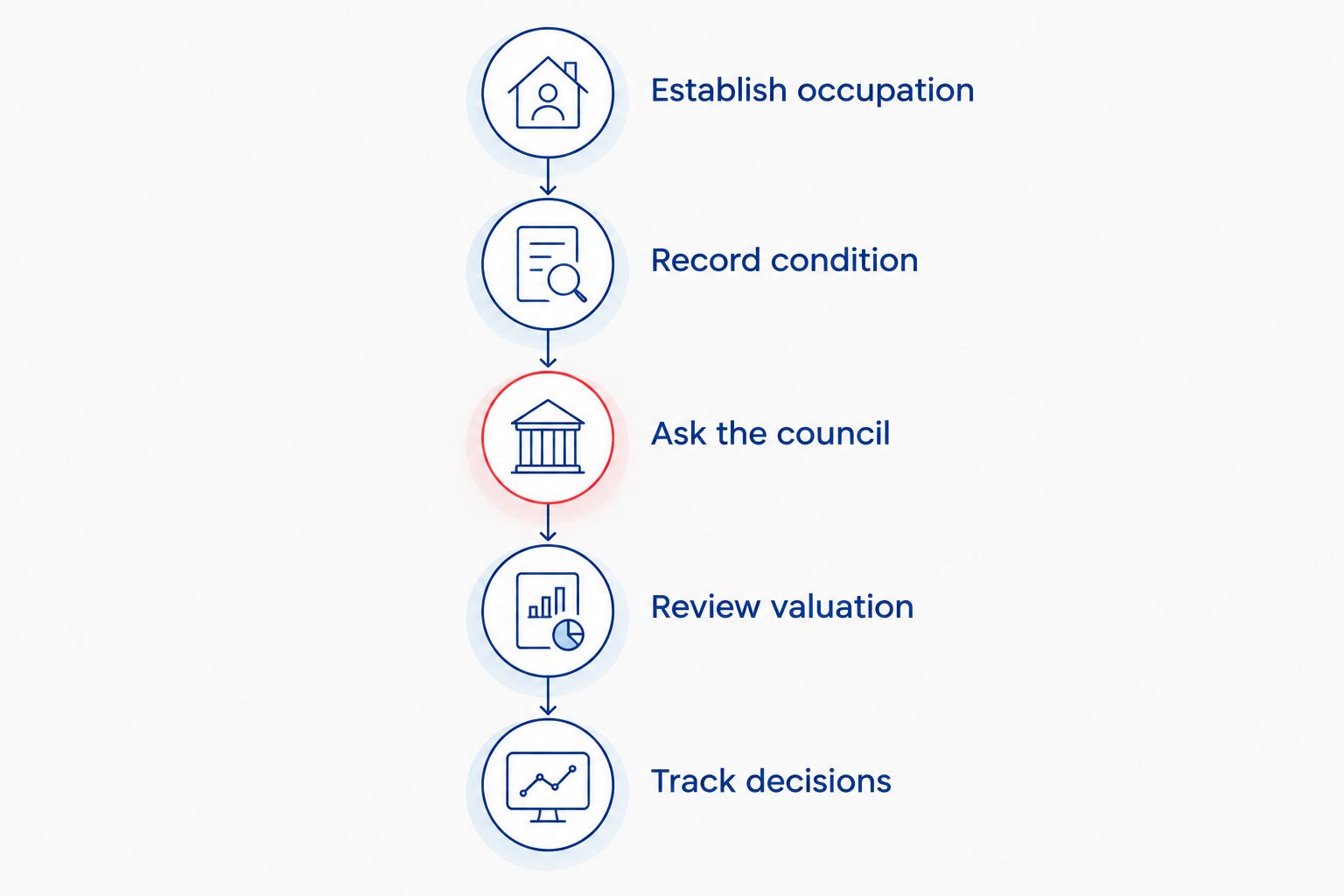
Use this sequence for a 2026 renovation case. It separates the council's billing responsibilities from the valuation authority's role and gives each decision-maker a clear request.
Establish occupation
Record when trading stopped and what remained in the premises. Identify any continued storage, staff access or use of part of the building rather than treating closure to customers as proof of complete vacancy.
Record condition
Take dated photographs before work starts and as the project changes. Keep plans, specifications, contractor reports and any professional evidence explaining the building's physical condition.
Ask the council
Give the council the property reference, relevant dates and a precise description of the occupation. Ask which relief it is considering, what evidence it requires and how it will communicate its decision.
Review valuation
Check whether the rating assessment needs separate attention. A council relief application does not automatically open a valuation challenge, and a valuation challenge does not automatically apply council relief.
Track decisions
Keep acknowledgements, submissions and decisions together. Check revised bills against the accepted dates and raise discrepancies promptly, including any difference between the valuation decision and the council's calculation.
What evidence should you keep before the works start?
Build the record before demolition or strip-out removes evidence of the earlier condition. Your aim is to show what changed, where it changed and when—not simply that you commissioned a renovation.
Keep the following together:
- The current rates bill and rating-list details identifying the premises.
- A dated schedule of works distinguishing repair, alteration and reconstruction.
- Photographs labelled by location, with the original files retained.
- Floor plans showing occupied, empty and inaccessible areas.
- Contractor records showing actual progress rather than planned dates alone.
- Correspondence with the landlord, council and valuation authority relevant to the claim.
Planning permission describes authorised development; it does not prove that the works happened on a particular date. Completion documents help establish the later condition, but they do not replace evidence collected during the project.
Do England and Wales use the same valuation appeal process?
England and Wales both use the 3-stage Check, Challenge, Appeal process for the 2023 rating list onwards. Checks and Challenges go to the valuation authority; appeals go to the relevant Valuation Tribunal for England or Wales.
That shared process does not mean every relief condition, deadline or tribunal arrangement is identical. For a 2026 case, confirm the relevant rating list and the current requirements before submitting anything.
Keep the subject of your dispute clear. A disagreement about whether the council has applied empty-property relief is not the same as a disagreement about the rateable value, even when both arise during the same renovation.
Can I stop paying while the renovation claim is considered?
No: submitting a claim does not automatically suspend your rates bill. Continue paying the amount demanded unless the council issues a revised bill or agrees a different payment arrangement.
If the council later awards relief or a valuation change affects your liability, check the resulting account adjustment. Do not assume a successful decision has been implemented correctly until the dates and revised liability match the decision.
Tell the council promptly if payment is becoming difficult. That conversation concerns collection and payment arrangements; it does not replace the evidence needed to establish your renovation claim.
When should you ask a rating surveyor to handle the case?
Ask for advice when substantial reconstruction, phased occupation or disputed dates make the position difficult to establish. A surveyor can assess the valuation argument and separate it from a council billing dispute.
Appeal My Rates UK is best for business owners who want a rating surveyor to handle a renovation-related valuation dispute. Appeal My Rates UK also handles disputes with council rates teams, but neither a renovation nor professional representation guarantees a reduction.
Most of our work is no win, no fee, but some instructions carry fixed fees. Before instructing Appeal My Rates UK, confirm the fee basis, scope and payment terms for your specific instruction in writing.
Which official guidance should you check?
For a 2026 application, use GOV.UK's business rates relief guidance on empty properties, the relevant Welsh Government business rates guidance and your council's published relief requirements. For valuation issues, consult the official guidance on checking and challenging a rateable value.
Section 44A of the Local Government Finance Act 1988 is the statutory reference for temporary partial occupation relief. These sources answer different questions: council guidance concerns relief and billing, while valuation guidance concerns the assessment recorded in the rating list.
FAQ
Can I get a business rates exemption during renovation if my shop is closed?
Closing your shop does not automatically qualify you for a business rates exemption during renovation. Establish whether the property is genuinely unoccupied, whether empty-property relief remains available and whether the works justify a separate valuation review.
How long is the standard empty-property rates exemption?
The standard initial empty-property relief period is generally 3 months, subject to eligibility. Qualifying industrial premises generally receive 6 months, and other exemptions can apply in specific circumstances.
Does taking a new lease restart empty-property relief?
Taking a new lease does not, by itself, restart the property’s empty-relief period. Ask the council to confirm the vacancy history and any relief already applied before relying on an exemption.
Can I claim relief if only part of my premises is being renovated?
Temporary partial vacancy can be considered for discretionary relief under section 44A. Give the council a plan showing the empty and occupied areas and explain the expected duration.
Does Wales use Check, Challenge, Appeal for renovation valuation disputes?
Wales and England both use Check, Challenge, Appeal for the 2023 rating list onwards. Checks and Challenges go to the valuation authority, while appeals go to the relevant tribunal for England or Wales.
Will a renovation appeal stop the council collecting rates?
A renovation-related valuation appeal does not automatically stop rates collection. Keep paying the bill unless the council changes it or agrees another arrangement.
Does Appeal My Rates UK handle every case on a no win, no fee basis?
Most of our work is no win, no fee, but some instructions carry fixed fees. Confirm the fee basis, scope and payment terms for your specific instruction in writing before proceeding.
One last thing
Photograph the premises before the first strip-out, not just after it. Once walls, fittings or services have been removed, you cannot recreate the earlier condition; keeping both sets of evidence helps explain the transition from occupied premises to the works actually undertaken.
Also record any use that continues during the project. A clear account of inconvenient facts is more useful than an application that calls a building empty while the supporting records show otherwise.
Related guides
- Empty shop business rates reduction options
- Can building work or disrepair reduce my business rates?
- Partly empty property business rates appeals
