

No. You cannot stop paying business rates simply because you have started an appeal in England or Wales in 2026; keep paying the current bill unless the council issues a revised demand or confirms a different payment arrangement. An appeal does not automatically suspend collection, and withholding payments can lead to recovery action and additional costs.
- Can I stop paying business rates during an appeal? No: a valuation challenge does not suspend your current bill.
- England and Wales both use Check, Challenge, Appeal for current business rates valuation disputes.
- Ask the council about payment difficulties separately from your valuation challenge, and obtain any agreement in writing.
- Appeal My Rates UK handles business rates valuation challenges and disputes with council rates teams.
Can I stop paying business rates during an appeal?
Starting a business rates appeal does not give you permission to stop paying. The council continues to collect against the bill currently in force while the valuation dispute follows its own process. Paying that bill does not mean you accept the valuation or abandon your challenge.
Keep 2 separate questions in view: whether the property's valuation is correct, and what you must pay under the current demand. The valuation authority deals with the first; your council's business rates team deals with billing and collection. A message to one does not automatically resolve the other.
The 2026 business rates appeals guide explains the wider challenge process. For payments, follow the latest council demand unless the council changes it or agrees alternative terms.
| Approach | Best for | What it achieves | Limitation or risk |
|---|---|---|---|
| Continue scheduled payments while challenging | Ratepayers who can maintain their instalments | Keeps payments aligned with the current demand while the dispute continues | Does not provide immediate cash-flow relief |
| Request a council payment arrangement | Ratepayers struggling to meet the current schedule | Gives the council an opportunity to consider alternative payment terms | Requires agreement; submitting a request does not change the bill |
| Stop paying without agreement | Not recommended as an appeal strategy | Does not advance the valuation challenge | Creates arrears and exposes the account to recovery action |
Why this matters
A valuation challenge and an unpaid rates account can run alongside each other. Evidence that your rateable value is wrong does not, by itself, prevent the council pursuing missed instalments.
This distinction matters when you are budgeting for 2026. An expected reduction is not money you can already treat as available: the outcome, effective date and resulting account adjustment still need to be established.
Your practical aim is to protect both positions. Keep the valuation challenge moving, while dealing directly with the council about the current bill and any payment difficulty. Do not let a promising appeal become a reason to ignore a separate collection problem.
What should I do before my next instalment is due?
Use this sequence before deciding to change a payment. You need a clear record of what is due, what you dispute and what the council has actually agreed.
- Read the current demand. Check the property, named ratepayer, billing period, instalment dates and outstanding balance. Separate a disagreement about valuation from an apparent error in the council's account.
- Identify the dispute. Write down whether you are questioning the rateable value, liability dates, occupation details, relief or the payment record. Different issues need different evidence and decision-makers.
- Contact the council. Explain any difficulty meeting the next instalment and ask what arrangements it will consider. Include your rates account reference and the relevant dates.
- Keep paying as required. A request awaiting a response is not an agreed variation. Do not cancel a direct debit solely because an appeal or payment request is pending.
- Obtain written confirmation. If the council agrees different terms, check the amounts, due dates and treatment of any existing arrears. Retain the confirmation with your rates records.
Record the date, name and substance of any telephone discussion. If the answer is unclear, ask the council to confirm whether the original payment schedule remains in force rather than interpreting silence as approval.
Does Check, Challenge, Appeal change the payment rule?
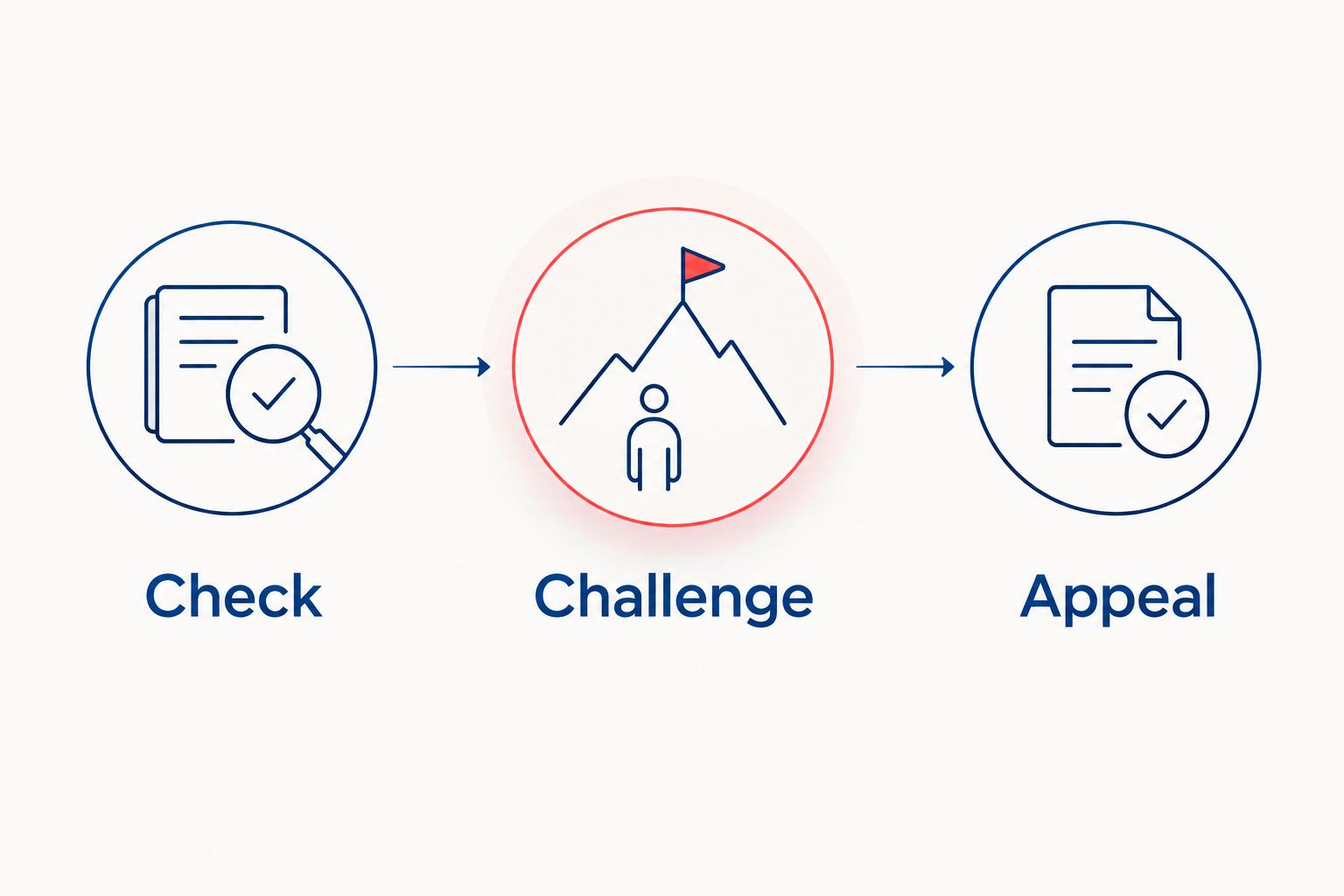
None of the 3 stages—Check, Challenge and Appeal—automatically suspends your business rates payments. The stages concern the valuation dispute, not permission to withhold the council's bill.
England and Wales both use Check, Challenge, Appeal for current valuation challenges in 2026. Wales adopted the process on 1 April 2023, as confirmed in GOV.UK's background information on non-domestic rating challenges and changes. There is no separate current Welsh proposal-based route to use instead.
- Check: Establish the property facts and address inaccuracies through the valuation authority's process. Keep your council payment schedule separate from this work.
- Challenge: Present the grounds and supporting evidence for changing the valuation. Submitting that evidence does not amend the council's demand.
- Appeal: Where the rules allow, take the dispute to the relevant Valuation Tribunal for England or Wales. A tribunal appeal is not an automatic collection hold.
The valuation authority handles Checks and Challenges in both countries. Appeals go to the relevant tribunal; that shared framework does not mean every relief, billing rule or procedural deadline is identical across England and Wales.
Why your payment position varies
The appeal itself does not create a payment holiday. Differences between accounts arise from the bill, the account history and any decision or agreement affecting payment.
- The current demand: A newly issued bill can replace an earlier payment schedule. Check which demand is operative before relying on an old instalment amount.
- An agreed arrangement: A council-confirmed arrangement can change how payments are scheduled. Ask whether it covers only new instalments or also existing arrears.
- An awarded relief or exemption: Eligibility arguments do not change the account by themselves. Check that the council has made its decision and applied the resulting adjustment.
- A revised valuation: A confirmed valuation change can require the council to recalculate liability for the applicable period. Check the effective date rather than assuming it covers every bill.
- Existing recovery action: A payment request does not automatically withdraw a reminder, summons or other recovery step. Ask the council specifically what happens to action already under way.
For a 2026 account, read those documents together rather than relying on a single appeal acknowledgement. The key evidence is the latest bill, any written payment agreement and the decisions that affect liability.
What if I cannot afford to keep paying during the appeal?
Contact the council's business rates team before missing the payment. Explain the cash-flow problem, identify the next due date and ask it to consider an arrangement you can realistically maintain. A pending valuation challenge is useful context, not a substitute for that request.
Give the council a clear account of your position. Explain whether the difficulty is temporary, what you can pay and when, and whether arrears already exist. Do not promise a payment schedule that depends entirely on winning the appeal.
Ask for a written answer covering:
- The payments and dates the council accepts.
- Whether the arrangement includes existing arrears.
- What happens to any recovery action already started.
- What you should do if your circumstances change again.
You can also ask the council to check relevant relief or support eligibility. That is a separate assessment: neither a relief application nor a request for time to pay automatically replaces the current demand.
What happens if I have already stopped paying?
Deal with the arrears immediately, even if your valuation challenge is strong. Read every council notice and identify the next response or payment date. Do not assume a surveyor's involvement means the council has paused collection.
Contact the business rates team with your account reference and ask for the current balance, the recovery stage and the action needed now. If you dispute part of the account, describe that part precisely rather than treating the entire demand as cancelled.
Non-payment can lead to a summons, a liability order and further enforcement, with additional costs. Do not assume a later valuation reduction will cancel every recovery cost already incurred; ask the council to explain the position on your account.
Keep copies of payments, correspondence and notices in 1 written record. If a deadline is close, tell your adviser about it immediately and obtain advice on the notice itself, not just the underlying valuation dispute.
Will I get money back if the appeal succeeds?
A successful appeal can produce an account credit or refund where the revised liability shows an overpayment. The council must apply the valuation change to the relevant period and reconcile the account before the amount due back is clear.
A reduction in rateable value is not automatically the same amount as a reduction in your bill. The council's calculation must reflect the applicable billing period and other relevant features of the account, including relief and payments already recorded.
When an amended demand arrives, check:
- The property and ratepayer details.
- The effective date of the change.
- The periods recalculated and payments credited.
- Any outstanding balance, credit or refund instructions.
Do not spend an expected refund before the council confirms it. If the recalculation is unclear, request a breakdown that connects the valuation decision to the revised liability and account balance.
How Appeal My Rates UK can help
Appeal My Rates UK is suited to business owners in England and Wales who need professional rating surveyors for valuation challenges and council rates disputes. The firm also handles property splits and mergers, where the property assessment itself needs attention.
Professional help addresses the evidence, process and dispute; it does not create a payment holiday or guarantee a reduction. Keep the council's payment requirements visible throughout the instruction, especially if reminders or recovery notices have already arrived.
From Appeal My Rates UK: Most of our work is no win, no fee, but some instructions carry fixed fees. Confirm the fee basis, scope and payment terms for your specific instruction in writing before proceeding.
When you contact us, provide the current bill, property details, appeal correspondence and any recovery notices. Explain whether you need help with valuation, council billing, or both, so the instruction addresses the actual problem.
FAQ
Can I stop paying business rates during an appeal in 2026?
No. A business rates valuation appeal does not automatically suspend payment in England or Wales in 2026. Continue paying under the current demand unless the council issues a revised bill or confirms a different arrangement.
Does paying my business rates mean I accept the valuation?
No. Paying the current demand does not, by itself, mean you accept the valuation or abandon a valid challenge. Payment and the valuation dispute are separate matters.
Can the council recover unpaid rates while my appeal is pending?
Yes. A pending valuation challenge does not automatically prevent the council recovering unpaid business rates. Contact the council about arrears and obtain written confirmation of any agreed arrangement.
Can I cancel my direct debit once a surveyor takes my case?
Do not cancel your direct debit solely because a surveyor has taken your case. Appointing a representative does not change the council’s demand or payment schedule.
Do England and Wales use the same current valuation appeal process?
England and Wales both use Check, Challenge, Appeal for current business rates valuation disputes. The valuation authority handles Checks and Challenges, with appeals going to the relevant Valuation Tribunal for England or Wales.
Will winning my appeal automatically produce a refund?
A successful appeal produces a refund or credit only where the recalculated account shows an overpayment. Check the effective date, revised bill and account balance before assuming money is due back.
Can Appeal My Rates UK help with both an appeal and a council dispute?
Appeal My Rates UK handles business rates valuation challenges and disputes with council rates teams. Most of our work is no win, no fee, but some instructions carry fixed fees. Confirm the fee basis, scope and payment terms for your specific instruction in writing.
One last thing
An appeal acknowledgement is not a payment instruction. Before changing any payment in 2026, identify the council document or written agreement that authorises the change.
If you cannot point to one, contact the council rather than assuming the appeal protects you. That check keeps the valuation argument separate from an avoidable arrears problem.
Related guides
- Can I claim business rates relief and appeal at the same time?
- Can I still appeal after paying my business rates bill in full?
- Refund after a successful business rates appeal