

Yes, splitting a property can reduce business rates, but separate assessments do not automatically produce a lower combined bill. The outcome depends on the property's layout, actual occupation, valuation and relief eligibility; you must also account for professional fees and any costs of changing the premises.
- Can splitting a property reduce business rates? Yes, but compare the combined liability, not just each new rateable value.
- Separate occupation and usable boundaries matter more than adding a partition or changing a property address.
- England and Wales both use Check, Challenge, Appeal for current valuation disputes.
- Appeal My Rates UK helps business owners with property splits, valuation challenges and council rates disputes.
Can splitting a property reduce my business rates bill?
A property split reduces your business rates bill only when the resulting assessments and applicable reliefs produce a lower liability. Creating smaller units is not, by itself, evidence of a saving. Compare the total bill for every resulting assessment before deciding that a split is beneficial.
For a 2026 review, separate the question of how the property should be assessed from the question of how much you will pay. The valuation authority determines the rating assessment; the council calculates and collects the bill, including applicable reliefs. For disputed assessments, see how Check, Challenge, Appeal applies to property splits.
| Situation | Best for | Potential benefit | Limitation or risk |
|---|---|---|---|
| Genuinely separate units with distinct occupiers | Reviewing an assessment that no longer reflects occupation | Separate assessments can reflect the actual units | The combined liability is not necessarily lower |
| One business dividing its own workspace | Checking whether the rating assessment matches the premises | A review can identify an assessment error | Internal partitions alone do not establish separate rateable properties |
| Part of a building becomes vacant | Reviewing liability and possible relief on unused space | The circumstances can support a separate relief enquiry | Vacancy alone does not guarantee a split or relief |
| A proposed subdivision before building work | Testing the rates implications before committing | You can compare the likely liabilities and evidence needed | Estimates do not guarantee the final assessment or council bill |
These are assessment scenarios, not interchangeable ways to claim a discount. Start with the facts of occupation, then consider the financial result.
Why this matters
A smaller rateable value on your retained space can look attractive while concealing a separate bill elsewhere in the building. A landlord, tenant or other liable party still needs to understand who pays for each part and from what date.
Your 2026 decision should therefore consider the whole property arrangement. A split that accurately records separate occupation can be necessary even when it does not save money; a proposed split that exists only on paper is not a sound basis for budgeting.
Appeal My Rates UK is best suited to business owners who need professional help with property splits and business rates disputes. Its role is to examine the assessment and handle the case, not to promise that subdivision always reduces liability.
What makes a property split relevant for business rates?
Business rates follow the rateable property and its occupation, not simply the postal address or ownership boundary. A lease, floor plan or separate entrance provides evidence, but no single document settles every case.
The assessment needs to reflect how the premises are occupied and function. Relevant questions include:
- Who occupies and controls each part of the building?
- Can each area function as a separate unit?
- How do occupiers reach their premises and use shared areas?
- Do the documents match what happens on site?
- When did the physical layout or occupation change?
Separate occupiers in the same building
A genuine letting of part of a building makes separate assessment a question worth examining. Supply the occupation agreement, a clear plan and evidence of when the occupier took possession. Explain any shared access, facilities or retained areas rather than leaving the authority to infer the arrangement.
The benefit is an assessment that reflects the actual occupation. The drawback is that creating separate entries does not establish that anyone's total liability will fall.
The same business using divided areas
Do not assume that separate rooms or departments need separate assessments. Where the same business occupies adjoining areas, their relationship and the applicable rating rules matter.
A partition can help describe the layout without changing the rating outcome. Get the assessment position checked before treating building work as a business rates saving.
An unused area within occupied premises
Empty space raises a different question from separate occupation. You need to establish whether the area remains within the occupied assessment, whether separate assessment is justified, and whether any relief applies.
Treat those as distinct enquiries. Calling a room unused does not establish a separate property, and a separate empty assessment does not automatically remove liability.
Why the outcome of a property split varies
There is no standard reduction for splitting commercial premises. The result depends on the property evidence and the billing position, rather than a fixed percentage saving.
- Actual occupation: The identity of each occupier and the extent of their control help establish what should be assessed.
- Physical arrangement: Access, boundaries and the relationship between areas affect how the premises are considered.
- Valuation evidence: Each resulting assessment needs an appropriate valuation; dividing floor area does not necessarily divide rateable value proportionately.
- Relief eligibility: Smaller assessments do not automatically qualify for small business rate relief, particularly where an occupier has other properties.
- Effective date: The date a change takes effect determines which period needs revised assessments and bills.
- Country and billing rules: England and Wales share the current valuation dispute process, but that does not make all relief and billing provisions identical.
For a 2026 proposal, ask for the valuation reasoning and the relief assumptions separately. That makes it easier to identify a saving that depends entirely on relief you have not yet established.
How do I check whether a split will reduce my bill?
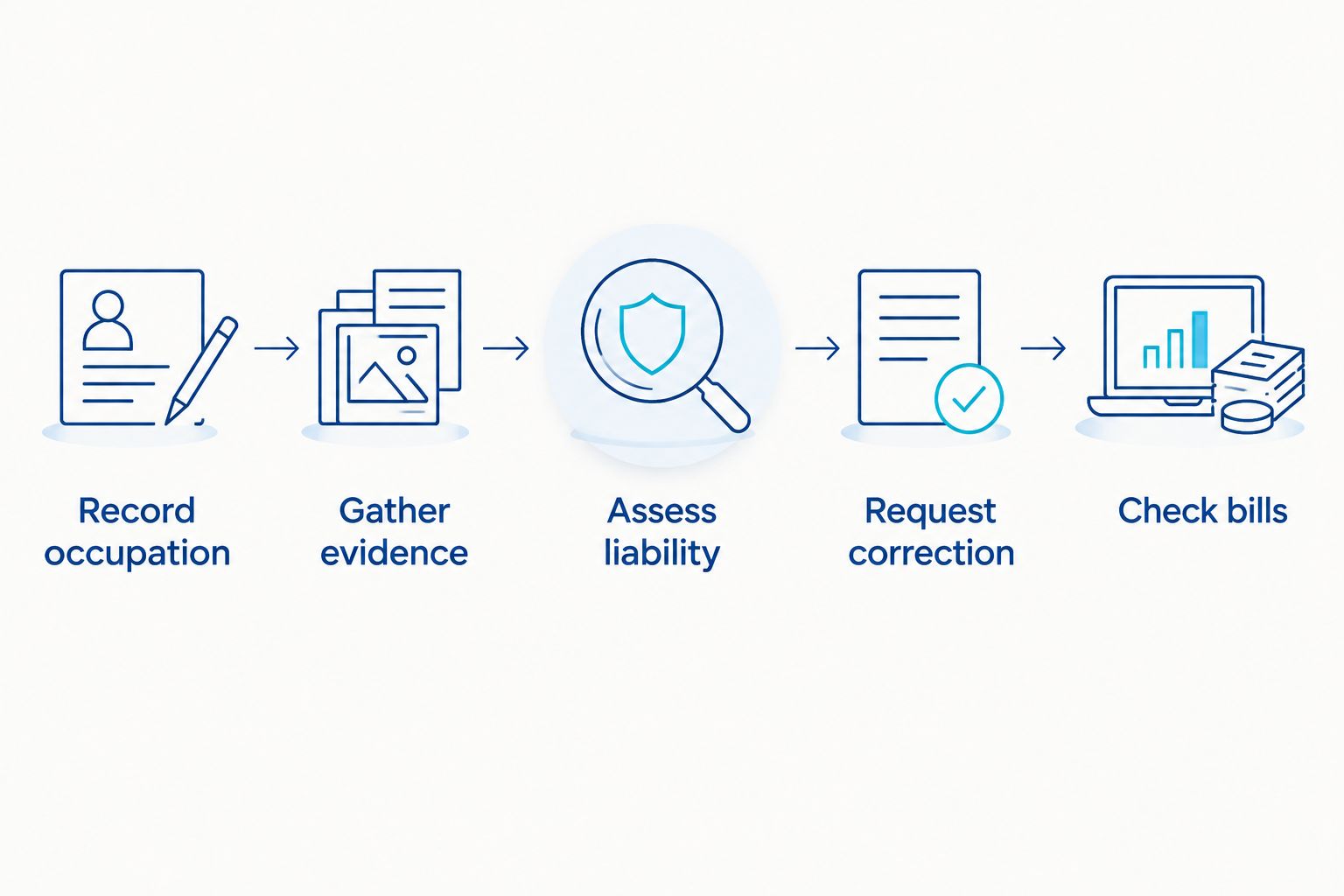
Use the following sequence before submitting a case or committing to alterations. It keeps the property evidence, valuation question and council billing work connected without treating them as the same decision.
- Record occupation. Identify every occupied and vacant area, the occupier responsible for it and the date the arrangement began. Distinguish the intended layout from the layout already in use.
- Gather evidence. Collect current bills, assessment details, plans, leases, licences and dated photographs. Explain shared areas and mark boundaries clearly.
- Assess liability. Compare the current bill with the combined position for the proposed assessments. Include relief conditions, responsibility for empty areas and professional fees.
- Request correction. Report the relevant property change or pursue the appropriate valuation dispute route. Make the requested change and supporting dates clear.
- Check bills. Review the council's revised demands against the assessment decision, liable parties, effective dates and relief position. Do not assume an assessment change resolves every billing issue.
Keep copies of submissions and decisions together. A clear record helps you explain why the assessment should change and check whether the revised bills reflect that decision.
What should a useful comparison include?
Ask for a written comparison of the existing and proposed position. It should identify the assessments involved, who is expected to pay each bill, the relevant dates and the assumptions behind any relief claim.
Do not compare only your retained unit with the original whole-property bill. Include the liability for the other space, especially if you will remain responsible for it while it is empty. Separate genuine reductions from costs merely transferred to another occupier.
Do England and Wales use the same appeal process?
England and Wales both use the 3-stage Check, Challenge, Appeal process for current valuation disputes. Checks and Challenges are handled by the valuation authority; appeals go to the relevant Valuation Tribunal for England or Wales.
Government background information on non-domestic rating challenges confirms that Wales adopted CCA on 1 April 2023. That establishes the shared process for the rating lists covered by that guidance; it does not establish identical relief rules or tribunal arrangements.
For a 2026 property split, distinguish reporting a factual property change from disputing a valuation decision. Your evidence should explain the layout, occupation and effective date, while any valuation dispute must follow the applicable procedure. Check the relevant list and deadlines before submitting rather than assuming every historic assessment remains open.
Will smaller units qualify for small business rate relief?
Smaller units do not automatically qualify for small business rate relief. Eligibility depends on the applicable rules, including the occupier's circumstances and other property interests, not simply on the fact that a building has been subdivided.
Check the council's current requirements for the country where the property sits. Do not apply an English relief assumption to a Welsh property, or treat every new assessment as an independent entitlement for the same business.
A useful 2026 calculation shows the liability both with and without any relief that still needs confirmation. That exposes the financial risk before you rely on the proposed saving.
Should I split the property before asking for advice?
Check the rating implications before making changes solely to reduce business rates. Physical alterations, occupation agreements and the resulting assessments need to describe the same arrangement.
If you already have separate occupiers, focus on documenting the existing position accurately. If the split is only proposed, ask what evidence would support separate assessment and what liabilities would remain if the expected relief did not apply.
Professional advice also has a cost and needs a defined scope. Appeal My Rates UK provides business rates surveyor services for property splits and council disputes: Most of our work is no win, no fee, but some instructions carry fixed fees. Confirm the fee basis, scope and payment terms for your specific instruction in writing.
You can contact us to discuss the property arrangement and the issue you need handled. Explain whether you need a valuation review, a split recorded, a council billing dispute addressed, or advice covering more than one of those tasks.
FAQ
Can splitting a property reduce business rates if I still occupy the whole building?
A split does not guarantee lower business rates when you still occupy the whole building. The assessment depends on the layout, occupation and applicable rating rules, not simply on dividing rooms or departments.
Will adding a separate entrance give me a separate business rates assessment?
A separate entrance alone does not establish a separate business rates assessment. It is evidence of the layout, but occupation, control and the relationship between the areas also matter.
Can I stop paying business rates while a property split is being reviewed?
A property split review does not suspend your existing business rates bill. Continue paying as billed unless the council confirms a different payment arrangement or issues a revised demand.
Does subletting part of my premises automatically reduce my bill?
Subletting does not automatically reduce your business rates bill. The occupation arrangement needs assessment, and any resulting separate liabilities must be checked alongside your retained bill.
Can a property split increase the total business rates payable?
Yes, a property split can leave a higher combined liability. Review all resulting assessments and relief eligibility rather than assuming that smaller units mean a smaller total bill.
Is the property split appeal route different in Wales?
England and Wales both use Check, Challenge, Appeal for current valuation disputes. Checks and Challenges go through the valuation authority, while appeals go to the relevant Valuation Tribunal for England or Wales.
Does Appeal My Rates UK handle every property split on no win, no fee terms?
Most of our work is no win, no fee, but some instructions carry fixed fees. Confirm the fee basis, scope and payment terms for your specific property split instruction in writing.
One last thing
A lower bill for your retained space is not proof that the split saved money. Before approving a 2026 proposal, ask where the rest of the liability goes and who pays it while any new unit remains empty.
That question separates a genuine reduction from a redistribution of the bill. Keep the answer alongside the proposed assessments and written fee terms before deciding to proceed.
Related guides
- How subletting part of your property affects business rates
- Land Registry plans as evidence for a property split
- Claiming business rates relief while appealing