

Instead of relying on a Land Registry plan alone to support a business rates property split appeal, use it to identify the legal boundary, then match it to the actual layout and occupation of each part. A title plan shows the extent of a registered title; it does not, by itself, prove that the Valuation Office Agency (VOA) should assess the space as separate properties.
- For a business rates property split appeal, use the Land Registry title plan to establish the registered boundary, not to prove separate occupation.
- Match the title plan with a dated floor plan and evidence showing who occupies each area.
- Appeal My Rates UK is best for owners who want a rating surveyor to assess a split before approaching the VOA.
- In 2026, England and Wales both use the Check, Challenge, Appeal process; confirm the current instructions and deadlines before submitting evidence.
Why this matters
Land Registry and the VOA answer different questions. HM Land Registry records legal interests in land. The VOA decides what should appear in the business rates list and assesses its rateable value. A line on a title plan is not automatically a line between business rates assessments.
That distinction matters when one building contains separate occupiers, or when an owner has divided space but the rating list still shows one entry. It also matters in reverse: separate titles do not necessarily mean separate business rates assessments. In 2026, your evidence needs to explain the physical layout, access and occupation, not simply point to a boundary.
If alterations form part of your case, check whether planning records support the business rates reassessment. A planning drawing can show what was proposed; your dated evidence must still establish what exists and how the property is used.
Before you start
- Get the correct property records. Have the address, postcode and any title numbers you already hold. Obtain the title register and title plan for the relevant registered land; check whether a lease plan covers the part in question.
- Gather current evidence of the split. Use a dated floor plan, photographs of access and separating features, and records identifying who occupies each area. Mark the same areas consistently across documents.
- Check who can act and which route applies. Confirm your interest in the property, the existing business rates entries and whether the property is in England or Wales. Wales adopted the same Check, Challenge, Appeal process on 1 April 2023; confirm the current instructions before submitting.
The gotcha: a title plan usually shows general boundaries, not the precise internal division of rooms or units. If the claimed split is inside one registered title, secure a floor plan showing that division before you start the rating case.
Identify the Land Registry records
- Open HM Land Registry's Search for land and property information service and search for the property. Match the result to the address and land you mean to discuss; neighbouring titles and multi-unit sites make an address-only match unreliable.
- Obtain the title register and title plan for the relevant title. Read them together. The plan depicts the registered extent, while the register identifies the title and recorded interests.
- Check whether a lease plan is available for an occupier's part. If you have a lease, inspect its attached plan rather than assuming the freehold title plan identifies the leased area.
- Save the copies you intend to use and record which title and document each file represents. Keep an unchanged copy, then make a separate annotated version for the case.
Expected result: you can identify the land covered by each record and explain whether the proposed business rates split follows a title boundary, a leased area or an internal division that the title plan does not show.
A title plan is useful evidence because it fixes the extent of a registered title in context. Its limitation is equally important: it is not a measured floor plan. Do not draw a precise internal boundary from the thickness of a line on it.
Map the proposed split to the building
- Put the title plan beside a current floor plan. On the floor plan, label the existing business rates assessment and the areas you say should be assessed separately.
- Mark entrances, shared corridors, connecting doors and any physical separation. Where part of the property is on another floor, include that floor rather than projecting the ground-floor boundary upwards.
- Identify the occupier and use of each area, with the dates relevant to your case. Separate legal ownership from actual occupation in your notes; they are not the same question.
- Add dated photographs that show the features marked on the floor plan. Give each photograph a location label so someone unfamiliar with the building can find it on the drawing.
Expected result: another reader can follow each proposed assessment from the title plan to the floor plan, then see the corresponding physical and occupation evidence. If that chain breaks, correct the drawings or gather the missing evidence before submitting.
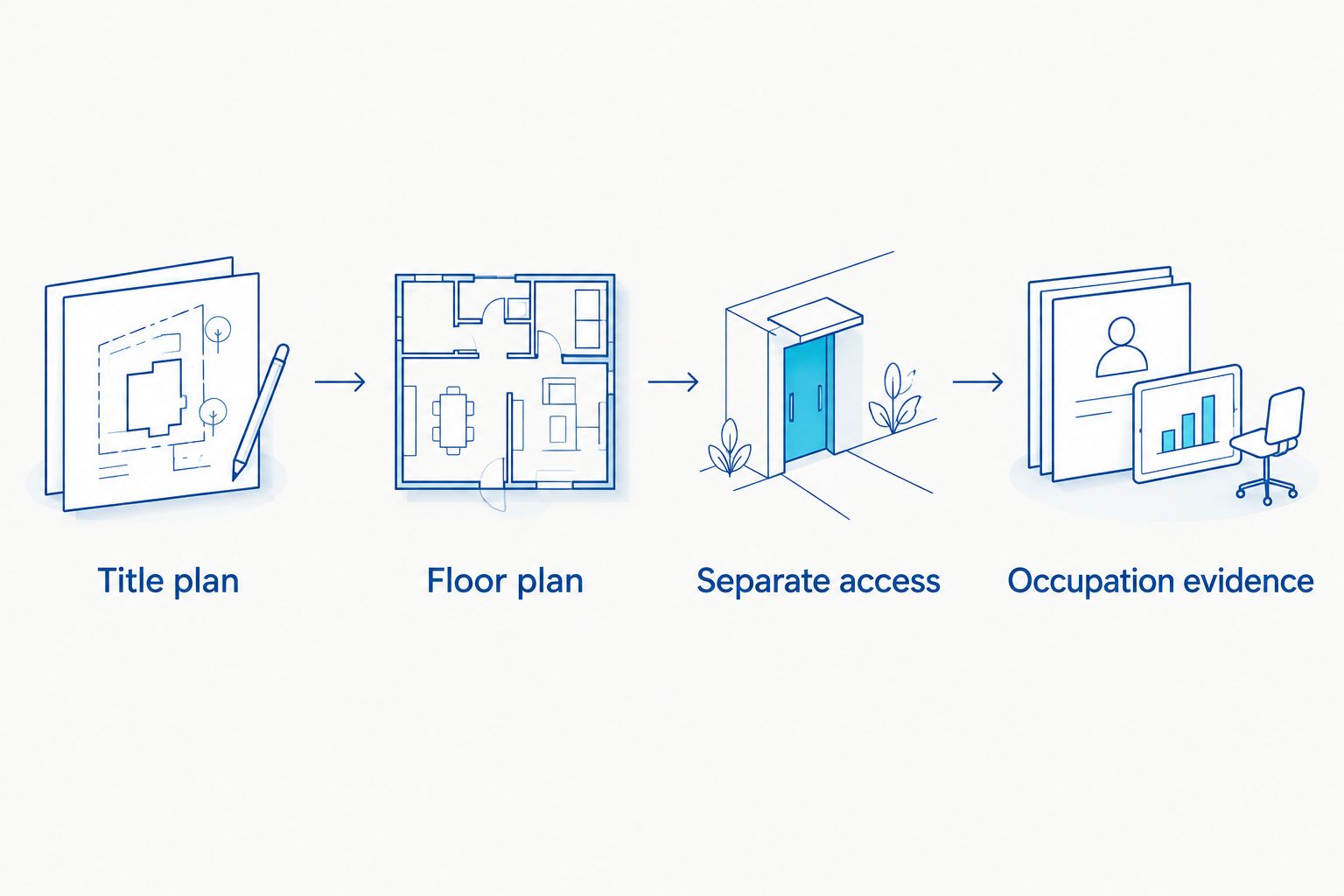
Which plan proves which point?
| Evidence | Best for | What it does not establish alone |
|---|---|---|
| Land Registry title plan | Showing the registered land in context | Exact internal layout or a separate business rates assessment |
| Lease plan | Identifying an area described in a lease | That the area is occupied as a separate rating property |
| Current floor plan | Showing the building's present layout and proposed dividing line | Who occupies each area or when a change happened |
| Dated photographs and occupation records | Showing physical features and use at relevant dates | The legal extent of a registered title |
Use the plans together, not as substitutes. A lease plan can identify the space granted to a tenant but still leave questions about shared access or occupation. A current floor plan can show a partition that an older title plan could never show, but it needs a date and supporting evidence. Neither an apparent boundary nor an empty area guarantees a split; an appeal involving partly empty property raises its own evidence questions.
Check the rating list and prepare the case
- Use the VOA's Find a business rates valuation service to locate the current rating-list entry or entries. Check the addresses and descriptions against the areas on your annotated floor plan.
- Write a short statement of the change you seek: which existing assessment covers the space, which areas you say should be separate, and the date from which you say the relevant facts apply. Do not present that date as established unless your records support it.
- Attach a document schedule. For each plan, photograph or occupation record, state what it shows and where it connects to the proposed split. If a plan describes an earlier layout, say so plainly.
- Confirm the procedure for the property's jurisdiction before submitting. In England, follow the applicable VOA Check, Challenge and Appeal stages and their requirements. Wales adopted the same Check, Challenge, Appeal sequence on 1 April 2023, so a Welsh property follows the same stages under the current rating list.
Expected result: your submission identifies the existing assessment, the exact change requested and the evidence for the property's condition and occupation. The VOA Check, Challenge, Appeal guide for 2026 explains the stages in more detail.
Do not treat a corrected Land Registry record as a completed rating appeal. The VOA's rating list is a separate record. Equally, a VOA decision about a split does not redraw a Land Registry title boundary. Keep the records distinct in correspondence so the issue you want resolved stays clear.
Submit a consistent evidence pack
- Name each file by its contents, such as title plan, current floor plan or dated entrance photograph. Use the same area labels in the statement, drawings and photograph schedule.
- State what each Land Registry document supports. If the split is entirely inside one title, explain that the title plan establishes the outer boundary only; point to the floor plan for the internal division.
- Check the dates on every document against your account of the change. If a lease began before a partition was built, do not use the lease date as proof that the physical layout already existed.
- Keep a copy of the submission and any acknowledgement. Respond to requests for clarification by referring to the relevant labelled area and document, not by sending an unexplained replacement drawing.
Expected result: the person reviewing the case can trace your requested change without guessing which line, entrance or occupier you mean. That is more useful than sending a larger bundle of unlabelled plans.
Appeal My Rates UK is best for business owners in England and Wales who need a rating surveyor to assess whether the evidence supports a property split. A review is particularly useful when the title, lease and occupied layout point to different boundaries. Appeal My Rates UK can handle the case, but a split or reduction cannot be promised from a plan alone.
Get your split case reviewed
Ask a rating surveyor to assess your plans, occupation evidence and next step.
When separate titles are later merged
The same method works in reverse when you believe entries should be considered together, but two titles are not proof that two business rates assessments must remain. Start with the current rating-list entries, then map the title boundaries, physical connections and occupation. State whether you want separate entries reconsidered, rather than describing the case as a split.
Check the dates of any building work and changes in occupation. A Land Registry title change, a lease change and a physical change can occur at different times. Keep each event on its own line in your chronology, with the record that supports it. Appeal My Rates UK handles property splits and mergers; the evidence must still address the actual property and the change requested in 2026.
Troubleshooting
The title plan shows one title, but the building has separate units
Use the title plan to establish the outer extent. Add a dated floor plan showing the internal division, access and occupiers. Do not mark an internal unit boundary on the title plan as though HM Land Registry recorded it.
The lease plan and current floor plan disagree
Identify when each plan was made and what each was intended to show. Explain changes in the building with dated photographs or other records. An older lease plan should not be presented as a drawing of the building's current condition.
The rating-list address does not match the title description
Match the property by location, extent and current rating-list entry before you submit. Set out the address discrepancy in your statement and label the plans so the VOA can see which assessed space you mean.
There is shared access between the proposed parts
Show the shared route and each occupier's access on the floor plan. Do not erase a corridor or connecting door to make a split look simpler. The reviewing officer needs the real arrangement.
You cannot establish when the split took effect
Separate what the current layout proves from what you can prove about an earlier date. Gather dated occupation records, plans and photographs before claiming a date. Do not infer it solely from registration of a title or the start of a lease.
Customize your evidence pack
For a multi-floor property, prepare a plan for every affected floor and show how people move between them. For a split based on occupation, add a clear record of who uses each area. For a case involving building work, keep the proposed drawings apart from drawings and photographs of the completed layout.
If a landlord holds the lease or title documents you need, request the relevant records early. The question of telling your landlord about a business rates appeal is separate from whether a title plan proves your case. Check your own lease and instructions before sharing documents or making statements on another party's behalf.
When instructing Appeal My Rates UK, ask for the scope, fee basis and payment terms for your specific case in writing. Most of our work is no win, no fee, but some instructions carry fixed fees. That distinction applies when discussing a split, a merger or a related dispute; do not assume the fee arrangement from the type of work alone.
FAQ
Can a Land Registry plan prove a business rates property split appeal?
No. A title plan shows the registered extent of land, but it does not establish separate rating assessments on its own. Add current layout and occupation evidence to explain the split you seek.
What if both units are on the same Land Registry title?
A single title does not settle whether the units should have separate business rates assessments. Show the internal layout, access and occupation with a dated floor plan and supporting records.
Is a lease plan better than a title plan for an internal split?
A lease plan is useful for identifying the area described in a lease. It does not, by itself, establish the building’s current layout or whether the area should be separately assessed.
Do I use Check, Challenge, Appeal for a Welsh property?
Yes — Wales adopted the same Check, Challenge, Appeal process on 1 April 2023, so the same sequence applies to a Welsh property under the current rating list. Confirm the current official instructions before submitting.
Can a separate Land Registry title guarantee a separate rating assessment?
No. A separate title records a legal interest, while the VOA assesses property for business rates. Provide evidence of the physical arrangement and occupation as well as the title documents.
What date should I put in a property split case?
Use a date supported by evidence relevant to the change you are claiming. A title registration date alone does not establish when the building’s layout or occupation changed.
How does Appeal My Rates UK charge for a split case?
Most of our work is no win, no fee, but some instructions carry fixed fees. Ask Appeal My Rates UK to confirm the fee basis, scope and payment terms for your specific instruction in writing.
One last thing
Mark what the title plan cannot show. If your proposed boundary runs through a building, the missing internal detail is the point of the floor plan, not a flaw to hide. In 2026, the clearest property split case distinguishes the registered land, the physical space and the occupier of that space before asking for a rating-list change.
Related guides
