
Business rates relief has no single sector-wide average: the schemes compared here range from no entitlement to 100% relief, depending on your property, occupation and eligibility. For 2026, compare the rules that apply to your premises—not an advertised saving or another business’s bill.
- Business rates relief depends on eligibility, not your sector name alone; compare England and Wales separately.
- Eligible English properties with rateable values of £12,000 or less receive 100% small business rate relief.
- Eligible Welsh properties with rateable values up to £6,000 receive 100% small business rates relief.
- Qualifying occupied charity properties receive 80% mandatory relief; further discretionary relief is not automatic.
- Appeal My Rates UK supports business owners with valuation challenges and council rates disputes, not guaranteed reductions.
Why this matters
A shop, workshop and office can qualify for the same small-business scheme. Two neighbouring shops can receive different relief because their rateable values, occupation arrangements or other properties differ.
Your sector is a starting point, not an entitlement. Before comparing bills, establish the country, the billing period and the precise relief awarded. The guide to business rates relief schemes for small businesses explains the next eligibility checks.
A percentage also needs a clear basis. Relief reduces a qualifying charge; a lower multiplier changes the calculation; an exemption concerns whether property is rateable. They are not interchangeable savings measures.
Business rates relief benchmarks for 2026
The table compares established relief entitlements, not average awards or measured sector savings. Rateable-value thresholds are valuation figures, not the amount of your rates bill.
| Property or ratepayer category | Country | Relief benchmark | Main qualification or limit | Best for |
|---|---|---|---|---|
| Overall comparison | England and Wales | 0%–100%; no calculated average | Entitlement depends on the particular scheme and property | Understanding the available range |
| Eligible small shops, offices and workshops | England | 100% at a rateable value of £12,000 or less | Normally one property; additional-property rules require checking | Eligible businesses occupying lower-value premises |
| Eligible small shops, offices and workshops | England | Tapered relief above £12,000 and below £15,000 | Relief reduces as rateable value rises | Businesses close to the upper threshold |
| Eligible small business premises | Wales | 100% at a rateable value up to £6,000 | Property exclusions and limits on qualifying properties apply | Eligible businesses occupying lower-value premises |
| Eligible small business premises | Wales | Tapered relief above £6,000 and up to £12,000 | Relief reduces to zero at the upper threshold | Businesses within the Welsh taper band |
| Qualifying occupied charity premises | England and Wales | 80% mandatory relief | Property must be wholly or mainly used for charitable purposes | Qualifying charities using premises for charitable work |
| Qualifying charity premises with further council support | England and Wales | Up to 100% total relief | The additional discretionary award is not automatic | Charities with grounds for a council discretionary award |
Full small-business relief reaches 100%; mandatory charity relief starts at 80%. England’s full-relief rateable-value ceiling is £12,000, compared with £6,000 in Wales. Those figures compare scheme thresholds—not business performance, property costs or the likelihood of a successful application.
Sources: GOV.UK, Business rates relief: Small business rate relief and Charitable rate relief; Welsh Government, Small business rates relief and charitable rates relief guidance. Scope: the standing schemes summarised for this 2026 comparison, rather than a survey of council awards. The overall range is a scheme range, not a weighted average; the table cannot show what a particular business will receive.
What the table deliberately keeps separate
Retail, hospitality and leisure support needs a billing-period-specific check. Do not carry an earlier temporary discount into a 2026 calculation, or describe a sector-specific multiplier as a relief percentage.
Agricultural exemptions also sit outside this relief comparison. Qualifying agricultural property is treated differently from a rateable shop receiving a discount. Adding both together as sector “savings” would compare different legal treatments.
How to use these benchmarks
- Check the country before the threshold. A £12,000 rateable value sits at England’s full small-business relief ceiling but at the upper end of the Welsh taper. The same valuation does not produce the same entitlement.
- Treat 80% charity relief and 100% total relief separately. Establish mandatory eligibility first, then check whether the council will award additional discretionary support. Do not budget for the extra award before confirmation.
- Check the whole property position. The full-relief thresholds do not remove rules about additional premises, property use or excluded categories. Give the council an accurate account of your occupation.
- Compare the final calculation, not percentages alone. A relief award and a valuation correction address different parts of the bill. Check the valuation, multiplier and relief entries separately.
These benchmarks help you identify the right question. They do not establish an entitlement, calculate a refund or replace the council’s written decision.
What the figures mean for each sector
Shops, offices and workshops
Best for: checking small-business eligibility before assuming sector exclusion. Small-business relief is not reserved for high-street retailers. Eligible offices and workshops also fall within the scheme rules.
The benefit is straightforward: qualifying properties below the full-relief ceiling receive 100% relief. The limitation is equally important: a low rateable value alone does not settle every eligibility condition.
For 2026, collect the current rating-list entry and details of every property your business occupies. Tell the council about additional premises rather than relying on the size of the bill for the property under review.
Restaurants, pubs, hotels and leisure premises
Best for: checking property use and the correct billing-period treatment. A hospitality label does not establish every relief or multiplier condition. The use of the actual premises matters.
The advantage of a sector-specific eligibility review is that it tests the correct category instead of assuming ordinary treatment. Its limitation is that a sector label cannot supply a reliable percentage saving without the applicable rules and bill.
For a mixed operation, describe the activities accurately. A business containing accommodation, food service and other uses needs a property-specific assessment, not an assumption that every part receives identical treatment.
Charities and community organisations
Best for: separating mandatory entitlement from discretionary support. Qualifying occupied charity premises receive 80% mandatory relief. Additional council relief can bring the total to 100%, but it requires a separate eligibility decision.
The strength of the mandatory route is its defined entitlement when the conditions are met. The limitation is that charitable status alone does not prove the property-use condition.
Keep evidence showing who occupies the premises and what happens there. A trading business supporting a good cause should not assume it receives the same treatment as qualifying charitable occupation.
Warehouses, factories and larger commercial premises
Best for: checking the assessment when small-business relief does not apply. A property above the small-business thresholds does not qualify for that scheme merely because the occupier considers itself a small business.
A valuation review addresses a different question: whether the assessment correctly reflects the property and applicable valuation rules. It is not a sector-wide discount, and a challenge does not guarantee a reduction.
For larger premises, separate evidence about the property from arguments about affordability. Floor areas, occupation boundaries and relevant valuation evidence address the assessment more directly than a comparison of headline bills.
Agricultural and mixed-use premises
Best for: distinguishing qualifying agricultural use from other commercial activity. Agricultural exemption is not a blanket exemption for everything on a farm. A separate commercial use needs its own consideration.
The advantage of examining use is that it identifies the correct treatment for each relevant part. The limitation is that a rural address or agricultural ownership does not settle the rating position.
Provide plans and a clear description of occupation. Do not assume that a shop, workshop or other commercial activity receives agricultural treatment simply because it shares a site with agricultural land.
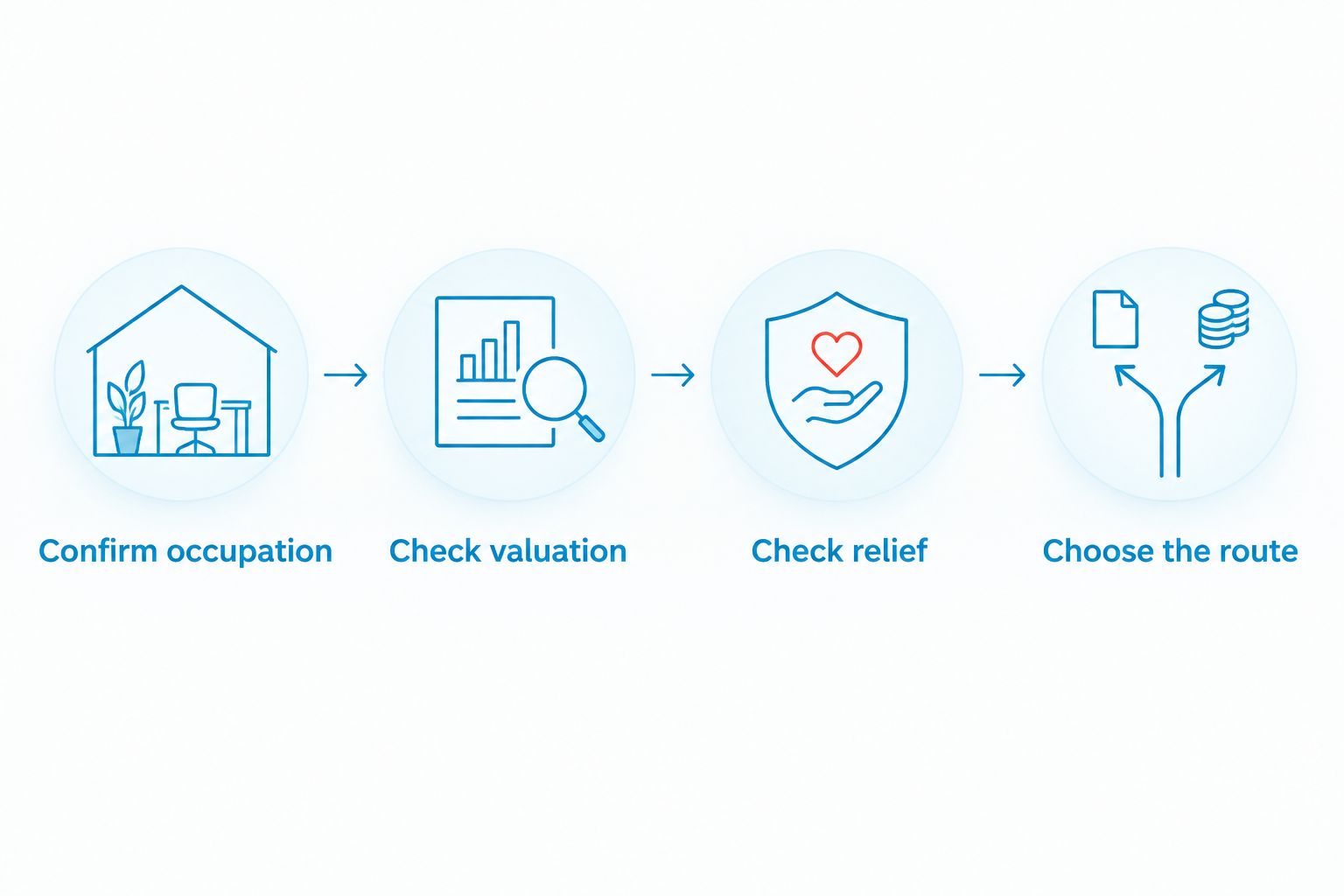
Check your bill in the right order
A useful 2026 review separates liability, valuation and relief before deciding which organisation needs to act. Otherwise, a relief query can turn into an unnecessary valuation challenge—or a valuation problem can remain unresolved while you pursue a discount.
Confirm occupation
Check the named ratepayer, address and dates of liability. Record which areas you occupy, whether anyone shares the building and when the arrangement changed.
Your lease helps explain occupation, but it is not a substitute for checking the rating assessment. Keep the actual use of the premises clear throughout the review.
Check valuation
Compare the rating-list entry with the premises. Identify the specific facts or valuation grounds that need examination rather than asking for an unexplained percentage reduction.
A neighbour’s lower bill is not proof of an incorrect valuation. Relief, occupation dates and other calculation differences can explain the gap.
Check relief
Match each relief entry to the applicable scheme and period. Ask the council to explain an omitted, reduced or withdrawn award in writing.
For a property near a threshold, use the exact rateable value. Rounding a valuation for convenience can put the property on the wrong side of an eligibility boundary.
Choose the route
Take relief and billing questions to the council. Use the valuation challenge process for a disputed assessment, with evidence supporting the particular grounds.
Keep relief claims and valuation challenges distinct, even when both need attention. The guide to claiming business rates relief while appealing explains why these questions should be considered separately.
Relief claims and valuation appeals are different
In England and Wales, current valuation challenges use Check, Challenge, Appeal. Checks and Challenges are handled by the valuation authority; appeals go to the relevant Valuation Tribunal for England or Wales.
The shared process does not make every relief rule, billing requirement or tribunal arrangement identical. For 2026 instructions, identify the country, rating list and relevant period before relying on procedural advice.
A relief application asks whether an eligible reduction belongs on your bill. A valuation challenge asks whether the underlying assessment is correct. Neither guarantees a particular outcome, and neither should be presented as a substitute for the other.
Let us handle your case
Appeal My Rates UK is best for business owners seeking rating-surveyor support with valuation challenges and council rates disputes in England and Wales. The firm also handles property splits and mergers; the appropriate instruction depends on the problem identified.
Professional support puts the property facts and dispute grounds into a structured case. It does not create relief eligibility or guarantee savings. Compare the proposed work with what you need resolved before instructing a representative.
Appeal My Rates UK on fees: Most of our work is no win, no fee, but some instructions carry fixed fees. Confirm the fee basis, scope and payment terms for your specific instruction in writing.
Let us handle your case
Discuss your valuation or council rates dispute and confirm the scope of your instruction.
FAQ
What is the average business rates relief across sectors?
There is no single sector average established by this comparison. The table shows scheme entitlements ranging from no relief to 100%, not measured awards across businesses.
Do small businesses get the same relief in England and Wales?
No. Eligible English properties receive full small-business relief at rateable values of £12,000 or less, while the Welsh full-relief ceiling is £6,000. Other eligibility conditions also apply.
Can a charity get 100% business rates relief?
A qualifying charity property can receive 100% total relief when additional discretionary support supplements the 80% mandatory award. The additional council award is not automatic.
Does a lower business rates multiplier mean I have relief?
No. A multiplier is part of the calculation of the rates charge, while relief reduces the qualifying charge. Check both entries rather than treating them as the same discount.
Can I claim relief and challenge my valuation?
You can pursue a relief entitlement and a valuation challenge where there are grounds for both. The council handles relief, while valuation disputes follow the applicable Check, Challenge, Appeal process in England and Wales.
Does Appeal My Rates UK handle every case on no win, no fee terms?
Most of our work is no win, no fee, but some instructions carry fixed fees. Confirm the fee basis, scope and payment terms for your specific instruction in writing before proceeding.
One last thing
A correct valuation can still produce an incorrect bill. Missing relief, incorrect liability dates or a calculation issue needs attention even when there are no grounds to challenge the assessment.
Before requesting a percentage reduction, ask for a written breakdown showing the rateable value, multiplier, relief and liability period. That separates an eligibility question from a valuation dispute and gives your next enquiry a specific purpose.
Related guides
- Find your rateable value in the rating list
- Can charities get 100% business rates relief?
- Retail, hospitality and leisure multiplier eligibility