

To find your rateable value in England or Wales, search GOV.UK for the official ‘Find a business rates valuation’ service, enter your property’s postcode or address, and open the matching rating-list entry. Check the property description, the rating-list period and the date the valuation takes effect before using the figure. Your rateable value is not the amount you pay on your business rates bill.
- How to find my rateable value: use the official GOV.UK business rates valuation search, then verify the property entry.
- For a 2026 lookup, check both the rating-list period and the valuation’s effective date.
- A council bill shows charges and reliefs; the rating list records the property’s rateable value.
- Appeal My Rates UK helps business owners address valuation disputes, property splits and mergers, and council rates disputes.
How to find your rateable value on the rating list
Use the official property record rather than a search-engine snippet, an old letting brochure or a neighbouring occupier’s bill. The public search lets you inspect an assessment without appointing a surveyor or starting a formal challenge.
For help organising the information after your search, use this guide to business rates finder checks and appeal evidence. Finding an entry identifies the assessment; checking its accuracy is a separate task.
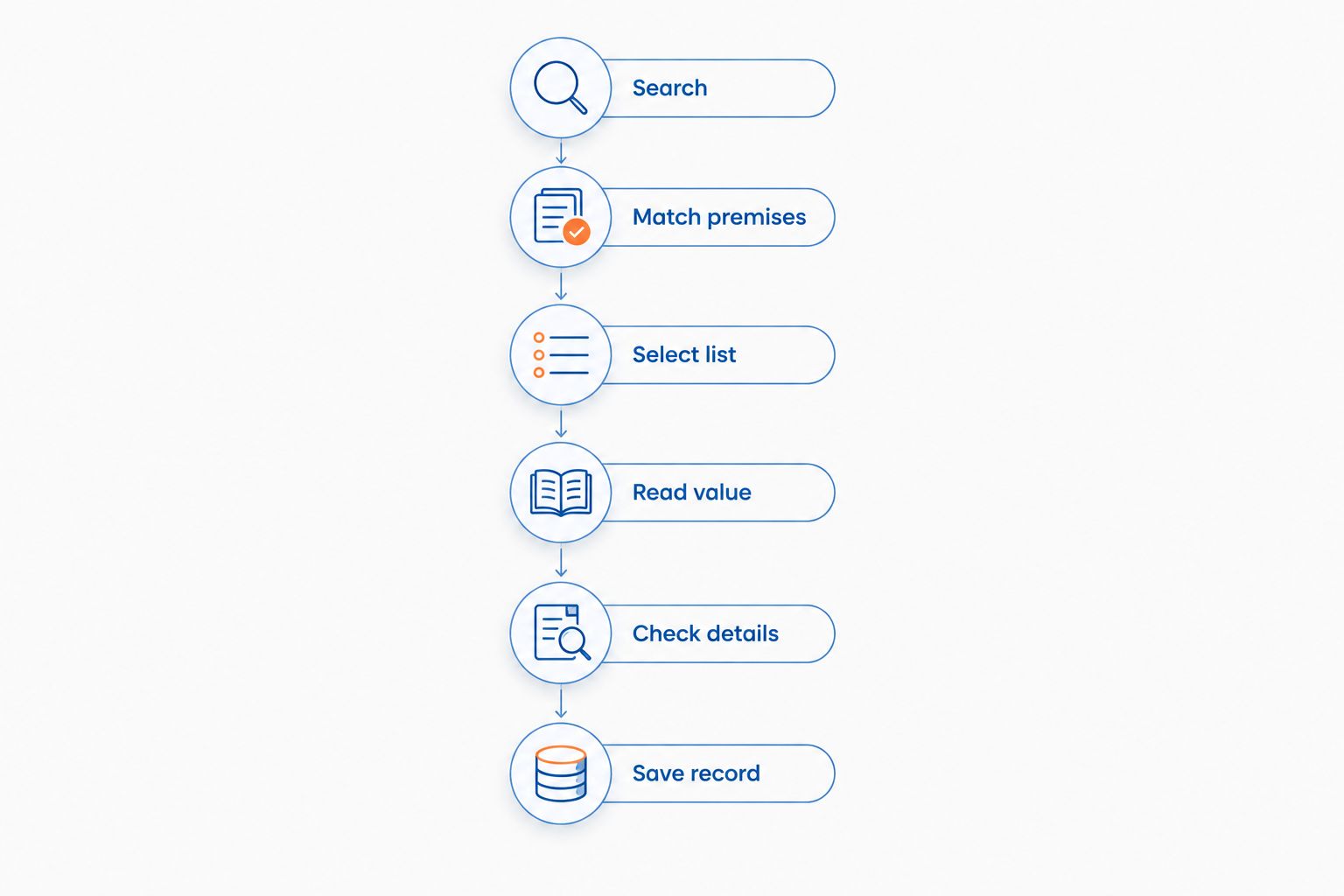
Search the official service
Search GOV.UK for ‘Find a business rates valuation’ and open the government service. Enter the postcode first, then select the address that matches your premises.
If the postcode returns several results, compare the unit number, street address and property description. Do not select an entry simply because its business name looks familiar: occupiers change, while the property assessment can remain in place.
Match the assessed premises
Read the whole address, including references to floors, rear premises, adjoining land or separate units. A building containing several businesses does not necessarily have a single rating assessment.
Check whether the entry covers the space you occupy. If you rent only part of a building, compare the assessment with your lease plan and the address on your council bill before deciding that the figure belongs to your business.
Select the right rating list
The 2026 rating list takes effect on 1 April 2026. If you are checking a bill or occupation period before that date, inspect the list applicable to that earlier period instead.
Keep the list period separate from the date you perform the search. Looking up a property today does not mean the currently displayed valuation applies to every earlier bill.
Read the value and effective date
Find the rateable value recorded against the assessment and note the date it takes effect. Where the service shows a history of changes, check whether the figure changed during the period you are investigating.
A revised entry can explain why an older bill and the current search result differ. Save the relevant entry and its dates rather than recording the value alone.
Check the supporting details
Review the property description and any valuation details available for that assessment. Where floor areas or other property facts are shown, compare them with reliable records of your premises.
Not every type of property is valued in the same way, and not every entry displays the same level of detail. A missing breakdown is not, by itself, evidence that the assessment is wrong.
Save a usable record
Keep a copy showing the address, assessment reference, rating-list period, rateable value and effective date. Add your latest council bill and the bill for any earlier period you are querying.
Save the context, not just the figure. Without the list period and effective date, a screenshot of a rateable value can leave the central question unresolved.
Why this matters
A correct property search gives you a starting point for checking your bill, reviewing an assessment or preparing evidence. It does not establish that you qualify for relief or that a valuation challenge will succeed.
For a 2026 review, keep 2 records together: the relevant rating-list entry and the council bill covering the same period. They answer different questions, so neither replaces the other.
| Record or service | Best for | What it tells you | Main limitation |
|---|---|---|---|
| Public rating-list search | Finding the recorded assessment | Property identity, rateable value and relevant dates | Does not establish your final bill or entitlement to relief |
| Council business rates bill | Checking the amount demanded | Billing period, charges and reliefs applied | Does not provide the full basis for the valuation |
| Business rates valuation account | Managing a formal valuation case | Access to property-related case activity and submissions | Requires the appropriate account access and authority |
Start with the public search if you only need the recorded value. Use your council bill to investigate the amount demanded, and use the formal valuation process when the assessment itself needs addressing.
Why your search result and bill can differ
The rating-list entry and the council bill serve different purposes. Before treating a mismatch as an error, check these factors:
- Different list periods: an older bill can refer to an assessment from a previous rating list.
- Different effective dates: a change to the entry can apply from a date that falls within the billing period.
- Different property boundaries: the assessment might cover more or less space than the premises you occupy.
- Reliefs or billing adjustments: these affect the council’s calculation rather than simply replacing the listed rateable value.
- A split or merger: changes to how premises are assessed can leave earlier and later records looking different.
- An address variation: unit names, floor descriptions or renumbering can make the correct assessment harder to identify.
For any discrepancy, write down exactly what differs and the period affected. ‘The bill is too high’ does not identify whether the problem concerns valuation, liability, relief or a council calculation.
What should I do if my property does not appear?
Search using the postcode, street address and alternative unit descriptions, then compare the results with your council bill. A failed name search does not establish that the property is absent from the rating list.
If you still cannot identify the entry, ask the council which assessment its demand relates to and raise the missing or unclear property record with the valuation authority. Do not treat an unsuccessful search as confirmation that no business rates are due.
Check separate and combined assessments
Look for an entry covering the whole building as well as entries for individual units. This matters if your premises have been divided, combined or described differently since the assessment was created.
A lease plan helps explain what you occupy, but it does not automatically settle how the property should be assessed for rating purposes. Keep dated plans and occupation information so the question can be examined properly.
Keep each reference in its place
Record the assessment reference from the valuation entry separately from your council account number. Use the reference requested by the organisation you are contacting rather than assuming that both systems use the same identifier.
When corresponding about several units, label each document with the relevant address. This reduces the risk of evidence for one assessment being attached to a dispute about another.
What should I check if the rateable value looks wrong?
Check the property facts and the valuation period before comparing the headline figure with nearby businesses. A neighbouring property’s lower value is a reason to investigate differences, not proof that your own assessment must fall.
Build an evidence file around the issue you can identify. Useful material includes:
- Plans showing the premises and the area you occupy.
- Measurements supported by a clear description of what was measured.
- Lease documents and relevant rental information.
- Dated photographs showing the physical facts in dispute.
- Records explaining a property split, merger or change in occupation.
- Correspondence identifying an earlier change to the assessment.
Separate facts from conclusions. ‘The assessment includes a store outside our occupied premises’ is a specific issue to examine; ‘another business pays less’ leaves the underlying reason unanswered.
Use the correct challenge process
England and Wales both use Check, Challenge, Appeal, with 3 stages, for current valuation disputes. Checks and Challenges are handled by the valuation authority; appeals go to the relevant Valuation Tribunal for England or Wales.
For a 2026 case, confirm the applicable requirements and deadlines before submitting anything. A public property lookup is not a Check, a Challenge or an appeal, and it does not preserve a deadline.
The shared process does not mean every relief, billing rule or tribunal arrangement is identical across England and Wales. Identify the country, list and issue before relying on procedural advice.
When should I ask a rating surveyor for help?
Ask for help when you cannot establish what premises the assessment covers, when the property facts appear wrong, or when you need to decide whether evidence supports a valuation challenge. A surveyor can also help distinguish an assessment issue from a dispute about the council’s bill.
Appeal My Rates UK is best for business owners seeking rating-surveyor help with valuation challenges, property splits or mergers, and council rates disputes. A straightforward public lookup does not require that service; an unresolved assessment or dispute is the relevant reason to seek advice.
For business rates instructions, Appeal My Rates UK explains its fee position plainly: Most of our work is no win, no fee, but some instructions carry fixed fees. Confirm the fee basis, scope and payment terms for your specific instruction in writing before authorising work.
Use the contact page to explain the property, the period and the issue you have identified. Send the assessment record and relevant bill so the discussion starts with the same documents.
FAQ
How do I find my rateable value using a postcode?
Search GOV.UK for ‘Find a business rates valuation’, enter your postcode and open the matching property entry. Check the unit, description, rating-list period and effective date before using the figure.
Is my rateable value the same as my business rates bill?
Your rateable value is not your business rates bill. The council calculates the bill using the applicable rules, including relevant multipliers, reliefs and adjustments.
Can I find my rateable value without setting up an account?
You can search the public rating list without setting up a business rates valuation account. Formal case management and submissions require the appropriate access and authority.
Which rating list should I check in 2026?
The 2026 rating list takes effect on 1 April 2026. For a bill covering an earlier period, check the assessment and list applicable to that period rather than assuming the latest value applies.
What if the address on the rating list is different from my business address?
Check whether the entry uses an older unit name, a floor description or an assessment covering a larger property. Compare the entry with your council bill and plans before concluding that it is the wrong assessment.
Does finding an incorrect rateable value automatically reduce my bill?
Finding an apparent error does not automatically change the rating-list entry or reduce your bill. The issue needs to be addressed through the applicable process, with evidence supporting the correction sought.
Do England and Wales use the same valuation challenge process?
England and Wales both use Check, Challenge, Appeal for current rating-list valuation disputes. Checks and Challenges go to the valuation authority, while appeals go to the relevant Valuation Tribunal for England or Wales.
Can Appeal My Rates UK help after I find my assessment?
Appeal My Rates UK helps business owners with valuation challenges, property splits and mergers, and council rates disputes. Most of our work is no win, no fee, but some instructions carry fixed fees. Confirm the fee basis, scope and payment terms for your instruction in writing.
One last thing
The most useful result of your search is a matched record, not a standalone value. Write the property address, assessment reference, list period and effective date together before comparing figures or asking anyone to review the assessment.
For your 2026 records, also note when you saved the entry. That gives you a clear reference point if the online record changes while you are investigating the issue.
Related guides
- How to find comparable properties for a rates appeal
- Use a valuation account to challenge a business rates valuation
- Can I claim business rates relief and appeal at the same time?