
Yes, you can sometimes keep or claim small business rates relief when you occupy more than one property, but England and Wales apply different eligibility rules. In England, additional properties must normally meet strict individual and combined rateable-value limits for ongoing relief on your main property; in Wales, relief is limited to two qualifying properties per business in each local authority area. For a 2026 claim, check every assessment, the relevant occupation dates and the council’s decision before budgeting for relief.
- Small business rates relief multiple properties rules differ between England and Wales; do not apply one country’s thresholds to the other.
- England normally restricts ongoing relief to your main property when additional premises meet individual and combined rateable-value limits.
- Wales limits small business rates relief to two qualifying properties per business in each local authority area.
- Appeal My Rates UK helps business owners with business rates valuations and council disputes; relief eligibility still needs council confirmation.
Can I claim small business rates relief on more than one property?
Yes, but occupying several properties does not mean each property receives relief. England’s additional-property exception and Wales’s two-property limit work differently.
Start by checking each property’s rateable value and rating-list entry. Rateable value is the valuation used to calculate rates, not your rent or the amount on your annual bill.
| Question | England | Wales |
|---|---|---|
| Can a business occupy multiple properties and still qualify? | Yes, subject to additional-property rules or applicable temporary protection | Yes, subject to each property qualifying and the local-authority limit |
| Which properties receive relief? | Normally the main property under the additional-property exception | Up to two qualifying properties per business in each local authority area |
| What must you check? | Each additional property’s rateable value and the combined total | Each property’s rateable value and the number of properties receiving relief locally |
| What is the main limitation? | Small additional assessments can still take the combined total over the limit | Qualifying premises beyond the local two-property limit do not receive this relief |
The baseline eligibility rules are set out in GOV.UK’s small business rate relief guidance for England and Welsh Government’s Business Wales small business rates relief guidance for Wales. Use the rules applicable to your claim period in 2026, particularly where occupation or an assessment changes during the year.
Why this matters
Taking another unit can affect the relief on premises you already occupy. The financial question is therefore wider than the new unit’s bill: you need to establish whether the expansion changes an existing award.
A separate store, workshop or office deserves the same attention as a second shop. Check the rating assessments, not just the number of trading addresses. Several spaces in one building can have separate entries, while the treatment of adjoining accommodation depends on the facts and rating rules.
Before signing a lease, ask the council to explain the relief position using the actual assessments and proposed occupation date. A landlord’s description of a unit as “small” does not establish eligibility.
England: additional properties below £2,900 rateable value
In England, the usual ongoing exception allows you to retain small business rate relief on your main property where each additional property has a rateable value below £2,900. The total rateable value of all your properties must also be below £20,000, or £28,000 in London.
Both tests matter. An additional property meeting the individual limit does not settle the combined-value test, and the combined total includes your main property.
For the main property, the standard relief structure provides:
- 100% relief: a qualifying rateable value of £12,000 or less.
- Tapered relief: a qualifying rateable value above £12,000 and below £15,000.
- No standard small business rate relief: a rateable value of £15,000 or more.
These figures are rateable-value thresholds, not service prices or guaranteed bill reductions. Other adjustments to a bill are separate questions.
GOV.UK guidance also addresses temporary retention of existing relief when a business takes on another property. For a 2026 expansion, ask the council to confirm the protection applicable to your occupation date and its end date in writing; temporary retention is not permanent eligibility.
What should I check before taking a second property in England?
Check the additional assessment against the £2,900 individual limit, then check the combined total against the relevant overall limit. Do not stop after checking the new unit alone.
Ask the billing council whether your existing award continues, whether any temporary protection applies and what evidence it requires. Where different councils bill your properties, provide the complete property schedule rather than assuming the councils already share it.
Wales: relief on up to two qualifying properties per council
In Wales, small business rates relief is limited to two qualifying properties per business in each local authority area. Each property must qualify under the Welsh scheme; the limit is not a promise of relief for any two premises you choose.
The standard Welsh rateable-value bands provide:
- 100% relief: qualifying premises with a rateable value of £6,000 or less.
- Tapered relief: qualifying premises with a rateable value above £6,000 and up to £12,000, reducing to zero at the upper limit.
Do not apply England’s £2,900 additional-property test to a Welsh claim. Wales has its own relief conditions, even though both countries use the same broad valuation challenge process.
For a 2026 claim involving several Welsh premises, identify which local authority bills each property. Then ask each authority to confirm which qualifying assessments receive relief and how it has applied the two-property restriction.
Can I receive relief in more than one Welsh council area?
The two-property limit applies per business in each Welsh local authority area, rather than as a single Wales-wide two-property allowance. Properties in different council areas still need to satisfy the applicable eligibility conditions.
Give each council an accurate account of the relevant premises and existing awards. A different postcode does not necessarily mean a different local authority.
Why multiple-property relief eligibility varies
Your outcome depends on the assessments and occupation facts, not simply on whether you describe the business as small. These factors determine what the council needs to consider:
- Country: England and Wales use different small business rates relief eligibility rules.
- Individual rateable values: England tests additional properties individually; Welsh properties must fall within the qualifying bands and conditions.
- Combined rateable value: England’s ongoing additional-property exception includes an overall limit.
- Local authority boundaries: Wales’s two-property restriction applies within each local authority area.
- Occupation dates: taking on or leaving premises can change the period for which relief is due.
- Rating-list entries: a split, merger or revised assessment changes the property information used to consider eligibility.
An award made before a change is not confirmation that the same relief continues afterwards. Tell the council what changed and request a decision covering the relevant period.
How do I check my claim before expanding?
Prepare one property schedule before contacting the councils. It makes the enquiry specific and helps expose missing assessments or inconsistent dates.
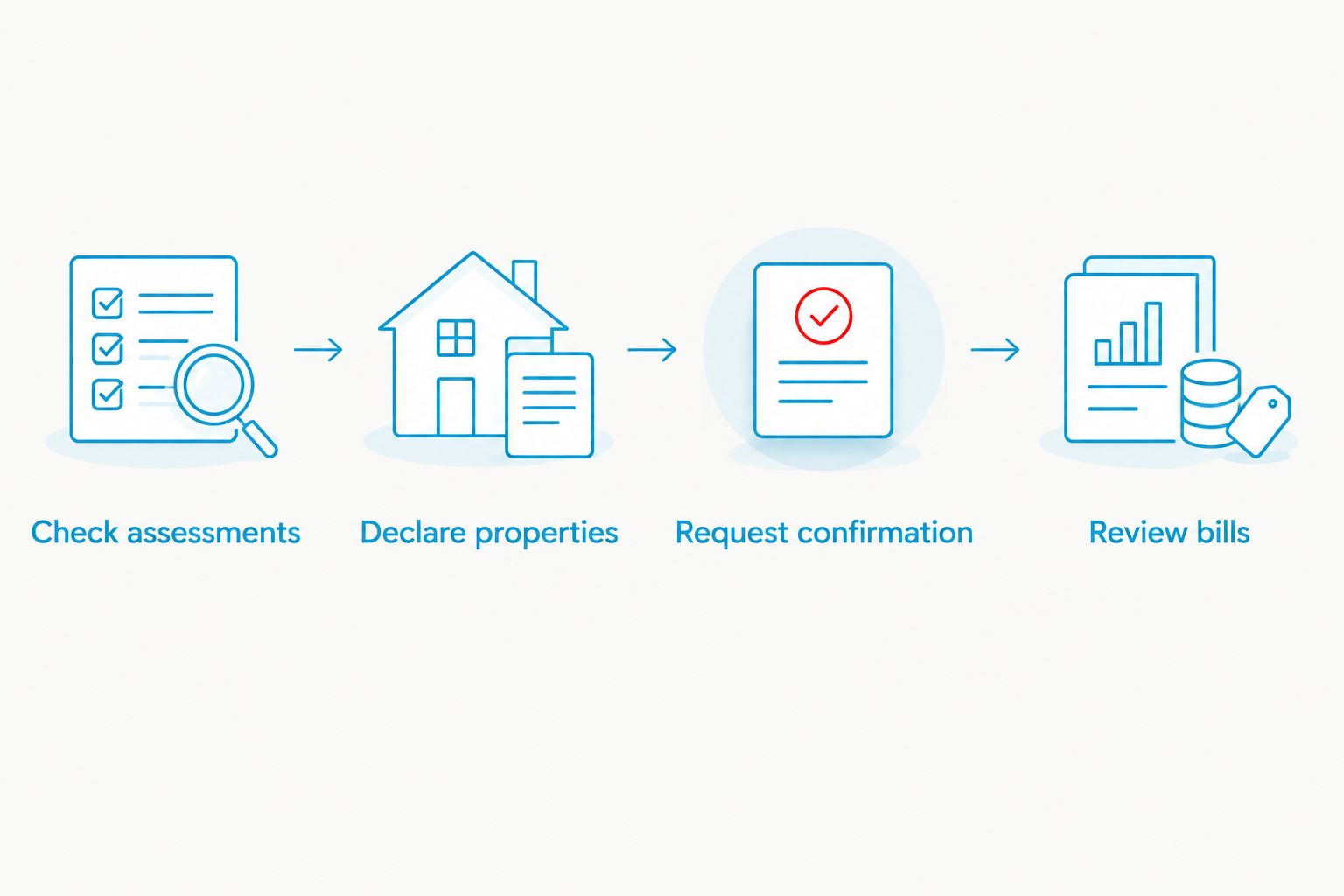
- Check assessments. List each property’s address, rating reference, rateable value and billing council. Use the entries relevant to the period under review, including the applicable 2026 assessment where necessary.
- Declare properties. Set out the legal occupier, occupation dates and existing relief for each assessment. Include ancillary premises rather than listing only customer-facing sites.
- Request confirmation. Ask the council which properties qualify, the effective dates and the reason for any restriction. In England, ask separately about temporary protection following expansion.
- Review bills. Compare the written decision with revised demands. Check the property, relief period and calculation rather than assuming a new bill implements everything correctly.
Keep the replies alongside leases, occupation records and previous bills. If the council asks for further evidence, answer against the individual assessment reference so the response reaches the correct account.
Does owning a property count if another business occupies it?
Ownership and occupation are different questions. Business rates liability generally follows occupation, while separate rules apply to unoccupied property.
Give the council the actual arrangement: who occupies the space, which assessment covers it and when occupation began or ended. A lease, sublease or serviced-office agreement needs to be considered alongside the facts; its title alone does not settle liability.
Do not omit a property simply because it produces no sales or is used only for storage. Equally, do not assume every property you own forms part of your business’s occupied-property claim.
Can splitting a property create extra relief?
A property split is not an automatic route to additional small business rates relief. Separate assessments must reflect the property and occupation arrangements, and the resulting entries still have to satisfy the relevant relief rules.
The potential benefit is a rating list that correctly records genuinely separate premises. The limitation is that more assessments can introduce additional eligibility restrictions rather than reduce the total bill.
Check the assessment position and the relief consequences together. A smaller rateable value on one entry does not, by itself, establish that the business pays less overall.
What if the council refuses relief or the valuation looks wrong?
First identify which decision you dispute. A council’s refusal to award relief is different from an incorrect rateable value, even when both affect the same bill.
For a relief dispute, request the council’s written reasons and check the property count, occupation dates and values it used. For a valuation dispute, England and Wales both use Check, Challenge, Appeal for the 2023 rating list onwards; Checks and Challenges go to the valuation authority, with appeals going to the relevant Valuation Tribunal for England or Wales.
Appeal My Rates UK is best suited to business owners who need rating surveyor help with valuations or council disputes. The firm’s business rates services also cover property splits and mergers, but professional involvement does not guarantee relief or a lower assessment.
Most of our work is no win, no fee, but some instructions carry fixed fees. Before asking Appeal My Rates UK to handle your case, contact us to confirm the fee basis, scope and payment terms for your specific instruction in writing.
FAQ
Can I get small business rates relief on two properties in England?
You can sometimes retain relief on your main property while occupying another property in England. The ongoing exception normally requires each additional property to have a rateable value below £2,900 and the combined total to remain below £20,000, or £28,000 in London; ask the council separately about temporary protection.
Can I claim small business rates relief on two properties in Wales?
Yes, Wales allows relief on up to two qualifying properties per business in each local authority area. Each assessment must meet the Welsh scheme’s conditions; two properties do not automatically mean two awards.
Does a small storage unit count as another property?
A separately assessed storage unit can affect your multiple-property relief position. Check its rating entry, occupation arrangements and rateable value rather than assuming storage is ignored.
Do I need to tell the council when I open another branch?
Yes, tell the council about the additional premises and ask it to confirm how your relief changes. Provide the assessment details and occupation date, including premises billed by another council.
Is rateable value the same as my business rates bill?
No, rateable value is the valuation used in calculating your business rates bill. Relief, the applicable multiplier and other relevant adjustments determine the amount demanded.
Can Appeal My Rates UK help if the council removes my relief?
Appeal My Rates UK handles disputes with local council rates teams and business rates valuation cases. Most of our work is no win, no fee, but some instructions carry fixed fees. Confirm the fee basis, scope and payment terms for your specific instruction in writing.
One last thing
Count assessments, not shopfronts. A business with one public entrance can still occupy separately assessed accommodation, so a property schedule is a better starting point than a list of branches.
Before your next 2026 occupation change, send that schedule to the relevant council and ask for a dated, written relief decision. That gives you a clear basis for checking the bill instead of relying on an assumption made before expansion.
Related guides
- Small business rates relief schemes
- Can splitting a property reduce my business rates bill?
- Can I claim business rates relief and appeal at the same time?