
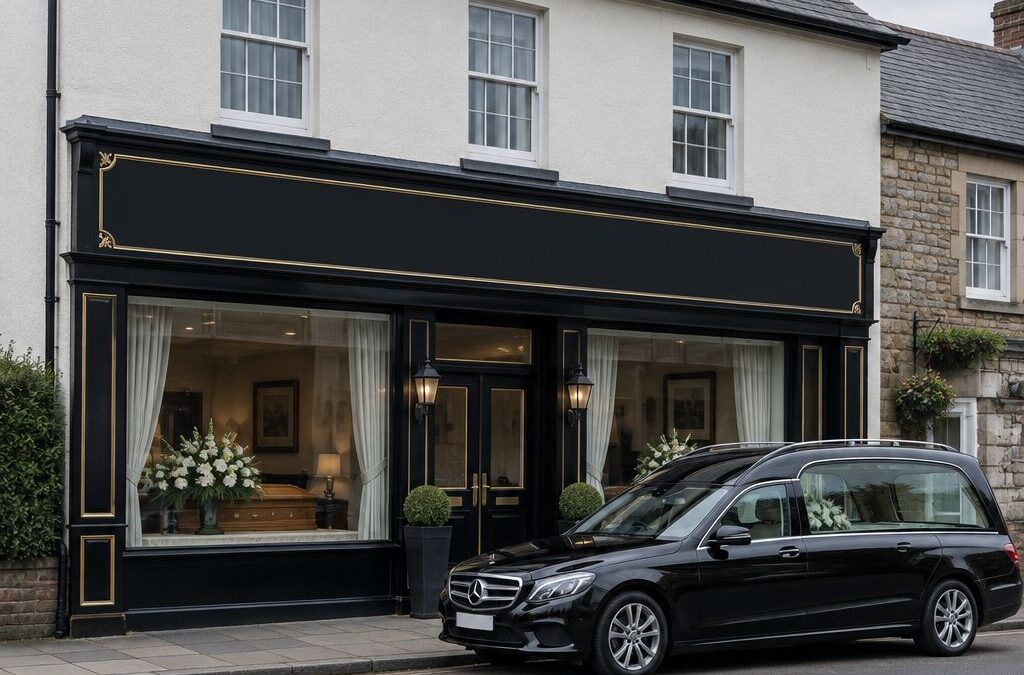
Business rates for funeral directors are worked out from the rateable value the Valuation Office assigns to your funeral home, chapel of rest or office, multiplied by a rates multiplier that changed on 1 April 2026. Funeral directors now sit inside the qualifying retail, hospitality and leisure (RHL) definition in England, which means most funeral premises should pay a lower multiplier than an office of the same size. Getting that classification right is worth real money on a bill you pay every month.
- Funeral directors qualify for the RHL multipliers: 38.2p under £51,000 RV, 43p up to £499,999.
- Crematoria are excluded, so a funeral home and its crematorium can be billed differently.
- The 2026 rating list uses rents as at 1 April 2024 and runs to 31 March 2029.
- Appeal My Rates UK challenges funeral premises valuations through Check, Challenge, Appeal.
Why this matters
The 2026-27 rates year is the first to run under five national multipliers instead of two, and the first year since 2020 without retail, hospitality and leisure relief. If your council has applied the standard 48p multiplier to a funeral home that should carry the RHL multiplier, the difference on a £95,000 rateable value is £4,750 a year before reliefs. The multiplier printed on your bill tells you immediately which way your premises have been treated.
Not every part of a funeral business qualifies. The government guidance on qualifying RHL properties lists funeral directors among services provided to visiting members of the public, so a funeral home should qualify. Crematoria sit on the excluded list. Where one rating entry covers a chapel of rest, offices and a crematorium together, the crematorium alone can pull the whole assessment out of the lower multipliers — which is exactly the kind of mixed-entry problem a rates surveyor checks first.
Before challenging anything, check what your business qualifies for: the RHL multipliers, small business rate relief and transitional relief stack differently on every bill.
The 2026-27 multipliers for funeral premises
| Multiplier | Rate | Applies to |
|---|---|---|
| Small business RHL | 38.2p | Qualifying RHL premises with a rateable value under £51,000 |
| Standard RHL | 43p | Qualifying RHL premises with a rateable value from £51,000 to £499,999 |
| Small business (non-RHL) | 43.2p | All other premises with a rateable value under £51,000 |
| Standard (non-RHL) | 48p | All other premises with a rateable value from £51,000 to £499,999 |
| High value | 50.8p | All premises with a rateable value of £500,000 or more |
The RHL multipliers sit 5p below their national equivalents and replaced the 40% retail, hospitality and leisure relief, which ended on 31 March 2026. Unlike the old relief there is no cash cap, so every qualifying branch in a funeral group benefits — the old £110,000 relief cap is gone.
Worked example: a funeral home with a £180,000 rateable value pays £77,400 a year at the standard RHL multiplier of 43p, against £86,400 at the standard 48p multiplier — a £9,000 difference. Councils add local items such as the business rates supplement on top, so read the bill, not just the arithmetic.
Six checks for your funeral premises in 2026
1. Find your premises on the 2026 rating list
Search GOV.UK's Find a Business Rates Valuation service by address or postcode. Note three things before anything else:
- The description. It should describe the funeral use — chapel of rest, funeral offices, mortuary — rather than an old description carried over from the previous rating list.
- The rateable value. Every entry on the 2026 list is valued on rents as at 1 April 2024, the antecedent valuation date.
- The assessed extent. The entry should cover the floors and buildings you actually occupy, and nothing you have vacated.
A branch you closed last year can still sit on the list in your name. The rating-list correction and the council billing change are two separate jobs — do both, and keep the confirmations.
2. Check which multiplier your council applied
Councils decide whether a hereditament meets the RHL definition, based on how the property is used. A qualifying funeral home shows either 38.2p (rateable value under £51,000) or 43p (from £51,000 to £499,999) on the bill.
- If the bill shows 48p or 43.2p on a qualifying funeral home, the council may have misclassified it.
- Raise it in writing with your council's business rates team, quoting your account reference and the government guidance on qualifying RHL properties.
- Correction is quick where the classification is plainly wrong. A tribunal appeal is the route only if the council refuses.
3. Confirm the entry matches the buildings you occupy
Funeral businesses often grow by acquisition, and acquisitions leave rating debris: a merged entry covering two properties you run as separate units, or an old single assessment surviving a split. Where the entry does not match occupation, a split or merger of the assessment can change both the value and the multiplier position.
- Compare the entry with your leases and floor plans.
- Flag any building in the entry you do not occupy — or any you occupy that is missing from it.
4. Check every relief on the bill
| Route | Best for | What it does | Limitation |
|---|---|---|---|
| RHL multiplier | Qualifying funeral premises | Lower multiplier applied automatically | The council must classify the property correctly |
| Small business rate relief | One property with a rateable value of £12,000 or less | Up to 100% off the bill | Tapers to zero between £12,001 and £15,000 |
| Transitional relief | Businesses facing large 2026 increases | Caps bill increases (5% small, 15% medium, 30% large for 2026-27) | Temporary — the cap unwinds across the list |
| Valuation challenge | An incorrect rateable value | Corrects the assessment itself | Needs evidence and Check, Challenge, Appeal deadlines |
If the RHL multiplier is wrongly missing, fixing the classification usually does more than any relief claim. Get the multiplier right first, then check what else the bill should carry.
5. Compare your valuation with similar funeral premises
Rental comparison is the VOA's main valuation method for most properties. Comparable funeral premises, chapel-of-rest lettings and similar high-street units tell you whether your rateable value sits inside the market range. Keep comparables recent and local, and match on size and use rather than on address alone.
6. Raise a Check if the facts are wrong
England and Wales run the three-stage Check, Challenge, Appeal process for current rating lists. A Check asks the valuation authority to confirm the property facts; a Challenge sets out your grounds and evidence for a lower rateable value; an unresolved dispute goes to the Valuation Tribunal for England, or the Welsh equivalent. Deadlines apply at each stage, so check them in your Business Rates Valuation Account before submitting.
- Check first when the facts — floor area, description, extent — are wrong.
- Challenge when the facts are right but the value is not.
- Keep paying the bill as issued while the case runs. A challenge does not suspend collection.
Appeal My Rates UK runs funeral premises challenges through this process for business owners across England, from first Check to tribunal where needed.
Common mistakes funeral directors make
- Treating the crematorium as RHL. Crematoria are excluded from the definition; only the funeral-service hereditament should carry the lower multiplier.
- Budgeting on the 2025-26 bill. The 40% RHL relief ended on 31 March 2026. The RHL multipliers are worth less than 40% for many premises, so the 2026-27 bill can rise even where you qualify.
- Leaving a closed branch on the bill. A vacated funeral home keeps accruing rates until both the rating entry and the liability are corrected.
- Challenging value before classification. If the wrong multiplier is the whole problem, a valuation appeal solves nothing.
Let us handle your case
A rating surveyor can check your funeral premises valuation, the RHL classification and every relief on the bill. Most of our work is no win, no fee, but some instructions carry fixed fees; the fee basis is confirmed in writing.
FAQ
Do funeral directors qualify for the RHL multiplier?
Yes. Government guidance lists funeral directors among services provided to visiting members of the public, so funeral premises can qualify for the 38.2p or 43p RHL multiplier in England.
Are crematoria eligible for the lower RHL multiplier?
No. Crematoria are on the excluded list, so a crematorium hereditament does not carry the RHL multiplier even when the funeral home next door does.
What multiplier applies to a funeral home with a £60,000 rateable value?
The standard RHL multiplier of 43p, if the council has classified it correctly — against 48p for a non-RHL property of the same value.
How is a funeral home valued for business rates?
The 2026 rating list values every premises on rents as at 1 April 2024. Check the valuation scheme details recorded for your property in your Business Rates Valuation Account.
Does the RHL multiplier apply in Wales?
No. The RHL multipliers are England-only. Wales sets its own multipliers and reliefs, so check the Welsh rules separately for premises there.
Can I appeal my funeral premises rateable value myself?
Yes. Check, Challenge, Appeal is open to any ratepayer. Gather the facts — floor area, description, extent — and raise a Check first.
Will an appeal stop the council collecting rates?
No. Keep paying the bill as issued unless the council revises it or agrees a payment arrangement in writing.
How does Appeal My Rates UK charge for funeral premises cases?
Most of our work is no win, no fee, but some instructions carry fixed fees. We confirm the fee basis, scope and payment terms for your instruction in writing.
One last thing
Check every branch in the group, not just the one that hurts. With no cash cap on the RHL multipliers, each qualifying funeral branch qualifies on its own rateable value. One misclassified branch can cost more per year than a valuation appeal would save — and finding it takes one look at the bill.
Appeal My Rates UK is a firm of rating surveyors handling business rates appeals and council disputes across England. Ask for a review of your funeral premises valuation with the demand notice and rating-list entry to hand.
Related guides
- The VOA Check, Challenge, Appeal process explained
- How to calculate your rateable value
- How to challenge a backdated business rates bill
- Claim a business rates refund from your council
