

A business rates exemption can apply retrospectively where you met the relevant legal conditions for the earlier period and the applicable rules allow the correction. It is not automatically backdated in the same way as a relief award: you must establish the qualifying dates, supply evidence and use the correct billing or valuation route.
- A business rates exemption backdated request needs evidence of earlier eligibility, not just a recent application.
- Council billing corrections and rating-list changes follow different routes; identify which decision is wrong before applying.
- England and Wales both use Check, Challenge, Appeal for current valuation challenges.
- Appeal My Rates UK helps business owners handle valuation challenges and council business rates disputes.
Why this matters
An exemption, a relief award and a reduced rateable value can all reduce a bill, but they do not establish the same entitlement. Applying under the wrong heading leaves the underlying problem unresolved.
For a request made in 2026, identify the period you want corrected and the rules that applied during that period. A current entitlement does not establish eligibility for every previous bill. If both your valuation and your relief award need attention, read about claiming business rates relief while appealing before treating them as a single application.
Can a business rates exemption be backdated like relief?
Yes, but the effective date comes from the relevant entitlement and procedural rules, not simply the date you ask for a refund. There is no single backdating period covering every business rates exemption, relief scheme and rating-list correction.
Start by identifying what should have happened to the earlier bill. These routes address different errors:
| Route | Best for | What it addresses | Main limitation |
|---|---|---|---|
| Council exemption or billing correction | A qualifying period missing from your account | Whether the council charged correctly for the circumstances | You must establish eligibility throughout the requested period |
| Council relief application | A relief scheme not reflected in your bill | Whether you qualified for that particular reduction | Scheme conditions and application rules determine retrospective entitlement |
| Rating-list correction | An incorrect valuation or entry | Whether the property’s assessment needs changing | Procedural rules and effective-date rules control the correction |
A council cannot resolve every valuation issue by changing your bill. Equally, challenging a rateable value does not automatically apply a missing relief award.
For your 2026 request, write down the precise correction sought: the property, account, start date, end date and reason. That gives the decision-maker something specific to assess rather than a general request to reduce historic charges.
Backdated exemption: prove the qualifying circumstances
The word exemption covers circumstances that need different treatment. Certain property classes are exempt from rating, while qualifying empty-property periods are dealt with through the billing account.
Best for: a property or period that met a recognised exemption condition but was charged incorrectly. The benefit is a correction tied to actual entitlement; the limitation is that the label alone proves nothing.
Describe the property's actual use and condition during the disputed period. A lease description, planning permission or business name is not a substitute for evidence of what happened on site.
Where the issue concerns whether the property belongs in the rating list, contact the valuation authority. Where an existing assessment is correct but the council has not recognised a qualifying billing exemption, address the council's decision. Some cases require coordinated action on both records.
Backdated relief: use the scheme’s own rules
Relief reduces the amount payable under a particular scheme. Retrospective eligibility depends on that scheme, the relevant period and the facts of your business or property.
Best for: an account missing a relief award for which you qualified. The advantage is a direct review of the missing reduction; the limitation is that eligibility today does not prove eligibility in an earlier period.
Ask the council to identify the scheme it considered and explain any restriction on earlier awards. If you disagree with the start date, challenge that date specifically and supply supporting records.
Do not use a general statement that relief is backdated as evidence that every exemption must receive the same treatment. Your 2026 application needs the rules for the actual claim, not a different business's outcome.
Rating-list correction: establish the effective date
A property listed incorrectly, assessed on incorrect facts or valued incorrectly raises a different question from an unapplied council reduction. The rating-list entry itself needs examination.
Best for: a disputed assessment rather than a missing billing award. A successful correction addresses the underlying entry, but it does not bypass the rules governing when changes take effect.
England and Wales both use the 3-stage Check, Challenge, Appeal process for valuation challenges on the 2023 rating list onwards. Wales adopted this process on 1 April 2023. Checks and Challenges are handled by the valuation authority; appeals go to the relevant Valuation Tribunal for England or Wales.
The shared process does not make every relief rule, deadline or tribunal arrangement identical. Identify the country, rating list and type of change before deciding which procedure applies.
Why backdating varies
The effective date depends on the claim, not just how long you have occupied the property. These factors determine what needs checking:
- The legal basis: an exemption, discretionary award, mandatory relief and valuation correction have different conditions.
- The relevant period: rules applying to earlier bills must be checked separately from those applying in 2026.
- The qualifying event: occupation, vacancy, a change of use or a physical alteration needs an evidenced date.
- The responsible ratepayer: ownership, tenancy and occupation records help establish whose account requires correction.
- The available evidence: records must support the period requested, not merely the property's present condition.
- The procedural position: application requirements, challenge deadlines and existing decisions affect the next step.
A strong request connects each claimed period to the relevant condition and evidence. A broad request for everything since you moved in does not make those connections.
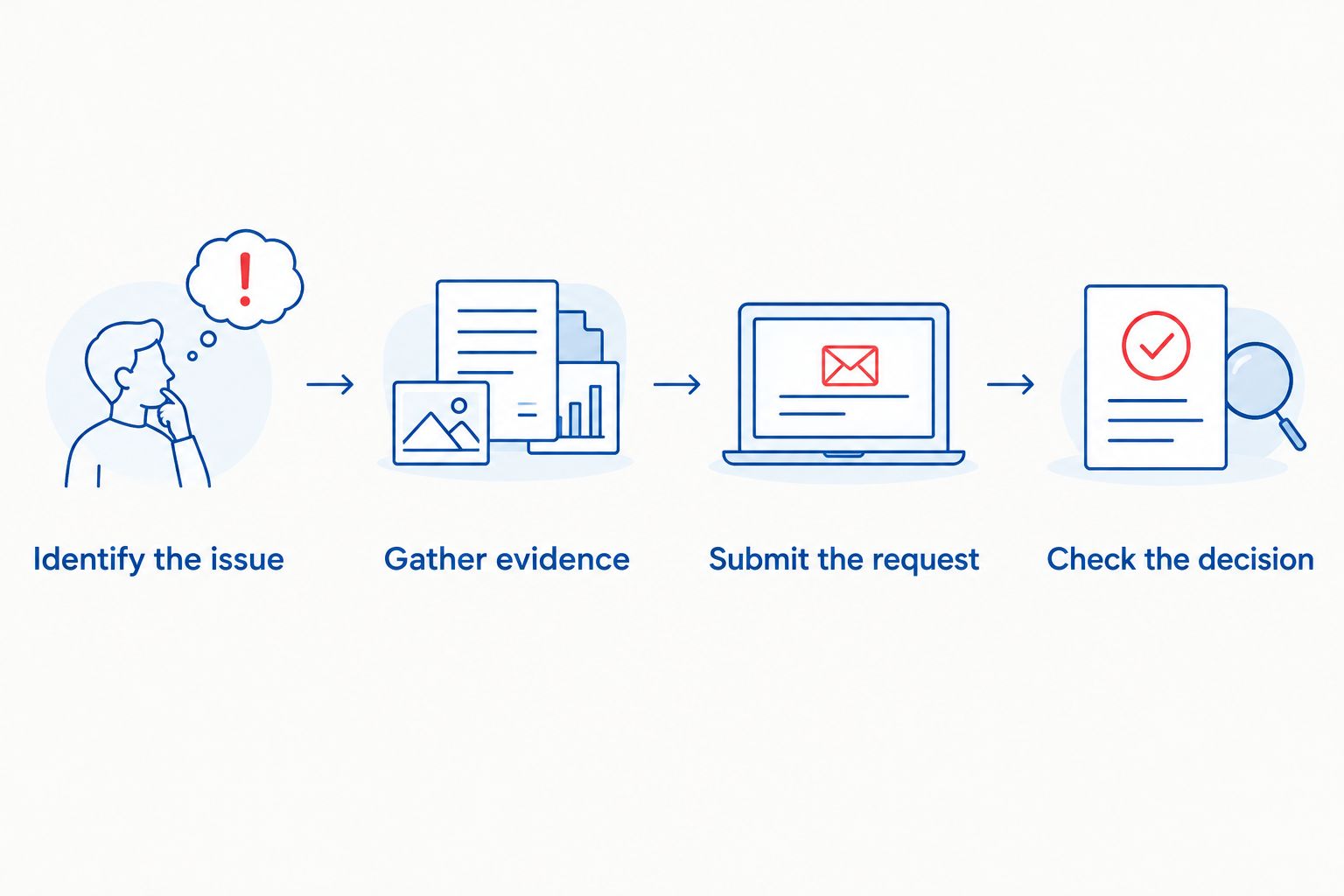
How do you request a backdated business rates exemption?
Use a short, documented sequence. Separate establishing entitlement from asking the council to repay any resulting credit.
Identify the issue
Read the bill alongside the rating-list entry and any previous decision. Decide whether you dispute liability, a missing exemption, a relief award or the valuation itself.
Do not assume an account problem requires a valuation appeal. State the error in plain language before selecting a procedure.
Gather evidence
Record 3 dates: the qualifying start date, the qualifying end date and the application date. If eligibility continues, say so rather than inventing an end date.
Collect documents that explain those dates. Relevant evidence includes leases, handover records, dated photographs, occupation records, correspondence and previous bills. Explain any gaps or conflicting dates directly.
Submit the request
Send a billing or relief request to the council's business rates team. Use the relevant valuation procedure where the assessment or rating-list entry needs correction.
Identify the property and account, state the period requested, explain the qualifying circumstances and attach an indexed evidence bundle. Ask for a written decision on both entitlement and the effective date.
Check the decision
Compare the decision with what you requested. An award starting later than your evidenced qualifying date needs an explanation, even if the council has accepted eligibility in principle.
Check the revised bill as well. A decision letter and an account adjustment are separate documents, and you need to understand how the correction reached your balance.
What should your evidence bundle contain?
Your evidence should establish circumstances, dates and responsibility. More paperwork is not automatically better; each document needs a clear purpose.
| Evidence | What it helps establish | What it does not prove alone |
|---|---|---|
| Lease and handover records | Contractual dates and responsibility | Actual occupation or qualifying use throughout the period |
| Dated photographs | Visible condition at a particular time | Continuous conditions between photographs |
| Trading or occupation records | How and when premises were used | Entitlement under every exemption or relief scheme |
| Bills and account statements | Charges, payments and previous adjustments | Whether the original assessment was correct |
| Previous correspondence | What was reported and decided | That an unacknowledged request was approved |
For a 2026 submission covering earlier bills, organise documents by period rather than by file type. Explain changes in occupation, use or condition instead of presenting the property as unchanged when your records show otherwise.
Keep a copy of the submission and acknowledgement. If the decision overlooks a document, you can identify exactly what was supplied.
Does paying the bill stop you requesting backdating?
Paying a bill does not, by itself, establish that the charge was correct or prevent you asking for a correction. Your entitlement and any applicable procedural limits still need assessment.
Do not stop paying simply because you have submitted a request. Follow the current demand unless the council confirms a revised amount or payment arrangement. A pending query is not an agreement to suspend collection.
Does buying or leasing the property set the backdating date?
The purchase or lease date is evidence of a transaction, not automatic proof of exemption. The relevant start date depends on when the qualifying circumstances existed and who was liable.
Check whether the period you want corrected belongs to your account or a previous ratepayer's account. An entitlement connected with a property does not automatically mean every resulting credit is payable to its current owner or occupier.
When should you ask a rating surveyor for help?
Ask for help when the council and valuation records point in different directions, the disputed period includes changes of use, or a refusal does not explain its effective date. These cases need the billing question separated from the valuation question.
Appeal My Rates UK is best for business owners who need rating-surveyor help with valuation challenges and council business rates disputes. Appeal My Rates UK handles business rates appeals, property splits and mergers, and disputes with council rates teams; an instruction does not establish entitlement or guarantee a reduction.
For Appeal My Rates UK business rates instructions, the fee basis matters: Most of our work is no win, no fee, but some instructions carry fixed fees. Confirm the scope, fee basis and payment terms for your specific instruction in writing. Use the contact page to explain the disputed period and the decision you want reviewed.
FAQ
Can I get a business rates exemption backdated if I applied late?
A late application does not establish or rule out retrospective entitlement on its own. The relevant exemption conditions, evidence and procedural rules determine whether the earlier period can be corrected.
How far back can a business rates exemption go?
There is no single backdating period covering every business rates exemption. Identify the exemption, relevant period and decision being challenged before relying on a deadline or effective date.
Is a backdated exemption the same as backdated relief?
A backdated exemption is not the same entitlement as backdated relief. Each requires assessment under its own conditions, even where both result in a revised council bill.
Do England and Wales use different valuation appeal processes?
England and Wales both use Check, Challenge, Appeal for the 2023 rating list onwards. Checks and Challenges go through the valuation authority, while appeals go to the relevant Valuation Tribunal for England or Wales.
Will an accepted backdating request automatically produce a refund?
An accepted request requires the account to be recalculated before the repayment position is clear. Ask for the revised bill and an explanation of any credit, outstanding balance or proposed repayment.
Can a rating surveyor guarantee that my exemption will be backdated?
A rating surveyor cannot guarantee a backdated exemption. Entitlement depends on the applicable rules and evidence; confirm the scope of any instruction and its payment terms in writing.
One last thing
Ask for a written decision on the start date, not just confirmation that you qualify. A favourable decision beginning too late leaves the earlier disputed bills unresolved.
For your 2026 request, make the desired period explicit in the opening paragraph. Then check that the decision and revised account answer that request rather than only confirming your current position.
Related guides
- Can agricultural buildings get a business rates exemption?
- Claiming a business rates refund from the council
- How to challenge a backdated business rates bill