
Empty property business rates relief normally exempts an eligible vacant commercial property from business rates for 3 months, extended to 6 months for qualifying industrial premises, including warehouses, in England and Wales. After that period, rates normally become payable unless another exemption applies; changing the owner or taking a new lease does not itself restart the vacancy period.
- Empty property business rates relief normally lasts 3 months, or 6 months for qualifying industrial premises.
- England and Wales share the standard vacancy periods, but other eligibility rules need separate checks.
- Appeal My Rates UK helps business owners with business rates valuation challenges and council disputes.
- Confirm the vacancy history, legal liability and exemption end date before accepting the council’s bill.
Why this matters
An empty building still creates a rates liability once its exemption ends. Your immediate job is to establish the correct vacancy dates, identify who is legally responsible and check whether the council has applied the right treatment.
For a vacant retail unit, the empty shop business rates reduction options explain the wider routes to investigate. Empty property relief addresses occupation status; a valuation challenge addresses the rating assessment. They are not interchangeable.
Who qualifies for empty property business rates relief?
You normally qualify for the initial exemption where the commercial property is genuinely unoccupied and the relevant exemption period has not already been used. The period follows the property’s occupation history, not simply the date your business acquired it.
The standard distinction for a 2026 claim is between ordinary commercial premises and qualifying industrial premises. The following comparison sets out the benefit and the limit of each treatment.
| Property or situation | Standard treatment | Best for | Main benefit | Main limit |
|---|---|---|---|---|
| Empty shop, office or other ordinary commercial premises | Normally 3 months exempt | Ratepayers establishing an ordinary vacancy claim | Removes rates liability during the qualifying period | Rates normally resume afterwards |
| Qualifying empty industrial premises, including warehouses | Normally 6 months exempt | Ratepayers with qualifying industrial property | Provides a longer initial exemption | Industrial qualification must be established |
| Property qualifying for a continuing exemption | Depends on the exemption conditions | Ratepayers with a specific qualifying property or legal status | Exemption can continue beyond the ordinary period | Vacancy alone does not establish eligibility |
GOV.UK’s business rates relief guidance on empty properties and Business Wales guidance on empty property relief describe the standard 3-month and 6-month periods. For a 2026 account, also check the relevant council’s requirements for evidence and any exemption you intend to claim.
Establish eligibility before calculating a saving
Start with the rating assessment shown on the demand notice. Match it to the actual premises, then establish when that assessed property became unoccupied.
A trading name, postal address or estate agent’s description does not settle the question. If the bill covers several areas, establish whether the whole assessment is empty or only part of it.
Ordinary commercial premises: 3 months exempt
The normal initial exemption for an empty shop, office or other non-industrial commercial property is 3 months. Once that period ends, the ordinary position is that business rates become payable despite continued vacancy.
The advantage is straightforward: a qualifying vacancy provides temporary relief without requiring you to prove that the rateable value is wrong. The limitation is equally important: a prolonged marketing campaign does not extend the exemption by itself.
Ask the council to confirm the vacancy start date and exemption end date in writing. If its records show an earlier vacancy under a previous owner or tenant, investigate that history before assuming your own handover date controls the calculation.
For 2026 budgeting, distinguish the initial exempt period from the months after it expires. An empty property is not automatically a rates-free property.
Qualifying industrial premises: 6 months exempt
Qualifying empty industrial premises, including warehouses, normally receive 6 months of initial exemption. The longer period depends on the property meeting the relevant industrial conditions.
The benefit is additional time before empty rates become payable. The limitation is that a building described commercially as a warehouse or industrial unit still needs the correct treatment for rating purposes.
Give the council evidence of the property’s use and physical arrangement where classification is disputed. A mixed office-and-storage property deserves particular care: do not assume every area receives a separate exemption merely because different activities took place there.
If the assessment combines premises that have changed through a split or merger, establish the correct assessment as well as the vacancy position. Changing the property record is a separate issue from awarding empty property relief.
When can exemption continue beyond the initial period?
Some empty properties qualify for exemption beyond the ordinary initial period. Recognised categories include listed buildings and certain properties connected with charities or community amateur sports clubs, subject to the applicable conditions.
Charitable ownership alone does not settle every case. The intended next use matters for the relevant charitable exemption, so keep evidence supporting that intended use rather than relying on the organisation’s name.
Other exemptions depend on specific property, legal or ratepayer circumstances. Ask the council to identify the precise exemption it has considered and explain why it accepts or rejects your claim.
Do not treat a possible continuing exemption as an approved claim. Until the council confirms its decision, distinguish the amount demanded from the treatment you are asking it to apply.
Why empty property relief varies
The standard vacancy period is only the starting point. These factors determine how it applies to your account:
- Property classification: qualifying industrial premises receive a different initial period from ordinary commercial premises.
- Vacancy history: a property already empty before your involvement can have an exemption period that is partly or fully used.
- Legal liability: ownership, lease obligations and the legal right to possession affect who is responsible for empty rates.
- Extent of occupation: a wholly empty assessment needs different consideration from a building with only some vacant areas.
- Continuing exemption conditions: listed status, intended charitable use or another qualifying circumstance requires its own evidence.
- Location: England and Wales require separate checks for specific exemption conditions and occupation-reset rules.
For a 2026 claim, do not copy another property’s result without checking these facts. Two neighbouring units can have different liability dates even when they appear equally empty.
How do you claim empty property business rates relief?
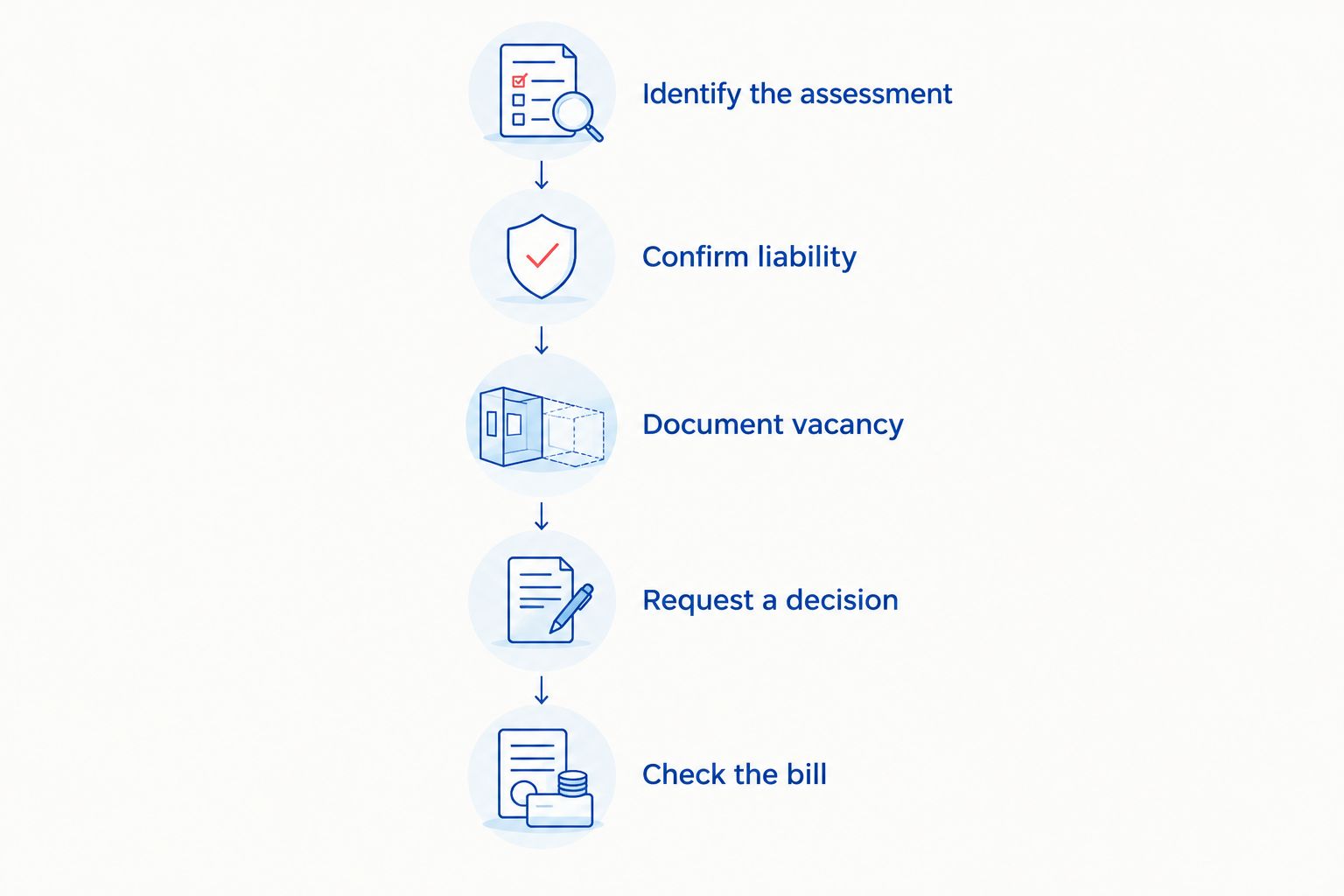
Contact the local council’s business rates team and provide a clear, dated account of what happened. A claim supported by a consistent timeline is easier to assess than a statement that the premises are simply empty.
- Identify the assessment. Use the property address, rates account reference and assessment details from the bill. Check that they describe the premises in question.
- Confirm liability. Supply the relevant lease, surrender, completion or possession documents. Explain any gap between the business leaving and its legal responsibility ending.
- Document vacancy. Provide the date occupation stopped and supporting records. Suitable evidence includes dated photographs, inspection records and handover correspondence.
- Request a decision. Ask the council to confirm the exemption category, start date, end date and any further evidence required.
- Check the bill. Compare the written decision with the revised account. Raise any mismatch in dates or property details promptly.
Keep copies of what you submit and the council’s replies. A telephone conversation helps resolve questions, but written confirmation gives you a record of the decision and the dates used.
Who pays when a tenant leaves?
The business moving out does not automatically end its rates liability. For empty property, the person entitled to possession is central to establishing liability; the lease and any valid termination or surrender therefore matter.
Separate the last trading day, the physical move-out date and the date the lease ended. Those events do not necessarily happen together, and the council needs the relevant evidence rather than an assumed handover date.
A landlord should also check whether the initial exemption was already running before possession returned. A change of ratepayer does not create a fresh exemption period on its own.
Can brief occupation restart the exemption?
Brief occupation does not automatically reset empty property relief. The occupation must be genuine and satisfy the applicable qualifying period and other requirements.
England and Wales have different rules governing the occupation needed before a fresh empty period qualifies. Before planning any temporary letting in 2026, check the current rules for the property’s location and document what the occupier will actually do.
Token storage or a paper arrangement is not a safe substitute for establishing genuine rateable occupation. Obtain advice before relying on a proposed arrangement, not after the council challenges it.
Does refurbishment make an empty building exempt?
Refurbishment does not automatically remove business rates liability. An empty building awaiting a new tenant remains subject to the ordinary rules unless a relevant exemption or a justified change to its rating assessment applies.
The scale and nature of works matter when considering the assessment. Keep dated photographs, specifications and a works timeline so that the property’s actual condition can be examined.
Distinguish routine repairs from a separate argument about whether the rating assessment remains correct. Describing premises as unusable is not, by itself, a council decision or a successful valuation challenge.
What if only part of the property is empty?
A partly empty building does not automatically qualify for relief as though the entire assessment were vacant. Establish whether the occupied and unoccupied areas form one rating assessment or separate assessments.
A council can consider discretionary relief for a property that is partly unoccupied for a short time under the relevant statutory provisions. That is a separate decision, not an automatic entitlement to a proportional reduction.
Provide a marked plan, dates and an explanation of how each area is used. Keep any proposal to split the assessment separate from the request for relief so that neither issue is lost.
Should you challenge the valuation or dispute the bill?
Use the council route for an incorrectly applied vacancy exemption or liability period. Use the valuation route where the rating assessment itself is wrong. Some cases require both issues to be addressed.
For the 2026 rating list, England and Wales both use Check, Challenge, Appeal for valuation disputes. Checks and Challenges are handled by the valuation authority; appeals go to the relevant Valuation Tribunal for England or Wales.
Appeal My Rates UK is a fit for business owners needing rating surveyor support with valuation challenges and council rates disputes. Professional support does not guarantee an exemption or reduction, and a straightforward vacancy notification can be handled directly with the council.
Most of our work is no win, no fee, but some instructions carry fixed fees. Ask Appeal My Rates UK to confirm the fee basis, scope and payment terms for your specific instruction in writing through the contact page.
FAQ
How long does empty property business rates relief last?
Empty property business rates relief normally lasts 3 months, extended to 6 months for qualifying industrial premises, including warehouses. Rates normally become payable afterwards unless another exemption applies.
Do I get a new exemption when I buy an empty commercial property?
Buying an empty commercial property does not itself restart the exemption period. Check the property’s vacancy and occupation history before calculating when rates become payable.
Can I claim empty property relief for a warehouse?
A qualifying empty industrial warehouse normally receives 6 months of initial exemption. Confirm the property’s qualification and the vacancy dates with the council.
Does putting my property up for sale stop business rates?
Putting your property up for sale does not itself stop business rates. Liability depends on the applicable vacancy exemption, any continuing exemption and who is legally responsible.
Do England and Wales use different valuation appeal processes?
England and Wales both use Check, Challenge, Appeal for current valuation disputes. Council billing and relief decisions remain separate from challenges to the rating assessment.
Can I stop paying while the council considers my relief claim?
A pending relief claim does not itself cancel the current bill. Ask the council to confirm what remains payable and obtain written agreement to any revised payment arrangement.
Does Appeal My Rates UK handle every case on a no-win, no-fee basis?
Most of our work is no win, no fee, but some instructions carry fixed fees. Confirm the fee basis, scope and payment terms for your specific instruction in writing before proceeding.
One last thing
Ask for the property’s exemption history, not just your own account history. A bill can appear inconsistent when an earlier vacancy period sits under a previous ratepayer’s account.
For your 2026 review, put the occupation timeline beside the legal documents and exemption decision. That comparison identifies the dates requiring an explanation before you argue about the total demanded.
Related guides
- Can you claim business rates relief and appeal at the same time?
- Partly empty property business rates appeals
- Can you claim a business rates exemption during renovation?