

Instead of repeatedly chasing a council business rates dispute by phone, build one evidence file, request a written decision, and escalate through the route that matches the problem. For a 2026 case, separate council billing and complaint issues from valuation challenges before sending another letter.
- A council business rates dispute needs a written decision, supporting evidence and the correct escalation route.
- Appeal My Rates UK is best for business owners seeking rating-surveyor help with council disputes and valuation challenges.
- England and Wales both use Check, Challenge, Appeal for current valuation challenges; council complaints do not replace it.
- Do not assume a complaint suspends payment, recovery action or a separate appeal deadline.
Why this matters
A council can correct its billing records, review a relief decision and investigate how its staff handled your account. It cannot replace the valuation authority's process for changing a property's rateable value.
Send the right issue to the right decision-maker. Otherwise, a complaint about an unanswered email can progress while the underlying valuation issue remains untouched.
Appeal My Rates UK helps business owners with business rates disputes and valuation challenges. Professional support is useful when your case combines occupation dates, disputed bills and property changes, but appointing a surveyor does not itself stop recovery or guarantee a reduction.
Before you start
- Gather the account records: your latest bill, account reference, property address, disputed notices, payment records and previous correspondence. Have the relevant lease, handover evidence or relief application ready where it supports your case.
- Confirm access and authority: identify who can correspond for the ratepayer, obtain any representative authorisation required, and check the council's published contact and complaints arrangements. Council portals and field names differ; follow your council's actual instructions rather than a generic button sequence.
- Check the separate clocks: record every payment date, response deadline and hearing date shown on your documents. A complaint does not automatically suspend collection, and it does not preserve a separate statutory appeal deadline.
Keep 3 working files: correspondence, supporting evidence and decisions. Use 1 dated timeline to connect them; this is a practical filing method, not a council requirement.
Choose the correct dispute route
Before escalating a council business rates dispute in 2026, identify what you want changed. Use the table to distinguish a request for an account correction from a valuation challenge or a service complaint.
| Route | Best for | Strength | Limitation |
|---|---|---|---|
| Council revenues review | Wrong account details, disputed billing periods, payment allocation or a relief decision | Puts the evidence before the team administering the bill | Does not change the property's rateable value |
| Council formal complaint | Unanswered correspondence, avoidable delay or poor handling | Creates a documented request to investigate administrative failings | Does not replace a statutory appeal or suspend recovery |
| Check, Challenge, Appeal | Disputes about the property's rating valuation | Provides the formal valuation challenge process | Requires valuation grounds and compliance with the applicable procedure |
| Relevant public services ombudsman | Unresolved administrative complaints within its remit | Provides external scrutiny of alleged administrative failings | Eligibility restrictions apply; it is not a substitute valuation appeal |
Both England and Wales use Check, Challenge, Appeal, known as CCA, for current valuation challenges. Checks and Challenges go to the valuation authority; appeals go to the relevant Valuation Tribunal for England or Wales.
Do not interpret that shared process as identical rules for every relief, council decision or tribunal matter. Check the route attached to the specific decision you are disputing.
Evidence file and issue statement
- Identify the decision. Record the bill or notice date, account reference, property and disputed period. State whether you dispute liability, calculation, relief treatment, payment allocation or valuation.
- Write the requested correction. Ask for a defined outcome, such as reviewing an occupation date, explaining a refused relief application or allocating a recorded payment. Avoid asking only for the bill to be made fairer.
- Build the timeline. Record when occupation changed, when you applied, when the council replied and what each reply decided. Distinguish the date of an event from the date you reported it.
- Index the evidence. Give each attachment a clear filename and explain what it supports. A lease clause, payment confirmation or handover record is more useful when the reviewer knows why it matters.
Expected result: a reader unfamiliar with your account can identify the disputed decision, the evidence and the correction requested without searching through an email chain.
Keep the original documents unchanged. If you highlight a copy, retain the complete original so that missing context does not become another point of disagreement.
Written review request
- Use the council's published business rates contact route. Include the account reference and ask for the request to reach the team responsible for the disputed issue.
- Send the issue statement and indexed evidence. Separate what happened from why you say the decision is wrong. Identify any earlier document the council has overlooked.
- Request a reasoned written response. Ask which facts and rules the council relied on, whether it will amend the account, and what review or appeal route applies to that decision.
- Address recovery separately. Ask whether recovery will be paused while the council reviews the issue, and request written confirmation. Do not treat silence or an acknowledgement as agreement.
Expected result: you have a submission record and either a written decision or a clear record that the request remains unanswered.
Use headings such as Decision disputed, Evidence supplied and Outcome requested in your letter. These are document headings, not standard council portal fields.
For a 2026 submission, include the rating list and billing period shown on the documents. Do not assume that the year on a new bill identifies every period covered by the dispute.
Formal complaint record
- Read the council's complaints procedure. Establish how to submit a complaint, which stages apply and what response arrangements it publishes. Do not assume every council uses the same stage names.
- Identify the handling failure. Explain whether the problem is an unanswered review request, repeated loss of evidence, contradictory replies or failure to explain a decision. Keep the underlying account correction visible but distinct.
- Attach the earlier submission and receipt. Show what the council received and when. Ask the complaint handler to address the outstanding points rather than merely acknowledge dissatisfaction.
- Request the next stage where justified. If the response leaves specific points unanswered, list those omissions and follow the published escalation process. Retain the final response and any external referral information.
Expected result: you can show which complaint stages you used, what each response addressed and which issues remain unresolved.
A stronger complaint identifies an unanswered point; a longer complaint merely repeats it. Keep the requested remedy connected to the problem, such as a reasoned decision, corrected records or an explanation of avoidable delay.
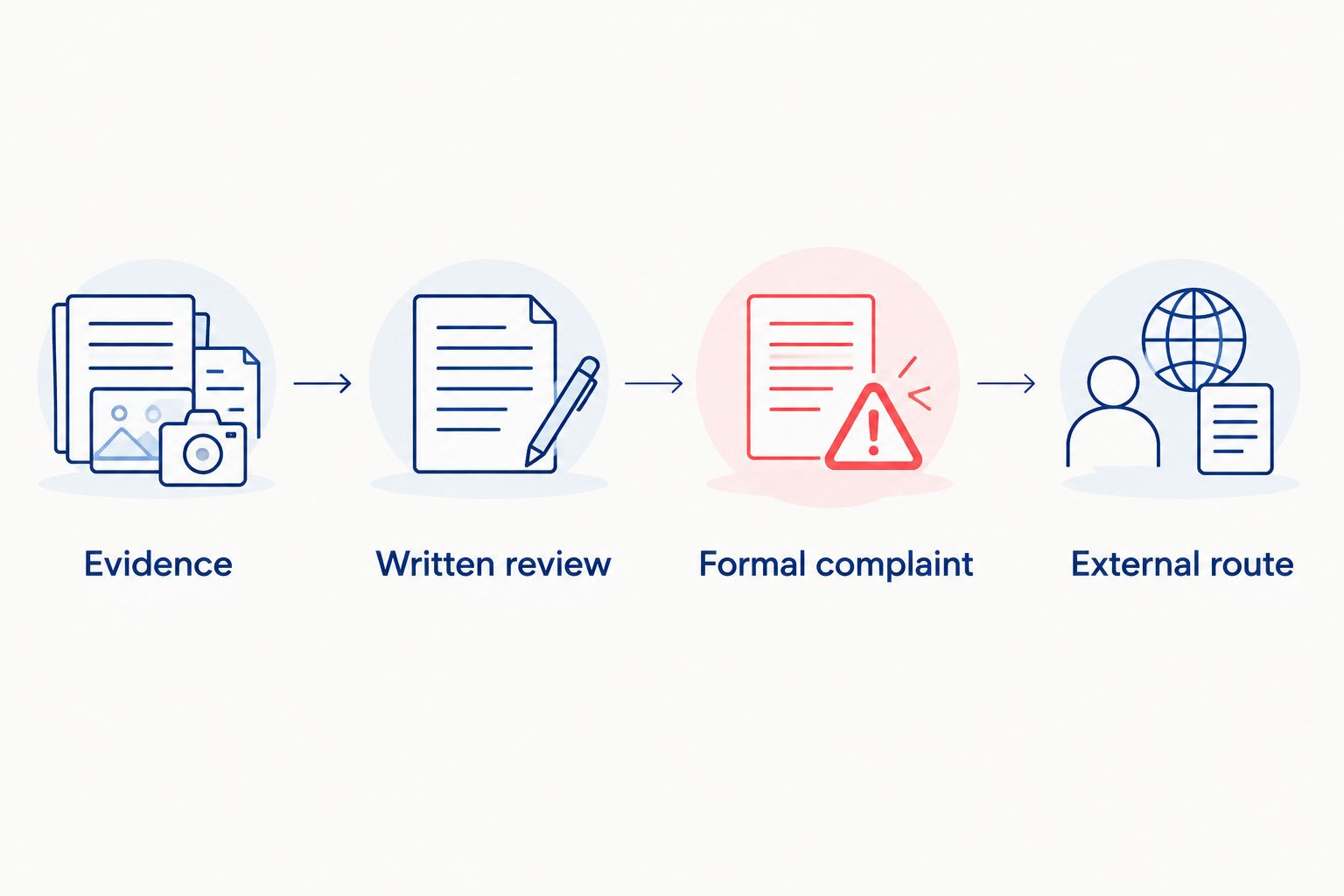
The workflow is Evidence, Written review, Formal complaint and External route. An urgent legal deadline runs alongside these stages; it does not wait for them to finish.
External route and deadline record
- Classify the unresolved issue again. A final complaint response does not turn a valuation disagreement into an administrative complaint. Check whether you need a valuation challenge, a decision-specific appeal or an external complaint.
- Check the external body's remit. For council administration complaints, the relevant bodies are the Local Government and Social Care Ombudsman in England and the Public Services Ombudsman for Wales. Read their current acceptance rules before submitting.
- Use the correct valuation procedure. If rateable value is the issue, follow CCA and the relevant tribunal arrangements rather than asking an ombudsman to set a valuation.
- Record the next action and deadline. Save the decision, submission confirmation and any directions. Seek prompt advice where you receive a summons, hearing notice or enforcement correspondence.
Expected result: the unresolved issue reaches a body able to consider it, with its procedural requirements identified.
For a 2026 case, use current official guidance and the instructions attached to your decision. Do not borrow a deadline from an unrelated relief scheme, another council's page or a different type of appeal.
When a revised bill arrives during your dispute
A new bill is a separate document to check, not proof that the original complaint has been resolved. Compare the revised bill with the correction you requested.
- Check the revised period and liable party. Confirm whether the council changed the dates or account details actually disputed.
- Reconcile the account. Check payments, credits, relief entries and any balance carried forward. Ask for an account breakdown where the movement is unclear.
- Update the existing case. Send the revised bill under the existing reference and explain what it resolves and what remains wrong.
- Confirm the complaint's scope. Tell the council whether you still seek a response about delay or handling, even if the billing error has been corrected.
Expected result: the dispute narrows to the remaining issues instead of restarting with a fresh, disconnected email thread.
If a valuation change led to the revised bill, check the effective date shown against the council's calculation. Treat the valuation decision and the council's resulting account adjustment as connected but separate records.
Troubleshooting
The council keeps referring you to the valuation authority
State exactly what needs correcting. If you accept the rateable value but dispute a payment allocation or occupation date, make that distinction explicit; if the valuation itself is wrong, use CCA.
You receive acknowledgements but no substantive answer
Keep the acknowledgement and compare progress with the council's published response arrangements. Escalate through its complaint procedure, identifying the original submission date and the questions still unanswered.
Recovery continues while the complaint is open
Contact the revenues or recovery team immediately and request a clear written position. Continue to follow payment requirements unless the council confirms a different arrangement; seek urgent advice if legal proceedings or enforcement are involved.
The council says you have not supplied evidence
Resend the indexed documents with your original submission receipt. Ask which particular fact remains unsupported so you can answer the actual evidence gap rather than send the entire file repeatedly.
Your representative cannot obtain account information
Check the council's authorisation requirements and confirm the correct ratepayer name and account reference. Agree who will send instructions and receive decisions so that important correspondence does not sit with the wrong person.
Customise your workflow
For multiple properties, keep a separate evidence file and timeline for each account. A shared summary helps you track progress, but evidence about one site does not automatically establish the position at another.
If relief and valuation are both disputed, maintain separate action lists. The guide to claiming business rates relief while appealing explains that distinction in more detail.
Appeal My Rates UK can help with council business rates disputes, valuation challenges and property splits or mergers. Let us handle your case when you need help identifying the issue, organising evidence and taking it to the appropriate decision-maker.
Appeal My Rates UK — fees: Most of our work is no win, no fee, but some instructions carry fixed fees. Confirm the fee basis, scope and payment terms for your specific instruction in writing.
Get help with your council dispute
Explain the disputed bill, the council’s response and any deadline you have received.
FAQ
How do I escalate a council business rates dispute?
Request a written review with indexed evidence, then use the council’s published complaint procedure for unresolved handling failures. Keep any statutory appeal or valuation challenge separate and protect its deadline.
Can the council reduce my property’s rateable value?
The council does not determine your property’s rateable value. Valuation challenges follow Check, Challenge, Appeal through the valuation authority, with appeals going to the relevant Valuation Tribunal for England or Wales.
Does making a complaint stop business rates recovery?
A complaint does not automatically stop business rates recovery. Ask the council for written confirmation of any pause or payment arrangement, and obtain urgent advice about a summons or enforcement notice.
Do England and Wales use different valuation appeal routes?
Both England and Wales use Check, Challenge, Appeal for current valuation challenges. That shared process does not mean every relief rule, deadline or tribunal arrangement is identical.
Can an ombudsman investigate my business rates complaint?
An ombudsman can consider eligible complaints about council administration within its remit. Check the relevant body’s acceptance rules; an ombudsman complaint does not replace a valuation appeal or another statutory remedy.
What evidence should I send with my dispute?
Send the disputed notice, a dated timeline and documents supporting the correction you request. Include relevant payment records, occupation evidence or relief correspondence rather than unrelated paperwork.
Can Appeal My Rates UK help me deal with the council?
Appeal My Rates UK helps business owners with council rates disputes and rating valuation challenges. Confirm the proposed scope of the instruction and the fee basis and payment terms in writing before proceeding.
One last thing
Ask for the reason, not just the result. A response confirming that the bill remains unchanged is harder to act on than a decision explaining the accepted facts, the rule applied and the next available route.
For your 2026 dispute file, keep the original bill alongside every replacement. The differences between them help you identify whether the council corrected the disputed issue or changed something else.
Related guides
- How to challenge a backdated business rates bill
- Business rates demand notices and appeal evidence
- How to track your business rates appeal case status