

Sports club business rates reduction is the process of checking a club property’s valuation and relief eligibility with the aim of correcting its bill. In 2026, a golf or sports club needs to separate valuation questions from relief questions: the Valuation Office Agency (VOA) deals with the rating assessment, while the council administers the bill and relief.
- Business rates reduction sports club verdict: check the rating assessment and relief eligibility before starting an appeal.
- A registered community amateur sports club can qualify for 80% mandatory relief if it meets the conditions.
- Appeal My Rates UK is best for clubs that want a rating surveyor to handle valuation evidence or a council dispute.
- A lower rateable value is not guaranteed; compare the evidence and confirm the fee terms in writing.
Why business rates matter for sports clubs
A sports club can use land and buildings in different ways. A golf course, clubhouse, changing rooms and separately occupied space do not necessarily raise the same valuation or billing question. Your first job is to identify exactly what the bill covers, rather than assume every part of the site has the same status.
For a business rates reduction sports club review in 2026, start with the current demand notice and the published rating assessment. The VOA Check, Challenge, Appeal guide explains the valuation route; it does not replace a separate request to the council about relief. Pursuing the wrong route delays an answer to the question you actually need resolved.
Status matters too. A registered community amateur sports club, or CASC, can qualify for 80% mandatory business rates relief on an eligible property. The remaining 20% of the bill is a separate question for the council, which has discretion over additional relief. A club is not eligible simply because it provides sport: its registration, occupation and use must meet the applicable conditions.
How to review a sports club rates bill
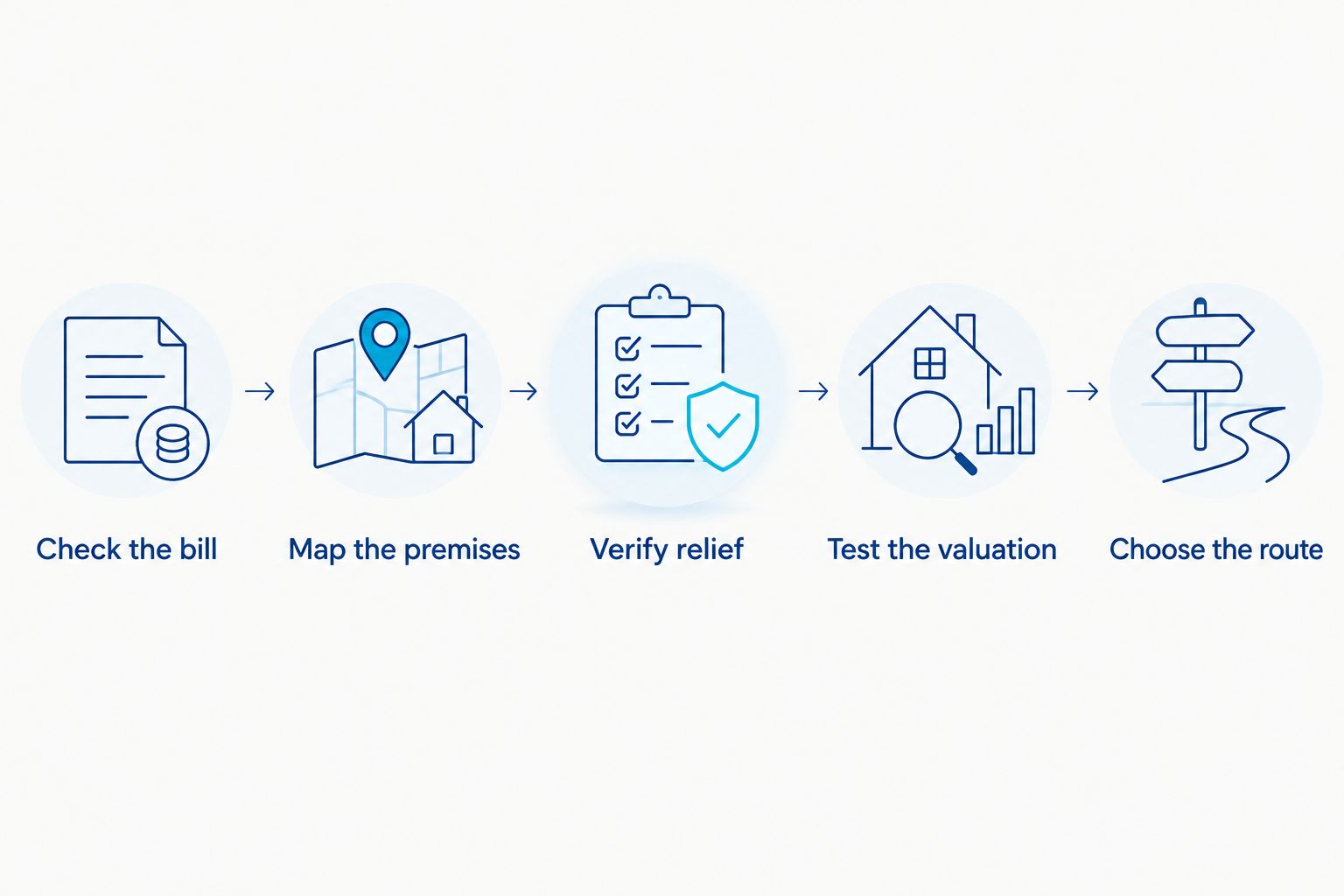
Work from the property and its records, not from a promised saving. In 2026, the useful sequence is to check the bill, map the premises, verify relief, test the valuation, choose the route, collect evidence and agree who will handle the case. Each stage answers a different question.
Check the bill
Read the council’s 2026 demand notice alongside the VOA entry. Match the property address, named ratepayer and description of the assessed premises. A rateable value is a valuation used to calculate the bill; it is not the amount the club pays.
If the notice and assessment appear to describe different premises, write down the difference before contacting either organisation. Ask the council to explain a billing entry; ask the VOA about the rating assessment. Keep a copy of each reply so the club does not have to reconstruct the issue later.
- Record the property address and ratepayer shown on the demand notice.
- Compare the notice with the published rating assessment.
- Mark each charge or relief entry you cannot explain.
- Save the notice and correspondence in the club’s case file.
Map the premises
Walk the site with the assessment in hand. Identify the course or pitches, clubhouse, changing facilities and any area another organisation occupies. The point is not to assume that every room needs its own assessment. It is to establish what space the existing entry covers and whether the recorded property still matches the occupation on the ground.
A café run by the club and a space occupied independently by someone else raise different questions. Record who occupies each area and the terms of that occupation before asking for a split or merger. A property split or merger is a response to the facts of occupation, not an automatic way to cut a bill.
- Sketch the boundaries of the assessed property.
- Note who occupies each area and how it is used.
- Keep leases, licences or occupation agreements where they exist.
- Flag any area whose use or occupation has changed.
Verify relief
Check whether the club is registered as a CASC or charity and whether the property meets the conditions for the relief claimed. Then compare the council’s decision with the relief entries on the 2026 bill. Do not treat an unanswered relief question as proof that the valuation is wrong.
An eligible CASC can receive 80% mandatory relief. A council can consider discretionary relief on the remaining 20%, but that further reduction is not automatic. Ask the council for its criteria and a written decision for the property. If registration or use has changed, give the council accurate current details.
- Check the club’s registration status rather than relying on its name.
- Identify the property and occupation covered by the relief request.
- Ask the council which evidence it needs for mandatory or discretionary relief.
- Compare the written decision with the relief shown on the bill.
Test the valuation
A higher bill is not, by itself, evidence of an incorrect rateable value. Compare the VOA’s property description and valuation details with the club’s actual premises. Look for errors in what has been assessed, changes in occupation or physical conditions that affect the property.
For a golf club, describe the issue precisely. A building that is unusable, an area under building work and a disagreement with the assessed property boundaries are different cases. Date the evidence. Photographs without a location, date or explanation give the VOA less to work with than a clear account of what changed and when.
- Compare the recorded property details with the site as it stands.
- Describe each suspected error in ordinary language.
- Gather dated plans, photographs and relevant correspondence.
- Separate evidence about the property from complaints about the size of the bill.
Choose the route
Send a billing or relief question to the council. Take a valuation question through the procedure applicable to the property’s country and rating list. In England and Wales, that generally means the VOA’s Check, Challenge, Appeal process. Wales adopted the same Check, Challenge, Appeal process on 1 April 2023, so a club in Wales follows the same stages; confirm the current official instructions and deadlines before submitting.
A formal valuation challenge needs a defined reason and supporting evidence. If the immediate problem is a missing relief entry, ask the council about that entry first. If the bill and assessment both raise concerns, keep the requests distinct so each organisation can answer the part it controls.
- Ask the council about liability, billing entries and relief decisions.
- Ask the VOA about the assessment and valuation details.
- Check the applicable procedure before submitting a challenge.
- Keep separate records for separate valuation and billing issues.
Assemble your evidence
Put the club’s records in date order before submitting a case. Include the demand notice, assessment details, relevant property documents and a short explanation of the change or error. Identify who can confirm how the premises are used. A committee discussion is useful preparation, but the submission needs documents that address the specific issue.
Do not wait until a dispute to locate an old plan or occupation agreement. For a club with multiple spaces or users, a simple property schedule can prevent confusion about which area a photograph or document describes. If evidence conflicts, explain the conflict rather than leaving it for the reviewer to find.
- List each document with its date and the area it concerns.
- Match photographs to locations on a plan.
- Record changes in occupation and the dates they took effect.
- Draft a short statement of the correction or decision requested.
Agree who handles the case
You can check the bill, gather documents and contact the council or VOA yourself. If the assessment is disputed, a rating surveyor can review the property evidence and handle a valuation case. Appeal My Rates UK provides rating surveyor services for valuation challenges, property splits or mergers and disputes with council rates teams in England and Wales.
Appeal My Rates UK is best for sports clubs that want a rating surveyor to review a disputed assessment and handle the case; it cannot promise a reduction. Let us handle your case when the property evidence warrants a challenge. Most of our work is no win, no fee, but some instructions carry fixed fees. Confirm the fee basis, scope and payment terms for your specific instruction in writing before work begins.
- Decide who at the club can approve instructions and supply records.
- Ask what issue the proposed work will address.
- Confirm the fee basis, scope and payment terms in writing.
- Retain copies of submissions and decisions for the club.
Which option fits your club?
There is no single route called a sports club rates reduction. Choose the option by the decision you need changed. You can use more than one route when the issues are genuinely separate, but do not assume that success on relief proves the valuation should also fall.
| Option | Best for | Fee position | Key limitation |
|---|---|---|---|
| Club-led bill review | Clubs checking the notice, occupation and available records | No adviser fee for doing your own review | The committee must identify the issue and manage correspondence. |
| Council relief request | Clubs asking whether the property qualifies for relief | Confirm any applicable costs or terms directly | The council cannot correct a VOA valuation through a relief decision. |
| Club-led valuation challenge | Clubs with a specific assessment error and supporting evidence | No adviser fee for preparing your own case | The club must follow the applicable procedure and present its evidence. |
| Appeal My Rates UK rating surveyor service | Clubs wanting professional help with a valuation, split, merger or council dispute | Confirm the fee basis, scope and payment terms in writing | An instruction does not guarantee a reduced assessment or bill. |
For 2026, start with the route that matches the clearest documented issue. If the council has not applied relief despite evidence of eligibility, ask for a written relief decision. If the property description is wrong, focus on the assessment. Paying for a valuation challenge will not, on its own, resolve an unanswered council relief application.
Common mistakes sports clubs make
Treating a large bill as proof of a bad valuation. A bill reflects more than rateable value. Check the assessment, the charge and any relief separately before stating what needs to change.
Assuming sports use guarantees relief. CASC or charitable relief depends on eligibility and the property’s use. Give the council registration and occupation information; ask it to explain a refusal in writing.
Confusing an occupied room with a separate rating assessment. A clubhouse can contain different activities without every room requiring its own entry. Establish the boundaries and occupation first, then consider whether a split or merger question exists.
Sending a valuation complaint only to the council. The council handles the bill and relief; the VOA handles the assessment. Send each question to the organisation that can decide it, and keep the answers together.
Agreeing to representation without clear terms. A promise of a reduction is not evidence. For 2026 instructions, request a written description of the issue, proposed work, fee basis and payment terms before appointing anyone.
FAQ
How can a golf club reduce business rates in 2026?
A golf club should check its rating assessment for errors and ask the council whether it qualifies for relief. Valuation challenges and relief applications address different parts of the bill.
Does every sports club qualify for business rates relief?
No. Relief depends on the club’s status, the property and the applicable conditions. Ask the council to assess the club’s circumstances rather than relying on its sporting purpose alone.
Can a registered CASC get business rates relief?
An eligible registered CASC can receive 80% mandatory business rates relief. The council can consider additional discretionary relief on the remainder, but it is not automatic.
Who corrects a sports club’s rateable value?
The VOA handles the rating assessment and valuation. The council handles billing and relief, so send a valuation challenge through the procedure applicable to the property.
Should a club appeal because its rates bill has risen?
No. A higher bill alone does not establish a valuation error. Compare the assessed property with the premises and gather evidence of a specific mistake or relevant change.
Can changing the use of part of a clubhouse affect rates?
A change in use or occupation can raise a valuation or billing question. Record who uses the space, how it is occupied and when the change happened before asking for a review.
Is Appeal My Rates UK always no win, no fee?
No. Most of our work is no win, no fee, but some instructions carry fixed fees. Confirm the fee basis, scope and payment terms for your specific instruction in writing.
One last thing
The most useful 2026 check is often the simplest: put the council bill next to the VOA assessment and mark who must answer each question. A relief decision will not fix an inaccurate assessment, and a valuation challenge will not replace a relief application. Keep those tracks separate so the club can ask for the right correction with the right evidence.
Related guides
- Is a business rates appeal worth it?
- Partly empty property business rates appeal
- Compare business rates consultant fee terms
