

To get a business rates refund, ask your council to correct your business rates account and repay any resulting credit, supported by payment records and evidence of the error or change. If the overpayment comes from an incorrect rateable value, you must address the valuation through Check, Challenge, Appeal before the council can recalculate the affected bill. A lower valuation or revised bill does not automatically mean a cash refund: the account must show that you paid more than you owed.
- How to get a business rates refund: establish the correction, obtain a revised bill, then request repayment of the credit.
- Council billing corrections and rateable value challenges need different evidence and go to different decision-makers.
- England and Wales both use Check, Challenge, Appeal for the 2023 rating list onwards.
- Appeal My Rates UK is best for business owners needing professional help with disputed valuations or council rates accounts.
How to claim a business rates refund from your council
Start with the reason you overpaid, not just the amount you want returned. A council needs a basis for changing your liability, such as a duplicated payment, corrected occupation dates, an approved relief or an amended valuation.
Appeal My Rates UK helps business owners challenge valuations and handle disputes with council rates teams. For a straightforward credit already shown on your account, start by asking the council for its refund procedure.
Identify the correct route
Use this comparison to separate the correction from the repayment request. The best route depends on what caused the overpayment, not whether your premises are in England or Wales.
| Route | Best for | Main advantage | Limitation |
|---|---|---|---|
| Council account correction | Duplicate payments, payment allocation errors or incorrect liability dates | Addresses the billing account directly | Does not change an incorrect rateable value |
| Council relief review | Relief missing from a bill or applied for the wrong period | Addresses the relief decision and resulting calculation | Eligibility and backdating depend on the particular relief |
| Check, Challenge, Appeal | An incorrect rateable value or property assessment | Addresses the valuation underlying the bill | A submission alone does not establish a refund entitlement |
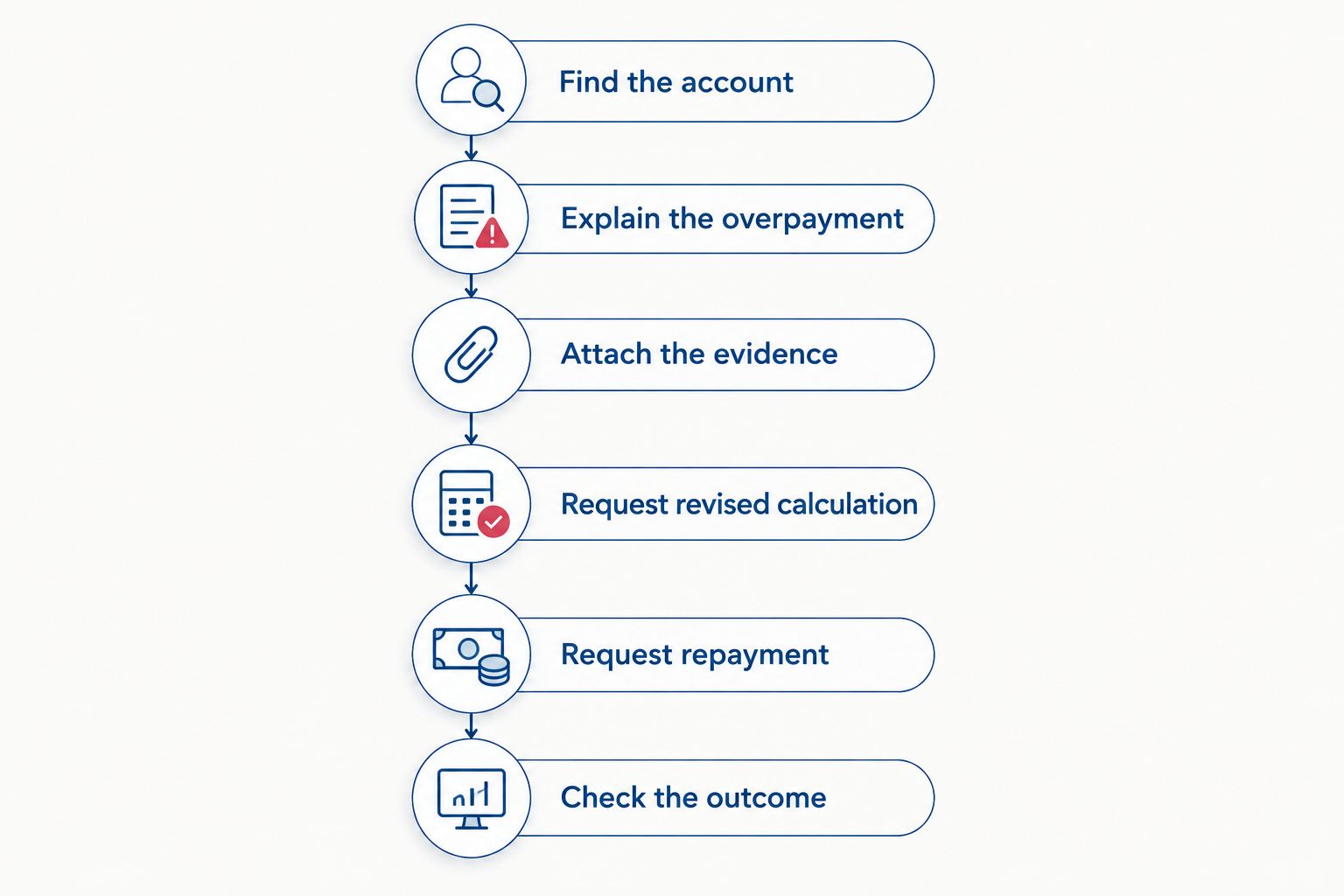
Follow these steps
- Find the affected account. Record the council, property address, business rates account reference and legal name of the ratepayer. Match these details against the bills you want corrected.
- Explain the overpayment. State whether the issue concerns payments, occupation dates, relief or valuation. Identify the affected billing period rather than asking for an unspecified refund.
- Attach the evidence. Send the bills, relevant payment records and documents supporting the correction. For a valuation change, include the decision or amended assessment details.
- Request a revised calculation. Ask the council to show the corrected liability, payments credited and resulting balance. A decision letter is not a substitute for checking the account calculation.
- Request repayment. Once the account shows a credit, follow the council's refund process. Confirm the intended recipient and provide payment details through a verified channel.
- Check the outcome. Compare the repayment or credit allocation with the revised account. Ask for an explanation of any difference before treating the matter as closed.
Keep a copy of the submission and its acknowledgement. If you later need to chase the council, a dated record makes the request easier to identify and avoids repeating the whole case.
Why this matters
A business rates refund involves two separate questions: what should you have owed, and what did you actually pay? You need both answers to establish an overpayment. Evidence that supports a lower liability does not, by itself, prove that money is due back.
For a refund request made in 2026, separate each affected billing period and keep the original bills alongside any revisions. That allows you to check whether the council applied the correction to the right dates rather than simply changing the current instalments.
Do not stop paying business rates merely because you have requested a refund or challenged the valuation. Continue paying as billed unless the council confirms a different arrangement; a pending dispute does not automatically suspend collection.
Refunds caused by a council billing error
A billing correction is the right starting point when the valuation is not the issue. Examples include a payment credited to the wrong account, a duplicate payment or a bill covering dates for which you were not the liable ratepayer.
Tell the council exactly which entry you dispute. If your bank statement shows a payment that the account does not show, provide its date, amount and reference. Ask the council to trace the payment before requesting repayment of an assumed credit.
Occupation disputes need evidence of the relevant dates and responsibility for the premises. A lease, surrender document, handover record or other supporting correspondence helps explain the change, but no single document automatically settles every liability question.
For a closed account, ask for a final account statement. Check that the council has recorded the correct end date and reconciled the payments before relying on the displayed credit balance.
Refunds caused by missing or corrected relief
If the bill omitted relief, request a review of the relief decision and the affected billing periods. Explain the eligibility basis and submit the documents the council requires. Paying the bill in full does not establish that relief should have applied.
Do not assume relief starts on the date your business opened, bought the property or signed its lease. Eligibility, the effective date and any backdating rules depend on the relief concerned. Ask the council to state those points in writing.
For a relief review in 2026, identify the scheme and period explicitly. England and Wales share the current valuation challenge process, but that does not make their relief rules identical.
After relief is approved, check the revised bill against the decision. If the correction reduces an unpaid balance, you have a lower amount to pay; if it creates an overpayment, ask how the council will handle the credit.
Refunds following a rateable value reduction
If the rateable value is wrong, a refund request to the council does not replace a valuation challenge. The valuation authority handles Checks and Challenges, while an appeal goes to the relevant Valuation Tribunal for England or Wales.
Both England and Wales use Check, Challenge, Appeal for the 2023 rating list onwards. Wales adopted the process on 1 April 2023, as confirmed in the government's non-domestic rating challenges background information published with its September 2025 statistics. A current Welsh valuation challenge is not a separate proposal-based route.
For a valuation case pursued in 2026, identify the rating list, property assessment and effective date involved. Keep the evidence about the valuation separate from the documents proving what you paid to the council.
The business rates finder and appeal evidence guide explains the records to assemble before disputing an assessment. A clear evidence file supports the valuation case; your billing and payment records support the refund calculation afterwards.
Once an assessment changes, ask the council to confirm receipt of the amendment and issue the relevant revised bills. Check the effective date carefully: a reduction applying from a particular date does not automatically change every earlier bill.
What evidence should you send with a refund request?
Prepare 3 document groups: bills, payments and the correction evidence. Keep them distinct so the council can check the liability and the money received without searching through unrelated paperwork.
- Bills: original and revised demand notices, the account reference and the affected periods.
- Payments: bank records, receipts or transaction confirmations showing the relevant dates, amounts and references.
- Correction evidence: the relief decision, valuation amendment, occupation documents or correspondence explaining the error.
Include your business's legal name and the property address in the covering message. Where a trading name differs from the ratepayer's name, explain the connection rather than assuming the council will recognise it.
If a representative submits the request, provide the authorisation the council requires. Keep bank details out of unverified messages and use the council's official submission method when supplying sensitive information.
What should your refund request say?
Keep the request factual and specific. Identify the account, describe the correction and state what you want the council to do next. Avoid claiming an amount unless you can reconcile it to the payments and revised liability.
Use this checklist to structure your message:
- Identify the property, ratepayer and business rates account reference.
- State the billing period you want reviewed.
- Explain the error, approved relief or valuation amendment.
- List the documents attached and what each proves.
- Request a revised statement showing liability, payments and credits.
- Ask for repayment of any confirmed overpayment and written confirmation of its treatment.
If the council has already issued a revised bill, refer to that document directly. Ask whether the credit remains on the account, has been allocated elsewhere or has been authorised for repayment.
Request a calculation, not just a status update. A reply saying the account has been adjusted does not explain whether every relevant payment and billing period has been included.
Why business rates refunds vary
The refund depends on the corrected account, not simply the size of a valuation reduction. These factors determine what the council must reconcile:
- Effective date: the correction affects the period to which the decision applies.
- Payments received: only money credited against the relevant liability establishes an overpayment.
- Outstanding balances: ask whether the council has applied a credit against another amount owed.
- Relief position: the revised calculation must account for the applicable relief, not just the rateable value.
- Account ownership: changes of ratepayer or legal entity require the correct account and recipient to be identified.
- Property changes: splits, mergers or altered assessments require the affected properties and dates to be matched to the bills.
When checking a refund calculation in 2026, compare like with like: the same property, ratepayer and billing period. Do not combine unrelated accounts into one assumed refund total.
When should you ask a rating surveyor for help?
Appeal My Rates UK is best for business owners needing professional help with disputed valuations or council rates accounts. Professional support is relevant when the case involves valuation evidence, property splits or mergers, disputed liability dates or an unresolved council disagreement.
For an undisputed credit already confirmed by the council, a direct refund request is the simpler starting point. Appointing a representative adds an instruction and fee agreement; it does not remove the need for evidence or guarantee a reduction.
Appeal My Rates UK on fees: Most of our work is no win, no fee, but some instructions carry fixed fees. Confirm the fee basis, scope and payment terms for your specific instruction in writing before appointing a representative.
Get help with your rates case
Discuss a valuation challenge or council dispute and confirm the scope and fee terms in writing.
Can I get a refund without appealing my valuation?
Yes, a valuation appeal is unnecessary when the overpayment comes from a billing or payment error. Ask the council to correct the account and repay any confirmed credit; use the valuation process only when the assessment itself needs changing.
Will a successful appeal automatically produce a refund?
No, a successful appeal produces a refund only if the revised account shows an overpayment. The change can instead reduce an outstanding bill, so check the revised liability against payments already made.
Can my business rates refund cover earlier bills?
A refund can cover earlier bills when a valid correction applies to those periods and creates an overpayment. The effective date and applicable rules control the period; buying or occupying the property does not automatically set the refund start date.
FAQ
How do I get a business rates refund from my council?
Ask the council to correct the relevant account, issue a revised calculation and repay any confirmed overpayment. Include the account reference, affected billing periods, payment evidence and documents supporting the correction.
Who pays a refund after a business rates valuation appeal?
The council handling your business rates account processes the billing adjustment and any resulting refund. The valuation authority handles Checks and Challenges; appeals go to the relevant Valuation Tribunal.
Do England and Wales use the same business rates appeal process?
England and Wales both use Check, Challenge, Appeal for the 2023 rating list onwards. That shared process does not mean all relief rules, deadlines or tribunal arrangements are identical.
How long does a council business rates refund take?
There is no single processing time that applies to every council refund request. Ask whether the correction has been recorded, whether the account has been reconciled and whether repayment has been authorised.
Should I stop paying business rates while waiting for a refund?
No, continue paying as billed unless the council confirms a different arrangement. A refund request or valuation challenge does not automatically suspend payment obligations.
Can I claim a business rates refund after leaving the property?
Leaving the property does not prevent you from requesting repayment of an overpayment on your former account. Ask for a final statement and provide evidence of the relevant liability dates and payments.
Does Appeal My Rates UK handle every case on a no win, no fee basis?
Most of our work is no win, no fee, but some instructions carry fixed fees. Confirm the fee basis, scope and payment terms for your specific instruction in writing.
One last thing
A credit balance and a cash repayment are not the same outcome. Before closing your 2026 refund file, ask the council to confirm where the credit went and reconcile that answer with your bank records or outstanding balance.
Keep the final revised bill, account statement and repayment confirmation together. Those records explain the completed correction if a later demand notice raises the same period again.
Related guides
- How much can I save by challenging my business rates?
- Can a business rates refund be backdated to the purchase date?
- Compare business rates consultant fee terms
