

You save only if a business rates challenge produces a valuation change that reduces what you owe; there is no standard saving or guaranteed percentage. For a case started in 2026, assess the revised council bill, the period affected and the agreed professional fees—not just the proposed reduction in rateable value.
- How much can you save challenging business rates? Calculate the bill reduction, then deduct agreed fees.
- A lower rateable value does not automatically produce an equal percentage reduction in your bill.
- England and Wales use Check, Challenge, Appeal for the 2023 rating list onwards.
- Appeal My Rates UK helps business owners challenge valuations; confirm the scope and fee terms in writing.
How much can I save by challenging my business rates?
Your saving is the difference between the correct bill and the original bill, less the fees agreed for your instruction. Separate any refund for an earlier period from reductions in future bills. They affect your cash flow differently, and a projection is not money already recovered.
A rating surveyor should explain the evidence supporting a change before presenting a savings estimate. An incorrect floor area, an unsuitable valuation comparison or a property assessment that no longer matches the premises needs a different argument; dissatisfaction with the bill alone does not establish a valuation error.
Appeal My Rates UK provides business rates appeals and rating surveyor services for business owners in England and Wales. Appeal My Rates UK is best suited to business owners who want professional help challenging a valuation or resolving a council rates dispute. Professional representation gives you help preparing and handling the case, but it does not guarantee a reduction.
What should a savings estimate show?
Ask for a calculation that separates these elements:
- Valuation change: the rateable value being challenged and the proposed replacement.
- Bill impact: how that change affects the amount payable after the applicable billing rules and reliefs.
- Effective period: the dates for which the change would apply.
- Past adjustment: any potential credit or refund relating to amounts already paid.
- Future reduction: the effect on later bills, shown separately from past adjustments.
- Net benefit: the amount left after the agreed professional fees and any other applicable charges.
A useful estimate explains its assumptions. If it treats every reduction in rateable value as an identical reduction in the final bill, ask for the calculation to be rebuilt using your actual circumstances.
Why this matters
Your rateable value is not your business rates bill. It is part of the calculation, alongside the applicable multiplier, reliefs and other billing adjustments. That distinction matters when someone presents a large valuation reduction as though it were the amount you will receive.
For your 2026 budgeting, keep expected savings separate from confirmed changes. Continue paying the amounts demanded unless the council changes your bill or agrees another arrangement; submitting a valuation challenge does not suspend the payment obligation.
The practical question is not simply whether the valuation looks high. It is whether there is a supported correction, whether that correction changes your liability and whether the benefit justifies the agreed cost of pursuing it.
Valuation challenge, relief or billing correction?
A valuation challenge is not the answer to every high bill. Identify what is wrong before choosing the route, because the valuation authority and the council deal with different parts of business rates administration.
| Route | Best for | What it addresses | Main limitation |
|---|---|---|---|
| Valuation challenge | Businesses with evidence that their property assessment is wrong | The property's rateable value or assessment | A reduction needs supporting evidence and does not guarantee an equivalent bill reduction |
| Relief application or review | Businesses that meet the conditions for an applicable relief | Whether relief has been awarded correctly | Eligibility depends on the particular relief and circumstances |
| Council billing correction | Businesses with an incorrect demand, liability period or payment allocation | Errors in the council's bill or account | Correcting the account does not itself change the property valuation |
Choose the route that matches the error, not the route advertised with the largest saving. If your bill names the wrong liable party or covers the wrong occupation period, start with the council account. If the property assessment itself is wrong, investigate the valuation.
These routes can overlap. Keep each issue identifiable in your correspondence so that a valuation question does not obscure a billing error, or vice versa. Ask who will handle each part and whether the proposed instruction includes all of them.
How to assess your potential saving
A defensible savings estimate starts with records, not a promised percentage. Use this sequence to establish what needs correcting and what the correction would mean for your business.
- Check the assessment. Identify the property, rating list and valuation entry relevant to the bill. Compare the recorded details with the premises you actually occupy.
- Gather evidence. Collect the demand notice, lease information, plans, measurements and correspondence relevant to the suspected error. Record when any relevant property change occurred.
- Test the grounds. Explain why the assessment is wrong, rather than simply why the bill is difficult to afford. Any comparable property must be relevant to the valuation argument.
- Calculate the impact. Work through the resulting bill adjustment using the applicable rules, reliefs and effective dates. Separate money already paid from future liability.
- Confirm the terms. Get the scope, fee basis and payment terms in writing before instructing a representative. Check how the agreement treats refunds and future reductions.
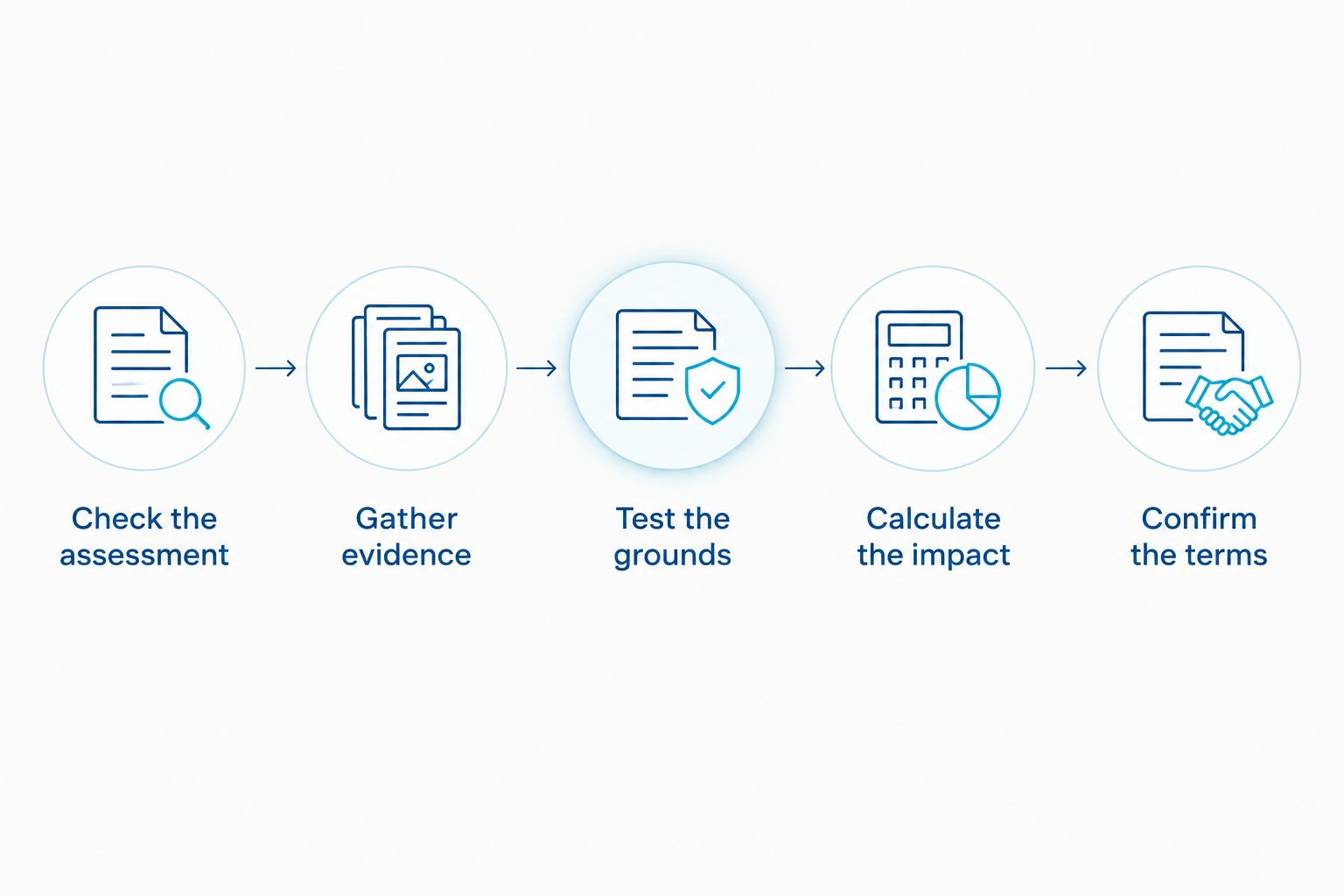
Keep an evidence trail from the outset. A dated plan showing the area under dispute is more useful than an unsupported statement that the premises are smaller than the valuation record suggests. Likewise, a comparison needs an explanation of why the properties are genuinely comparable.
When reviewing a case in 2026, distinguish the bill date, the occupation dates, the rating list and the effective date sought. Those dates answer different questions. Combining them into one assumed refund period creates an unreliable estimate.
How does Check, Challenge, Appeal affect the saving?
England and Wales both use Check, Challenge, Appeal for valuation disputes concerning the 2023 rating list onwards. Wales adopted the process on 1 April 2023, as confirmed in the government's non-domestic rating challenges and changes background information covering those rating lists.
Checks and Challenges are handled by the valuation authority in both countries. Appeals go to the relevant Valuation Tribunal for England or Wales. The shared process does not mean that every relief, billing rule, deadline or tribunal arrangement is identical.
The stages serve different purposes:
- Check: establish and address the relevant property facts.
- Challenge: put forward the valuation case with supporting evidence.
- Appeal: take an eligible unresolved dispute to the relevant tribunal.
For a 2026 instruction, ask which rating list and stage your case concerns. Do not assume that a completed Check establishes a saving, or that every dispute must proceed to an appeal. The financial outcome depends on the assessment change and its effect on your liability.
The Check, Challenge, Appeal guide explains the route in more detail. Before proceeding, establish the applicable requirements and deadlines for your particular case rather than relying on a generic timetable.
Why business rates savings vary
The size of the bill is not enough to predict the saving. These factors determine whether a supported valuation change produces a useful financial result:
- The valuation error: the evidence must establish what is wrong and support the proposed correction.
- The current liability: reliefs and billing adjustments affect how a valuation change translates into the amount payable.
- The effective date: the date from which a correction applies determines which periods need recalculating.
- Payments already made: a revised liability and a cash refund are not necessarily the same amount.
- Property circumstances: occupation, physical layout and splits or mergers can affect what needs assessing.
- Instruction terms: professional fees affect what you retain, even when the underlying case succeeds.
Ask for these factors to appear in the explanation of your estimate. A single headline figure conceals too much: it can combine a past adjustment, a projected future reduction and a fee calculation that has not yet been agreed.
Avoid comparing your expected outcome with a neighbouring business's reported refund. Without matching the property assessment, relevant dates, relief position and instruction terms, that comparison does not establish what your own case is worth.
What do I keep after professional fees?
You keep the benefit remaining after the fees and charges agreed for your instruction. Read the written terms before authorising work, particularly how the agreement defines success and calculates the amount payable.
Most of our work is no win, no fee, but some instructions carry fixed fees. Appeal My Rates UK confirms the fee basis and payment terms for the specific instruction in writing; confirm the scope as well, including what happens if further work becomes necessary.
Ask whether the fee calculation includes past refunds, future reductions or both. Check whether VAT or other charges apply, what triggers an invoice and whether payment becomes due before the council has processed an adjustment. These questions concern the contract, not the size of the valuation reduction.
Professional help provides case preparation and representation, but the cost reduces your retained benefit. Handling the case yourself avoids a representative's fee, but leaves you responsible for the evidence, procedure and deadlines. Choose based on the complexity of the case and the written terms—not a promise that every instruction costs nothing upfront.
Let us handle your case
Confirm the scope, fee basis and payment terms for your business rates instruction in writing.
Can I get a refund for business rates I have already paid?
A successful valuation challenge can lead to an adjustment for a past period where the change applies. The council then needs to revise the relevant liability and account for payments already made.
An adjusted account is not automatically an immediate cash refund. Check whether the council has issued a revised demand, how the adjustment appears on your account and whether any amount is being credited against outstanding liability.
Ask for the effective date to be explained before treating earlier payments as recoverable. Your purchase date, lease start date or first payment date does not by itself establish the start of a valuation-related refund.
Can my business rates go up after a challenge?
A valuation review is not a guaranteed one-way reduction. If the assessment is found to be too low or property facts require correction, the outcome can increase the valuation rather than reduce it.
Before submitting a case, ask for the grounds and risks to be explained. A strong recommendation addresses evidence that works against the proposed reduction as well as evidence that supports it. Do not proceed solely because a consultant has promised savings.
Is challenging my business rates worth it in 2026?
A challenge is worth pursuing when there is a supported valuation issue and a meaningful expected benefit after the agreed fees. A high bill alone does not meet that test.
Make the decision using the likely bill impact, applicable dates, evidence quality and contractual terms. Keep the downside visible too: the assessment can remain unchanged, the process requires work and an unfavourable correction can increase liability.
If the issue is actually a missing relief or a billing error, address that issue directly. You do not need to force every dispute into a valuation challenge to seek a correct bill.
FAQ
How much can you save challenging business rates?
Your saving depends on the reduction in your actual business rates liability, less the agreed professional fees. There is no standard percentage: the valuation outcome, reliefs and effective dates determine the result.
Does a lower rateable value mean my bill falls by the same percentage?
No, a lower rateable value does not guarantee an identical percentage reduction in your bill. The applicable multiplier, reliefs and other billing adjustments affect the amount payable.
Do England and Wales use the same business rates appeal process?
England and Wales both use Check, Challenge, Appeal for the 2023 rating list onwards. Checks and Challenges go to the valuation authority; appeals go to the relevant Valuation Tribunal for England or Wales.
Are all Appeal My Rates UK services no win, no fee?
Most of our work is no win, no fee, but some instructions carry fixed fees. Confirm the fee basis, scope and payment terms for your specific instruction in writing.
Should I stop paying business rates while challenging the valuation?
No, a valuation challenge does not suspend your payment obligation. Continue paying the amounts demanded unless the council revises the bill or agrees another arrangement.
Can I get back business rates I have already paid?
A valuation change can produce a past-period adjustment where its effective date covers that period. The council must recalculate the liability and account for payments before the refund or credit position is clear.
Can a business rates consultant guarantee a saving?
No consultant can guarantee that a valuation challenge will reduce your liability. Ask for the supporting evidence, the calculation assumptions and the risks before instructing anyone.
One last thing
Ask for a bill-based savings calculation, not just a valuation-based headline. It should identify the period affected, separate refunds from future reductions and show the benefit after the agreed fees. That gives you a decision you can explain to your accountant—and a clear way to check the eventual outcome.
Related guides
- Compare business rates consultant fee terms
- Understand refunds after a successful business rates appeal
- Find comparable properties for a rates appeal
