

Yes, you can still appeal business rates after paying your bill in full: payment alone does not remove your right to challenge the property's rateable value. Your case must still meet the relevant eligibility rules and deadlines, and paying does not extend those deadlines. A refund depends on a change that reduces your liability for a period you have already paid—not simply on submitting an appeal.
- You can appeal business rates after paying bill in full; eligibility, evidence and deadlines still control your case.
- England and Wales both use Check, Challenge, Appeal for current valuation disputes.
- A successful valuation challenge needs a council account adjustment before any overpayment can be established.
- Appeal My Rates UK helps business owners handle business rates valuation challenges and council disputes.
Can I still appeal after paying my business rates bill in full?
Yes. Paying the bill settles the demand; it does not establish that the valuation or billing calculation is correct. The practical next step is to identify what you dispute, rather than treating every disagreement as a valuation appeal.
For a valuation dispute in 2026, follow these steps:
- Identify the assessment. Match the property address, rating assessment and disputed period to your bill. Keep the paid bill and payment confirmation together.
- Check the grounds. Identify the property facts or valuation evidence supporting a correction. A large bill, by itself, does not demonstrate an incorrect rateable value.
- Confirm the route and deadline. Establish which rating list and effective date your case concerns before submitting anything.
- Use the appropriate process. Current valuation disputes in England and Wales follow Check, Challenge, Appeal. Council billing errors need to be raised with the council.
- Reconcile the outcome. If your liability changes, compare the revised bill with your payments and ask the council how it will deal with any credit.
The guide to appealing business rates in 2026 explains the valuation route in more detail. Keep your original documents even if the account currently shows nothing outstanding.
Why this matters
A paid account and a correct assessment are different things. You can have no outstanding balance while still having a valid concern about the property's valuation, the occupation dates or the application of relief.
The reverse also matters. A payment receipt proves payment, not entitlement to a reduction. You still need evidence that addresses the actual reason the assessment or bill is wrong.
For a 2026 review, separate the billing year shown on the demand from the rating list underlying the assessment. A bill received now can concern an earlier period, so its issue date alone does not identify the rules or deadlines relevant to your dispute.
Which route applies after you have paid?
Start with the error you want corrected. The valuation authority determines the rating assessment; the council calculates and collects the bill using that assessment and the applicable billing rules.
| Route | Best for | What it addresses | Main limitation |
|---|---|---|---|
| Valuation challenge | Incorrect property facts or rateable value | The underlying rating assessment | Requires relevant grounds and compliance with the valuation process |
| Council billing query | Incorrect dates, payments or account calculations | The demand and account balance | Does not itself change the property's rateable value |
| Relief application or review | Relief entitlement not reflected in the bill | The application of an available relief | Depends on the scheme's eligibility and period rules |
These routes can overlap without becoming interchangeable. For example, correcting occupation dates does not necessarily require a valuation challenge, while disputing the assessed floor area is not resolved merely by showing the council that you paid.
Name the correction you need before asking for a refund. This gives the receiving team a specific issue to investigate and reduces the risk of a billing query being mistaken for a valuation disagreement.
What if the rateable value is wrong?
Use the valuation process if your evidence concerns the assessment itself. Relevant material can include measured plans, lease documents, property descriptions and evidence supporting the valuation approach.
Explain the connection between the evidence and the correction requested. A plan is more useful when it identifies the disputed area than when it is supplied without explanation.
What if the council bill is wrong?
Write to the council's business rates team if the disagreement concerns payments, the billed period or an account calculation. Include the account reference, the disputed entry and the documents supporting your position.
Ask for a written explanation or corrected demand. Do not assume that opening a council query also starts a valuation challenge or protects a separate deadline.
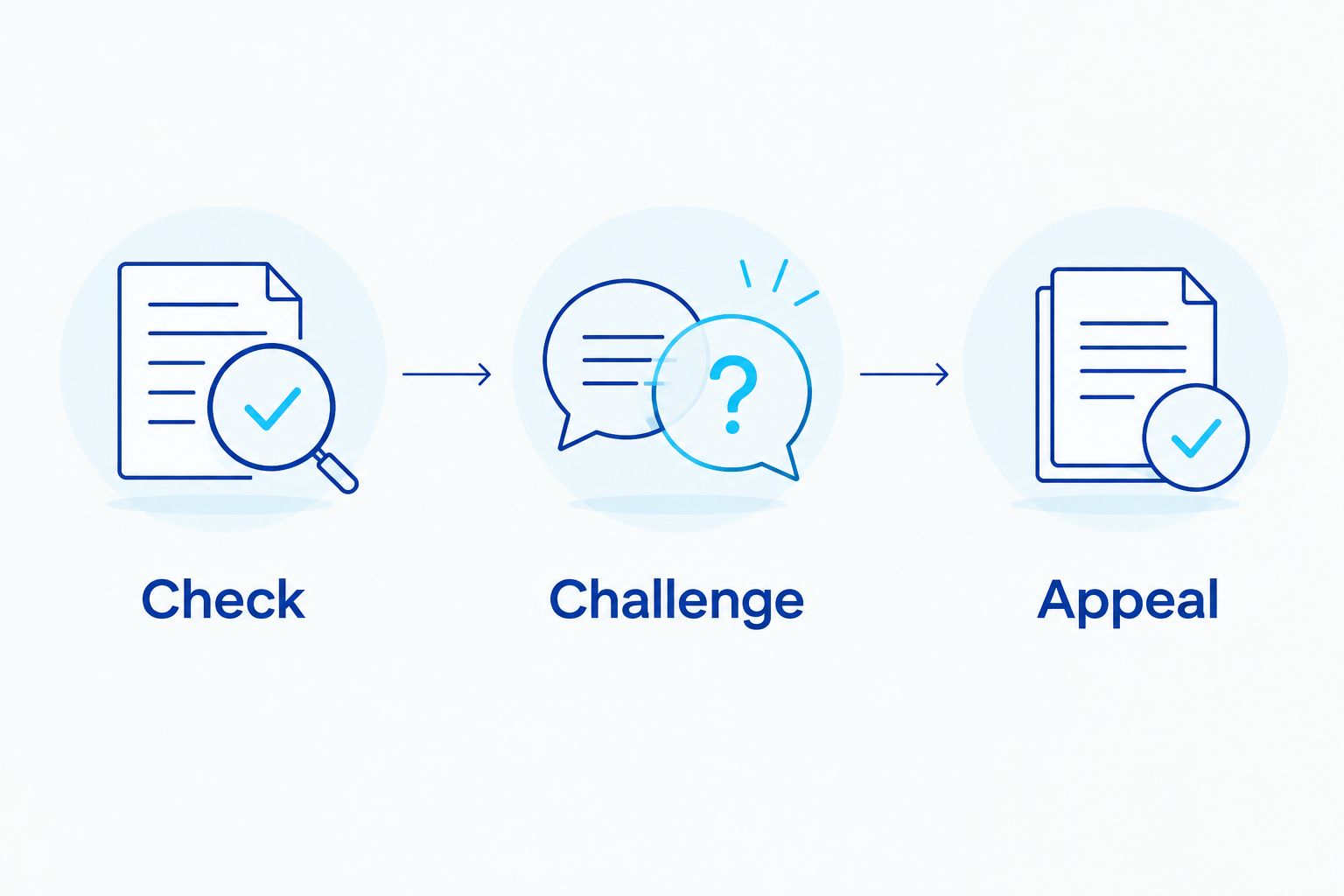
How does Check, Challenge, Appeal work after payment?
Check, Challenge, Appeal has 3 stages. Payment does not add another stage or remove the requirements of the existing process.
- Check: Establish and correct the factual information held about the property through the valuation authority's process.
- Challenge: Set out the disagreement with the valuation, supported by evidence and a reasoned case.
- Appeal: Take an eligible unresolved valuation dispute to the relevant Valuation Tribunal, subject to the applicable requirements.
Both England and Wales use this process for current rating lists. Wales adopted Check, Challenge, Appeal on 1 April 2023; Checks and Challenges are handled by the valuation authority, while appeals go to the relevant Valuation Tribunal for England or Wales.
The shared process does not make every regional rule identical. For a 2026 case, confirm the requirements for the property, rating list and stage involved rather than copying a deadline from another case.
Do not send an unsupported appeal simply because the bill is already paid. First establish whether the facts are wrong, whether the valuation grounds are sound and whether the procedural route remains open.
Why the outcome varies after payment
Payment status is only part of the account history. These factors determine whether a dispute can proceed and whether it produces an overpayment:
- The disputed issue. Valuation, billing and relief questions require different decisions and evidence.
- The relevant rating list. The assessment being disputed determines which procedural requirements apply.
- The effective date. A reduction only affects liability from the date it legally takes effect.
- Your liability period. The council must establish the dates for which your business was liable.
- The evidence. Documents must support the correction requested, not simply show that the bill was burdensome.
- The account position. Revised charges, payments and any other relevant entries determine whether the account has a credit.
A successful case therefore needs more than a lower figure on a valuation record. The council must apply the change to the correct period and reconcile your account.
What evidence should I keep after paying in full?
Keep 2 separate records: one for the valuation issue and one for the council account. This prevents payment evidence from being confused with evidence supporting a lower assessment.
Your valuation record should contain the assessment details, relevant plans, lease information and a clear explanation of the disputed facts. Include dated photographs where they help establish the property's condition or layout during the relevant period.
Your account record should contain the original demand, later bills, payment confirmations and council correspondence. If occupation dates are disputed, retain documents that establish when your liability began or ended.
Use a short document index. Record what each item proves, which period it covers and which correction it supports; a large attachment folder without an explanation is harder to assess.
Keep copies of submissions and responses as well as the evidence itself. The correspondence shows what was raised, what was decided and which issues remain unresolved.
Will I get a refund if the challenge succeeds?
A successful challenge produces a refund only if the resulting liability is lower than the amount properly credited to the relevant account. The effective date, your liability period and the revised calculation all matter.
Ask the council for a revised demand or account statement showing:
- The assessment or billing change applied.
- The period covered by the adjustment.
- The payments already credited.
- Any remaining balance or credit.
- How any credit will be refunded or otherwise dealt with.
Do not treat a valuation decision as confirmation that money has already been authorised for repayment. The decision establishes the assessment change; the council account establishes the overpayment.
For a case resolved in 2026, check the revised statement against the relevant historic demands as well as the current account balance. A total figure without a period-by-period explanation can conceal a misunderstanding about which liability has changed.
Does paying in full mean I accepted the valuation?
Paying in full does not, by itself, prevent you from disputing the valuation. Payment and challenge are separate actions: one addresses the bill, while the other addresses whether the assessment is correct.
A previous agreement or formal decision is a different issue. If you have already settled the same valuation dispute, provide that correspondence before starting another case so the remaining options can be assessed.
Should I stop paying future bills while the dispute continues?
Continue paying business rates as billed unless the council issues a revised demand or agrees a different payment arrangement. A valuation challenge does not automatically suspend collection.
If a new demand arrives after you paid the earlier bill in full, check what it covers. It might concern a different period or an adjustment; do not assume the earlier payment settles every later demand.
Is professional help worthwhile for a paid bill?
Professional help is most relevant when you need to establish valuation grounds, organise evidence or resolve a dispute involving both the assessment and the council account. Paying already does not make those tasks unnecessary.
Appeal My Rates UK is suited to business owners in England and Wales who need help with business rates valuation challenges or council disputes. Its services include valuation challenges, property splits and mergers, and disputes with council rates teams.
The limitation is straightforward: representation does not guarantee a reduction or reopen an expired route. Ask for an assessment of the grounds before treating a refund as an expected result.
Most of our work is no win, no fee, but some instructions carry fixed fees. Before instructing Appeal My Rates UK, confirm the fee basis, scope and payment terms for your specific instruction in writing.
Ask whether the proposed work covers the valuation case, council account reconciliation or both. Clear scope matters because a changed assessment and a completed refund are separate outcomes.
Let us handle your case
Discuss your paid bill, disputed assessment and the scope of help you need.
FAQ
Can I appeal business rates after paying the whole year’s bill?
Yes, paying the whole year’s bill does not by itself prevent a valuation challenge. Eligibility, evidence and the relevant procedural deadlines still apply.
Do I need to ask the council for permission before challenging my valuation?
The council’s permission is not the basis for starting a valuation challenge. Use the valuation authority’s process for assessment disputes and contact the council separately about billing errors.
Can I get a refund just because I have submitted a challenge?
Submitting a challenge does not create an entitlement to a refund. A change must reduce your liability for a period already paid, and the council must reconcile the account.
Is the current valuation appeal process different in Wales?
England and Wales both use Check, Challenge, Appeal for current rating lists. Appeals go to the relevant Valuation Tribunal for England or Wales; the shared process does not make every regional rule identical.
Can my business rates valuation go up when it is reviewed?
A valuation review can identify grounds for an increase as well as a reduction. Assess the property’s facts and valuation evidence before pursuing a challenge.
Can I challenge a paid bill after leaving the property?
Leaving the property does not make payment the deciding factor in whether a challenge is possible. Your interest in the property, disputed period, rating list and applicable procedural rules need to be checked.
Does Appeal My Rates UK handle every case on a no win, no fee basis?
Most of our work is no win, no fee, but some instructions carry fixed fees. Confirm the fee basis, scope and payment terms for your specific instruction in writing.
One last thing
A zero balance is not a valuation decision. Before filing away a paid 2026 bill, write down the exact correction you believe is needed and the period it affects.
That simple distinction makes the next move clearer: challenge the assessment, query the council calculation or review relief entitlement. Ask for the resulting account adjustment in writing rather than assuming a successful decision completes the refund process.
Related guides
- Claiming a business rates refund from the council
- Refunds after a successful business rates appeal
- Comparing business rates consultant fee terms
