

Yes, you can challenge the business rates assessment of a mixed-use property in England or Wales if its valuation, description or assessment boundaries are wrong. Residential use does not automatically remove business rates from the commercial part, and an appeal does not suspend your existing payment obligations. For a case started in 2026, establish which rating list and decision you are challenging before submitting evidence.
- To appeal business rates mixed use property assessments, identify a valuation error, incorrect boundary or wrongly recorded occupation.
- England and Wales both use Check, Challenge, Appeal for valuation disputes on current rating lists.
- Business rates and Council Tax can apply to different parts of the same building.
- Appeal My Rates UK handles business rates challenges, property splits and mergers, and council disputes.
Why this matters
A shop with a flat above it can involve both business rates and Council Tax. The practical question is not simply whether somebody lives at the address: it is whether the commercial assessment correctly reflects the property and its use.
Challenge the assessment error, not the fact that the building has mixed uses. Start with the recorded property details and your supporting documents; the business rates evidence guide explains how to organise that starting point.
Can I appeal business rates on a mixed-use property?
Yes. A mixed-use property is not excluded from a valuation challenge, but mixed use alone is not evidence that the rateable value is wrong. Your case needs an identifiable issue, such as domestic accommodation included in the commercial assessment, incorrect floor areas or an assessment that no longer reflects separate occupation.
First, distinguish a valuation dispute from a billing dispute. The valuation authority deals with the rating assessment; the council deals with the bill, payment account and relief decisions.
| Issue you have identified | Best for | What this route addresses | Main limitation |
|---|---|---|---|
| Incorrect commercial floor area or valuation | Valuation review through Check, Challenge, Appeal | Errors in the rating assessment | A high bill alone does not establish a valuation error |
| Residential accommodation apparently included as commercial space | Assessment boundary review | Whether domestic and non-domestic parts are correctly recorded | Actual use and property facts matter, not just room labels |
| Separate occupiers shown under an unsuitable assessment arrangement | Split or merger review | Whether the rating assessments reflect the occupation | Creating separate assessments does not guarantee a lower total bill |
| Wrong liable person, missing relief or account error | Council billing enquiry | How the council has calculated or administered the demand | The council cannot resolve the underlying rateable value through a billing correction |
These routes can overlap. Keep the valuation evidence separate from the account correspondence so each organisation can address the issue within its responsibility.
A shop with a flat above: check the assessment boundary
A shop and residential flat can occupy the same building while being treated separately for local taxation. You should check whether the commercial valuation includes only the space that belongs in the non-domestic assessment.
Compare the recorded layout with the property on the ground. Look at entrances, internal connections, rooms used as living accommodation and any commercial storage within otherwise residential-looking areas.
Do not assume an upstairs room is domestic simply because it sits above a shop. An upstairs stockroom remains a different proposition from a self-contained home. Explain what each disputed area is used for and provide evidence of that use.
A plan is useful because it shows the boundary you are disputing. It is stronger when supported by photographs, occupation records and a clear explanation of when the relevant arrangement began.
Working from home: distinguish incidental use from business premises
Using a laptop at home does not automatically mean your home needs a separate business rates assessment. The nature and extent of business use matter, including adaptations, customer visits and whether part of the property operates as distinct business premises.
A room used occasionally for administration is not the same factual situation as a separately operated workshop. Describe the real activity rather than relying on a label such as home office.
If a business assessment already exists, identify why you believe it is incorrect. Evidence about access, equipment, exclusive business use and the relationship with the rest of the home helps explain the disputed position.
Planning permission and rating treatment answer different questions. A planning description is useful background, but it does not decide the business rates assessment on its own.
Separate businesses in one building: check occupation
A building containing commercial and residential space can also contain different business occupiers. A landlord, a shop tenant and a separate office tenant do not necessarily share the same rating position merely because they share an address.
Record who occupies each area and how the areas connect. Include leases, licences, access arrangements and the dates when occupation changed.
A split or merger review addresses the assessment structure, not just the valuation figure. Its advantage is that it examines whether the recorded units match the actual arrangement; its limitation is that the resulting bills and relief position still need separate consideration.
Do not request a split solely because you expect it to produce savings. Establish the correct assessment structure first, then assess its billing consequences.
How do I challenge a mixed-use assessment in 2026?
England and Wales both use Check, Challenge, Appeal, commonly shortened to CCA, for valuation disputes on the 2023 rating list onwards. Wales adopted CCA on 1 April 2023; current Welsh challenges are not a separate proposal-based route.
The process has 3 stages, but a case does not necessarily need to reach the final stage. A correction or agreement can resolve the issue earlier.
- Check. Review the property facts recorded for the assessment. Identify incorrect areas, descriptions or other relevant details, and provide evidence supporting the correction you seek.
- Challenge. If the valuation remains disputed, explain the grounds for changing it and provide the supporting valuation evidence. State the change you seek rather than simply saying the bill is unaffordable.
- Appeal. Where the rules permit an appeal after the Challenge stage, take the dispute to the relevant Valuation Tribunal for England or Wales. Follow the applicable requirements and deadline.
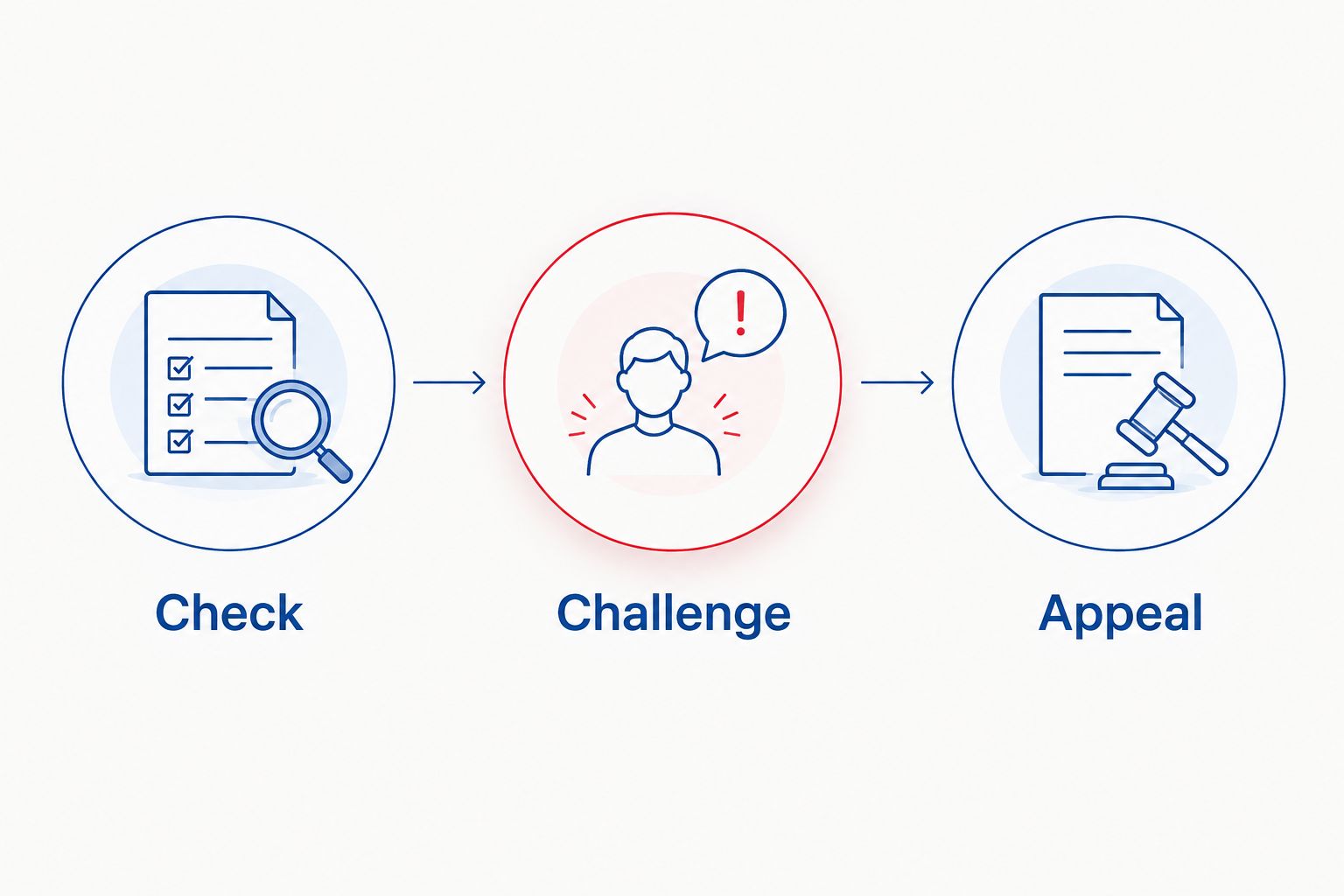
Checks and Challenges are handled by the valuation authority in both countries. A shared process does not mean every relief rule, deadline or tribunal arrangement is identical, so use the guidance applicable to the property and rating list.
For the practical submission sequence, use the Check, Challenge, Appeal guide for 2026. Confirm the relevant deadline before spending time preparing a full case.
Why mixed-use business rates outcomes vary
The result depends on what is wrong and what the evidence establishes. These factors determine the shape of the case:
- Domestic and commercial boundaries. The dispute needs to show which space belongs outside or inside the non-domestic assessment.
- Actual occupation. Separate occupiers and their control of different areas affect how the property should be assessed.
- Recorded measurements. Incorrect floor areas can affect the valuation, but the evidence must use an appropriate measurement basis.
- Access and layout. Connections between areas help explain whether the existing assessment arrangement reflects the premises.
- Timing. The date of a conversion, occupation change or other relevant event helps establish which period the evidence addresses.
- Valuation evidence. Relevant rental and assessment evidence supports a valuation argument; an unrelated neighbour's lower bill does not prove your assessment is wrong.
Keep these questions separate from relief eligibility. A correct valuation can still produce a bill that requires a council relief enquiry, while an incorrect valuation needs attention even where relief currently reduces the amount payable.
What evidence should I prepare before making a challenge?
Build a file that lets someone unfamiliar with the building understand the disputed arrangement. You do not need a persuasive story about the burden of rates; you need a traceable explanation of the alleged error.
Start with these documents:
- The rating assessment details and the relevant council demand notice.
- A floor plan identifying domestic, commercial and shared areas.
- Photographs showing the disputed rooms, entrances and connections.
- Leases or licences showing occupation and the space covered.
- Records establishing when the use or layout changed.
- Relevant valuation evidence if you dispute the value rather than the property facts.
Mark the disputed area clearly and explain why each document matters. A photograph without a location or date can leave the central question unanswered.
For a 2026 submission, make sure current photographs do not silently stand in for an earlier layout. Label historical material and explain what it establishes about the period under dispute.
Can I appeal if I rent the commercial part?
Tenants can challenge business rates assessments where they have the required interest and authority to use the process. Owning the whole mixed-use building is not a universal prerequisite.
Check the lease, the named ratepayer and the area you occupy. If another business or household occupies the rest, avoid presenting their space as part of your own occupation without evidence.
Will an appeal stop my business rates bill?
An appeal does not suspend your existing payment obligations. Continue paying the council's demand unless the council confirms a different arrangement, and raise any payment difficulty directly with its rates team.
A valuation correction and a revised council account are separate steps. Keep the decision and subsequent bills so you can check that any adjustment has been applied to the relevant period.
When should I ask a rating surveyor to handle the case?
Professional help is particularly relevant when the domestic boundary, separate occupations and valuation arguments overlap. Appeal My Rates UK is best suited to business owners who want a rating surveyor to handle mixed-use business rates disputes.
Appeal My Rates UK handles business rates appeals, property splits and mergers, and disputes with council rates teams. The benefit is having those issues assessed together; the limitation is that appointing a surveyor does not guarantee a reduction or remove the need for evidence.
Most of our work is no win, no fee, but some instructions carry fixed fees. Ask for the fee basis, scope and payment terms for your specific instruction in writing before authorising work.
Confirm whether the instruction covers only the valuation issue or also includes assessment changes and council correspondence. That written scope matters as much as the headline fee arrangement.
FAQ
Can I appeal business rates because there is a flat above my shop?
Yes, if there is an error in the commercial assessment, but the flat’s existence alone does not establish one. Check whether domestic accommodation has been included incorrectly and support your case with plans and evidence of use.
Do England and Wales use the same business rates appeal process?
England and Wales both use Check, Challenge, Appeal for valuation disputes on the 2023 rating list onwards. Wales adopted CCA on 1 April 2023; specific deadlines, relief rules and tribunal arrangements still need checking for the relevant country.
Can I pay Council Tax and business rates at the same address?
Yes, Council Tax and business rates can apply to different parts of the same building. Check that each assessment reflects the relevant domestic or non-domestic space rather than assuming a shared address creates an error.
Does working from home mean I must pay business rates?
Working from home does not automatically create a separate business rates assessment. The nature and extent of business use, adaptations and whether part of the property operates as distinct business premises matter.
Will splitting my mixed-use property guarantee lower rates?
No, splitting an assessment does not guarantee a lower combined bill. Establish whether separate assessments are correct, then consider the resulting valuations and relief position.
Can my rateable value increase after a review?
Yes, reviewing an assessment can expose an undervaluation as well as an overvaluation. Assess that risk before submitting a challenge, especially if the existing property details are incomplete.
Does Appeal My Rates UK charge only when a case succeeds?
Most of our work is no win, no fee, but some instructions carry fixed fees. Confirm the fee basis, scope and payment terms for your specific instruction in writing before authorising work.
One last thing
Check the rating list, not just the latest bill. The 2026 rating list took effect on 1 April 2026, so evidence about an earlier assessment does not automatically establish an error in the current entry.
Write the property reference, disputed area and relevant period on your evidence summary. That simple distinction helps keep a boundary correction, a historic account problem and a current valuation challenge from becoming one confused request.
Related guides
- How subletting part of your property affects business rates
- Land Registry plans for a business rates property split
- Compare business rates consultant fee terms
