

Yes. A business rates reduction company can represent you at a valuation tribunal hearing through an appointed representative, subject to the tribunal’s rules and directions; however, you must confirm that hearing preparation and attendance are included in your instruction, rather than assuming an agreement to challenge your valuation covers them.
- Business rates reduction company tribunal representation must be expressly included in your agreed scope of work.
- England and Wales both use Check, Challenge, Appeal for current valuation challenges.
- An appointed representative can present your case, but the tribunal decides the outcome.
- Appeal My Rates UK helps business owners with valuation disputes; confirm hearing representation before instructing.
Why this matters
An agreement to seek a business rates reduction is not automatically an agreement to represent you at a hearing. A firm might handle the valuation challenge but require a separate instruction for tribunal work. That distinction matters before you commit to an appeal, not after a hearing notice arrives.
For a valuation dispute in 2026, first establish where your case sits in the Check, Challenge, Appeal process. Representation cannot replace the required earlier stages, and a representative still needs a properly supported case.
Can a business rates reduction company attend a tribunal hearing?
Yes. You can appoint a representative to act for you in a business rates valuation appeal, and that representative does not have to be a solicitor. A rating surveyor can present valuation arguments, explain supporting evidence and respond to the other party’s case within the applicable tribunal procedure.
The important distinction is between the company you instruct and the person who actually conducts the hearing. Ask for the proposed representative’s name, role and relevant experience. A company’s general promise to handle an appeal does not tell you who will speak for your business.
| Representation option | Best for | Main advantage | Main limitation |
|---|---|---|---|
| Representing yourself | Owners able to prepare and explain their own evidence | You retain direct control of the case | You take responsibility for procedure, preparation and presentation |
| Appointing a rating surveyor | Disputes centred on property facts and valuation evidence | The representative can connect property evidence with the valuation argument | Tribunal work must be included in the instruction; expertise varies |
| Appointing a legal representative | Cases involving substantial legal or procedural questions | Legal arguments receive specialist attention | Separate valuation expertise can still be needed |
These are not mutually exclusive arrangements. A case can involve both valuation and legal expertise, but you should know who leads the work and what each person is responsible for before agreeing the scope.
What happens before a tribunal hearing in 2026?
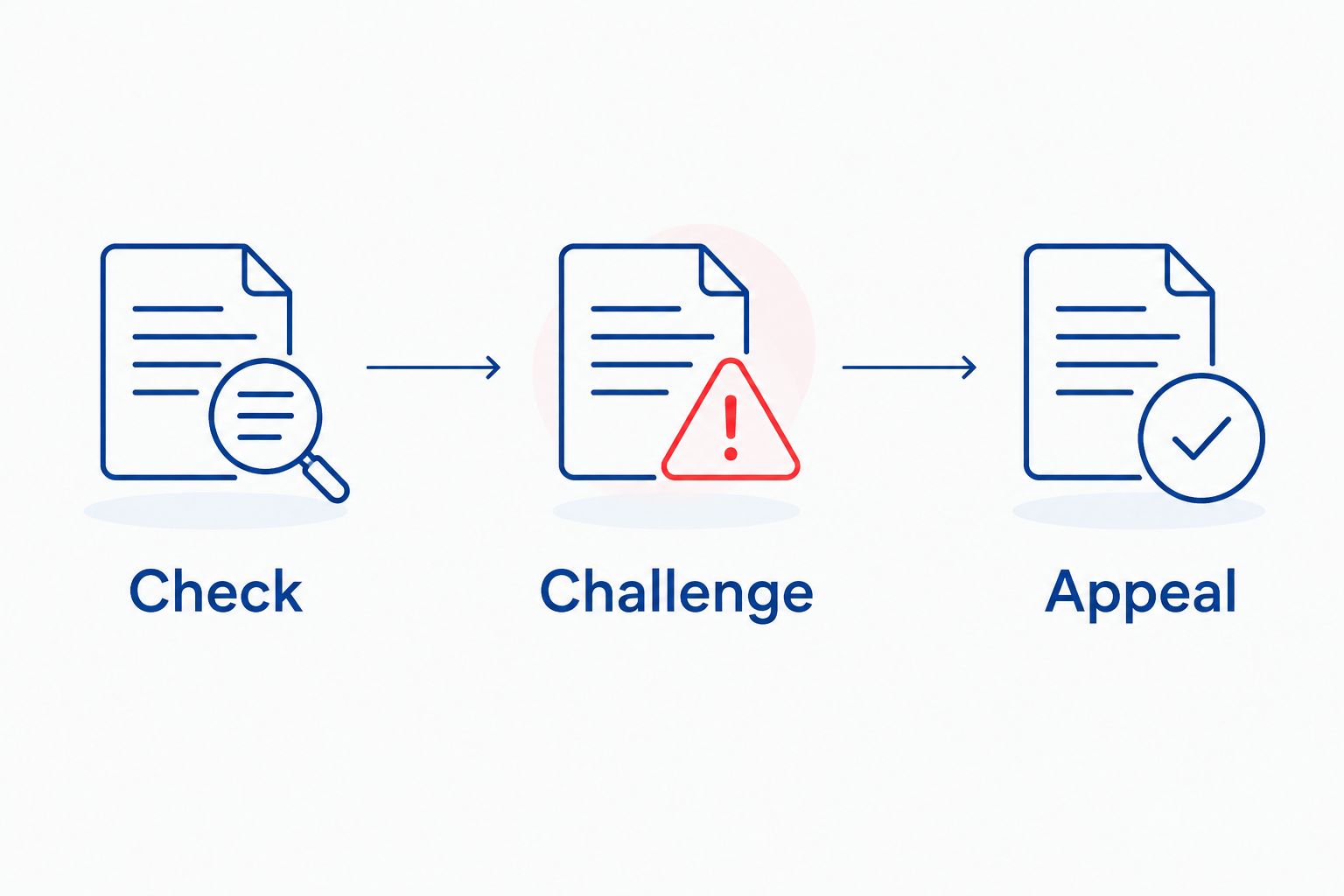
England and Wales both use Check, Challenge, Appeal for current business rates valuation challenges. Checks and Challenges are handled by the valuation authority; an appeal goes to the relevant Valuation Tribunal for England or Wales.
The route has 3 stages, but they serve different purposes. Do not treat a disagreement with your council’s bill as proof that a valuation appeal is the right next step.
Check
The Check stage concerns the property information underlying the valuation. Your representative should identify the facts in dispute and assemble records that support any correction sought, rather than simply stating that your bill feels too high.
Challenge
The Challenge stage sets out the valuation dispute and the evidence supporting your proposed change. Ask your representative to explain the grounds, the relevant documents and the result being sought in language you understand.
Appeal
An appeal asks the relevant tribunal to determine an unresolved dispute within its jurisdiction. Your representative must address the applicable appeal requirements and tribunal directions; filing an appeal is not a fresh opportunity to ignore what happened earlier.
The shared CCA route does not mean every deadline, billing rule or tribunal arrangement is identical across England and Wales. For a 2026 instruction, ask the representative to identify the applicable requirements for your property, rating list and case.
What should tribunal representation include?
A useful instruction separates preparing the appeal from appearing at the hearing. Ask for a written list of included tasks and exclusions, with responsibility assigned to a named person or team.
Case assessment
Your representative should explain the disputed valuation issue, the evidence supporting your position and the weaknesses in the case. Ask what result the evidence supports, rather than accepting a promised reduction without an explanation.
An honest assessment also identifies arguments that do not belong in a valuation appeal. Financial pressure alone does not establish that a property’s rateable value is wrong.
Evidence preparation
Agree who gathers leases, plans, photographs, measurements and relevant property records. Ask who checks the documents for accuracy and who explains any differences between your records and the valuation authority’s information.
Evidence must support the particular issue being argued. A photograph showing a property’s present condition does not, by itself, establish its condition at the date relevant to the dispute.
Written submissions
Confirm who drafts the case, reviews the other party’s material and prepares any required document bundle. You should receive an explanation of the argument, not just a request to approve unfamiliar paperwork shortly before the hearing.
The representative should also explain any limits on introducing material at the appeal stage. Do not assume that documents omitted earlier can simply be added without addressing the applicable rules.
Hearing attendance
Ask whether the named representative will attend, present the argument and answer the tribunal’s questions. Clarify what happens if that person becomes unavailable or the hearing is rearranged.
Attendance alone is not the full service. A representative needs to understand the evidence, the disputed issues and the outcome being requested.
Decision and follow-up
Agree who will explain the decision and identify any action required afterwards. If the outcome involves a valuation change, distinguish that decision from the council’s subsequent billing work.
Do not assume that an instruction includes every later dispute or further appeal. Ask where the agreed service ends.
Why tribunal representation varies
The right scope depends on the actual dispute, not simply the size of your rates bill. These factors help you assess what work is required:
- The issue in dispute: Incorrect property facts, valuation methodology and legal interpretation require different preparation.
- The existing evidence: A complete, consistent record needs different work from missing plans or conflicting measurements.
- The case’s procedural position: The representative needs to understand what was submitted and decided during the earlier stages.
- The property arrangement: Splits, mergers and occupation changes require a clear account of the premises involved.
- The hearing directions: The tribunal’s requirements determine what must be submitted and how the case proceeds.
- The agreed division of work: Your business might gather factual records while the representative prepares the valuation argument.
For a 2026 appeal, use these factors to request a case-specific scope. A standard description such as ‘full appeal support’ leaves too much room for disagreement unless the individual tasks are defined.
What should you ask before appointing a representative?
Use the following 6 steps before authorising tribunal work. They help you distinguish a clear instruction from a broad sales promise.
- Identify the dispute. Ask whether the problem concerns rateable value, council billing, relief or another issue. The correct route follows the dispute, not the label on the service.
- Name the representative. Establish who will prepare the case and who will attend the hearing. Ask about experience relevant to the property and issue involved.
- Define the scope. Include document preparation, submissions, attendance, rearranged hearings and post-decision advice where required. Record exclusions as clearly as included work.
- Confirm your responsibilities. Ask which documents you must supply, whether you need to give evidence and when your input will be needed.
- Agree the fee basis. Obtain the scope and payment terms in writing, including how the agreement treats additional work or a change in instructions.
- Review the case assessment. Ask for the strengths, weaknesses and intended argument. Do not confuse confidence in presentation with certainty about the tribunal’s decision.
Appeal My Rates UK is best for business owners in England and Wales seeking rating surveyor help with valuation disputes. Its stated services include valuation challenges, property splits and mergers, and disputes with council rates teams; confirm whether the particular instruction includes tribunal preparation and attendance.
Appeal My Rates UK fee note: Most of our work is no win, no fee, but some instructions carry fixed fees. Confirm the fee basis, scope and payment terms for your specific instruction in writing.
Discuss your valuation dispute
Ask what your instruction covers, including hearing preparation, representation and written fee terms.
Do I still need to attend if I appoint a representative?
Appointing a representative does not automatically remove the need for your involvement. Your representative can present the argument, but you might still need to provide factual evidence about occupation, alterations or the property’s condition.
Before the hearing, ask whether your attendance is required under the tribunal’s directions and what questions you should be prepared to answer. Tell your representative promptly if the proposed arrangements create a practical difficulty.
Do not assume that appointing an agent excuses you from a hearing requirement. Get a clear answer about your role before making attendance plans.
Can a representative guarantee a business rates reduction?
- A representative can assess evidence and argue for a change, but the tribunal decides the appeal. A confident prediction is not a binding result.
Ask the representative to distinguish the proposed valuation from the outcome they can actually promise to deliver. Preparing and presenting a case is a service commitment; obtaining a particular tribunal decision is not within the representative’s control.
A useful recommendation explains why the evidence supports the proposed change and where the argument is vulnerable. That gives you a basis for deciding whether to proceed.
Is a council billing dispute the same as a valuation appeal?
- A dispute over the property’s rateable value is different from a disagreement about how the council has calculated or administered your bill. Identifying the difference prevents you from pursuing the wrong issue through a valuation hearing.
For example, an argument about property measurements concerns different evidence from an argument about payments credited to an account. Ask your adviser to separate the issues if your case involves both.
In 2026, request a written explanation of which organisation must address each part of the dispute. Do not assume the valuation tribunal will resolve every complaint connected with your business rates account.
FAQ
Can a business rates reduction company speak for me at a tribunal?
Yes. An appointed representative can present your valuation appeal, subject to the tribunal’s rules and directions. Confirm that hearing preparation and attendance are expressly included in your instruction.
Do I need a solicitor for a business rates valuation appeal?
No. You can represent yourself or appoint a representative, including a rating surveyor. Cases involving substantial legal questions can require legal advice alongside valuation expertise.
Does Check, Challenge, Appeal apply in Wales as well as England?
Yes. Both England and Wales use Check, Challenge, Appeal for current valuation challenges. Checks and Challenges go through the valuation authority, while appeals go to the relevant tribunal for England or Wales.
Will I have to attend the hearing if I use a representative?
Your attendance depends on the tribunal’s directions and the evidence required in your case. Ask your representative whether you need to attend or give factual evidence; do not assume appointment of an agent removes those responsibilities.
Is tribunal attendance automatically covered by my appeal agreement?
No. You must check the written scope of your instruction. Ask specifically about evidence preparation, written submissions, attendance, rearranged hearings and advice after the decision.
Can a business rates consultant promise that I will win?
No. The tribunal decides the appeal, so a consultant cannot guarantee its decision. Ask for an evidence-based assessment of the case’s strengths and weaknesses instead.
What should I confirm before instructing Appeal My Rates UK?
Confirm the scope, named representative, fee basis and payment terms for your specific instruction in writing. If tribunal work is required, ask expressly whether preparation and hearing attendance are included.
One last thing
Ask your proposed representative to explain what would weaken your case. A useful answer identifies the evidence or argument that needs attention; it does not simply repeat the amount you hope to save.
Before approving a 2026 tribunal instruction, keep the written scope alongside the case assessment. Together, they tell you both what the representative will do and why the appeal is being pursued.
Related guides
- Compare business rates consultant fee terms
- Find comparable properties for a rates appeal
- Check business rates consultant RICS credentials
- Can a business rates appeal be rejected?
