

Yes. Agricultural buildings in England and Wales qualify for an agricultural business rates exemption when they meet the statutory conditions for agricultural use; a farm address or agricultural planning permission alone does not establish entitlement. In 2026, you need to check what each building is actually used for, because shops, workshops, holiday accommodation and other diversification activities can create a separate rates liability.
- Agricultural business rates exemption depends on qualifying use, not simply owning farmland or calling a building a barn.
- Mixed-use farms need separate checks for agricultural buildings, retail premises, commercial storage and other diversification activities.
- England and Wales both use Check, Challenge, Appeal for current rating-list valuation disputes.
- Appeal My Rates UK provides professional help with business rates valuation challenges and council rates disputes.
Why this matters
A farm can contain exempt agricultural buildings alongside rateable commercial premises. Treating the entire holding as exempt risks overlooking a valid bill; accepting every assessment without checking risks paying rates on property that should be excluded.
Start with the use of each building, not the total bill. Keep the valuation question separate from the council's calculation of your liability. Appeal My Rates UK helps business occupiers challenge valuations and resolve council rates disputes, including cases involving property splits or mergers.
Can agricultural buildings get a business rates exemption?
Agricultural buildings can be exempt, but the exemption has a legal definition. The principal statutory source is Schedule 5 to the Local Government Finance Act 1988, which addresses agricultural land and buildings in England and Wales.
GOV.UK's business rates guidance identifies agricultural land and buildings, including fish farms, among properties exempt from business rates. The statutory conditions still determine whether your particular building qualifies.
Use this table as a starting point, not as a substitute for examining the occupation and activities at your premises.
| Building or activity | Starting position | What you need to establish |
|---|---|---|
| Barn storing crops from the associated farm | Potentially exempt | Its qualifying agricultural use and relationship with agricultural land |
| Building housing agricultural livestock | Potentially exempt | The livestock use and applicable statutory conditions |
| Farm shop | Not automatically exempt | The retail activity and whether a separate rateable assessment applies |
| Barn let for unrelated commercial storage | Not agricultural merely because it is a barn | The tenant's actual use, occupation and property boundaries |
| Holiday accommodation in a converted farm building | Agricultural exemption does not follow from its former use | The applicable domestic or non-domestic treatment |
| Riding school or livery premises | Not automatically agricultural | The precise equestrian use and any separately qualifying agricultural land |
The distinction is between qualifying agricultural use and other uses, not between rural and urban property. An agricultural building is not disqualified simply because farming is a business. Equally, a commercial operation does not become agricultural because it takes place on a working farm.
Which farm buildings qualify?
A building occupied with agricultural land and used solely in connection with agricultural operations on that land can fall within the exemption. Other statutory provisions cover particular agricultural circumstances, so the relationship between the land, occupier and activity matters.
A crop store, livestock building or machinery shed needs a factual assessment. Identify whose crops, animals or equipment are present, where the associated agricultural operations take place, and whether any unrelated activity also occurs there.
The building's name is not evidence of its current use. A lease describing premises as an agricultural barn does not settle the position if the occupier uses it as a distribution warehouse.
For a 2026 review, record the current activity and the dates of any changes. Older photographs and documents help explain a previous use, but they do not establish that the same use continues today.
Do farm shops and diversified buildings qualify?
A farm shop is not automatically exempt because it sells produce from the holding. Retail use needs its own assessment, including the premises occupied and the relationship between the shop and surrounding agricultural operations.
The same caution applies to cafés, vehicle repair workshops, offices, event venues and storage let to unrelated businesses. Each activity needs to be considered on its facts. Do not extend an agricultural exemption across a whole yard without checking the individual uses.
Where agricultural and non-agricultural activities share a building, first establish how the space is occupied. Separate access, leases, partitions and the identity of the occupiers are useful evidence, but no single feature settles every case.
The guide to business rates appeals on mixed-use property explains the wider assessment issue. A property split or merger also needs examination where the existing rating entry does not reflect the occupation on the ground.
Are stables and horse-related buildings exempt?
Stables are not automatically exempt agricultural buildings. Riding schools and livery activities need to be distinguished from qualifying agricultural use; the presence of horses does not settle the rating position.
Land used for grazing can have a different treatment from buildings used for an equestrian business. That makes it important to describe the land and buildings separately rather than presenting the entire operation as one agricultural activity.
Explain what happens in each space. Identify grazing areas, stables, exercise facilities, storage and customer-facing premises. A general description such as horse farm leaves the key questions unanswered.
Why agricultural exemption decisions vary
Different outcomes reflect different facts and statutory conditions. These are the main factors to establish before you challenge an assessment:
- Actual use: Record what the building is used for, rather than relying on its historic description or planning designation.
- Connection with agricultural land: Explain which land the building serves and how its activities relate to agricultural operations there.
- Occupation: Identify who occupies the building and associated land, including any tenants or separate businesses.
- Non-agricultural activity: Identify retailing, unrelated storage, workshops or other uses that need separate consideration.
- Changes over time: Establish when activities began, ended or moved, so the evidence supports the period being disputed.
These factors also explain why a neighbouring farm's treatment does not prove your entitlement. Similar-looking buildings can have different occupiers, activities and connections with agricultural land.
Planning records remain useful supporting evidence, particularly where they document a conversion. They do not replace the rating test or prove the building's day-to-day use.
How do you check an agricultural building's assessment?
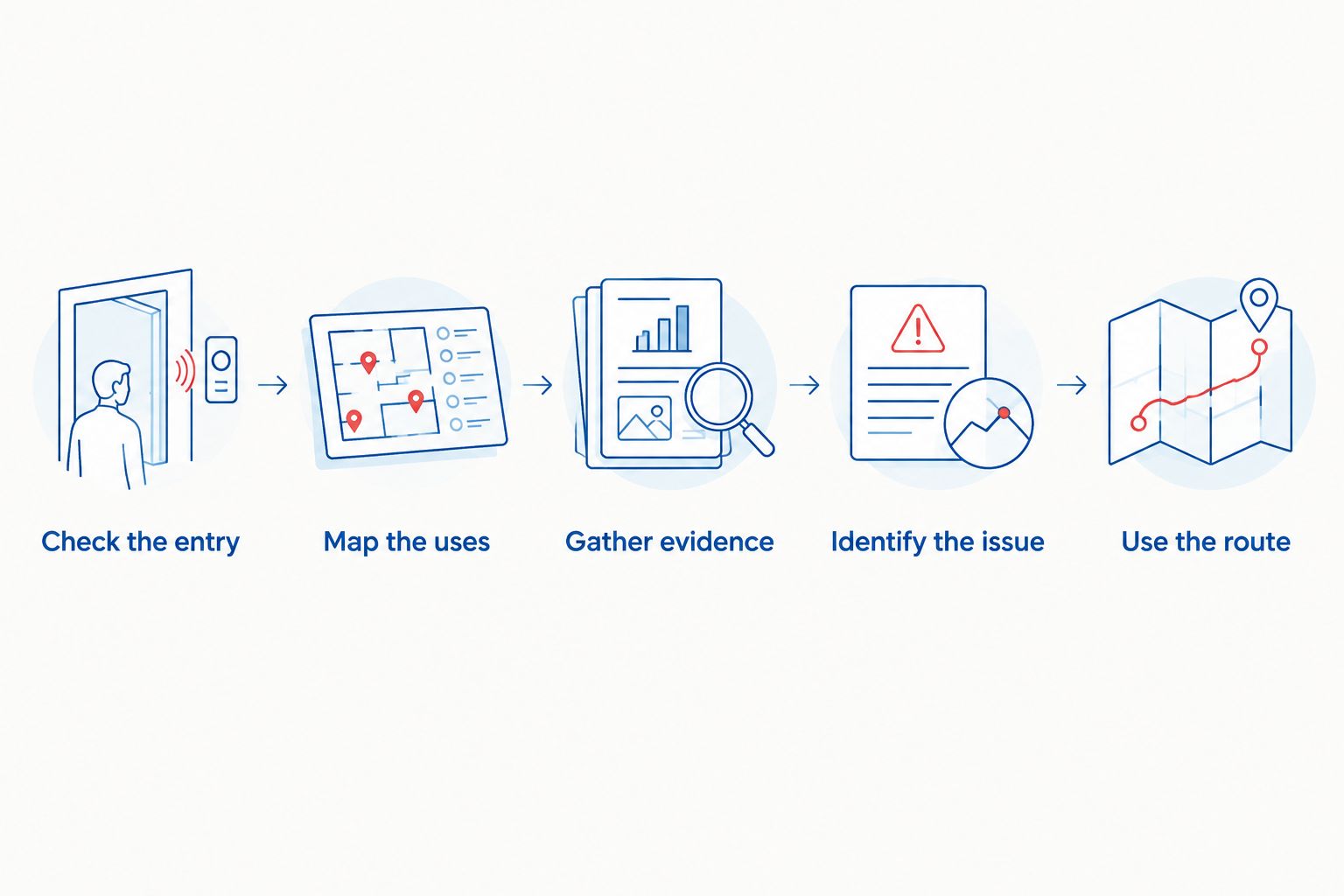
Use the following sequence for a 2026 assessment review. Establish the facts before choosing the dispute route. A request to correct the rating list is different from asking the council to correct a bill.
- Check the entry. Find the property in the rating list and compare its description, address and assessed extent with your premises. Check whether the disputed building is included within a larger assessment.
- Map the uses. Mark agricultural areas, commercial areas and shared spaces on a clear plan. Identify separate occupiers and note any changes during the relevant period.
- Gather evidence. Collect dated photographs, leases, occupation records and documents showing the agricultural operations connected with the building. Explain any apparent inconsistencies.
- Identify the issue. Decide whether the problem concerns inclusion in the rating list, the assessment's extent or value, or the council's billing and relief decisions.
- Use the route. Raise the issue with the responsible authority and follow the applicable procedure. Keep copies of submissions, decisions and supporting documents.
A clear file should let someone unfamiliar with your farm understand the building, its occupier, its use and the period in question. Avoid sending a collection of photographs without explaining what each image shows.
How do you challenge an incorrect rating entry?
In 2026, England and Wales both use Check, Challenge, Appeal for current rating-list valuation disputes. The process has 3 stages: Check establishes the property facts, Challenge presents the grounds for changing the assessment, and Appeal takes an unresolved dispute to the relevant tribunal where the requirements are met.
Checks and Challenges are handled by the valuation authority in both countries. Appeals go to the relevant Valuation Tribunal for England or Wales. The shared process does not mean every deadline, billing rule or tribunal arrangement is identical.
If your argument is that a building qualifies for agricultural exemption, explain why its inclusion in the rating list is wrong. Supply the evidence connecting the building's use, occupation and agricultural operations to the statutory conditions.
Do not replace that argument with a general statement that business rates are unaffordable. Financial pressure does not establish agricultural exemption. Also check the list and period involved: a current procedure should not be assumed to resolve every historic dispute.
Is agricultural exemption the same as business rates relief?
No. Agricultural exemption concerns whether qualifying property belongs in the non-domestic rating list; relief reduces a bill for rateable property. The distinction determines both the evidence you need and who deals with the issue.
A non-exempt farm shop or workshop might have a separate relief question. Eligibility must be checked against the relevant scheme and country rather than inferred from the exemption applying elsewhere on the farm.
| Route | Purpose | Main limitation |
|---|---|---|
| Agricultural exemption | Exclude qualifying agricultural property from rating | Requires the statutory conditions to be met |
| Valuation challenge | Correct an inaccurate rating assessment | Requires grounds and supporting evidence |
| Business rates relief | Reduce a bill under an applicable relief scheme | Does not establish agricultural exemption |
| Council billing correction | Correct liability, dates or billing errors | Does not itself change the property's valuation |
Keep these routes separate in correspondence. Ask for the specific correction you need and identify the decision you dispute, rather than requesting a general exemption without explaining the basis.
Should you use a rating surveyor?
Appeal My Rates UK is for business occupiers who need professional help with valuation challenges or council rates disputes. Professional help is particularly relevant where agricultural and commercial occupation overlap, the assessment boundaries are disputed, or you need to establish the correct challenge route.
The advantage is help organising the evidence and presenting the rating issue. The limitation is that representation does not create an exemption or guarantee a reduction; the facts and statutory conditions still control the outcome.
Most of our work is no win, no fee, but some instructions carry fixed fees. Before instructing a surveyor, confirm the fee basis, scope and payment terms for your specific instruction in writing. Ask whether the agreed work covers valuation issues, council correspondence and any later tribunal proceedings.
Let us handle your case
Discuss your assessment and confirm the scope, fee basis and payment terms in writing.
FAQ
Can I get agricultural business rates exemption for a barn?
A barn qualifies only if it meets the statutory conditions for agricultural exemption. Establish its actual use, occupation and connection with agricultural operations rather than relying on its name or location.
Does agricultural planning permission mean I do not pay business rates?
Agricultural planning permission does not by itself establish business rates exemption. The rating position depends on the applicable statutory conditions and the building’s actual use.
Will renting my barn to a storage business affect its exemption?
Letting a barn for unrelated commercial storage changes the facts relevant to agricultural exemption. Check the tenant’s use, the occupied area and whether the rating list needs to reflect a separate commercial assessment.
Are farm shops exempt from business rates in 2026?
Farm shops are not automatically exempt from business rates in 2026. Their retail use needs separate assessment, and any entitlement to relief is a different question from agricultural exemption.
Do England and Wales use the same agricultural valuation appeal process?
England and Wales both use Check, Challenge, Appeal for current rating-list valuation disputes. Checks and Challenges go to the valuation authority, while appeals go to the relevant Valuation Tribunal for England or Wales.
Can I stop paying my rates while I dispute agricultural exemption?
Do not stop paying solely because you dispute agricultural exemption. Continue to follow the council’s payment requirements unless it confirms a different arrangement, and raise payment difficulties separately from the valuation dispute.
How does Appeal My Rates UK charge for agricultural rates work?
Most of our work is no win, no fee, but some instructions carry fixed fees. Confirm the fee basis, scope and payment terms for your specific instruction in writing before work starts.
One last thing
A separate lease can matter more than the word barn on an old plan. If you have let part of your farm to another business, put the lease, occupation dates and marked-up plan together before seeking advice.
For your 2026 review, describe every disputed building in a sentence covering who occupies it, what happens there and which agricultural land it serves. If you cannot answer those questions clearly, that is the first gap to close—not a reason to assume exemption.
Related guides
- Business rates exemptions and their potential impact
- How subletting part of your property affects business rates
- Compare business rates consultant fee terms