
You do not pay to look up your business rates valuation through the official government service in 2026. Paying a surveyor to assess the valuation, prepare evidence or handle a dispute is a separate matter: the fee basis, scope and payment terms depend on the instruction and should be confirmed in writing.
- The cost to check business rates valuation is different from the cost of professional advice or representation.
- An official rateable value lookup is free; it does not establish whether your valuation is correct.
- Appeal My Rates UK handles business rates valuation challenges; confirm the instruction and fee terms in writing.
- England and Wales both use Check, Challenge, Appeal for current valuation disputes.
Why this matters
A valuation lookup, a surveyor’s assessment and a formal valuation challenge are different tasks. Confusing them makes it difficult to tell what you are being offered and when you are agreeing to pay for work.
Start by finding your rateable value and rating list. You can then decide whether you need help checking the property details, assessing the valuation evidence or questioning a council bill.
A free lookup gives you information, not a verdict on whether your business rates are correct. Before appointing anyone, identify the question you need answered and ask what the proposed service actually includes.
Does it cost anything to check my business rates valuation?
Looking up the published valuation yourself carries no government lookup charge. Professional advice is different: a surveyor undertakes work on your behalf under agreed terms, which you should understand before authorising the instruction.
For your 2026 review, separate the following options rather than treating every service described as a business rates “check” as equivalent.
| Option | Best for | Main benefit | Limitation or commitment |
|---|---|---|---|
| Official valuation lookup | Finding the published entry | Lets you inspect the recorded valuation and available property details | Does not assess whether the valuation is defensible |
| Professional valuation review | Understanding whether evidence supports further action | Adds a surveyor’s assessment of the property and valuation | Scope and fee terms require written agreement. Appeal My Rates offers a free initial audit of your valuation and billing. |
| Formal Check, Challenge, Appeal work | Pursuing an identified valuation dispute | Provides a structured route to question the assessment | Requires evidence and compliance with the applicable procedure |
| Council billing enquiry | Questioning the demand rather than the valuation | Directs a billing issue to the body responsible for the bill | Does not itself change the rating list valuation |
The right choice depends on the problem, not simply the size of the bill. A high demand is a reason to investigate, but it does not establish that the valuation is wrong.
What does the official lookup tell you?
The official service lets you find the published rateable value and inspect the information available for the property. Check that you have the correct address, assessment and rating list before comparing anything else.
Rateable value is not the same as the amount your council asks you to pay. The bill also reflects the applicable billing rules and any reliefs or adjustments, so a correct valuation does not settle every question about the demand.
What does a professional review add?
A surveyor assesses the issue rather than merely retrieving the published entry. Depending on the agreed instruction, that assessment can involve reviewing property facts, considering valuation evidence and advising whether further action has grounds.
Ask for a defined deliverable. You need to know whether you are buying an initial opinion, evidence preparation, representation or a wider service—not just accepting an undefined promise to check your rates.
Checking the entry is not the same as submitting a Check
The word “check” has an everyday meaning and a formal meaning in business rates. Reading your valuation online is not the same as submitting a Check through the Check, Challenge, Appeal process.
Both England and Wales use this process for the 2023 rating list onwards. Wales adopted it on 1 April 2023; a Welsh property is not a reason to assume that a separate current proposal-based route applies.
The process has 3 stages:
- Check: establish and, where necessary, correct the facts held about the property through the valuation authority’s procedure.
- Challenge: present the grounds and supporting evidence for disputing the valuation to the valuation authority.
- Appeal: take an eligible unresolved dispute to the relevant Valuation Tribunal for England or Wales.
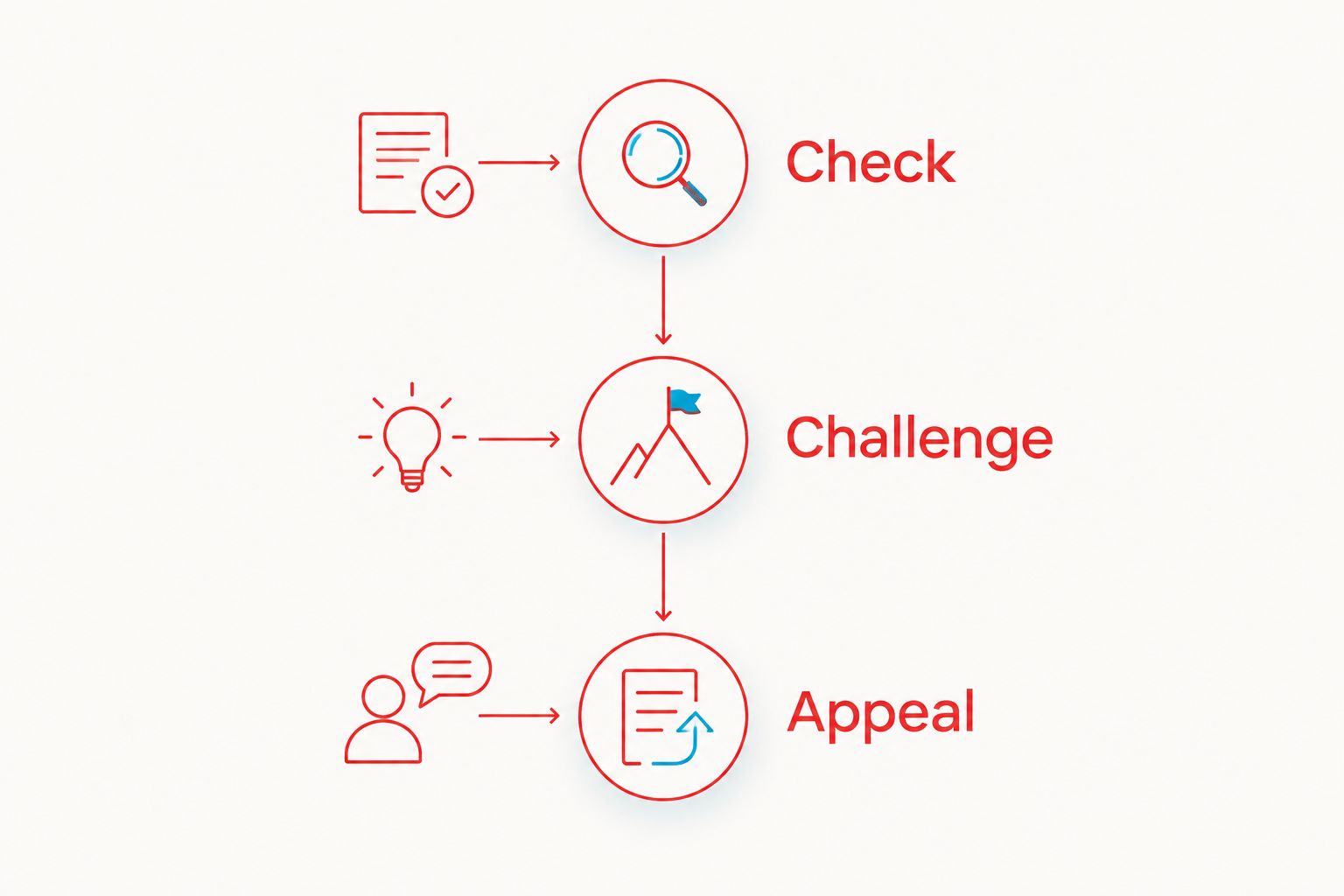
The shared process does not mean every deadline, relief rule or tribunal arrangement is identical. For a case considered in 2026, establish the relevant list, country and procedural requirements before deciding what to submit.
Checks and Challenges go to the valuation authority, not the council’s billing team. An appeal goes to the relevant tribunal; asking the council to explain a bill is not a substitute for following the valuation dispute procedure.
Why the cost of professional help varies
The fee question becomes meaningful when you define the work. An enquiry about a published entry is different from an instruction to prepare and pursue a dispute.
Ask how the proposed terms address these factors:
- Scope: does the instruction cover advice only, submissions, correspondence or representation?
- Property assessments: does the work concern a single assessment, several entries, or a proposed split or merger?
- Evidence preparation: who gathers plans, measurements, lease documents and supporting records?
- Procedural stage: does the instruction stop after an initial review or extend through later stages?
- Type of dispute: is the issue a valuation matter, a council billing dispute, or both?
- Payment trigger: what event makes a fee payable, and how is that event defined?
These are questions to settle before instructing, not reasons to assume a particular fee model applies. Ask the adviser to identify included work, exclusions and any additional authority needed before extending the instruction.
A written comparison is more useful than a headline promise. Use this guide to compare business rates consultant fee terms before deciding whether the proposed scope matches your case.
What should I ask before agreeing to professional help?
Do not authorise work until you understand both the service and the payment obligation. A conversation about potential savings does not replace an instruction setting out what happens next.
For a 2026 instruction, ask for written answers to the following questions:
- What property, assessment and rating list does the instruction cover?
- What work will you carry out, and what will I need to supply?
- What is the fee basis, and when does payment become due?
- How do the terms define a successful outcome or a saving?
- What happens if the valuation remains unchanged or increases?
- Does the scope include later stages or tribunal representation?
- What happens if I withdraw or want to change representative?
Do not assume that a fee tied to an outcome covers every possible piece of work. Equally, do not assume that a fixed-fee instruction includes ongoing representation beyond the stated scope.
Read the agreement alongside the explanation you received. If they differ, ask for clarification in writing before proceeding rather than relying on what you understood from a telephone conversation.
When is a rating surveyor the right next step?
Appeal My Rates UK is for business owners who want a rating surveyor to handle a business rates valuation dispute. Its stated services also cover property splits and mergers and disputes with local council rates teams.
Professional help is relevant when you need someone to assess evidence, distinguish valuation issues from billing issues, or handle the case on your behalf. The limitation is straightforward: appointing a surveyor does not itself establish grounds for a reduction or guarantee a lower bill.
The fee position at Appeal My Rates UK is: Most of our work is no win, no fee, but some instructions carry fixed fees. Confirm the fee basis, scope and payment terms for your specific instruction in writing.
Provide the property address, your rates demand and a short explanation of the concern when making an enquiry. Ask what assessment will take place before you are invited to authorise further work.
Discuss your valuation concern
Explain the property issue and ask for the proposed scope, fee basis and payment terms in writing.
Can I check my valuation without appointing a surveyor?
You can look up your published business rates valuation without appointing a surveyor. Start with the correct property entry, then compare the available details with your records rather than assuming a neighbouring property proves your assessment is wrong.
Keep the first review focused. Check the address and description, identify the period you are questioning, and write down the specific fact or valuation issue that concerns you.
You do not need to turn that first review into a full appeal argument. Its purpose is to establish whether you have a clear question and what evidence would help answer it.
Does a free check mean my business rates will fall?
A free lookup does not mean your business rates will fall. It shows the published information; a reduction requires a valid basis and the appropriate action.
A review can also identify information that supports leaving the assessment unchanged or increasing it. Treat the outcome as an assessment of accuracy, not a promised saving.
For your 2026 decision, ask what evidence supports the proposed next step and what outcome risks need consideration. Do not instruct solely because someone describes your bill as too high.
Will the council correct my valuation if I query my bill?
A council billing enquiry does not replace a valuation challenge. The council deals with the demand, while the valuation authority handles Checks and Challenges about the rating assessment.
State the issue precisely when you make contact. A question about who owes the bill, a relief decision or a payment allocation needs a different response from a disagreement about the property’s valuation.
Keep copies of the demand, correspondence and any reference numbers. This helps you explain which decision you dispute without repeatedly starting the enquiry from scratch.
What should I prepare before asking for a review?
Bring together the documents you already hold rather than commissioning extra work before anyone has identified the issue. A useful starting pack includes the rates demand, the published property entry and relevant lease or occupancy records.
Add plans or photographs where they explain a specific concern. Label what each item shows and why it matters; an unexplained folder of documents is harder to assess than a short, organised account.
Separate facts from assumptions. For example, record which area you occupy and when that occupation changed, rather than concluding that the property automatically qualifies for a reduction.
Finish with a clear question: “Are the property details correct?”, “Is there evidence to dispute the valuation?” or “Is the council billing the correct party?” That gives an adviser a defined starting point and helps you agree the right scope.
FAQ
Is there a cost to check my business rates valuation online?
There is no charge to look up your published business rates valuation through the official government service. That lookup is separate from professional advice, evidence preparation or representation.
Does a free valuation lookup tell me whether I am overpaying?
A free valuation lookup does not establish whether you are overpaying. You need to consider the valuation evidence separately from billing rules, reliefs and adjustments.
Does Appeal My Rates UK charge for every instruction?
Most of our work is no win, no fee, but some instructions carry fixed fees. Ask Appeal My Rates UK to confirm the fee basis, scope and payment terms for your specific instruction in writing.
Do England and Wales both use Check, Challenge, Appeal?
England and Wales both use Check, Challenge, Appeal for the 2023 rating list onwards. Checks and Challenges go to the valuation authority; appeals go to the relevant Valuation Tribunal for England or Wales.
Can I stop paying business rates while the valuation is checked?
You must continue paying business rates as billed while a valuation dispute is considered unless the council agrees otherwise. Raising a Check or Challenge does not suspend the payment obligation.
Can checking a valuation lead to an increase?
A valuation review can lead to an increase as well as a reduction or no change. Assess the evidence and the risks before deciding to pursue a formal dispute.
What should I ask before signing a surveyor’s agreement?
Ask for the scope, fee basis and payment terms in writing before signing. Establish what triggers payment, what work is excluded and whether later stages require a separate instruction.
One last thing
Before asking “What will the check cost?”, ask “What exactly will the check deliver?” A published entry, a professional opinion and a formal submission are different outputs, even when they are described using the same word.
For a business rates review in 2026, make the first decision about the problem you need solved. Then agree the work and its terms before anyone starts acting on your behalf.
Related guides
- How much does a business rates appeal cost?
- Check, Challenge, Appeal guide for 2026
- Can I pause paying business rates during an appeal?