
You can ask your council for payment arrangements, applicable relief or corrections to your business rates bill, but you cannot bargain down a correctly calculated bill simply because it is unaffordable. In England and Wales in 2026, a dispute about the property's rateable value follows Check, Challenge, Appeal (CCA) through the valuation authority, not a negotiation with the council's billing team.
- To negotiate business rates with council teams, distinguish payment difficulties from relief claims, billing errors and valuation disputes.
- Council payment arrangements change when you pay; they do not automatically reduce what you owe.
- England and Wales both use Check, Challenge, Appeal for current business rates valuation disputes.
- Appeal My Rates UK provides business rates representation for owners facing valuation challenges or council disputes.
Why this matters
A lower payment instalment is not the same as a lower rates liability. If your immediate problem is cash flow, a payment arrangement addresses timing. If the bill is wrong, you need the underlying error corrected.
Sending a valuation argument to the council's debt recovery team does not start a valuation challenge. Equally, starting CCA does not resolve a missing payment or an incorrect occupation date on your council account.
Before contacting anyone, identify what you want changed: the payment schedule, relief decision, billing record or rateable value. The guide to getting a business rates reduction without an appeal explains why a valuation challenge is not always the right starting point.
Can I negotiate my business rates bill directly with my council?
You can discuss matters the council administers, including collection, relief applications and billing corrections. The council cannot substitute a negotiated property valuation for the rateable value in the rating list.
Use this comparison to direct your request. Each route solves a different problem, and none guarantees a reduction.
| Route | Best for | What it can achieve | Main limitation |
|---|---|---|---|
| Payment arrangement | Temporary payment difficulty | An agreed payment schedule | Does not itself reduce the debt |
| Relief application | A business or property meeting a scheme's conditions | A reduction under the applicable rules | Eligibility and supporting evidence are required |
| Billing correction | Incorrect dates, account details or payment allocation | A corrected account and recalculated bill where appropriate | Does not change the underlying property valuation |
| Valuation challenge | Evidence that the rating assessment is wrong | A review through Check, Challenge, Appeal | Requires valuation evidence; the outcome is not guaranteed |
| Council complaint | Poor administration or an unresolved service failure | Review of how the council handled the matter | Does not replace the appropriate statutory dispute route |
The useful question is not whether the council will accept less. It is which part of the bill or collection process has a valid basis for change.
Payment arrangements: ask for time, not an assumed discount
Explain why you cannot meet the existing schedule and provide a realistic proposal. Support it with current financial information rather than a general statement that trading is difficult.
Ask the council to confirm any agreement in writing, including instalment dates and how it will treat recovery action. A request is not an agreement, and sending an email does not put collection on hold.
Do not offer instalments your business cannot sustain. An arrangement that fails leaves the original payment problem unresolved and creates further correspondence about arrears.
Relief applications: ask which conditions apply
Ask the council to identify the relief schemes relevant to your property and circumstances. Explain how you occupy the premises, what the business does and whether circumstances have changed.
Relief is not a discretionary discount available simply because you ask firmly. Some reliefs depend on statutory conditions; discretionary assistance depends on the applicable powers and the council's decision.
For a 2026 bill, use the current scheme guidance for the property's country and billing period. Do not assume that an England-based relief rule applies to a property in Wales.
Billing corrections: identify the exact error
If the council has billed the wrong party, used disputed occupation dates or failed to allocate a payment, set out the specific correction requested. Attach the records that support it.
A lease, completion document, handover record or payment reference can help establish the relevant facts. Explain what each document proves; a large bundle without a clear account of the error makes the issue harder to assess.
Ask for an itemised explanation if the council disagrees. That gives you a decision to examine rather than another bill with the same disputed figure.
How should I approach the council about my bill?
A clear written request gives the council something it can decide. Keep the immediate payment problem separate from any argument about the property's valuation.
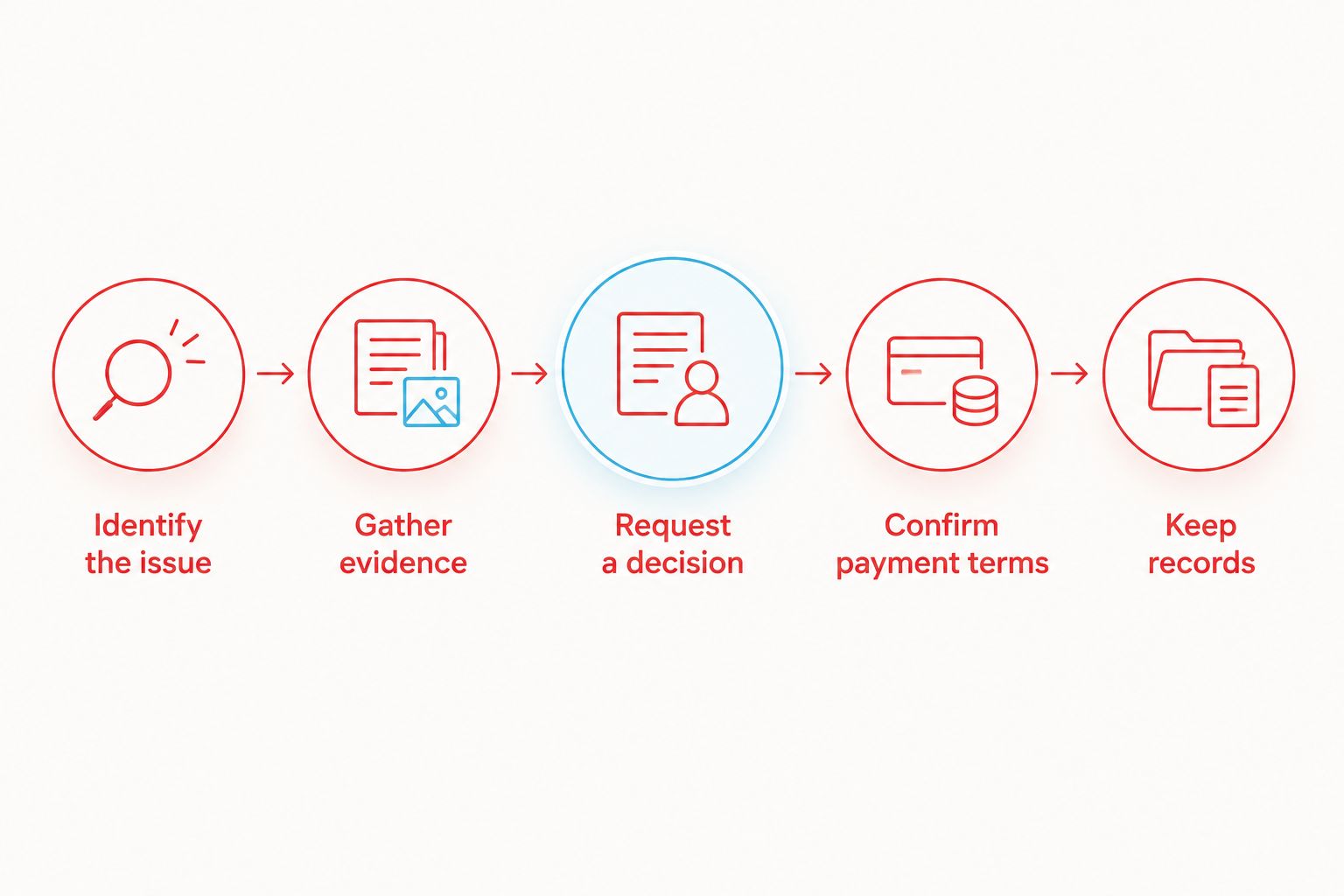
- Identify the issue. State whether you need payment terms, relief, an account correction or an explanation of a decision. Include the property address, account reference and billing period.
- Gather evidence. Match each disputed fact to a document. Use occupation records for occupation dates, bank records for payments and financial information for an affordability request.
- Request a decision. Explain the outcome you want and ask the council to give reasons if it refuses. Avoid asking only for someone to look into the matter.
- Confirm payment terms. If you need different instalments, ask separately for written agreement. Also ask whether recovery will continue while the substantive issue is reviewed.
- Keep records. Save correspondence, attachments, decisions and payment confirmations together. Record telephone discussions and send a written summary afterwards.
This sequence helps separate a disputed debt from an undisputed amount that you cannot currently afford. Those problems need different responses, even when they concern the same account.
What should I write in my request?
Use a subject line that identifies the account and purpose, such as a business rates payment arrangement request for 2026. Put the requested outcome near the start, not beneath a long account of your trading history.
Your message should cover:
- The account: property address, account reference and the period concerned.
- The issue: the payment difficulty, disputed entry or relief decision.
- The evidence: the documents attached and the facts they establish.
- The action: the correction, decision or payment arrangement you want.
- The reply: a request for written reasons and confirmation of the next step.
Keep allegations out of the first request. A precise explanation of an incorrect occupation date is more useful than saying the entire bill is unfair.
If enforcement correspondence has already arrived, address it explicitly. Do not assume a general enquiry has reached the team handling recovery.
What if the rateable value is the real problem?
A valuation dispute belongs with the valuation authority, not the council's billing team. The rateable value is part of the calculation behind your bill; changing payment dates does not correct it.
For current valuation challenges, England and Wales both use Check, Challenge, Appeal. Wales adopted CCA on 1 April 2023; current Welsh challenges are not a separate proposal-based process.
Checks and Challenges are handled by the valuation authority. Appeals go to the relevant Valuation Tribunal for England or Wales, subject to the applicable requirements.
That shared process does not make every relief, deadline or tribunal arrangement identical. Check the rules for the property, rating list and decision concerned before taking action.
Start with the rating assessment and evidence about the property. A neighbouring business's smaller bill does not, by itself, establish that your assessment is wrong: its property, occupation or relief position can differ.
The Check, Challenge, Appeal guide for 2026 explains the valuation route. Keep any council payment discussion running separately rather than treating CCA as a payment holiday.
Why the council's response varies
The council's response depends on the request and the evidence, not just how strongly you object. These factors determine what it can assess:
- Type of request: payment collection, relief, billing and valuation are different functions. The billing team cannot decide every issue affecting your bill.
- Relevant period: a request must identify the dates and billing period concerned. Evidence about current occupation does not necessarily establish earlier circumstances.
- Eligibility: relief depends on the applicable conditions. Financial difficulty alone does not prove entitlement to every scheme.
- Quality of evidence: dated records help establish who occupied the premises, when changes occurred and what payments were made.
- Account status: an account already in recovery needs explicit attention to that recovery action alongside the underlying dispute.
For a 2026 request, make sure your supporting documents address the period you actually dispute. Reusing an old explanation without checking the dates can leave the council unable to answer the current question.
Can the council write off business rates because I cannot afford them?
Financial hardship does not automatically cancel business rates. Ask the council about applicable hardship assistance and payment arrangements, and provide evidence supporting the particular request.
Be clear whether you are seeking a reduction or more time. A response offering instalments does not answer a separate request for relief, so ask for a written decision on each.
Should I keep paying while I dispute the bill?
A dispute does not automatically suspend business rates payments. Continue paying as required unless the council confirms a different arrangement or the liability is formally changed.
If you cannot maintain payments, contact the council rather than silently stopping. Ask it to confirm both the payment position and whether recovery action will continue.
What if the council refuses my request?
Ask for the decision, reasons and applicable review or appeal route in writing. A refusal of payment terms, a rejected relief application and a valuation disagreement do not all have the same escalation process.
A council complaint can address poor administration, but it does not replace CCA or another applicable statutory route. Read the decision carefully and act on any stated deadline rather than waiting for a complaint to finish.
When is professional help useful?
Professional help is relevant when the account dispute and property assessment overlap, the evidence is contested or you need someone to manage the case. A straightforward payment-allocation error is often better raised directly with the council first.
Appeal My Rates UK is best suited to business owners seeking professional representation on business rates valuations or council rates disputes. Its rating surveyor services cover valuation challenges, property splits and mergers, and disputes with council rates teams in England and Wales.
Representation does not guarantee a reduction or stop payment obligations. You still need to provide accurate records and understand the instruction before authorising work.
For Appeal My Rates UK instructions: Most of our work is no win, no fee, but some instructions carry fixed fees. Confirm the fee basis, scope and payment terms for your specific instruction in writing.
Get help with your rates dispute
Discuss whether your issue concerns the council account, payment terms or property valuation.
FAQ
Can I negotiate business rates with council officers over the phone?
You can discuss payment arrangements, relief and billing issues by phone, but ask for any decision or agreement in writing. A telephone conversation does not itself change your liability or suspend recovery.
Can my council lower my rateable value?
Your council’s billing team does not determine the property’s rateable value. A valuation dispute follows Check, Challenge, Appeal through the valuation authority, with appeals going to the relevant tribunal.
Will the council accept less if I pay my business rates immediately?
Do not assume an immediate payment earns a negotiated discount on a correctly calculated business rates bill. Ask about applicable relief or a specific billing correction instead.
Can I stop paying business rates while the council investigates?
An investigation does not automatically suspend payment. Continue paying as required unless the council confirms another arrangement or your liability is formally changed.
Do business rates appeals work differently in England and Wales?
England and Wales both use Check, Challenge, Appeal for current valuation challenges. Checks and Challenges go to the valuation authority, while appeals go to the relevant Valuation Tribunal for England or Wales; other rules require country-specific checking.
Can I ask for relief and a payment arrangement together?
You can raise a relief application and a payment-arrangement request together, but ask the council to decide each separately. Applying for relief does not itself change the existing payment schedule.
Does Appeal My Rates UK handle council business rates disputes?
Appeal My Rates UK handles disputes with council rates teams as well as business rates valuation challenges. Most of our work is no win, no fee, but some instructions carry fixed fees. Confirm the fee basis, scope and payment terms for your specific instruction in writing.
One last thing
Ask the council to answer two separate questions: whether the bill is correct, and what payment arrangement applies while the issue is considered. A reply to one does not resolve the other.
For any unresolved 2026 account, keep the latest demand, your evidence and the council's written response together. Do not mistake an acknowledgement for a decision, or a decision for an agreed payment plan.
Related guides
- How to escalate a council business rates dispute
- Can I pause paying business rates during an appeal?
- Can I claim business rates relief and appeal at the same time?