
Yes, business rates mitigation is legal when you use a lawful relief, exemption, valuation challenge or liability correction and give accurate information. In 2026, the answer depends on the arrangement and the rules where your property sits: reducing a bill lawfully is different from making false claims, and appointing an adviser does not suspend your payment obligations.
- Is business rates mitigation legal? Yes, when the relief, exemption or valuation challenge meets the applicable rules.
- England and Wales use Check, Challenge, Appeal for current valuation disputes; council billing disputes need separate attention.
- Appeal My Rates UK supports business owners in England and Wales with valuation challenges and council rates disputes.
- Reject arrangements based on false occupation records, concealed facts or guaranteed reductions.
Why this matters
A business rates bill can be wrong for different reasons. The valuation might be inaccurate, a relief might not have been applied, or the council might have billed the wrong ratepayer or period. Each problem needs its own evidence and route to correction.
Start with the error, not the promised saving. A lower bill is the possible result of a valid case, not evidence that a proposed arrangement is lawful. You can also claim business rates relief and appeal at the same time where you meet the requirements for both; they address different parts of the calculation.
Is business rates mitigation legal in the UK?
Yes. Claiming an entitlement or correcting an assessment is legitimate. The word mitigation does not, by itself, establish whether a particular scheme works or complies with the law.
Use this comparison to identify what a proposal actually involves. The best route depends on the problem with your property or account, not the label an adviser uses.
| Route | Best for | Main benefit | Limitation or risk |
|---|---|---|---|
| Relief or exemption claim | A property or ratepayer meeting specific eligibility rules | Applies an entitlement to the bill | Conditions and reporting duties must be met |
| Valuation challenge | Evidence that the rating assessment is wrong | Corrects an inaccurate assessment | The review does not guarantee a reduction |
| Billing or liability correction | An incorrect ratepayer, period or account entry | Addresses the council's billing decision | Does not itself change the property valuation |
| Property split or merger review | A genuine change in how premises are occupied | Tests whether the rating entries reflect the facts | Separate entries do not automatically mean a lower total bill |
| Proposed occupation arrangement | A genuine proposed use needing assessment | Allows the actual facts to be considered | Paperwork alone does not establish qualifying occupation |
A lawful arrangement can still fail to deliver the expected saving. Legality, eligibility and financial benefit are separate questions. Before acting in 2026, establish all of them rather than accepting a general assurance that a scheme is approved.
Relief and exemptions: claim only what the facts support
A relief claim is appropriate when your circumstances meet the relevant conditions. An exemption concerns whether a property or occupation falls within a recognised category. Neither follows simply because trading is difficult or a business rates bill feels unaffordable.
Ask which rule supports the claim and what evidence demonstrates eligibility. Depending on the claim, relevant records include occupation dates, property use, leases and information about other premises. The evidence must describe what actually happens at the property.
Keep the application and the resulting decision together. If circumstances change, check whether you must notify the council and whether the entitlement continues. An award based on earlier facts is not permission to leave an account unchanged indefinitely.
For a 2026 claim, check the applicable country's current guidance rather than relying on an old approval for another property. England, Wales, Scotland and Northern Ireland do not share every relief rule, even where similar terminology appears.
Valuation challenges: use the formal process
A valuation challenge is a legitimate way to dispute an inaccurate assessment. Relevant evidence can include floor measurements, property descriptions, rental information and comparable assessments, subject to the valuation rules that apply. A neighbouring property's lower bill is a starting point for investigation, not proof that your assessment is wrong.
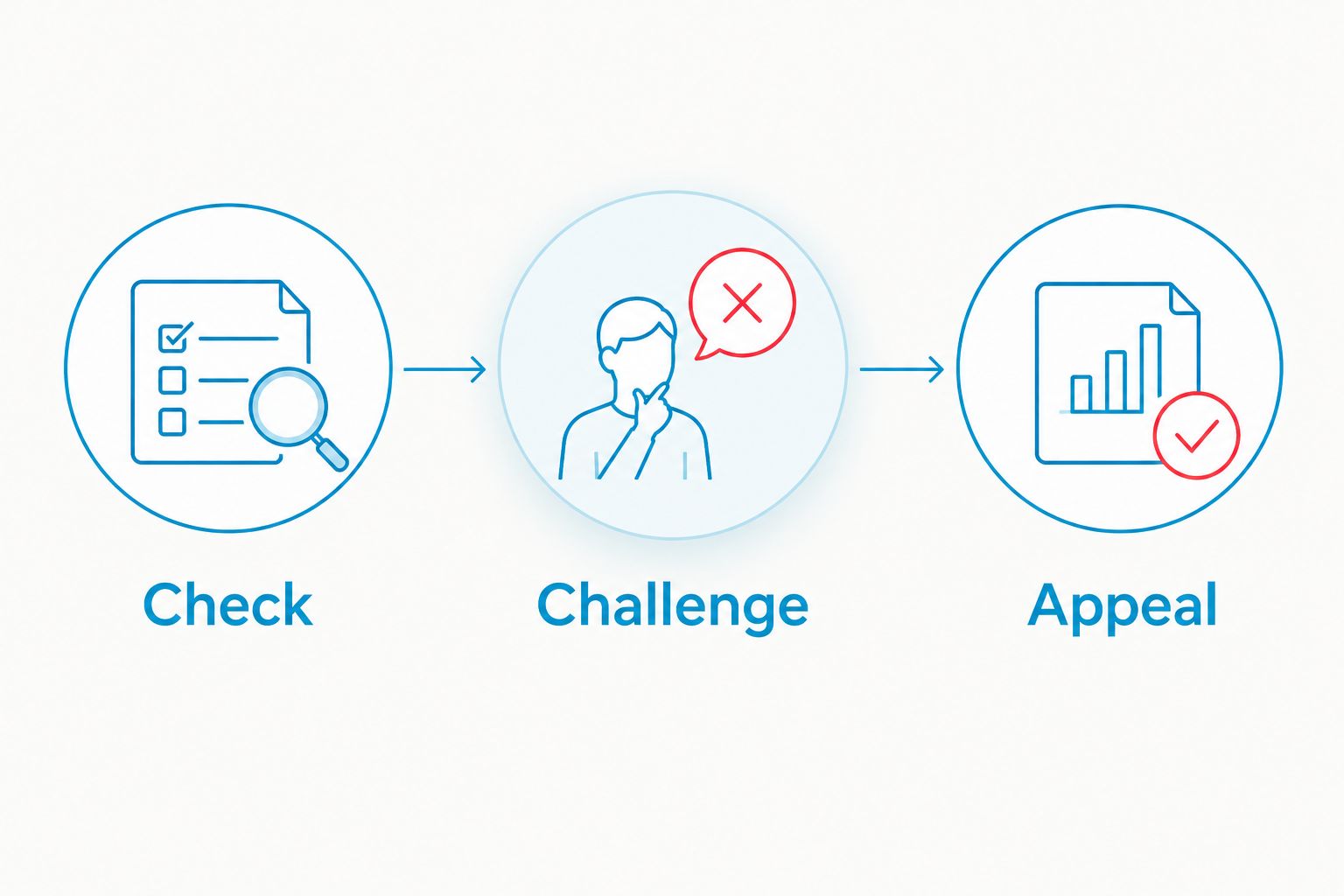
England and Wales both use Check, Challenge, Appeal, commonly shortened to CCA, for the 2023 rating list onwards. Wales adopted CCA on 1 April 2023, as confirmed in GOV.UK's background information on non-domestic rating challenges and changes.
The process has 3 stages:
- Check: establish and correct the facts recorded about the property through the valuation authority.
- Challenge: explain the disputed valuation and submit the supporting case to the valuation authority.
- Appeal: take an eligible unresolved dispute to the relevant Valuation Tribunal for England or Wales.
The shared process does not make every deadline, billing rule or tribunal arrangement identical. For a case submitted in 2026, identify the rating list and the applicable requirements before preparing the submission.
A challenge is not a guaranteed reduction. Reviewing an assessment can reveal facts that support leaving it unchanged or increasing it. Assess that risk before authorising a submission, rather than treating every review as a one-way opportunity.
Empty property arrangements: examine the actual occupation
An empty property needs a fact-specific review. Establish when occupation ended, who holds the relevant interest, how the premises are being used and which empty-property provisions apply. Do not assume an unused room makes an otherwise occupied building exempt.
Temporary occupation arrangements require particular care. A lease, licence, delivery receipt or photograph is evidence to examine; none automatically settles whether the legal requirements for occupation have been met. The actual use and surrounding circumstances matter.
Ask the provider to explain the legal basis for any proposed change and the consequences if the council disputes it. Your review should cover responsibility for the bill, control of the premises and the documents you are being asked to sign.
Do not create or approve misleading evidence. False dates, invented activity or inaccurate descriptions of use are not legitimate mitigation. A genuine short-term arrangement still needs assessment against the applicable rules; its duration alone does not establish the answer.
Property splits and mergers: reflect reality, not a target saving
Splitting or merging rating entries can be appropriate where the physical layout and occupation support that treatment. A paper division of a building does not automatically establish separate rateable properties.
Start with plans, access arrangements, leases and a clear description of who occupies each area. Record changes when they happen, including which spaces remain shared. The question is how the property should be assessed on the facts, not how many entries would produce the most attractive bill.
Separate assessments can change the overall outcome, including how relief conditions apply. Compare the total liability across the affected premises, rather than looking only at a proposed reduction for one unit. A split or merger is a property assessment issue, not a guaranteed saving mechanism.
Why the legality of business rates mitigation varies
The same sales description can cover very different arrangements. These factors determine what needs checking:
- Location: establish which country's rating rules apply. Advice about an English property does not automatically settle a Welsh, Scottish or Northern Irish case.
- Actual occupation: identify who uses the property, for what purpose and on what dates. Documents must match those facts.
- The route used: distinguish a valuation challenge from a relief application or council billing dispute. Sending evidence to the wrong body does not resolve the underlying issue.
- Eligibility conditions: confirm every condition attached to the claimed relief or exemption, including obligations to report changes.
- Rating list and timing: establish which assessment and period are in dispute. Do not assume a correction can take effect from any date you choose.
- Accuracy of evidence: check that plans, declarations and supporting records are complete and truthful. An adviser cannot make inaccurate information safe to submit.
For any 2026 proposal, ask for the explanation in writing. A statement that other businesses use the arrangement does not establish your entitlement.
How do I check a mitigation proposal before signing?
Use this sequence before you authorise an adviser, change occupation arrangements or submit a claim.
Identify the issue
Write down exactly what appears wrong: the valuation, relief decision, liable party, occupation dates or property entries. If the proposal does not identify a specific issue or entitlement, ask for clarification before proceeding.
Request the basis
Ask which rule or valuation principle supports the proposed action. The explanation should connect your circumstances to that basis, rather than relying on phrases such as a secret exemption or an automatic entitlement.
Review the evidence
Read every declaration submitted in your name. Check dates against leases, handover records and correspondence. Query any document that describes occupation or activity differently from what actually happened.
Understand the downside
Ask what happens if the application fails, the assessment increases or the council disputes the arrangement. Include any continuing property obligations in that review. A claimed saving does not cancel contractual responsibilities you have accepted elsewhere.
Confirm the instruction
Get the scope, fee basis and payment terms in writing before work starts. Establish who handles council correspondence, whether tribunal representation is included and what happens if you end the appointment. Avoid signing a broad authority you do not understand.
Keep a copy of the signed terms and all subsequent instructions. You should be able to explain what is being claimed, why it applies and what happens if it is refused.
Can I stop paying business rates while mitigation is reviewed?
No: a claim, complaint or valuation challenge does not itself suspend your obligation to pay the bill. Continue paying as billed unless the council issues a revised demand or confirms another arrangement.
A dispute about affordability also needs separate attention. Contact the council about payment difficulties rather than assuming the mitigation provider is handling them. Keep written confirmation of any agreed arrangement and distinguish it from correspondence about the valuation.
Does a mitigation company make the arrangement legal?
No: appointing a company does not establish that its proposal is lawful or that you qualify for a reduction. You still need accurate facts, a valid basis and clear instructions about what will be submitted on your behalf.
Check any claimed professional membership directly with the relevant body. IRRV or RICS references should identify a verifiable credential, not act as a substitute for explaining the case. Do not treat a professional designation as a guarantee of a particular result.
When should you get rating surveyor support?
Appeal My Rates UK is for business owners in England and Wales who need professional rating surveyor support with valuations, property splits or mergers, and council rates disputes. Support is relevant when the evidence or correct route is unclear, or when a proposed arrangement changes how premises are occupied.
Professional representation does not guarantee a reduction or remove the need for accurate instructions. You should still understand the case being advanced and review the appointment terms before authorising work.
Most of our work is no win, no fee, but some instructions carry fixed fees. Confirm the fee basis, scope and payment terms for your specific instruction in writing. Do not assume that every appeal, split, merger or council dispute uses the same arrangement.
To discuss the facts before acting, contact Appeal My Rates UK. Explain the property location, the issue with the bill and any deadline shown on correspondence.
FAQ
Is business rates mitigation the same as evasion?
No. Lawful mitigation uses a valid entitlement or correction supported by accurate facts. False declarations or concealed information are not legitimate ways to reduce liability.
Can a business rates company guarantee a reduction?
A company’s promise does not bind the council, valuation authority or tribunal. Ask for the evidence supporting the proposed reduction and a written explanation of the risks.
Does Wales use Check, Challenge, Appeal?
Yes. Wales adopted Check, Challenge, Appeal on 1 April 2023 for the 2023 rating list onwards. Checks and Challenges go to the valuation authority, while eligible appeals go to the Valuation Tribunal for Wales.
Is a temporary occupier enough to remove empty property rates?
No. A temporary occupier does not automatically establish an entitlement to relief. The actual occupation and the applicable rules need assessment.
Can I challenge a valuation without using a consultant?
Yes. You can handle your own valuation challenge, provided you follow the applicable process and supply the required evidence. Professional support is an option, not a condition of making a case.
Does Appeal My Rates UK handle every case on a no win, no fee basis?
Most of our work is no win, no fee, but some instructions carry fixed fees. Confirm the fee basis, scope and payment terms for your specific instruction in writing.
Is this guidance the same across the whole UK?
No. This article focuses on England and Wales, which share the current Check, Challenge, Appeal framework. Scotland and Northern Ireland have their own rating systems, so the appropriate local rules need checking.
One last thing
An unaffordable bill and an incorrect bill are different problems. Evidence that your business is struggling does not, by itself, prove that the property's valuation is wrong. Equally, paying a bill does not establish that every detail on it is correct.
Before taking action in 2026, separate valuation evidence, relief eligibility and payment difficulties into distinct issues. That makes it easier to request the right decision from the right body—and avoids mistaking a mitigation proposal for permission to stop paying.
Related guides
- Can splitting a property reduce my business rates bill?
- Empty commercial property rates relief eligibility
- Compare business rates consultant fee terms