
Yes, you can qualify for business rates relief while your business is dormant, but dormancy itself does not create an entitlement: the council assesses the property, its occupation and the conditions of the relevant relief. A dormant company that still occupies premises can remain liable, while genuinely empty premises can qualify for empty property relief even though the lease continues.
- Business rates relief dormant business claims depend on property use and eligibility, not company status alone.
- Standard empty property relief normally covers 3 months; qualifying industrial premises normally receive 6 months.
- Small business rate relief is not an automatic substitute when premises become empty.
- Appeal My Rates UK helps business owners with business rates valuations and council disputes, not company dormancy filings.
Why this matters
Stopping sales does not necessarily stop your business rates liability. Your company records, your lease and the actual use of your premises answer different questions, so telling Companies House that a company is dormant does not settle the council account.
For a 2026 claim, start with the premises rather than the company label. Establish whether the property is occupied, empty or partly occupied, then check the relevant conditions for empty commercial property rates relief.
Do not assume that a closed business has an empty property. Stock, equipment, storage and continued access all need explaining accurately to the council.
Can I claim business rates relief while my business is dormant?
You can claim any relief for which the property and ratepayer meet the conditions. There is no general business rates exemption simply because a company is dormant, has no turnover or has stopped taking orders.
The distinction matters whether you operate through a limited company or as a sole trader. A sole trader does not have a Companies House dormancy filing, but the same practical question remains: what is happening at the premises, and who is liable for them?
| Your situation | Route to check | Main benefit | Main limitation |
|---|---|---|---|
| Trading has stopped, but you still use the premises | Occupied-property relief eligibility | Relevant relief can reduce an eligible occupied-property bill | No turnover does not prove eligibility |
| The premises are genuinely empty | Empty property relief | A qualifying initial exemption can apply | The period is limited and previous vacancy matters |
| Only part of the premises is temporarily unused | Partly occupied property relief | The council can consider eligible temporary partial occupation | It is discretionary, not an automatic reduction |
| The bill names the wrong liable party or dates | Council account correction | Corrects the billing basis where evidence supports it | Ending trade alone does not end liability |
| The property's rating assessment is wrong | Valuation review | Addresses errors in the assessment | Dormancy alone is not evidence of an incorrect valuation |
Match the claim to the property facts, not the description of your business. That gives the council a clear issue to decide and prevents a relief request becoming confused with a valuation challenge.
Empty commercial premises: normally 3 months of initial relief
Standard empty commercial property relief normally provides a 3-month exemption when a qualifying property becomes unoccupied. After that initial period, empty property rates generally become payable unless another exemption applies.
GOV.UK's business rates relief guidance and Business Wales's empty property relief guidance describe this standard initial exemption. These are property-based rules: a dormant company does not receive an additional allowance merely because it has stopped trading.
The important date is when the property became unoccupied, not necessarily when you last invoiced a customer. If you stopped selling but continued storing stock or carrying out work, explain that sequence rather than supplying a single closure date without context.
Ask the council to confirm the recognised vacancy date and any empty relief already recorded. Do not assume a new lease, new company status or new bill starts a fresh 3-month period.
Qualifying industrial premises: normally 6 months of initial relief
Qualifying industrial premises, including qualifying warehouses, normally receive a 6-month initial empty property exemption. That longer period depends on the property's classification and the relevant conditions, not simply on calling the building a warehouse.
The standard 3-month and qualifying industrial 6-month periods appear in official guidance for both England and Wales. This shared starting point does not mean every exemption, reoccupation condition or other rule is identical across the two countries.
For a 2026 application, ask the council which classification it has applied and what vacancy history it holds. A remaining lease commitment does not, by itself, prevent empty property relief, but it can mean you remain responsible once relief ends.
Keep the distinction clear: the exemption concerns the property being empty; it does not cancel the lease or transfer responsibility to the landlord.
What if the dormant business still occupies the property?
A business can stop trading while continuing to occupy premises for storage, administration or another business purpose. The absence of customers is not conclusive evidence that a property is unoccupied.
If the premises remain occupied, check occupied-property relief conditions instead of assuming empty property relief applies. Small business rate relief has eligibility requirements involving the property and ratepayer; dormancy does not replace those requirements.
Equally, do not assume an existing occupied-property relief continues unchanged after you vacate. Tell the council what changed and ask it to confirm the correct treatment from the relevant date.
Describe actual use rather than arguing from turnover. A dated explanation of what remained inside, who accessed the premises and what activity continued is more useful than a statement that the company earned nothing.
Why business rates relief eligibility varies
These factors determine which route needs checking:
- Actual occupation: continuing storage or other use can affect whether the premises qualify as empty.
- Property classification: qualifying industrial premises have a different standard initial exemption period from other commercial premises.
- Vacancy history: earlier empty periods and intervening occupation affect the account's relief history.
- Legal responsibility: ownership, a continuing lease or an effective surrender can affect who owes the rates.
- Location: England and Wales share some rules, but you must check the guidance applying to the property.
- Evidence and dates: the council needs a supported account of when occupation changed and which conditions were met.
None of these factors is resolved by a dormant company entry alone. Give the council the underlying property facts and ask for a written decision identifying the relief, dates and reasons.
How do I apply while my business is dormant?
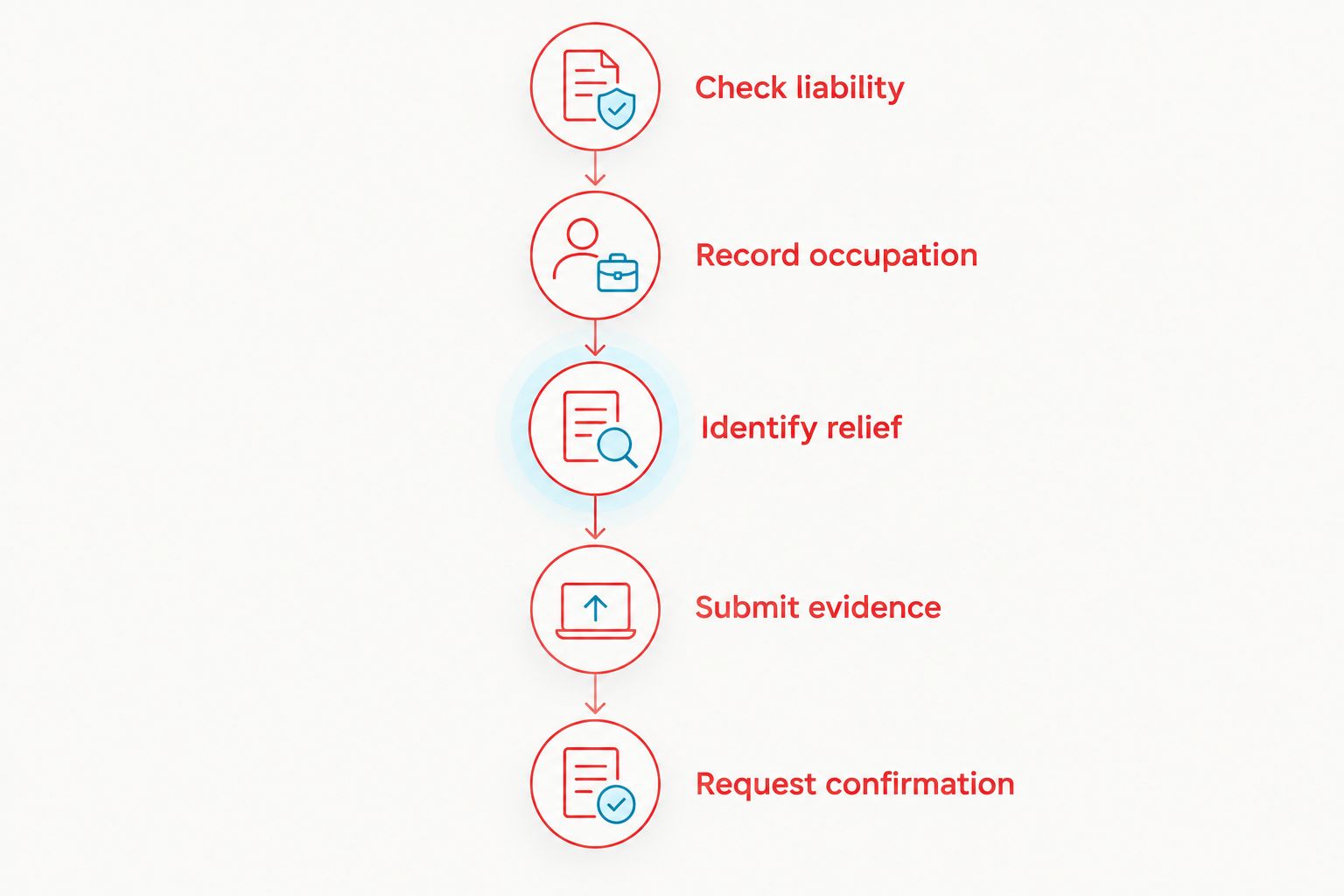
Use this sequence to prepare a 2026 claim. Keep the council account reference and property address on every submission so the evidence reaches the correct account.
- Check liability. Read the demand notice and identify the named ratepayer, charged period and property. Compare those details with the lease, ownership documents or surrender agreement.
- Record occupation. Set out when trading stopped, when staff left, when stock or equipment moved and what use continued. Separate these events if they happened on different dates.
- Identify relief. Ask the council whether the facts support empty property relief, occupied-property relief or consideration of temporary partial occupation relief.
- Submit evidence. Provide the documents requested by the council, supported by a clear timeline. Keep copies of attachments and confirmation that the submission was received.
- Request confirmation. Ask for the decision, effective dates and revised bill in writing. If the council refuses relief, request its reasons and the appropriate review or dispute route.
The purpose is to make one consistent account of the property available to the billing team. Contradictory dates across a landlord's email, application form and company records need explaining before they become a dispute.
What evidence should I keep?
Keep evidence that demonstrates the property's status, not just the company's accounting position. Useful records include:
- The business rates demand notice and relevant account correspondence.
- The lease, break notice, surrender agreement or completion documents.
- Dated photographs showing the condition and contents of the premises.
- Records of stock removal, equipment collection or key handover.
- Utility readings and access records where they help explain occupation.
- Company records as supporting context, rather than proof of vacancy.
A photograph is a snapshot, not a complete history. Explain what it shows and connect it to the timeline, particularly where equipment remained or someone continued visiting the premises.
Can I claim relief and challenge the valuation together?
Yes, relief eligibility and valuation accuracy are separate issues, so each can need attention. A relief application goes to the council; an incorrect property assessment requires the relevant valuation process.
In England and Wales, current valuation challenges use Check, Challenge, Appeal. Checks and Challenges are handled by the valuation authority, with appeals going to the relevant Valuation Tribunal for England or Wales; the shared process does not make every regional rule identical.
For a 2026 case, distinguish an incorrect assessment from a business that has simply stopped trading. Dormancy, reduced turnover and an unaffordable bill do not by themselves establish a valuation error.
Keep paying according to the current demand unless the council confirms a different arrangement. Applying for relief or starting a valuation challenge does not itself suspend collection.
When should I ask a rating surveyor for help?
Ask for help when the dispute concerns more than a straightforward vacancy notification: contested occupation, overlapping liability dates, a property split or merger, or an assessment that does not reflect the property correctly.
Appeal My Rates UK is for business owners seeking business rates valuation and council-dispute support, not company dormancy advice. Professional assistance can help organise the property issues, but it does not guarantee relief or a lower assessment.
Before instructing Appeal My Rates UK in 2026, distinguish the work required from the outcome you want. Confirm whether the instruction concerns council billing, relief eligibility, a valuation challenge or more than one issue.
Most of our work is no win, no fee, but some instructions carry fixed fees. Confirm the fee basis, scope and payment terms for your specific instruction in writing through the contact page.
FAQ
Does registering my company as dormant stop business rates?
No. Dormant company status does not automatically end business rates liability or create relief entitlement. The council considers the property, occupation, liable party and applicable relief conditions.
How long can an empty business property receive initial relief?
Standard qualifying empty commercial premises normally receive 3 months of initial exemption; qualifying industrial premises normally receive 6 months. Ask the council to confirm the property’s classification, vacancy history and applicable conditions.
Can I keep small business rate relief after closing my business?
Closing the business does not guarantee that small business rate relief continues. Tell the council whether the premises remain occupied or have become empty, and ask it to confirm the correct relief treatment.
Do I still owe rates if my dormant company has no income?
Yes, a company can remain liable for business rates despite having no income. Lack of income alone is not an exemption, so check the property facts and any applicable relief.
Can I get relief if stock is still inside the premises?
Stock remaining inside the premises requires a factual assessment of occupation; it does not produce an automatic answer. Explain what remains, why it remains and how the property is being used.
Can I stop paying while the council considers my relief claim?
A relief application does not itself suspend your payment obligations. Follow the current demand unless the council confirms a revised bill or payment arrangement.
Does handing the keys back end my rates liability?
Handing back keys does not by itself prove that your legal responsibility has ended. Keep evidence of the effective lease termination or surrender and ask the council to confirm the liability end date.
One last thing
Your last trading day, vacancy date and liability end date can all be different. Put them on separate lines in your 2026 claim, with evidence beside each, rather than using one closure date for everything.
That simple distinction helps the council decide the right question: whether relief applies, who owes the bill and for which period.
Related guides
- Can I claim business rates relief and appeal at the same time?
- Can I appeal business rates on a property I've vacated?
- How to escalate a council business rates dispute