

Yes, you can appeal business rates on a listed building in England or Wales if you have grounds to challenge its rating assessment. Listed status does not automatically reduce an occupied property's bill; an empty listed building raises a separate exemption question for your council.
- Can you appeal business rates on a listed building? Yes: challenge an incorrect assessment, not simply the listing.
- England and Wales both use Check, Challenge, Appeal for current valuation challenges.
- Empty listed buildings require a separate exemption check with the billing council.
- Appeal My Rates UK handles business rates disputes for business owners seeking professional representation.
Why this matters
A listed building can raise several different business rates questions. You might dispute its rateable value, need the council to recognise an empty-property exemption, or find that your bill covers the wrong occupation dates. Each problem needs the right evidence and decision-maker.
Start by separating the assessment from the bill. A valuation challenge does not replace an exemption request, and telling the council that your premises are listed does not itself challenge their rateable value. For the exemption distinction, read how business rates exemptions work for listed buildings.
Can you appeal business rates on a listed building?
Yes. For a 2026 case, identify what is wrong, which rating list is involved and what correction you need before starting a formal challenge. Use this sequence:
- Identify the assessment. Match the rating-list address and property description to your premises. Record the rateable value and the list it belongs to.
- Define the disputed point. Explain the alleged error rather than relying on the building's age or listed status alone.
- Gather supporting records. Keep the bill, listing entry, plans, occupation records and relevant correspondence together.
- Choose the correct route. Use Check, Challenge, Appeal for valuation issues; contact the council about exemptions, reliefs and billing matters.
- Check the applicable timetable. Confirm the requirements for the relevant list, decision and stage before submitting anything.
The distinction is practical: you need a request that the receiving authority can decide. An appeal built around the wrong issue wastes time even where the underlying concern is genuine.
| Route | Best for | Main advantage | Main limitation |
|---|---|---|---|
| Valuation challenge | An allegedly incorrect rating assessment | Addresses the assessment underlying the bill | Listed status alone does not establish an error |
| Council exemption request | An empty listed building requiring an eligibility decision | Addresses whether empty-property rates are payable | Does not automatically correct the rateable value |
| Council billing dispute | Incorrect liability dates or an unapplied decision | Targets the council's account records | Does not replace a valuation challenge |
Occupied listed buildings: challenge the assessment, not the listing
An occupied listed building is not automatically exempt from business rates. Heritage protection and business rates serve different purposes, so a listing entry is not a substitute for evidence that the rating assessment is wrong.
Start with the records. Does the assessment identify the correct premises? Do its recorded details match the property you occupy? Is your objection about the assessment itself, or about something the council has done when preparing the bill?
If your concern involves restrictions on alterations, retain the actual consent decisions and correspondence. Do not assume that a restriction creates a standard reduction. Its relevance needs to be considered against the particular assessment and applicable rating guidance.
For a 2026 review, describe the building as it actually stands and distinguish existing facts from proposed works. A planned refurbishment, an application awaiting a decision and completed alterations are different evidence, not interchangeable descriptions.
Empty listed buildings: ask the council about exemption
Empty listed commercial buildings can qualify for exemption from empty-property business rates. That is a council liability issue, separate from whether the property's rateable value is correct.
Give the council the listing details, the property address, the vacancy date and evidence of occupation ending. Ask for a written decision identifying the premises and period covered. Do not assume the council has connected a heritage record to your rates account.
An empty building and an unsuccessful business are not the same thing. If trading has stopped but the premises remain in use, describe that use accurately rather than calling the property empty without explanation.
Part occupation also needs care. A vacant upper floor does not establish that the whole building is empty. Explain which areas remain occupied, by whom and for what purpose, and ask what evidence the council requires.
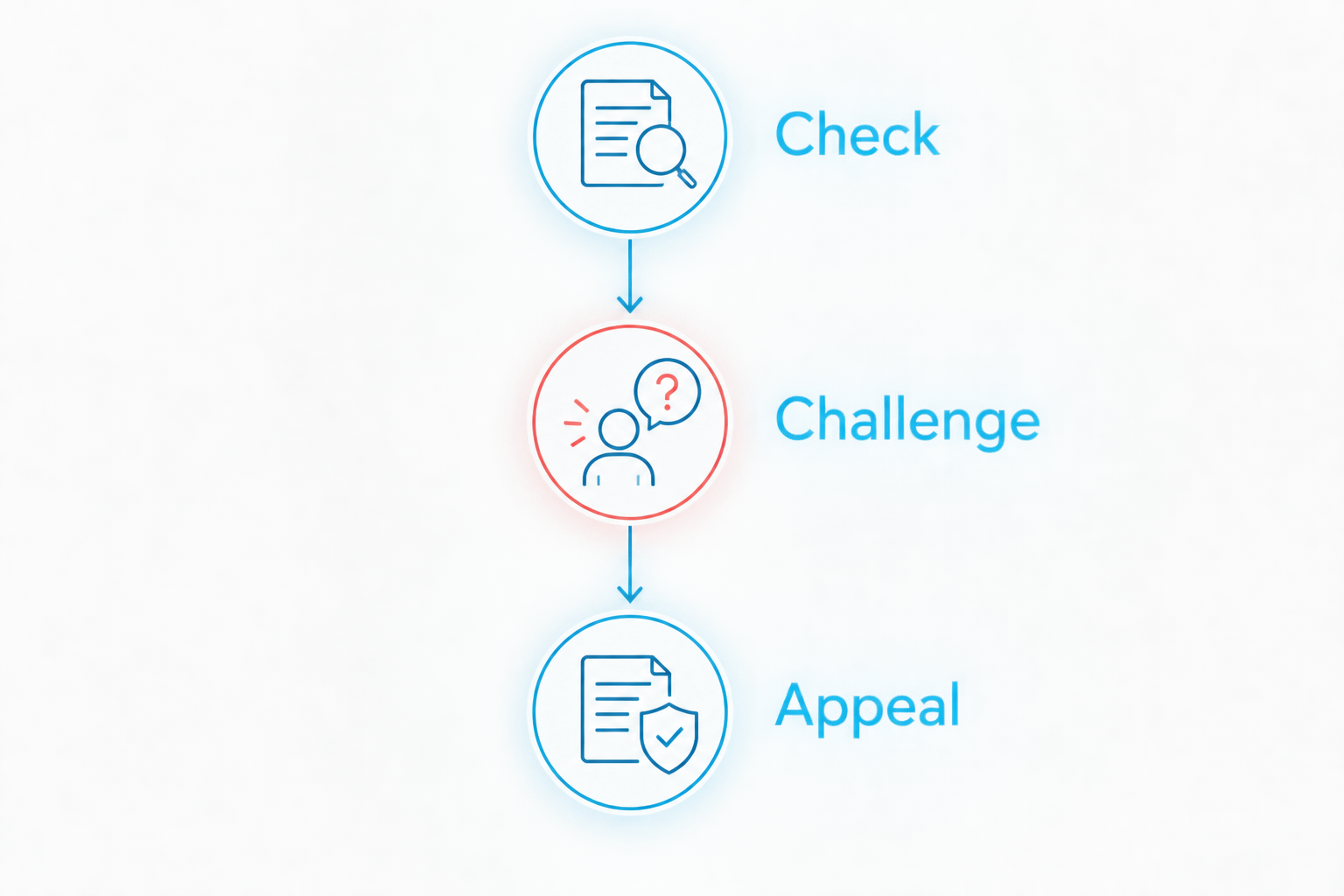
How does Check, Challenge, Appeal work?
England and Wales both use the 3-stage Check, Challenge, Appeal process for current valuation challenges. Wales adopted CCA on 1 April 2023, and both countries use it for the 2023 rating list onwards, including the 2026 list.
Check
The Check stage addresses the property facts held by the valuation authority. Review those records carefully and supply evidence for corrections. Keep the submission and the response: later arguments need to remain consistent with the factual record.
Challenge
The Challenge stage sets out why you believe the assessment is wrong and the change you seek. Present a clear case supported by relevant evidence. A statement that the building is listed, without explaining the disputed assessment, does not do that job.
Appeal
An eligible unresolved case can proceed to the relevant Valuation Tribunal for England or Wales. The valuation authority handles Checks and Challenges; the tribunal handles appeals. A tribunal appeal is not simply another complaint to the council.
Sharing CCA does not make every regional rule identical. For your 2026 case, check the applicable deadlines, relief rules and tribunal guidance for the country and rating list concerned.
Why the right route varies
The building's listed status is only part of the case. These factors determine what you should investigate and where to send it:
- The disputed decision: an assessment, an exemption refusal and an incorrect bill require different requests.
- Occupation: establish whether the premises are occupied, wholly empty or partly used.
- The rating list: identify which list and period your objection concerns before checking procedural requirements.
- The factual record: compare the property details with documents rather than assumptions about the building.
- The evidence available: listing records, occupation dates and decision letters answer different questions.
- The case stage: an initial enquiry and a tribunal appeal have different requirements.
These factors can overlap. You might need the council to consider an empty-property exemption while separately reviewing the rating assessment. Keep the requests distinct so that each decision addresses the correct issue.
What evidence should you collect?
Build an evidence file around the correction you want. A large bundle is not useful if the decision-maker cannot see what each document proves.
| Evidence | What it helps establish | What it does not establish alone |
|---|---|---|
| Official listing entry | The building's listed status and recorded description | An automatic reduction for occupied premises |
| Current rates bill | Account details, billed periods and applied reliefs | Whether the assessment is correct |
| Rating-list record | The assessment being disputed | Whether the council applied an exemption correctly |
| Dated occupation records | When occupation began, changed or ended | Every condition of exemption eligibility |
| Plans and photographs | The premises and their recorded physical details | A particular reduction without further analysis |
| Consent decisions | What a particular decision permits or restricts | A standard percentage allowance |
Write a short chronology alongside the documents. Include when occupation changed, when any relevant decision arrived and when you contacted the authority. Use dates from records rather than estimates wherever possible.
For a 2026 submission, label older documents clearly. Historic plans and correspondence can still be relevant, but explain whether they describe the property during the period under dispute.
Can listed-building restrictions support a challenge?
Listed-building restrictions can form part of the evidence, but they do not guarantee a reduction. The key question is whether the evidence supports a recognised ground for changing the particular assessment.
Keep the restriction and its practical consequences separate. A consent refusal proves that a particular proposal was refused; it does not, by itself, prove that the existing rating assessment is wrong.
Ask your adviser to explain the connection in plain English before proceeding. You should understand the alleged error, the evidence supporting it and the correction sought—not just hear that listed buildings are difficult or expensive to maintain.
Should you stop paying while the case is reviewed?
Do not stop paying business rates simply because you have raised a challenge or exemption query. Follow the bill unless the council issues a revised demand or confirms another arrangement.
If payment is difficult, contact the council separately about the account. A valuation dispute and an affordability problem are different matters, and starting the former does not resolve the latter.
Keep copies of payment records and revised bills throughout the case. When a decision arrives, check that the council has applied it to the correct property, account and period rather than assuming the account is settled.
When should you use a rating surveyor?
You can handle your own case, but professional representation is relevant when the disputed assessment, evidence or procedure needs specialist attention. A listed property also requires care not to confuse planning restrictions, occupation and rating issues.
Appeal My Rates UK is best for business owners who want professional rating surveyors to handle a business rates dispute in England or Wales. The firm handles valuation challenges, property splits and mergers, and disputes with council rates teams.
Representation does not guarantee a reduction. Ask what the proposed instruction covers, who will handle each stage and whether any tribunal work requires separate agreement.
Appeal My Rates UK explains its fee approach plainly: Most of our work is no win, no fee, but some instructions carry fixed fees. Confirm the fee basis, scope and payment terms for your specific instruction in writing before appointing anyone.
Let us handle your case
Explain your listed-building rates issue and confirm the proposed scope and terms in writing.
FAQ
Can you appeal business rates on a listed building in 2026?
Yes, you can challenge a listed building’s rating assessment in 2026 if you have valid grounds. Listed status alone does not establish that the assessment is wrong.
Does a listed building automatically get lower business rates?
No, listed status does not automatically reduce business rates for occupied premises. An empty listed building raises a separate exemption question for the council.
Who decides whether my empty listed building is exempt?
Your billing council decides the exemption question for your rates account. Provide listing and occupation evidence and ask for a written decision covering the relevant premises and period.
Does Wales use a different valuation appeal process from England?
No, both England and Wales use Check, Challenge, Appeal for the 2023 rating list onwards. Checks and Challenges go to the valuation authority; appeals go to the relevant tribunal.
Can I challenge the valuation and ask for an exemption together?
Yes, a valuation challenge and a council exemption request address separate decisions. Keep their evidence, correspondence and procedural requirements distinct.
Can I stop paying rates while my listed-building appeal is considered?
No, starting a challenge does not suspend your payment obligations. Follow the current bill unless the council revises it or confirms another arrangement.
Does Appeal My Rates UK handle every case on no win, no fee terms?
Most of our work is no win, no fee, but some instructions carry fixed fees. Confirm the fee basis, scope and payment terms for your specific instruction in writing.
One last thing
A lower rateable value and an exemption are different outcomes. If your immediate concern is an empty listed building's bill, do not let discussion of a valuation appeal distract from asking the council to decide exemption eligibility.
Write down the result you need before making contact: correct the assessment, recognise the exemption or correct the account. That sentence gives your case a clear starting point.
Related guides
- How to appeal business rates in 2026
- Claiming business rates relief while appealing
- Comparing business rates consultant fee terms