

A change of use can lower your business rates if it justifies a lower rateable value, changes your relief entitlement or takes qualifying space outside business rating, but planning permission alone does not reduce your bill. Your new use can also leave the bill unchanged or increase it, so check the valuation and council billing consequences before budgeting for savings.
- Does change of use lower business rates? Only when the valuation, relief entitlement or liability changes in your favour.
- Planning permission is evidence of permitted use, not an automatic business rates reduction.
- England and Wales both use Check, Challenge, Appeal for current valuation disputes.
- Appeal My Rates UK helps business owners challenge valuations and resolve council business rates disputes.
Can a change of use lower my business rates?
Yes, but the change must affect how your property is assessed or how your bill is calculated. A new planning description, a different business name or a quieter trading period does not, by itself, establish that your assessment is wrong.
For a 2026 review, separate the intended use from what has actually happened at the property. Your planning records for a business rates reassessment help explain permission and conditions; dated evidence of occupation shows what you implemented.
| Situation | Potential benefit | Limitation or risk | Best next step |
|---|---|---|---|
| Planning permission changes, but occupation stays the same | Documents a permitted future use | Does not establish a lower assessment | Compare permission with actual occupation |
| Actual use changes | Supports reviewing the valuation basis | The correct assessment can be unchanged or higher | Check property facts and valuation evidence |
| Space is split or combined | Supports reviewing the assessment boundaries | Separate assessments do not guarantee a lower total bill | Record boundaries, access and occupation |
| New use affects relief eligibility | Can change the council's calculation | Relief has its own conditions | Ask the council to review eligibility |
| Commercial space becomes genuinely domestic | Supports reviewing the appropriate rating treatment | Mixed use and incomplete conversion need separate consideration | Establish the extent and date of domestic use |
Why this matters
Business rates involve separate questions: what property is assessed, what its rateable value should be, and how the council calculates the amount payable. A change affecting one question does not automatically settle the others.
Keep those questions separate when planning a conversion in 2026. Do not fund building work on the assumption that a planning approval will produce a rates saving. Establish the likely rating position before committing to a budget that depends on it.
Planning permission: approval is not a rates reduction
Planning permission concerns what development or use is permitted. A business rates assessment concerns the property and the relevant rating rules; a council bill then applies the appropriate billing treatment.
For example, permission to convert a shop into another commercial use does not prove that the property has changed physically or that the new use has started. Permission is supporting evidence, not a substitute for the facts on the ground.
Keep the decision notice and its conditions alongside plans, photographs and occupation records. Explain whether the permission is unused, partly implemented or fully implemented, rather than describing every stage as a completed change.
Best for checking: permission documents establish the authorised position. Their limitation is that they do not, alone, establish the correct rateable value or payable bill.
Actual use: the valuation needs evidence
A genuine change in occupation can justify reviewing whether the rating assessment describes and values the property correctly. That review needs to consider the property's characteristics and the valuation approach appropriate to it, not simply whether the new business earns less.
Changing from customer-facing trading to storage, for example, calls for a factual review rather than an assumed reduction. Record which areas changed, whether alterations took place, and how access and occupation now work.
Lower turnover is not a general substitute for property valuation evidence. Where trading information is relevant to the valuation method, it needs to be assessed in that context rather than presented as proof that every struggling business deserves a lower assessment.
Best for checking: dated plans and occupation evidence explain the actual change. The limitation is that a review can confirm the existing assessment or identify grounds for an increase.
Splits, mergers and mixed use: check the assessment boundaries
A change of use sometimes accompanies a physical split, a new occupier or the combination of neighbouring premises. In those cases, the question is not only what activity takes place but also what property should form each assessment.
Mark the occupied areas on a plan. Identify entrances, internal connections, shared facilities and which occupier controls each part; a different sign above a door does not explain those arrangements.
Mixed commercial and domestic occupation also needs a clear description of each area. Do not assume that describing part of a building as residential removes the whole property from business rates.
Best for checking: boundary and occupation evidence supports a review of the assessed property. The limitation is that splitting or merging assessments does not guarantee a lower combined liability.
Relief and exemptions: check separately from the valuation
A new use can change the questions the council needs to ask about relief or exemption. Eligibility depends on the relevant rules and the property's circumstances, not simply on adopting a different business description.
Ask whether the current bill reflects the actual use and any applicable entitlement. If you dispute both the valuation and the council's relief decision, identify them as separate issues so neither gets lost in the correspondence.
For your 2026 bill, check the rules for the country and billing period concerned. The shared valuation appeal process in England and Wales does not mean that every relief, billing rule or eligibility condition is identical.
Best for checking: a council billing review addresses relief and liability questions. Its limitation is that the council does not determine the rateable value through a relief application.
Why the effect of a change of use varies
The outcome depends on the change you can establish and the rules that apply to it:
- Actual occupation: explain what happens at the premises, not only what the planning permission allows.
- Physical layout: record alterations, usable areas, access and any divisions between occupiers.
- Valuation basis: identify whether the existing assessment remains appropriate for the property after the change.
- Effective date: establish when the relevant facts changed; permission, works and occupation can have different dates.
- Relief eligibility: check the conditions attached to the relief or exemption you are seeking.
- Billing position: reconcile the assessment with the council's bill, including the liable occupier and period charged.
A useful submission connects each document to one of these points. Sending a large bundle without explaining what it proves makes the issue harder to resolve.
How do I get my assessment and bill checked?
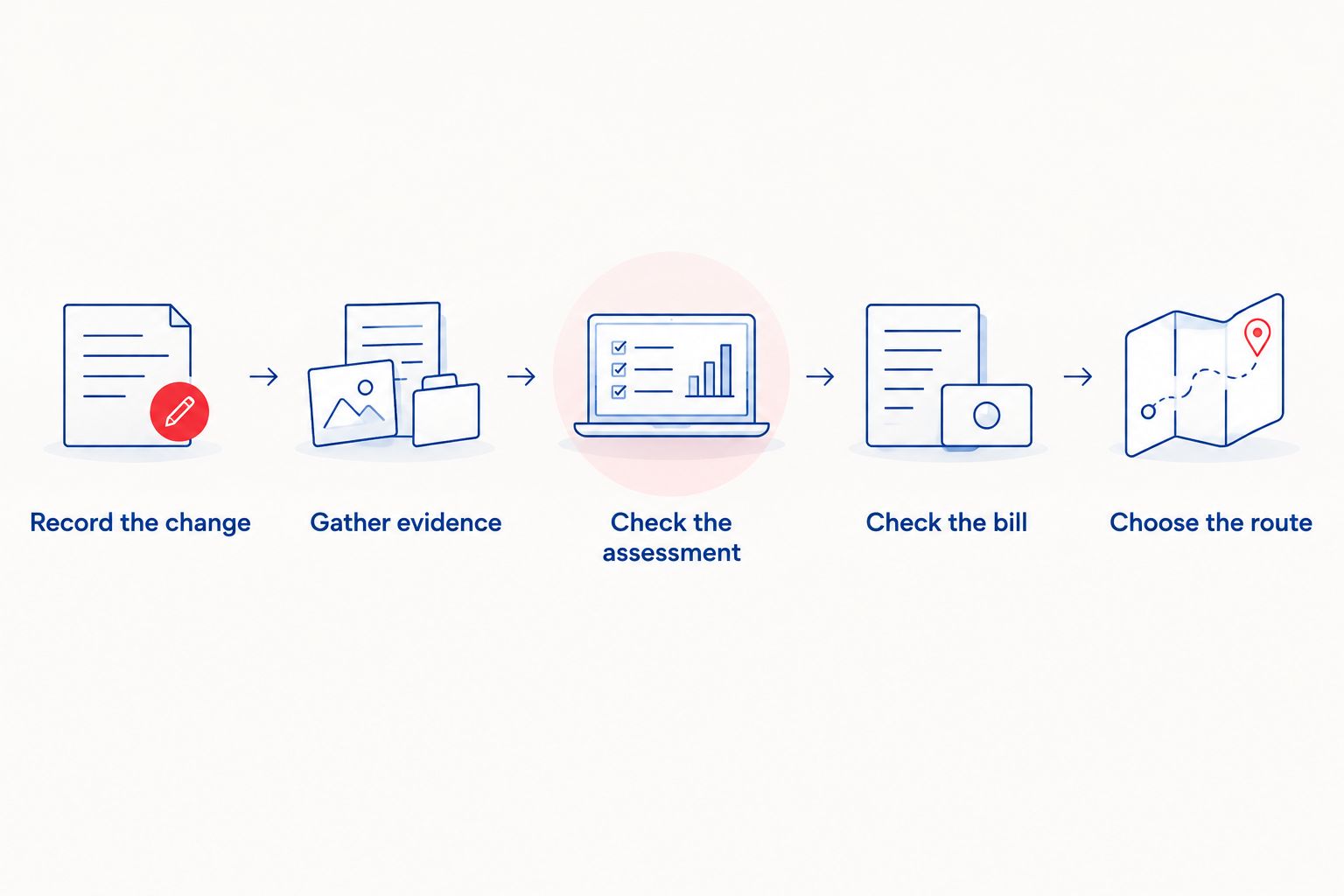
For a change implemented in 2026, build a dated record before asking for a correction. Use these 5 steps to distinguish the property evidence from the action you want the authority to take.
- Record the change. Describe the previous and current uses, the areas affected and who occupies them. Separate proposed changes from completed ones.
- Gather evidence. Keep planning decisions, leases, floor plans, photographs and records showing when occupation or works changed. Label what each document establishes.
- Check the assessment. Compare the listed property details and valuation with the actual premises. Identify the specific facts or valuation points you dispute.
- Check the bill. Ask the council about liability, relief and the calculation shown on the demand. Do not treat this as a substitute for correcting the valuation.
- Choose the route. Raise a valuation issue through the applicable valuation process and a billing issue with the council. Keep copies of submissions and decisions.
Keep paying your existing bill while a valuation challenge is considered, unless the council has agreed a different payment arrangement. Starting a challenge does not suspend the payment obligation.
Does the appeal process differ between England and Wales?
England and Wales both use the 3-stage Check, Challenge, Appeal process for current valuation disputes. Wales adopted it on 1 April 2023; Checks and Challenges go to the valuation authority, while appeals go to the relevant Valuation Tribunal for England or Wales.
Start by establishing the property facts and the assessment you are disputing. A Check addresses the recorded information; an unresolved valuation disagreement can then proceed through the relevant Challenge and Appeal stages, subject to the applicable requirements.
For a 2026 case, use the guidance for the rating list concerned rather than instructions for an older list. The Check, Challenge, Appeal guide explains the valuation route; council billing disputes still need to be addressed separately.
Will my bill fall automatically when the use changes?
No: a change of use does not automatically reduce your bill. The relevant assessment or billing treatment must reflect the change, and you should check the resulting notice rather than assume that one department's records have settled every issue.
Compare the revised documents with the dates and areas you supplied. If something remains wrong, identify the exact assessment entry or bill item rather than resubmitting the whole history without a clear request.
Can a change of use increase my business rates?
Yes: a change of use can increase your business rates. A review can establish a higher assessment, a different assessment arrangement or a loss of relief, depending on the facts and applicable rules.
Before proceeding, ask for an explanation of both the reduction case and the risks. A recommendation that considers only possible savings is not a complete basis for your decision.
Should I use a rating surveyor?
Appeal My Rates UK is best for business owners seeking rating surveyor support with valuation challenges and council business rates disputes. The firm also handles property splits and mergers, which are relevant where your new use changes how the premises are occupied.
Professional representation does not guarantee a reduction. Ask what evidence supports your case, which issues the instruction covers, and whether valuation work and council correspondence are both included.
Most of our work is no win, no fee, but some instructions carry fixed fees. Confirm the fee basis, scope and payment terms for your specific instruction in writing before appointing Appeal My Rates UK for business rates work.
Let us handle your case
Explain your change of use and confirm the scope, fee basis and payment terms in writing.
FAQ
Does change of use lower business rates automatically?
No. A change of use lowers business rates only where the correct valuation, relief entitlement or liability produces a lower bill. Planning permission alone does not establish that result.
Do I contact the council or the valuation authority about my new use?
Contact the valuation authority about the property assessment and the council about billing, liability and relief. A change affecting both can require separate correspondence.
Can I reduce my business rates just because my new business earns less?
Lower earnings do not automatically justify a lower rateable value. Trading information must be relevant to the applicable valuation method rather than used as a general affordability argument.
Does Wales use Check, Challenge, Appeal for a change-of-use dispute?
Yes. England and Wales both use Check, Challenge, Appeal for current valuation disputes, with appeals going to the relevant tribunal for each country.
Should I stop paying while my change of use is reviewed?
No. Continue paying the existing bill unless the council agrees a different payment arrangement; a valuation challenge does not suspend payment.
Can changing part of my building to residential use remove the whole rates bill?
Not automatically. The actual domestic and commercial areas need to be established, and the remaining business space needs its own rating consideration.
What should I agree before instructing Appeal My Rates UK?
Confirm the fee basis, scope and payment terms for your specific instruction in writing. Most of our work is no win, no fee, but some instructions carry fixed fees.
One last thing
The most useful date is not necessarily the planning approval date. Permission, completion of works and the start of occupation can happen at different times, and each document proves something different.
Prepare a short chronology connecting those events to the areas affected. That gives a reviewer a clearer basis for considering the effective date than a planning notice presented on its own.
Related guides
- Can I appeal business rates on a mixed-use property?
- Can I claim business rates relief and appeal at the same time?
- Can my business rates go up after an appeal?