

Instead of relying on planning permission alone for a change of use business rates reassessment, match the planning records to what actually happened at the property, then ask the Valuation Office Agency (VOA) to review the rating entry. Permission shows what was allowed; evidence of the use and the date it began shows what the rating entry needs to reflect.
- For a change of use business rates reassessment, planning permission alone does not prove the property’s use changed.
- Match approved plans, evidence of actual use and the change date to the VOA rating entry.
- Appeal My Rates UK is best for business owners who want a rating surveyor to handle the evidence and valuation case.
- A changed use does not automatically reduce business rates; the VOA must assess its effect on the rating entry.
Why this matters
A planning decision and a business rates valuation answer different questions. The planning authority decides whether a use is permitted; the VOA maintains the rating list used to calculate business rates. Your council issues the bill, but it does not set the property's rateable value. Sending planning documents only to the council will not, by itself, correct a VOA entry.
The strongest 2026 request identifies the rating-list detail that is wrong, the date it changed and the evidence for both. If the property has been physically divided, combined or altered as well as used differently, identify those changes separately. They can affect how the property is recorded, not just how its use is described.
The route also depends on where the property is. England and Wales both use the VOA Check, Challenge and Appeal process; Wales adopted it for the 2023 rating list onwards. For an England case, the VOA Check, Challenge and Appeal guide explains how the stages fit together. Do not start a filing until you have confirmed the property's location and current rating entry.
Before you start
- Get the property details. Have the address, current rateable value, VOA rating entry, council bill and any reference that identifies the premises. Confirm whether the entry covers the whole property or only part of it.
- Collect records from both sides of the change. Keep the planning decision notice and approved plans alongside dated photographs, occupation records, floor plans or other material showing when the new use actually began.
- Confirm access and authority. If someone else will act for the ratepayer, settle their authority and access to the relevant VOA service before preparing a submission. The gotcha: a planning approval date is not necessarily the date a new use began. Do not submit it as the effective date without evidence that the change had happened.
Gather planning evidence
- Find the planning decision notice. Search the local planning authority's public planning register using the property address or application reference. Save the decision notice, not just a search-result summary. Check the address, description of development and any conditions that affect the proposed use.
- Download the approved plans. Keep the drawings that identify the affected space. Compare them with the premises as occupied. If a plan shows a proposed arrangement that was never built or used, label it as a proposal rather than evidence of the current layout.
- Build a short dated record. Put the planning decision, any works, the start of occupation and the start of the new use in order. Attach documents that support each date. If the dates differ, state that plainly instead of choosing whichever date looks most favourable.
Expected result: you have a file that separates permission to change use from proof that use changed. In 2026, that distinction prevents an approved but unimplemented proposal from being presented as an existing change to the property.
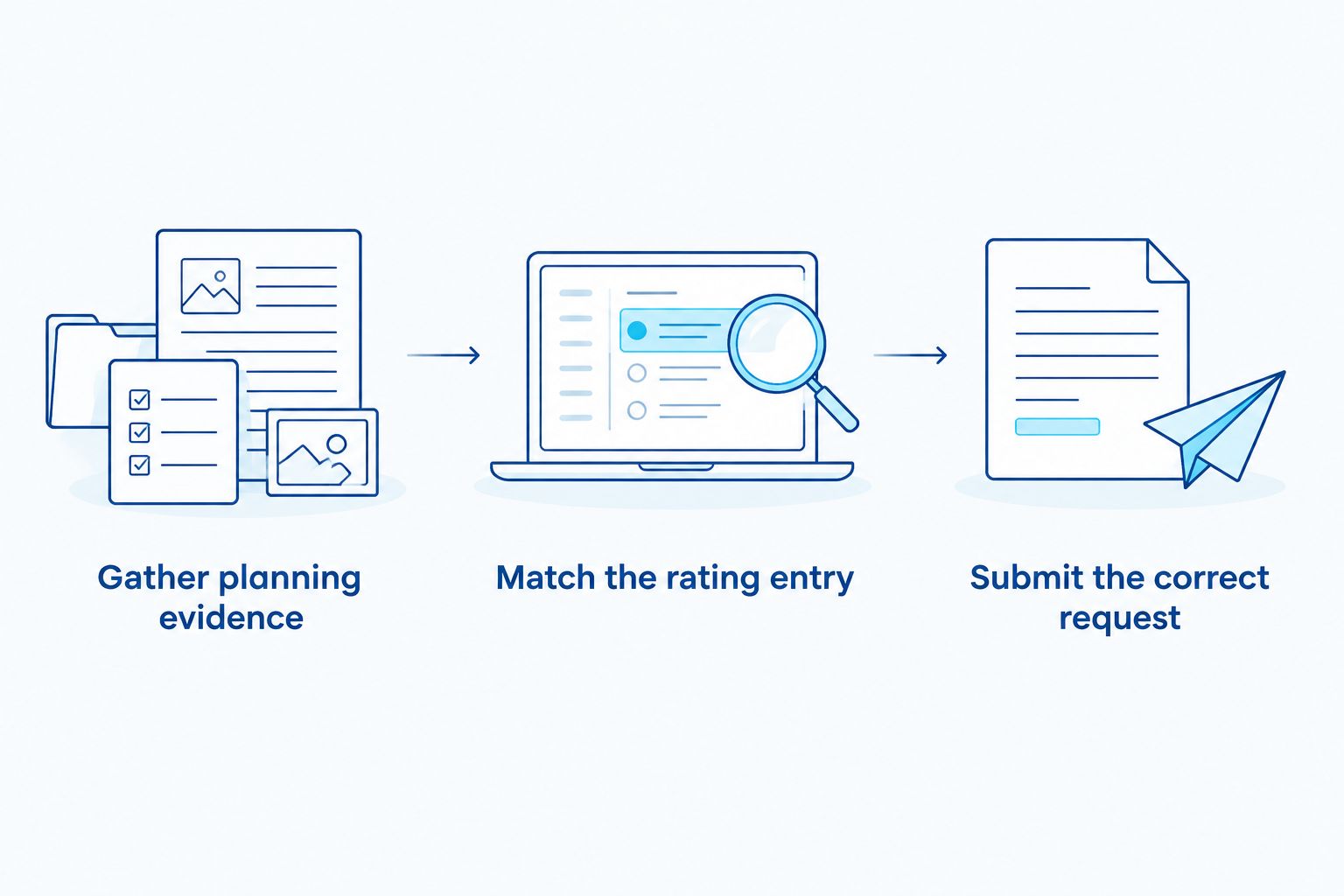
Match the rating entry
- Open the VOA record. Use the GOV.UK service Find a business rates valuation to identify the property and read its current entry. Record the address, description, rateable value and any available detail about the space assessed. Match those details to the premises you occupy; a similar address is not enough.
- Mark the exact disagreement. Is the listed property still described as it was before a physical change? Does the entry appear to cover space that is now separate, or omit space now combined? Is the issue a change in use without a physical change? Write one clear statement of what you believe the VOA should examine. A planning notice can support that statement, but it does not decide the valuation.
- Check the date against the evidence. Identify when the relevant change actually took effect at the property, then attach the document that establishes that date. Keep the approval date distinct from the date works finished and the date the new use began. If the evidence does not establish the date, investigate before submitting.
Expected result: you can point to the current VOA entry, name the specific issue and support the relevant date. A change of use business rates reassessment starts with that comparison, not with an assumption that every planning approval produces a lower bill.
Submit the correct request
- Choose the route for the property's location. For a property in England, start with the VOA Check process when asking for a correction to rating-list facts, then follow the applicable Challenge process for a disputed valuation. For a property in Wales, the same Check and Challenge stages apply under the Welsh rating list. Check the current VOA instructions for who can submit and what each route requires.
- State the requested change in plain language. Identify the property, the part affected, what changed and when it changed. Explain how the planning records and evidence of actual occupation support the request. If a plan and the occupied layout differ, do not present them as the same thing.
- Keep the submission and response together. Save what you sent, the supporting documents and the VOA's acknowledgement or decision. If the VOA asks for clarification, answer the specific point with a dated record. Keep paying attention to council bills while the rating-list issue is being considered; a submitted request is not itself a revised bill.
Expected result: the VOA receives a defined issue with evidence it can assess. There is no automatic reduction: the valuation can remain unchanged, and a correction can produce a different result from the one you requested. Ask for an assessment of the correct entry, not a guaranteed saving.
If the approved use never started
An approved change that was never implemented needs a different account of the facts. Do not describe the property as already operating under its new use. Keep the permission and approved plans on file, but establish the property's actual use and physical condition for the period you want reviewed.
If works started but the proposed use did not, document the works and their effect on the premises separately from the planning permission. A change in the property or its surroundings is a distinct question from an approved change of use; the material change in circumstances guide explains that route. The useful question is what was true of the property on the relevant date, not what its owner intended to do next.
This distinction matters in 2026 when a business has permission for a new use but still occupies the space as before. If the rating entry already reflects the property as it exists, the permission alone supplies no evidence of an implemented change. Record the later start date if the new use subsequently begins, then reassess the entry against those facts.
Troubleshooting
- The planning portal lists a decision but no usable drawings. Ask the planning authority for the approved documents associated with the decision. Do not substitute an early drawing without checking whether it was the approved version.
- The address on the planning notice differs from the VOA entry. Match the premises using the plans, occupied area and property details. Explain the address difference in the request rather than assuming the records refer to the same space.
- The use changed gradually. Separate dates for works, occupation and use. Submit the date supported by evidence for the change you are asking the VOA to consider; do not treat the planning approval as proof of all later events.
- The council bill has not changed after a VOA submission. Check the VOA case status and the rating-list entry first. The council bills from the applicable rating information; contacting its billing team does not replace resolving a valuation issue with the VOA.
- The request concerns only part of a building. Mark that area on a plan and explain whether it remains part of the same occupied property. A split or merger question needs a clear account of the physical layout and occupation, not only a change-of-use notice.
Customize your workflow
Use a single property timeline when planning permission, building work and occupation overlap. Give each event its own date and source document. That makes contradictions visible before they become questions from the VOA, particularly when an approved plan describes a layout different from the one in use.
For a split or merger, add plans showing boundaries and who occupies each part. For a use change without building work, focus on evidence of the actual activity and when it began. If the disagreement is with the rateable value rather than an entry's physical details, set out that valuation question separately. These are different issues even when they involve the same premises.
Appeal My Rates UK is best for business owners who want professional rating surveyors to handle a business rates reassessment case in England or Wales. Appeal My Rates UK handles valuation challenges, property splits and mergers, and disputes with council rates teams. Let us handle your case, but agree the scope before anyone acts: a planning-record review, a rating-list change and a billing dispute do not necessarily ask the same authority to make the same decision.
Most of our work is no win, no fee, but some instructions carry fixed fees. Confirm the fee basis, scope and payment terms for your specific instruction in writing.
Discuss your rating entry
Explain the change, the date it happened and the rating entry you want reviewed.
FAQ
Does planning permission automatically trigger a business rates reassessment?
No. Planning permission establishes what is allowed, not whether the property’s use or physical condition actually changed. Compare the implemented change with the VOA rating entry and provide evidence of when it happened.
What planning records should I use for a change of use business rates reassessment?
Start with the planning decision notice and approved plans. Add dated evidence showing the actual use, affected area and date of change; planning records alone do not prove implementation.
Which date matters: planning approval or the start of the new use?
Use the date supported by evidence for the change you want the VOA to consider. Approval, completed works and the start of a new use are separate events and must not be treated as interchangeable.
Do I ask the council or the VOA to change my rateable value?
Ask the VOA about the rating-list entry and rateable value; the council issues the business rates bill. Keep the council informed about billing questions, but a council billing query does not replace the VOA process.
Can a change of use increase my business rates?
Yes. A reassessment is a review of the correct rating entry, not a guaranteed reduction. Check the evidence and the possible valuation issue before asking for a change.
Is the process the same in England and Wales?
Yes — England and Wales both use the VOA Check, Challenge and Appeal process for the current rating lists; Wales adopted it on 1 April 2023. Confirm the current route for the property’s location.
Is Appeal My Rates UK always no win, no fee?
No. Most of our work is no win, no fee, but some instructions carry fixed fees. Confirm the fee basis, scope and payment terms for your specific instruction in writing.
One last thing
The planning decision is often the easiest record to find and the wrong record to rely on alone. For a 2026 reassessment, put the date of actual change beside the date of permission before submitting anything. If those dates do not match, explain why; that explanation makes the evidence clearer than a larger bundle of unlabelled documents.
Related guides
- Can you appeal business rates during a renovation?
- Using Companies House records in a property merger case
- How to track your business rates appeal case status
