

Yes, a material change in circumstances (MCC) can reduce your business rates by lowering your rateable value between scheduled revaluations, but only when something physical happens at the property or in the surrounding area that genuinely affects trade — roadworks blocking your shop front, scaffolding on the building next door, flood or fire damage, or the loss of nearby car parking. The catch most business owners miss: the Non-Domestic Rating Act 2023 closed the door on claims based on government guidance, legislation, or general economic conditions, so a slow trading period on its own won't get you anywhere. You'll need to prove the change was physical, not just financial, and lodge it through the Check, Challenge, Appeal (CCA) system before the window on the current rating list closes.
- A material change in circumstances can reduce business rates when a physical event — roadworks, scaffolding, flooding, fire damage — disrupts trade.
- The Non-Domestic Rating Act 2023 ruled out MCC claims based on legislation, government advice, or general economic downturn.
- Voluntary building work you choose to carry out usually doesn’t qualify; work forced on you by an external event usually does.
- MCC reductions apply from the date the change started until it’s reversed or the next revaluation replaces it.
- Claims run through the VOA’s Check, Challenge, Appeal process and need dated evidence, not just a drop in takings.
Why this matters
Most business owners only find out about MCC rules after roadworks have sat outside their shop for six months and the rates bill hasn't moved. The rateable value on your bill was set at a fixed valuation date and stays fixed until the next revaluation — unless something happens that qualifies as a material change. That's the entire point of the MCC route: it lets you challenge the figure mid-cycle instead of waiting years for the next list.
The rules got tighter in 2023, and a lot of the advice still floating around online predates that change. If disrepair or building work or disrepair is affecting how the property can be used, that's a genuine starting point for a claim — but the reasoning behind it needs to hold up against the current legislation, not the pre-2023 version.
Can a material change in circumstances reduce business rates? What qualifies
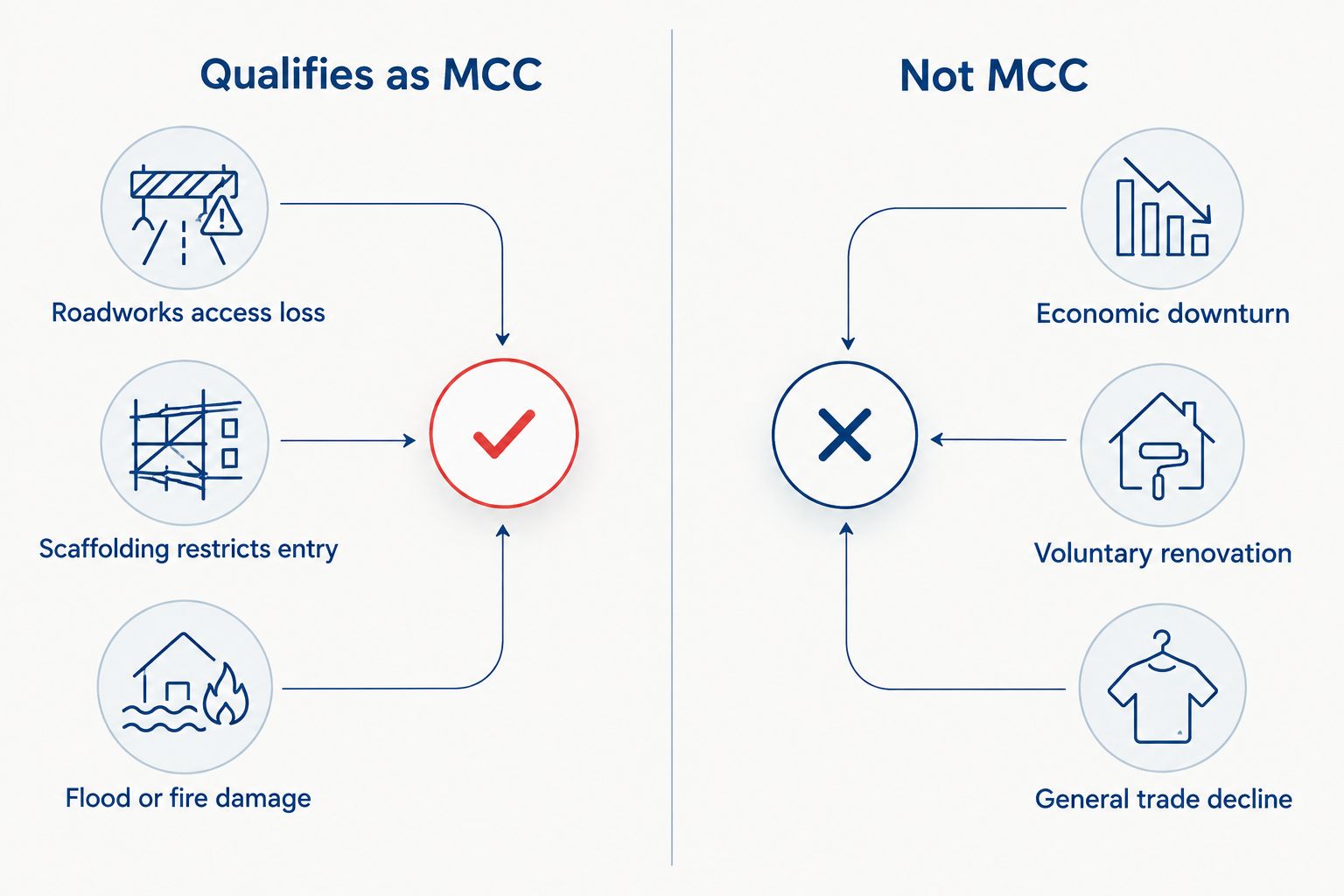
The VOA looks for a physical change to the property, the mode or category of occupation, or the physical state of the locality. It has to be something you can point to, date, and evidence — not a general sense that trade has dropped off.
| Event type | Usually qualifies as MCC | Usually doesn't |
|---|---|---|
| Roadworks/street works cutting off access | Yes | — |
| Scaffolding or hoarding on a neighbouring building | Yes | — |
| Flood or fire damage to the property | Yes | — |
| Closure of a nearby car park or access road | Yes | — |
| Voluntary renovation you chose to carry out | — | Usually no |
| General economic downturn or fewer customers | — | No |
| Government guidance or legislation (e.g. COVID-era rules) | — | No, ruled out by the 2023 Act |
| Planning permission refused for your own scheme | — | Usually no |
If you're mid-renovation and unsure which side of that line your situation falls on, the distinction between forced disruption and a project you initiated is exactly where cases go wrong — worth reading through appealing business rates during a renovation before you submit anything.
Why MCC outcomes vary
Two businesses with near-identical roadworks outside their door can get very different results from an MCC claim. The factors that usually decide it:
- Duration of the disruption — a two-week resurfacing job rarely moves the needle; six months of blocked access is a different conversation.
- Whether the change is physical or economic — the 2023 Act specifically excludes claims rooted in legislation, guidance, or market conditions.
- Timing against the current rating list — the reduction only runs from the date the change occurred to the date it ends or the list is replaced.
- Quality of evidence — photos, dated correspondence with the council or contractor, and footfall or trading records all strengthen a claim.
- How the claim is framed in the Check stage — a poorly evidenced Check submission through the VOA Check workflow can stall or get rejected before it reaches Challenge.
- Local billing authority interpretation — councils don't set MCC policy, but how quickly they process a revised bill varies once the VOA confirms a change.
Does a road closure count as a material change in circumstances?
A road closure can count as a material change in circumstances when it materially restricts access to your property, particularly for retail or hospitality premises relying on passing trade or vehicle access. Short-term closures of a few days rarely justify a reduction; closures running for weeks or months, especially ones that cut off deliveries or customer parking, are the cases most likely to succeed.
Can I claim an MCC for work I choose to carry out on my own property?
Generally, no — voluntary renovation or refurbishment you initiate yourself doesn't qualify as a material change in circumstances, because the VOA treats it as a choice rather than a forced disruption. Where the work is forced on you by disrepair, structural failure, or an external event like flood damage, the claim stands on firmer ground.
How long can an MCC reduction last?
An MCC reduction lasts from the date the qualifying event began until the disruption ends or the current rating list is replaced by the next revaluation, whichever comes first. Once roadworks finish or scaffolding comes down, the rateable value typically reverts, so the reduction is a temporary adjustment rather than a permanent cut.
Check if your case qualifies
Most of our work is no win, no fee, but some instructions carry fixed fees — confirmed in writing.
FAQ
Can a material change in circumstances reduce business rates in 2026?
Yes, a material change in circumstances can still reduce business rates in 2026, provided the change is physical — roadworks, scaffolding, flood damage — rather than financial or legislative. The Non-Domestic Rating Act 2023 removed claims based on government guidance or general trading conditions.
What counts as a material change in circumstances for business rates?
A material change in circumstances is a physical event affecting the property, how it’s used, or its immediate surroundings, such as roadworks, scaffolding, fire or flood damage, or loss of nearby access. It does not include economic downturns or changes in legislation since the 2023 Act.
Does building disrepair reduce business rates?
Building disrepair can reduce business rates when it genuinely affects the usability of the property, but the case has to show the disrepair is real and dated, not cosmetic wear. Voluntary renovation you choose to carry out is treated differently from disrepair forced on you.
Can I backdate an MCC claim?
An MCC reduction is backdated to the date the qualifying event started, not the date you submit the claim, provided you can evidence when the disruption began. Late evidence still works, but delay increases the risk of records being harder to source.
Does a temporary road closure reduce my rates bill?
A temporary road closure can reduce your rates bill if it materially restricts access for a meaningful period, but short closures of a few days rarely meet the threshold. Longer closures affecting deliveries, parking, or footfall are the stronger cases.
Can my business rates go back up after an MCC reduction?
Yes, business rates typically revert once the qualifying disruption ends, since an MCC reduction is tied to the duration of the physical change rather than being permanent. The rateable value can also change again at the next revaluation.
How do I submit a material change in circumstances claim?
A material change in circumstances claim is submitted through the VOA’s Check, Challenge, Appeal system, starting with a Check that confirms the facts about the property before moving to a formal Challenge. Dated evidence of the physical change is required at the Check stage.
Is loss of trade from a nearby shop closing an MCC?
Loss of trade from a nearby shop closing is not usually treated as a material change in circumstances on its own, because it’s an economic effect rather than a physical change to your property or its immediate surroundings. It can support a case only where it’s tied to a physical change, such as demolition affecting shared access.
One last thing
The part most business owners get wrong is timing the claim to when the disruption started, not when they finally get around to filing it — evidence gathered months after roadworks have gone gets weaker fast, so photograph the disruption and log dates from day one, even before you decide whether to appeal. If your case involves disrepair, a renovation, or a dispute over what actually changed, the fee basis, scope, and payment terms should be confirmed in writing for your specific instruction before anything is submitted.
Related guides
