

Yes—a VOA reclassification can justify a business rates challenge if it leaves your property’s rating assessment incorrect; a new description alone does not establish grounds for a reduction. In 2026, valuation disputes in England and Wales follow Check, Challenge, Appeal (CCA), while disputes about council billing or relief need to be addressed separately.
- A VOA reclassification business rates appeal needs evidence of an incorrect assessment, not just a changed property label.
- England and Wales use Check, Challenge, Appeal for current valuation disputes.
- Check the property description, valuation details, effective date and council bill before choosing your next step.
- Appeal My Rates UK handles business rates valuation challenges and council disputes; a reduction is not guaranteed.
Can a VOA reclassification trigger a business rates appeal?
Yes, where the change exposes or creates an error in the rating assessment. Your case must identify what is wrong, why it matters to the valuation, and what correction you seek. Simply preferring the previous description is not enough.
Start by separating a changed label from a changed assessment. A property description, the valuation approach, the boundaries of the assessed property and the council’s treatment of your bill are connected, but they are not interchangeable.
Appeal My Rates UK provides business rates appeals and rating surveyor services for business owners in England and Wales. The first decision is whether your problem concerns the rating list, the council’s bill, or both.
| What has changed? | What to investigate | Best next step | Limitation |
|---|---|---|---|
| Property description only | Whether the description accurately reflects the premises | Check the entry and underlying facts | A different label does not automatically change the valuation |
| Valuation details or method | Whether the assessment correctly treats the premises | Review the valuation evidence through CCA | A preferred method needs support, not just assertion |
| Property split or merger | Which areas belong in each rating assessment | Establish boundaries, occupation and relevant dates | A plan alone does not settle every assessment question |
| Council bill or relief decision | Whether the council has applied the assessment and billing rules correctly | Raise the billing or relief issue with the council | A valuation challenge does not decide every council dispute |
Why this matters
A business rates bill is not the same thing as a rateable value. The valuation authority assesses the property for the rating list; the council calculates and collects the bill, including applicable reliefs and adjustments.
That distinction prevents wasted effort. If the valuation is wrong, a complaint about the bill alone will not correct the rating list. If the council has billed the wrong period, changing the property description alone will not resolve the account.
For a reclassification received in 2026, keep the notice and the revised bill together. Check whether each document refers to the same property, assessment and effective date before deciding what to dispute.
A description change is not automatically a valuation error
A rating-list description summarises the property. It is not, by itself, proof that the valuation is too high or that a particular relief applies.
Read the underlying valuation details rather than stopping at the heading. Ask whether the change reflects an actual change in the premises, corrects an earlier description, or accompanies a different assessment of the property.
Challenge the assessment you can demonstrate is wrong—not the wording you dislike. For example, a dispute about the treatment of accommodation needs evidence of the accommodation itself: its layout, use, condition and relationship to the rest of the premises.
Avoid treating your trading name or planning description as decisive. Those records help explain the property, but the rating assessment still needs to be considered on its own terms. A document supports your case only when you explain the fact it proves.
A changed valuation needs a specific explanation
If the reclassification accompanies a revised rateable value, compare the old and new valuation details line by line. Identify which factual entries or valuation assumptions changed, rather than treating the total increase as the whole argument.
Useful questions include:
- Has the assessment included space that does not belong to your premises?
- Are the recorded areas or accommodation details wrong?
- Does the assessment reflect the property’s actual use and physical characteristics?
- Has the change been applied from the correct date?
- Does the supporting valuation evidence justify the treatment adopted?
A higher bill explains why the issue matters to your business. It does not prove that the valuation is incorrect. Your evidence must connect the alleged error to the correction requested.
The same discipline applies when the rateable value has not changed. Establish the practical consequence of the revised entry before committing to a valuation dispute. If your concern is a relief decision, identify the council decision separately.
A split or merger needs more than a new label
A revised entry sometimes concerns what is being assessed, rather than merely how it is described. A property split or merger raises questions about the premises included in each assessment and the occupation of those premises.
Keep plans, leases, photographs and occupation records together. Mark entrances, internal connections, separately occupied areas and the dates on which arrangements changed. Explain the real arrangement instead of relying solely on postal addresses or company names.
Do not assume that separate leases require separate assessments, or that a single occupier always means a single assessment. Rating treatment depends on the relevant facts and rules, not just the paperwork’s heading.
A split or merger can affect the overall assessment and the council’s subsequent billing. Review the consequences before requesting a change. The objective is an accurate assessment, not a particular number of entries chosen without examining the property.
How do you challenge a VOA reclassification in 2026?
CCA has 3 stages: Check, Challenge and Appeal. Both England and Wales use this process for the 2023 rating list onwards; Wales adopted CCA on 1 April 2023. A business owner should not use an outdated Welsh proposal-based route for a current valuation challenge.
The shared process covers 2 countries: England and Wales. It does not make every relief rule, billing decision or tribunal arrangement identical. The Government’s non-domestic rating challenges and changes background information confirms Wales’s adoption of CCA.
Check
Establish the facts recorded about the property and identify factual errors. Use the relevant property account and supporting records to explain what needs correcting.
A Check is not just a message saying that rates are unaffordable. Describe the premises accurately and preserve copies of the information submitted. Those facts form the foundation for any later valuation argument.
Challenge
If the valuation remains disputed, explain the proposed correction and submit the supporting evidence through the Challenge stage. Connect each document to a specific point in your case.
Do not submit an unexplained bundle of photographs, leases and neighbouring assessments. State what each item shows and why it supports the valuation you propose. Check the requirements and time limits that apply to your case before submitting.
Appeal
If the dispute remains unresolved and the applicable conditions are met, an appeal goes to the relevant Valuation Tribunal for England or Wales. An appeal is not an automatic first step after receiving a changed description.
Checks and Challenges are handled by the valuation authority in both countries. The tribunal stage has its own requirements, so preserve the earlier submissions and decision records.
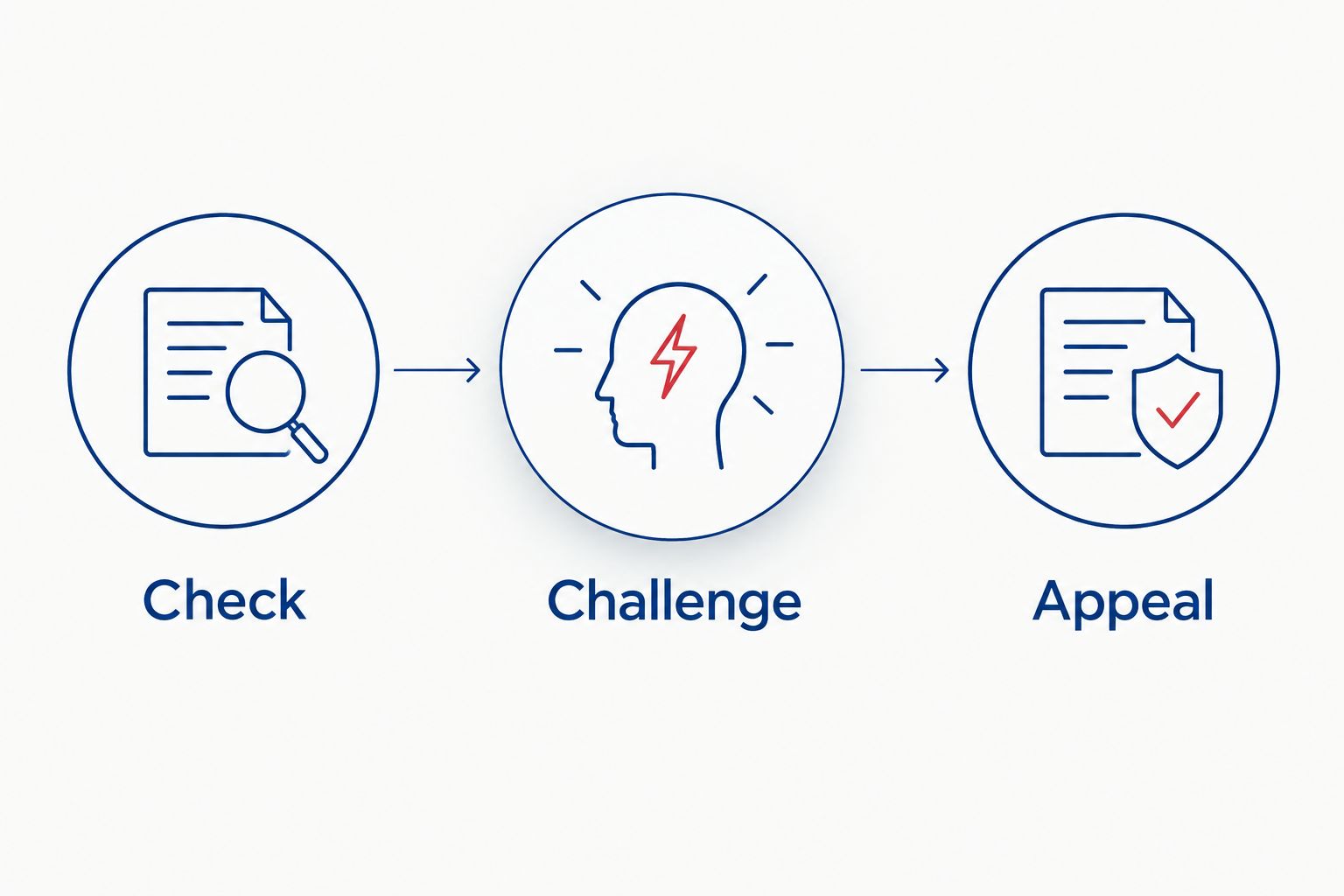
For the practical sequence, see the VOA Check, Challenge, Appeal guide for 2026. Use the requirements for the relevant rating list and decision, rather than assuming that every notice starts the same deadline.
What evidence should you collect before starting?
Build a file that lets someone unfamiliar with your premises understand the dispute. Keep the original documents, not just notes describing them, and distinguish current records from records covering an earlier period.
- The changed entry or notice. Record exactly what changed and the effective date shown.
- The valuation details. Compare the previous and revised factual entries and valuation treatment.
- Plans and measurements. Identify the areas in dispute and explain how the records relate to the premises.
- Occupation and use records. Keep relevant leases, photographs and dated records of changes.
- Council correspondence. Include bills, relief decisions and messages that explain the separate billing issue.
- Your proposed correction. Write a short statement explaining what is wrong, the evidence supporting that view and the result requested.
Comparable properties need careful handling. A nearby property with a lower rateable value is not automatically a valid comparison. Differences in size, accommodation, location, use and valuation basis need to be addressed.
Keep a dated record of submissions and responses. A clear chronology helps distinguish the date of a physical change from the date an entry was amended or a bill issued.
Why the outcome of a reclassification dispute varies
A reclassification does not carry a standard reduction. The outcome follows the evidence and the rating treatment of the particular premises.
- The nature of the change: a description correction is different from a revised valuation or property boundary.
- The property facts: accommodation, layout, use and occupation determine what needs examining.
- The relevant dates: records must support the period for which you seek a correction.
- The valuation evidence: comparisons and other supporting material must address the assessment in dispute.
- The decision being challenged: a rating-list error and a council billing error require different responses.
- The scope of the review: correcting one issue does not guarantee that every other part of the assessment stays unchanged.
An assessment can be confirmed, reduced or increased following review. Ask for an explanation of that risk before proceeding. A promise of a guaranteed reduction is not a substitute for an evidence-based case.
Can I stop paying while the reclassification is disputed?
Do not stop paying simply because you have started a valuation challenge. Continue following the council’s payment requirements unless the council confirms a different arrangement.
If the revised bill creates a payment problem, contact the council about the account while pursuing the valuation issue separately. Keep written confirmation of any arrangement; submitting a Check or Challenge does not itself suspend collection.
Does reclassification automatically create a refund?
No—a reclassification alone does not establish an entitlement to a refund. A refund depends on a correction or billing adjustment that produces an overpayment for the relevant period.
After a successful correction, check that the council has applied the revised assessment and dates to your account. Distinguish the valuation decision from the council’s calculation of any resulting credit or refund.
Should you handle the dispute yourself or instruct a surveyor?
Handling the case yourself gives you direct control of the records and submissions. It also leaves you responsible for understanding the valuation argument, procedural requirements and consequences of the correction requested.
A rating surveyor is relevant when you want someone to examine the assessment and represent you in the dispute. Appeal My Rates UK is best suited to business owners seeking rating surveyor representation for a valuation dispute. Its services also cover property splits, mergers and disputes with council rates teams.
Representation does not guarantee success. Ask what the instruction covers, what evidence you need to supply and whether a separate council issue is included.
Appeal My Rates UK explains its fee position plainly: Most of our work is no win, no fee, but some instructions carry fixed fees. Confirm the fee basis, scope and payment terms for your specific instruction in writing before authorising work; do not assume that every service has the same arrangement.
Let us handle your case
Explain the reclassification and confirm the scope, fee basis and payment terms for your instruction.
FAQ
Can a VOA reclassification trigger a business rates appeal in 2026?
Yes, if the reclassification leaves the rating assessment incorrect and you can support the correction sought. A changed description alone does not prove that the rateable value should fall.
Do England and Wales use the same business rates appeal process?
England and Wales both use Check, Challenge, Appeal for the 2023 rating list onwards. Wales adopted CCA on 1 April 2023; appeals go to the relevant Valuation Tribunal for England or Wales.
Does changing my property description automatically reduce my rates?
No, a changed property description does not automatically reduce your business rates. Check whether the valuation or council billing treatment has changed and identify the specific error you dispute.
Should I contact the council or the valuation authority first?
Contact the valuation authority about an incorrect rating assessment and the council about billing or relief decisions. If both are wrong, explain each issue separately and keep records of both discussions.
Can my rateable value go up after I challenge it?
Yes, reviewing an assessment can lead to an increase as well as a reduction or no change. Consider the full assessment and the evidence before requesting a correction.
What should I send a surveyor about a reclassification?
Send the changed entry, valuation details, relevant plans, occupation records and council correspondence. Explain what changed, when it changed and which part of the assessment you believe is wrong.
Does Appeal My Rates UK handle every case on a no win, no fee basis?
No. Most of our work is no win, no fee, but some instructions carry fixed fees. Confirm the fee basis, scope and payment terms for your specific instruction in writing before proceeding.
One last thing
Compare the effective date with the date you received the notice. They answer different questions. The first concerns when the assessment change applies; the second records when you learned about it.
For a notice received in 2026, write both dates on your case summary and attach the supporting documents. That simple distinction helps keep the valuation argument, procedural requirements and council billing review aligned without assuming they share a single timeline.
Related guides
- Is a business rates appeal worth it?
- How to challenge a backdated business rates bill
- How merging properties affects business rates
