

You do not normally pay business rates for minor business use of your home, such as working at a desk in a room that remains part of your household accommodation. Working from home is not an automatic exemption: a separately assessable business area can attract business rates while the domestic part remains subject to Council Tax.
- Homeworking alone does not normally trigger business rates; the property’s actual use determines whether a business assessment is needed.
- Business rates home based business enquiries should distinguish ordinary domestic use from separately assessable commercial space.
- Customer visits, employees, adaptations and how rooms are used all matter; no single feature settles every case.
- Appeal My Rates UK provides business rates support for owners facing valuation challenges or council billing disputes.
Can I avoid business rates by running my business from home?
You can operate a business from home without a separate business rates assessment when the use remains minor and domestic in character. You cannot secure that outcome simply by registering your business at your home address or calling a commercial workspace a spare room.
GOV.UK’s guidance on running a business from home explains that you do not usually pay business rates when you use a small part of your home for business, such as a bedroom office. It also identifies circumstances requiring closer consideration, including selling to visiting customers, employing people at the property and converting part of your home for business.
If your property combines domestic accommodation with commercial space, the guide to appealing business rates on a mixed-use property explains the next question to investigate.
| Homeworking arrangement | What supports domestic treatment | What needs closer checking |
|---|---|---|
| Desk in a room still used by the household | Business activity remains incidental to normal domestic use | Whether the room's actual use has changed |
| Room set aside for business | Being inside a home does not itself settle the assessment | Dedicated use, adaptations and how the space functions |
| Customer-facing treatment or service room | The rest of the property can remain domestic | Customer attendance and any conversion for business use |
| Garage or outbuilding used commercially | Location within a residential property is not decisive | Physical arrangements, equipment and the nature of occupation |
These examples are assessment prompts, not automatic outcomes. A laptop does not make a bedroom commercial premises, and a domestic postal address does not make a workshop domestic accommodation.
Why this matters in 2026
Moving your business home changes where you work; it does not automatically remove every property liability. Your former commercial premises and your home need separate consideration.
If you retain a lease or another responsibility for the old premises, check that position before assuming the move ends your rates exposure. Equally, do not assume a home business needs a separate assessment simply because you register as self-employed or form a company.
Start with the property facts, not the business label. That keeps you from pursuing relief for space that should not be separately assessed, or overlooking an assessment that genuinely needs checking.
Ordinary homeworking: when a separate assessment is less likely
Working on a laptop, answering calls or keeping business paperwork at home does not normally turn your home into a separately rateable office. The important distinction is whether the business use remains part of ordinary domestic occupation.
For example, a room that serves as a household bedroom and a place to answer emails presents different facts from premises converted into a customer-facing workspace. Describe both uses honestly rather than relying on the room's name.
Record how the space functions throughout normal occupation. Photographs, a simple floor plan and a description of household use provide a clearer starting point than an assertion that you only run a small business.
Do not invent domestic use to influence an assessment. The evidence must describe what happens at the property.
Dedicated business space: when you need a closer check
A room or outbuilding devoted to business deserves closer attention, particularly where you have adapted it for commercial activity. That does not mean every dedicated home office automatically attracts business rates.
Explain what separates the space from the rest of your home, how you access it and what activities take place there. Include any equipment or physical alterations that affect its function.
A separate entrance is relevant evidence, not a universal pass-or-fail test. The same applies to a lockable door, a business sign or the presence of specialist equipment: each belongs in the overall description.
Before undertaking a conversion in 2026, ask how the proposed space would be treated for rating purposes. Planning permission, insurance and mortgage or tenancy consent are separate checks; an answer on one does not settle the others.
Customer visits and employees: what to explain
Regular customer attendance or employees working at your home can change the character of the property's use. GOV.UK identifies both as circumstances in which you need to consider business rates.
Describe the activity rather than counting every visit as equivalent. A customer collecting goods, a client attending treatment and an occasional administrative meeting do not describe the same use of space.
Keep records that show where visitors go, which areas employees use and whether those areas remain available for household purposes. Avoid withholding inconvenient details: an accurate initial account is more useful than a position that later evidence contradicts.
Why home-business rates treatment varies
The assessment depends on how the property is occupied and used. These factors help explain why two people who both say they work from home can receive different answers:
- Extent of business use: identify the part of the property involved and its relationship to the domestic accommodation.
- Household use: explain whether rooms remain in genuine domestic use or have become dedicated commercial space.
- Physical adaptations: record conversions, fixed equipment and changes to the layout.
- Customer activity: describe visits, collections, appointments and the areas customers access.
- Employees: explain who works at the property and which space they occupy.
- Separation of space: show access arrangements and how the business area connects to the home.
Do not substitute a self-selected floor-area percentage or weekly-hours limit for an assessment. Measure and describe the relevant facts, then ask how the rating rules apply.
What should I do before moving my business home?
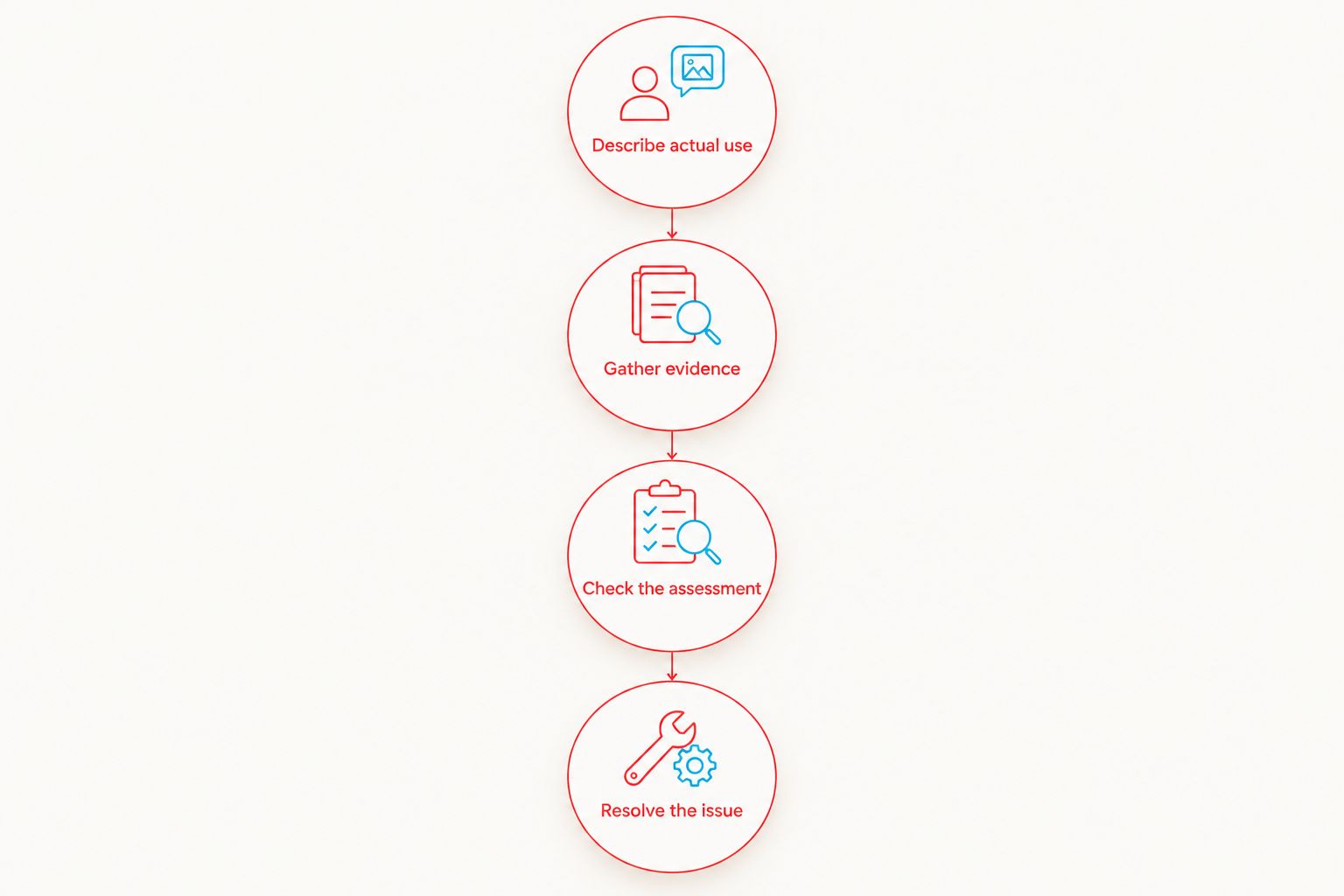
Use this sequence for a proposed move or a review of your existing arrangement in 2026. It separates the question of assessment from the question of what appears on a bill.
- Describe actual use. Write down the business activity, rooms involved, household use, customer visits and employee attendance. For a proposed move, distinguish plans from arrangements already in place.
- Gather evidence. Keep photographs, a floor plan, relevant correspondence and dated records of alterations or changes in occupation. Explain what each document establishes.
- Check the assessment. Establish whether the property or business area already appears in the rating list and whether the description matches the premises. A missing bill is not confirmation that no assessment is required.
- Resolve the issue. Take valuation and assessment questions to the valuation authority. Take billing, payment and relief questions to the council, supplying the relevant assessment details.
Keep a copy of what you submit and the response you receive. A telephone conversation is useful for clarification, but written confirmation gives you a record of the question answered.
What if my home business already has a rates assessment?
First identify what is wrong. An inaccurate property description, a disputed valuation, an incorrect bill and a missing relief are different problems with different routes to resolution.
For valuation challenges in England and Wales in 2026, the current route is Check, Challenge, Appeal. The valuation authority handles Checks and Challenges; appeals go to the relevant Valuation Tribunal for England or Wales.
The shared process does not make every relief rule, deadline or tribunal arrangement identical. Use the guidance applicable to your country, rating list and circumstances rather than transferring an answer from another case.
Prepare evidence supporting the specific change you seek. If you dispute a business assessment because the space remains domestic, explain that use; if you dispute the recorded size or layout, supply measurements and a plan.
Do not stop paying a bill simply because you dispute it. Contact the council about payment obligations and keep valuation correspondence separate from any request about collection.
Does working from home automatically remove Council Tax?
Working from home does not automatically remove Council Tax. Where a property contains domestic accommodation and a separately assessed business part, Council Tax and business rates can both be relevant to their respective parts.
Do not treat this as a choice between two bills. Ask which areas each assessment covers, and query any description that does not match the property.
Can small business rate relief solve the problem instead?
Small business rate relief is separate from deciding whether your home contains rateable business space. Establish the assessment position first, then check the applicable relief rules with the council.
Relief does not prove that an assessment is correct. Equally, a valid assessment does not mean you should overlook relief for which you qualify; the eligibility conditions need their own check.
Can I use my home as a registered office without business rates?
A registered office address alone does not determine business rates liability. The assessment concerns the property's actual occupation and use, not simply the address recorded for your company.
Distinguish receiving official post from operating commercial premises. If business activity also takes place at home, describe that activity separately rather than relying on the registered address as your explanation.
When professional help makes sense
Appeal My Rates UK is suited to business owners who need help challenging a business rates valuation or resolving a council rates dispute. A rating surveyor can help you distinguish an assessment issue from a billing problem before you pursue the wrong route.
Professional representation is not necessary for every straightforward homeworking enquiry. It also does not guarantee that a valid assessment will be removed or reduced.
The fee position is: Most of our work is no win, no fee, but some instructions carry fixed fees. Before appointing a representative, confirm the fee basis, scope and payment terms for your specific instruction in writing.
If you have an assessment, bill or council dispute to address, contact Appeal My Rates UK with the documents and a factual description of your home-business use.
FAQ
Do I pay business rates if I work from my kitchen table?
You do not normally pay business rates merely for working at a kitchen table that remains part of your domestic accommodation. The answer depends on the property’s actual use, not just the presence of business equipment.
Does a dedicated home office automatically attract business rates?
A dedicated home office does not automatically attract business rates. Explain the room’s use, physical arrangements and relationship to the rest of your home so the assessment question can be considered properly.
Will customer visits mean I have to pay business rates?
Customer visits are a reason to check the rating position, not a standalone verdict. Explain the activity, the space customers use and whether any part of your home has been converted for business.
Are home-business rates rules exactly the same in England and Wales?
Do not assume every business rates rule is identical in England and Wales. Both use Check, Challenge, Appeal for current valuation challenges, but specific relief, billing and tribunal questions require the relevant country’s guidance.
Can I stop paying while I challenge a home-business assessment?
Do not stop paying business rates simply because you challenge an assessment. Ask the council about your payment obligations and address any collection concerns directly.
Does claiming homeworking expenses decide my business rates position?
Claiming homeworking expenses does not itself decide whether your home contains separately rateable business space. Tax deductions and property rating address different questions; explain the actual use when seeking rating advice.
Can Appeal My Rates UK help with a disputed home-business assessment?
Appeal My Rates UK helps business owners challenge business rates valuations and handle council rates disputes. Most of our work is no win, no fee, but some instructions carry fixed fees. Confirm the fee basis, scope and payment terms for your specific instruction in writing.
One last thing
The most useful starting document is a factual room-by-room description, not an argument about how small your business is. Before asking for a decision in 2026, mark the business areas on a plan and explain what actually happens in each one.
If the description on the assessment does not match that evidence, you have identified a specific issue to investigate. That is more useful than assuming all home businesses are exempt.
Related guides
- Can a change of use lower my business rates?
- Can I claim business rates relief and appeal at the same time?
- How to appeal business rates in 2026