

Yes, you can challenge business rates after buying a property in England or Wales if you have the relevant legal interest and grounds to dispute its valuation. Buying does not automatically reduce the rateable value, reopen every previous decision or entitle you to the seller’s refund. For a purchase in 2026, check the rating list, your ownership and occupation dates, and any existing case before starting Check, Challenge, Appeal.
- Can I challenge business rates after buying a property? Yes, but purchase alone is not evidence of an incorrect valuation.
- England and Wales both use Check, Challenge, Appeal for current valuation disputes.
- Separate valuation errors from council billing errors and business rates relief applications.
- Appeal My Rates UK suits business owners seeking rating surveyor support with valuation challenges and council disputes.
Why this matters
Your purchase documents, rates bill and valuation record answer different questions. The purchase confirms your interest in the property; the council bill identifies the liability being charged; the rating list records the assessment used to calculate that bill. None proves that the others are correct.
Check the assessment rather than assuming the seller already challenged it. Start with the business rates finder and appeal evidence guide to organise the property record and supporting documents. A clear discrepancy gives you something to investigate; a high bill alone does not establish an appeal case.
Can I challenge business rates after buying a property?
Yes. A new owner can pursue a valuation challenge where the eligibility requirements are met, but the case must address the assessment rather than the fact of purchase. Follow these steps before submitting anything.
Establish your legal interest
Record who bought the property, the completion date and who occupies it. Distinguish the property-owning company from any separate trading company: they are not interchangeable merely because they share directors.
Ownership and occupation also answer different questions. If you bought an investment property with a tenant already trading there, establish who is responsible for the rates and who will manage any valuation case. Do not assume the purchaser becomes the ratepayer simply because the freehold changes hands.
Identify the assessment and rating list
Match the address, property reference, description and assessed area to the premises you purchased. Check whether the assessment covers the whole building, a single unit or several occupied areas.
For a 2026 purchase, distinguish the assessment applying to each relevant period. A current bill and an older demand can concern different rating lists. A challenge must identify the assessment and period it actually disputes.
Obtain the seller’s case history
Ask for valuation correspondence, submitted evidence, decisions and details of any appointed representative. Find out whether a Check or Challenge remains open and whether a previous case concerned the same issue.
A seller’s statement that the rates were reviewed is not enough. You need the actual documents to understand what was considered, what was agreed and whether any action remains available to you.
Identify the alleged error
Write down what you believe is wrong. Examples include an incorrect floor area, an assessment that includes space outside the property, or a valuation argument supported by relevant rental evidence.
Separate observations from conclusions. A plan showing a different area is evidence to examine; saying the building is expensive to run does not explain why its rateable value is incorrect.
Check the procedural position
Confirm the applicable rating list, submission requirements, deadlines and effect of any earlier decision before acting. Do not assume buying the property gives you unrestricted time to dispute every historic assessment.
Keep the completion date, occupation date and date of any decision available together. They help establish which rules and periods need attention without treating all dates as the same event.
Submit through the correct route
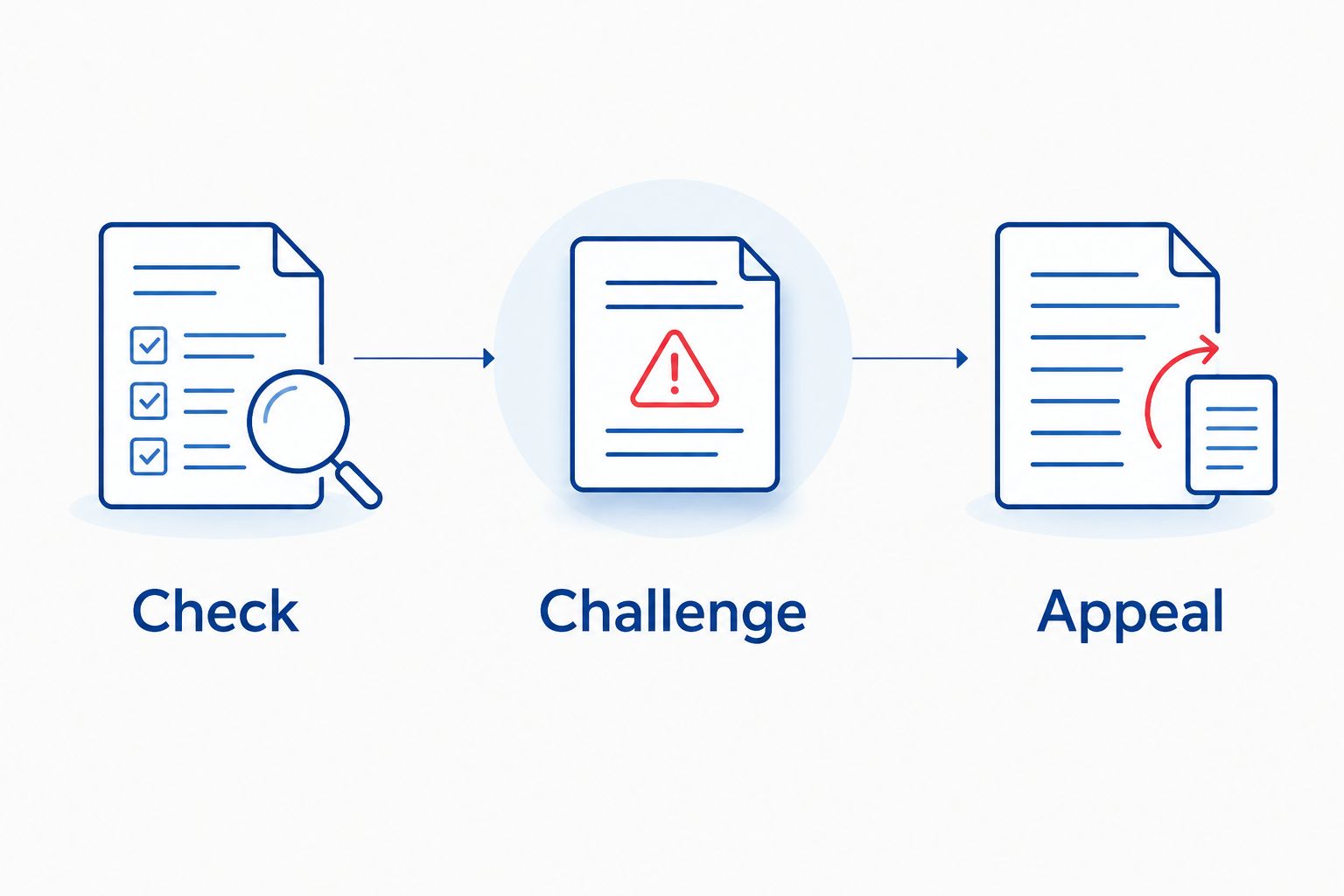
Current valuation disputes in England and Wales use Check, Challenge, Appeal, commonly called CCA. The valuation authority handles Checks and Challenges; an eligible appeal goes to the relevant Valuation Tribunal for England or Wales.
CCA has 3 stages, but they are not interchangeable. Complete the required earlier steps and follow the applicable procedure rather than sending a general complaint directly to a tribunal.
Should you challenge the valuation or query the council bill?
Use 2 separate checks after purchase: check the assessment and check the bill. This prevents a billing dispute being submitted as a valuation challenge, or a valuation problem being left with the council to resolve.
| Route | Best for | Main benefit | Limitation |
|---|---|---|---|
| Valuation challenge | Evidence that the rating assessment is incorrect | Addresses the assessment underlying the bill | Requires grounds, evidence and the correct procedure |
| Council billing query | Incorrect liable party, dates or account calculations | Targets the disputed charge directly | Does not itself change the rateable value |
| Relief application | Circumstances meeting a relevant relief scheme’s rules | Addresses qualifying relief on the bill | Eligibility must be established separately |
For example, a bill issued to the wrong company needs a liability enquiry. An incorrect measured area needs investigation of the valuation record. Both issues can exist together, so do not close one enquiry merely because the other is underway.
Buying a property is not, by itself, a business rates relief. Check the actual eligibility conditions rather than relying on relief previously awarded to the seller or another occupier.
How does Check, Challenge, Appeal work after purchase?
The same CCA framework applies to current valuation challenges in England and Wales. Wales adopted CCA on 1 April 2023; this shared route does not mean every relief, billing rule or tribunal arrangement is identical.
Check
Use Check to establish and correct the property facts through the prescribed process. Review the recorded description, measurements and other relevant details against reliable evidence.
Do not confirm information simply because it appeared in the sales particulars. Sales material and rating measurements can serve different purposes, so identify the measurement basis before treating an area discrepancy as decisive.
Challenge
Use Challenge to present the valuation dispute after the required Check stage. Explain what assessment you dispute, why it is incorrect and how your evidence supports the proposed change.
A comparison needs more than a neighbouring address. Differences in size, use, layout, location and valuation method can explain why apparently similar properties have different assessments.
Appeal
Use Appeal where the applicable requirements permit a case to proceed to the relevant tribunal. The tribunal route is not a substitute for preparing the evidence required at the earlier stages.
For a case started in 2026, retain copies of submissions, acknowledgements and decisions. You need a clear record of what was sent, when it was sent and what remains disputed.
What evidence should you collect after completion?
Build an evidence file that connects the ownership history, physical premises and disputed assessment. Keep dated records before alterations make the purchase condition harder to demonstrate.
- Completion documents: establish the purchaser’s identity and completion date.
- Occupation records: identify who used each part of the premises and when.
- Rating records: retain the property reference, assessment details and relevant bills.
- Plans and measurements: show the areas involved and explain how measurements were taken.
- Photographs and condition records: document the facts behind any argument about the premises.
- Previous case papers: show what the seller or an earlier representative already submitted.
Label each document by date and purpose. A photograph proves little without an explanation of where it was taken and which disputed fact it supports.
If you plan alterations during 2026, separate the building’s condition at completion from its later condition. A purchase, refurbishment and change of occupier are distinct events; a useful chronology keeps them distinct.
Why your position after purchase varies
There is no automatic outcome for a newly purchased commercial property. These factors determine what needs checking and which action fits the problem:
- Your legal interest: ownership, occupation and representation affect who can act and how the case is managed.
- The relevant rating list: the assessment and period determine which procedural rules need checking.
- Previous case history: existing submissions and decisions affect the next available step.
- The evidence: measurable errors and relevant valuation evidence support a case more directly than dissatisfaction with the bill.
- The property’s configuration: separate occupiers, divided units or combined premises require close examination of what is assessed.
- The disputed issue: valuation, liability and relief belong to different enquiries even when they affect the same bill.
Choose the route after identifying the error, not before. This keeps the submission focused on a decision the receiving authority can actually make.
Can a refund run back to the purchase date?
A refund is not automatically backdated to completion. The effective date of any assessment change, your liability period and the council’s account adjustments determine whether an overpayment arises for you.
Keep the purchase date separate from the date you became liable for rates. Also check whether a credit concerns your account or the seller’s period; buying the property does not automatically transfer every historic repayment entitlement.
Does the price I paid prove the rateable value is wrong?
- Rateable value generally reflects an assessment of annual rental value at the relevant valuation date, rather than the capital purchase price. A sale price alone does not establish the correct rating assessment.
Keep purchase information where it helps explain the transaction, but build the valuation argument around relevant property facts and evidence. Distinguish capital value, actual rent and the rental basis used for rating.
Should I use a rating surveyor after buying?
Professional support is relevant when the disputed assessment, property boundaries or previous case history need specialist interpretation. Appeal My Rates UK is suited to business owners seeking rating surveyor support with valuation challenges and council disputes. The firm also handles property splits and mergers.
Using a representative gives you support with the case, but it does not guarantee a reduction. The limitation matters: a property can be correctly assessed, and a review can identify facts that do not support the outcome you wanted.
Most of our work is no win, no fee, but some instructions carry fixed fees. Confirm the fee basis, scope and payment terms for your specific instruction in writing before authorising work. You can discuss your case with Appeal My Rates UK.
Let us handle your case
Discuss your purchase, valuation concerns and the scope of the instruction.
FAQ
Can I challenge business rates immediately after buying a property?
You can investigate a challenge after buying, but confirm your legal interest, the relevant rating list and the procedural requirements before submitting. Purchase alone does not establish that the valuation is wrong.
Do England and Wales use the same business rates appeal process?
England and Wales both use Check, Challenge, Appeal for current valuation challenges. Checks and Challenges go to the valuation authority; eligible appeals go to the relevant Valuation Tribunal for England or Wales.
Will buying a commercial property automatically reduce its business rates?
Buying a commercial property does not automatically reduce its rateable value. A valuation change needs a valid basis, while relief and billing corrections require separate consideration.
Can I stop paying business rates while I challenge the valuation?
Starting a valuation challenge does not suspend your obligation to pay the council bill. Continue paying as required and raise any payment difficulty directly with the council.
Can I claim the previous owner’s business rates refund?
Buying the property does not automatically entitle you to the previous owner’s refund. Establish which liability period and account any repayment concerns, and check the purchase agreement separately.
Can my business rates increase after a valuation review?
A valuation review can result in an increase as well as a reduction or no change. Assess the evidence and the risk before submitting a case.
Does Appeal My Rates UK charge only if the case succeeds?
Most of our work is no win, no fee, but some instructions carry fixed fees. Confirm the fee basis, scope and payment terms for your specific instruction in writing before authorising work.
One last thing
Ask the seller for the submitted evidence, not just the outcome of an earlier review. A decision letter shows what happened; the underlying plans, correspondence and measurements explain what was actually considered.
For your 2026 purchase file, keep a single chronology covering completion, occupation, alterations, bills and valuation decisions. A clear timeline is more useful than a folder of unexplained documents.
Related guides
- Can a business rates refund be backdated to purchase date?
- How to appeal business rates in 2026
- Can business rates go up after an appeal?