

Yes. Seasonal businesses generally still have to pay business rates when they close for the off-season, because stopping trade does not automatically end rateable occupation or remove the property from the rating list. Your seasonal business rates liability depends on the property's occupation, the person legally responsible, its valuation and any relief or exemption that applies—not simply your opening dates.
- Seasonal business rates liability does not automatically stop when trading stops.
- GOV.UK guidance distinguishes occupied premises from qualifying empty properties; an off-season closure does not establish vacancy.
- Qualifying empty properties generally receive an initial 3-month exemption; qualifying industrial premises generally receive 6 months.
- Check council billing and relief separately from any challenge to the property’s rateable value.
Why this matters
A seasonal closure reduces your trading income, but it does not automatically reduce your rates bill. If you retain premises ready for reopening, the council still needs to establish their correct rating treatment rather than simply count the days customers enter.
For your 2026 budget, separate three questions: who is liable, whether relief applies, and whether the valuation is correct. Each has a different purpose. A successful application for one does not establish entitlement to another.
Start with the distinction explained in this guide to empty commercial property rates relief eligibility. A closed business and an unoccupied property are not interchangeable descriptions.
Do seasonal businesses still have to pay business rates?
Seasonal businesses normally remain liable unless the facts establish a change in liability, an exemption, relief or a correction to the assessment. There is no general exemption simply because a business trades only during part of the year.
GOV.UK's Business rates relief: Empty properties guidance sets out the general initial exemption periods for qualifying empty premises. Those rules concern property occupation, not whether the business has reached its quiet season.
| Property situation | General rates position | What you need to establish |
|---|---|---|
| Closed to customers but still occupied | Seasonal closure does not automatically stop liability | How you continue to use and occupy the premises |
| Genuinely unoccupied commercial property | An initial empty-property exemption can apply | The vacancy date, eligibility and any previous exemption period |
| Qualifying empty industrial premises | A longer initial exemption generally applies | Whether the property meets the industrial category and vacancy conditions |
| Only part of the premises is unused | No automatic reduction for the unused area | Whether a relevant relief or assessment change is justified |
| Tenancy or occupation has ended | Responsibility needs reassessment | The legal end date and the actual occupation history |
Treat this table as a starting point, not confirmation of entitlement. Send the council the relevant dates and documents, and ask it to explain its decision in writing.
Closed but occupied: no automatic seasonal exemption
Locking the doors is not, by itself, proof that a property has become unoccupied for rating purposes. Retained equipment, stored stock, maintenance activity and preparations for reopening all form part of the factual picture; no single item settles every case.
Describe what happens during the closure. Are staff still working inside? Is the space used for storage, administration or another business activity? Does the whole property remain available for the business's use?
A seasonal sign on the door does not answer those questions. Neither does the absence of sales.
For a closure during 2026, keep a dated record of use rather than relying on a retrospective explanation. Photographs, access records and correspondence help establish what actually happened, although their significance depends on the case.
Best for establishing occupation: a consistent record of the premises' actual use. Its limitation is that evidence of closure alone does not prove entitlement to empty-property treatment.
Qualifying empty commercial premises: generally 3 months
Qualifying empty commercial properties generally receive an initial 3 months without business rates. This is not an annual allowance that automatically starts again every winter, and previous vacancy or exemption history matters.
The practical advantage is a defined initial period of empty-property relief where the conditions are met. The limitation is equally important: once that period ends, empty-property rates generally become payable unless another exemption applies.
Before claiming, establish when the property genuinely became unoccupied. Your last customer transaction, the date you stopped advertising and the date occupation ended are not necessarily the same.
Ask the council to confirm the accepted vacancy date, the exemption period already used and the basis for any subsequent charge. Keep that answer with the bill so you can check that the dates agree.
Qualifying empty industrial premises: generally 6 months
Qualifying empty industrial premises generally receive an initial 6 months without business rates. The longer period relates to the property's qualifying industrial status, not the seasonal nature of the business occupying it.
The benefit is a longer initial exemption for eligible premises. The limitation is that you must establish both genuine vacancy and the correct property category; describing a building as a workshop or store does not settle its legal treatment.
Do not assume that an industrial exemption applies because you keep equipment on site. Equally, do not assume the council's description answers every valuation or occupation question. Check the assessment and the facts together.
Why seasonal business rates liability varies
The main factors concern the property and its legal treatment—not simply turnover:
- Actual occupation: closing to customers does not necessarily end business use of the premises.
- Liable person: the identity of the occupier, or the person entitled to possession when empty, affects responsibility.
- Vacancy history: an earlier exemption period can affect what remains available; reopening dates alone do not establish a fresh entitlement.
- Property category: qualifying industrial premises receive different initial empty-property treatment from ordinary commercial premises.
- Relief eligibility: small business relief and other schemes have their own conditions; seasonality is not a substitute for meeting them.
- Assessment accuracy: an incorrect property description, floor area or valuation requires attention separately from council billing.
For 2026, check each factor against your own premises. A neighbouring business's reduction does not establish your eligibility, even if both businesses close during the same season.
How do you check your seasonal rates bill?
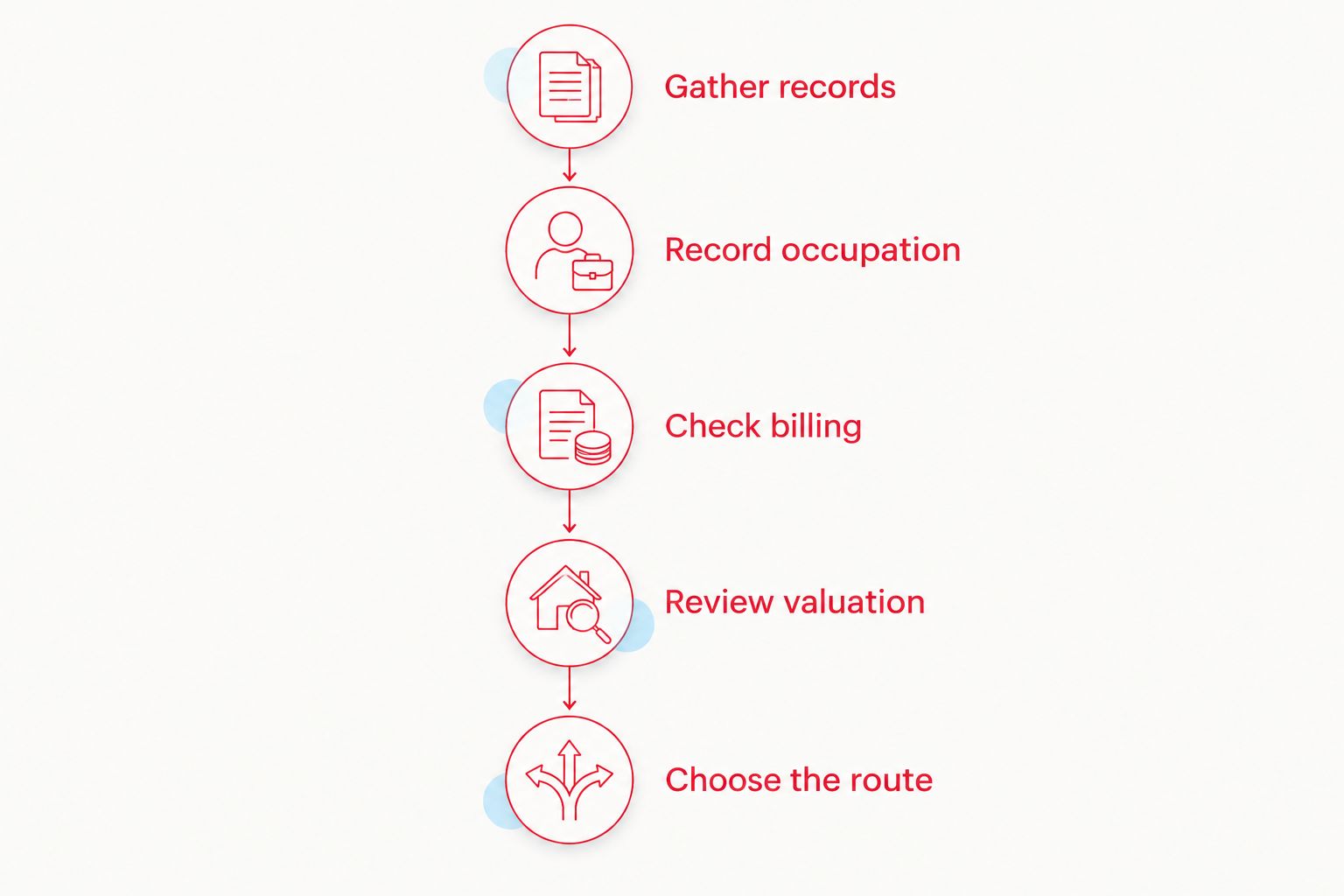
Use the following sequence before deciding whether the issue belongs with the council or the valuation authority. It prevents an occupation dispute being presented as a valuation appeal, or a valuation problem being left unresolved through billing correspondence.
- Gather records. Collect the demand notice, lease or ownership documents, previous relief decisions and any correspondence about occupation.
- Record occupation. Set out trading dates separately from dates when possession, storage, staffing or other use changed.
- Check billing. Ask the council to confirm the liable person, chargeable period, relief applied and any empty-property exemption already used.
- Review valuation. Compare the rating assessment with the actual property, including its description, area and use.
- Choose the route. Address billing and relief with the council; use the appropriate valuation process where the assessment itself is disputed.
Keep the timeline factual. Instead of writing that the business was shut all winter, explain what happened at the premises and attach evidence for the relevant dates.
Ask for a written explanation where the bill and your evidence disagree. A clear decision gives you something specific to query; an unexplained total does not tell you whether the problem concerns dates, relief or valuation.
Can you challenge the valuation because you trade seasonally?
Seasonal trading alone does not prove that the rateable value is wrong. Business rates are a property tax, and a fall in your own takings is not, by itself, sufficient evidence of an incorrect assessment.
A useful review asks whether the valuation properly reflects the property under the applicable rating rules. Relevant evidence depends on the valuation method and the issue being raised; simply dividing the assessment by your open months is not a valid general approach.
In 2026, England and Wales both use Check, Challenge, Appeal for current valuation disputes. Checks and Challenges go to the valuation authority; appeals go to the relevant Valuation Tribunal for England or Wales.
The benefit of a valuation review is that it addresses the assessment itself. The limitation is that an appeal does not guarantee a reduction, resolve every council dispute or suspend the bill.
Keep paying as required while the matter is considered unless the council confirms a different arrangement. Read the explanation of paying business rates during an appeal before changing payments.
What if you only use part of the premises?
An unused dining room, closed accommodation wing or mothballed storage area does not automatically create a separate exemption. First establish whether the property remains one assessment and how the unused area relates to the occupied space.
Ask the council whether temporary part-occupation relief is relevant to your circumstances. Separately, consider whether the rating assessment correctly represents the property; a permanent physical or occupational change raises different questions from a routine seasonal shutdown.
Do not split or rearrange premises on the assumption that savings will follow. The benefit of reviewing a genuine change is a more accurate assessment; the limitation is that a new arrangement does not guarantee a lower combined bill.
Does ending your lease stop your liability?
Ending your occupation can change who is responsible, but moving stock out or returning keys does not automatically establish the legal end of your liability. The lease position and the actual occupation history both need checking.
If the landlord accepts a surrender, retain the completed documentation and the agreed effective date. If the lease continues through the off-season, do not assume that a private agreement about who pays changes the council's statutory billing position.
For a 2026 departure, notify the council promptly and provide evidence. Ask for a revised account or a written explanation if it continues to bill you beyond the date you say responsibility ended.
When should you ask a rating surveyor for help?
Professional support is useful when the disagreement concerns more than an obvious administrative correction: disputed occupation dates, an inaccurate valuation, property splits or mergers, or unresolved council billing issues.
Appeal My Rates UK is a rating surveyor service for business owners in England and Wales who need help challenging valuations or resolving council rates disputes. Its services address those issues; instructing a surveyor does not itself establish relief entitlement or guarantee savings.
When considering Appeal My Rates UK for business rates advice, agree the exact task before authorising work. A valuation challenge and a council liability dispute need clearly defined instructions, even when they concern the same property.
Fee information from Appeal My Rates UK: Most of our work is no win, no fee, but some instructions carry fixed fees. Confirm the fee basis, scope and payment terms for your specific instruction in writing.
Let us handle your case
Discuss your seasonal closure, valuation or council billing dispute and confirm the scope of advice.
FAQ
Do I still pay business rates when my seasonal business is closed?
Yes, seasonal closure does not automatically stop business rates liability. The correct treatment depends on occupation, the liable person and any applicable relief or exemption.
Do I get three months free every time I close for winter?
No, the general initial 3-month empty-property exemption is not an automatic annual winter allowance. The property must qualify, and its previous occupation and exemption history matter.
Do empty industrial premises get a longer exemption?
Qualifying empty industrial premises generally receive an initial 6-month exemption. The property must meet the relevant industrial and vacancy conditions; seasonal trading alone does not qualify it.
Does leaving stock inside mean my premises are occupied?
Leaving stock inside is relevant evidence, but it does not settle every occupation case on its own. Explain the extent and purpose of storage alongside all other use of the premises.
Can I stop paying while the council reviews my seasonal closure?
Do not stop paying simply because you have requested a review. Continue as required unless the council confirms a different arrangement, and keep any agreement in writing.
Do England and Wales use different valuation appeal routes?
No, England and Wales both use Check, Challenge, Appeal for current valuation disputes. Checks and Challenges go to the valuation authority, while appeals go to the relevant Valuation Tribunal.
Can Appeal My Rates UK help with a seasonal business rates dispute?
Appeal My Rates UK handles business rates valuation challenges and disputes with council rates teams in England and Wales. Most of our work is no win, no fee, but some instructions carry fixed fees. Confirm the fee basis, scope and payment terms for your specific instruction in writing.
One last thing
Record two separate dates: when trading stopped and when occupation changed. They are not necessarily the same, and confusing them can weaken an otherwise straightforward billing query.
Before your next seasonal closure, prepare that record while the facts are fresh. It gives the council a clearer basis for deciding liability and gives your adviser a firmer starting point if the decision is disputed.
Related guides
- Can you claim business rates relief and appeal at the same time?
- Check, Challenge, Appeal guide for 2026
- Can a change of use lower your business rates?