

Yes—moving to a coworking space can change your business rates liability, but the result depends on who occupies and controls the space, whether it has a separate rating assessment, and what happens to your old premises. A membership that includes rates does not by itself settle your legal liability, and moving out does not automatically end responsibility for an existing office.
- Business rates liability coworking space depends on occupation and assessment, not simply a membership agreement.
- Shared hot desks and exclusive private offices need different liability checks before you move.
- Leaving your old office does not automatically close its business rates account.
- Appeal My Rates UK helps business owners challenge valuations and resolve council rates disputes.
Does moving to a coworking space change my business rates liability?
Your occupation matters more than the coworking label. A shared desk arrangement is different from taking control of an identifiable office, even when both are sold as memberships. Business rates concern the occupation of property; the agreement also determines whether you reimburse someone else's rates through your workspace charge.
Being a tenant rather than an owner does not automatically remove liability. The guide to business rates appeals as a tenant explains that distinction.
| Workspace arrangement | Best for | Rates position to check | Advantage | Limitation |
|---|---|---|---|---|
| Shared hot desk | Flexible use without a fixed office | Whether the operator remains the rateable occupier of the shared premises | No exclusive office to manage | Rates can still form part of your membership charge |
| Dedicated desk | A consistent workstation within shared space | Whether your rights amount to occupation of a separately identifiable area | A regular place to work | A named desk alone does not settle liability |
| Private office or suite | Businesses needing their own enclosed workspace | Whether your occupation supports a separate assessment and direct liability | Greater control over the space | Shared reception and services do not rule out a separate rates bill |
| Retained former office | Businesses keeping premises during a transition | Whether occupied or empty-property liability continues | Allows an overlap while moving | The old rates account needs its own resolution |
This is a decision guide, not a finding that every private office attracts a separate bill. The actual arrangement must support the assessment and the council's decision about who pays.
Why this matters
Your move can create two separate questions: who pays for the coworking premises, and who remains responsible for the office you leave. Resolving only the new membership leaves the old account exposed to further billing.
For a move in 2026, distinguish the council's rates demand from the operator's contractual charge. An operator can collect a contribution towards its property costs without that contribution making you the person legally responsible to the council. Equally, an inclusive contract does not prevent a council from examining your occupation.
Keep those questions separate when comparing workspaces. A simple monthly arrangement can still require a careful check of the rates position.
Shared hot desks: check the operator's occupation
A genuinely shared hot-desk arrangement, with no exclusive area under your control, points towards the operator occupying the workspace rather than each member occupying a separate office. You still need to establish how the premises are assessed and what the operator has agreed to cover.
Ask whether you can use any available desk, whether the operator moves members between areas, and whether you have rights over a defined space. Those facts are more useful than the word coworking on the agreement.
Best for: businesses that need flexible access rather than control of a particular office. The benefit is shared use; the limitation is that your membership terms still need to explain responsibility for rates-related charges.
Dedicated desks: a fixed workstation is not the whole answer
A desk reserved for you does not automatically become a separately rateable property. The question is whether the arrangement gives you occupation of an identifiable area in a way that supports a separate rating assessment.
Look beyond the desk number. Check your access rights, the operator's ability to relocate you, and whether other people can use the same area. Record how the arrangement works in practice, not just how the sales brochure describes it.
Best for: businesses wanting a regular workstation while sharing the wider premises. The advantage is consistency; the limitation is that neither the dedicated-desk label nor a fixed allocation conclusively answers who pays rates.
Private offices: shared services do not settle liability
An enclosed office under your control needs closer examination. A separate room can be relevant to a separate assessment even when reception, meeting rooms, kitchens and internet access are shared.
Check the rating list for the precise accommodation, not just the building's postal address. Ask the operator whether the office has its own assessment and whether previous occupiers received council demands. Previous billing is evidence to investigate, not proof that the same outcome applies to you.
Best for: businesses needing a defined office with greater control over access and use. The benefit is an identifiable workspace; the limitation is that an inclusive package can obscure the distinction between your contractual payments and statutory rates liability.
Why coworking business rates liability varies
The result depends on property and occupation facts, rather than a universal exemption for shared offices:
- Defined space: An enclosed suite or clearly identified area raises different questions from access to whichever desk is available.
- Control of occupation: Your rights to use the space, exclude others and remain there help establish who occupies it.
- Operator's retained control: Relocation rights, shared use and practical control help explain the arrangement, although no single clause decides the case.
- Rating assessment: The premises can appear as a whole building, separate offices or another configuration that needs checking against actual use.
- Contractual responsibility: An agreement can allocate rates costs between you and the operator without settling the council's legal decision.
- Former premises: Your continuing lease, occupation and handover arrangements affect the old account independently of the coworking move.
Do not rely on one document alone. Read the agreement alongside the rating entry, council correspondence and evidence of actual occupation.
What should I check before signing a coworking agreement?
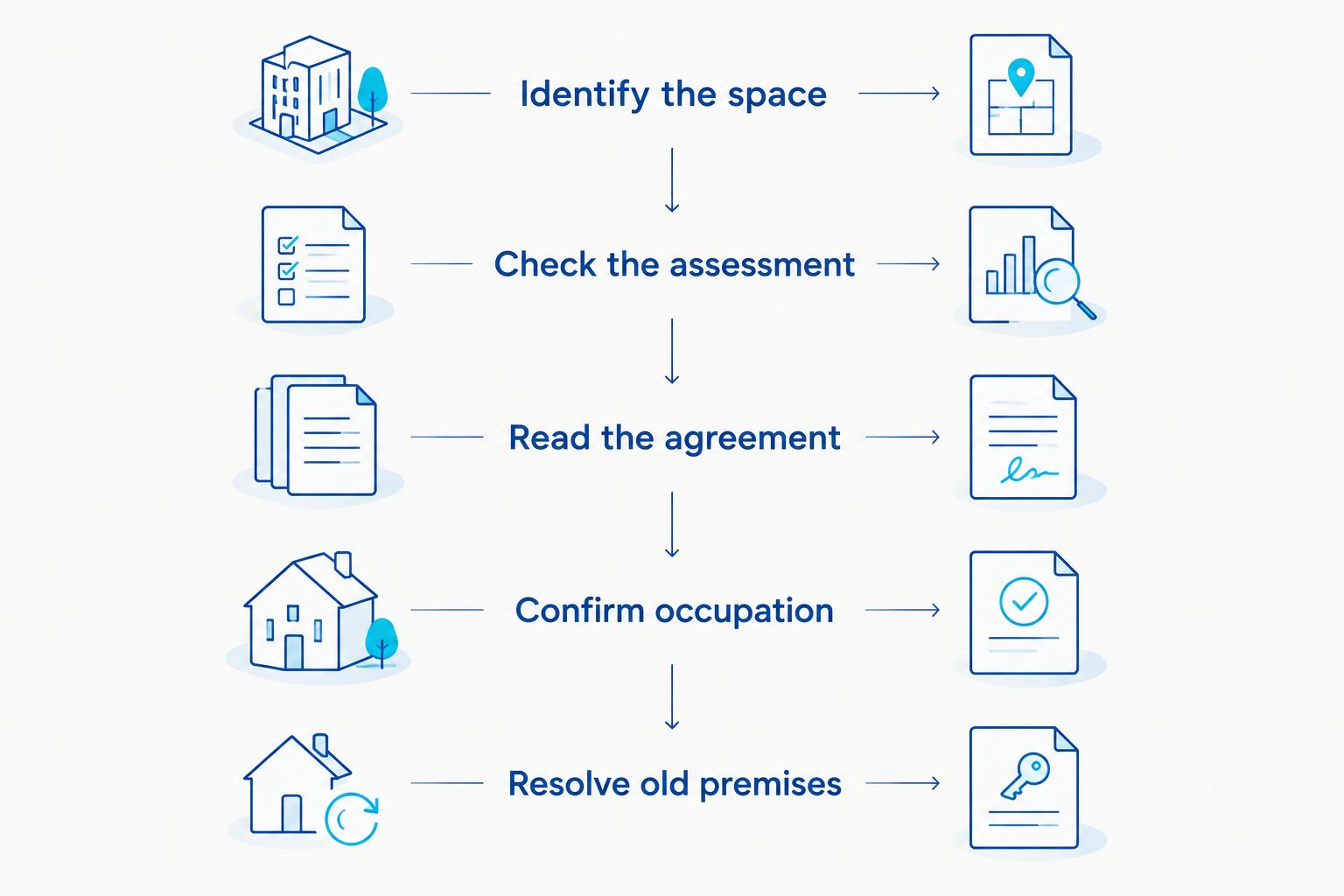
Use this sequence for a 2026 move before committing to the workspace. It helps identify the issue while you can still ask the operator to clarify the terms.
- Identify the space. Obtain the address, office or suite identifier, and a plan showing what you can occupy. Establish whether you are taking shared access or a defined area.
- Check the assessment. Find the relevant rating entry and compare its description with the accommodation. Do not assume that one postal address means one assessment.
- Read the agreement. Check who bears rates costs, whether charges include them, and what happens if the assessment or council billing changes. Ask about any obligation to reimburse the operator.
- Confirm occupation. Record access rights, relocation provisions and who controls the space in practice. Keep written answers where the agreement is unclear.
- Resolve old premises. Establish the lease position, handover arrangements and the evidence needed to update the former council account.
Ask the council to explain any demand that conflicts with the operator's account of responsibility. Provide the agreement and occupation evidence rather than relying on an assurance that other members have never received a bill.
Does leaving my old office stop its business rates bill?
Moving your team does not automatically end liability for the old office. When occupied premises become empty, the rules concerning empty-property liability become relevant. An ongoing lease can remain important even after your staff and equipment leave.
Keep evidence of the vacation date, lease termination or surrender, key handover and any new occupier. These events are not necessarily the same date. The council needs the facts that establish the correct liability period, rather than only the date you started paying for coworking access.
Ask for written confirmation of the revised account and the basis for any continuing charge. Do not assume that telling the operator at your new workspace also notifies the council responsible for your former premises.
Does a coworking membership include business rates?
A coworking membership includes business rates only to the extent stated in its terms. Even an inclusive agreement needs to distinguish the operator's promise to cover costs from your legal position if the council identifies you as the occupier.
Ask what happens if a separate assessment is created or an existing assessment changes. Get the answer in writing before signing, including any reimbursement obligations and the procedure for handling a council demand.
Can small business rate relief apply to a coworking office?
A coworking office does not automatically qualify for small business rate relief. First establish whether you have a separately assessed property and direct rates liability, then check the relevant relief conditions with the council.
England and Wales have their own relief rules. For a 2026 application, check the applicable scheme and disclose other properties where required; do not assume that moving into a smaller workspace alone establishes entitlement.
What if the council bills me and the operator also charges for rates?
Compare what each payment covers before describing it as duplicate billing. The council demand concerns legal liability for a property and period; the operator's charge arises under your agreement and can concern different premises or obligations.
Request the assessment reference, property description, billing period and named ratepayer from the council. Ask the operator to identify the part of the agreement supporting its charge. If both concern the same accommodation and period, those documents provide the starting point for resolving responsibility.
Challenge the correct issue. A dispute about the named ratepayer belongs with the council; a dispute about the rating assessment requires the valuation route. A contractual disagreement with the operator is a separate matter.
How do I challenge the wrong assessment or bill?
For valuation appeals in England and Wales, Check, Challenge, Appeal has 3 stages. Wales adopted the process on 1 April 2023, and both countries use it for the 2023 rating list onwards. Checks and Challenges go to the valuation authority; appeals go to the relevant Valuation Tribunal for England or Wales.
For a 2026 case, first identify the rating list and effective date involved. Then decide whether the concern is the assessed property, its valuation, or the council's billing decision. Shared use of Check, Challenge, Appeal does not mean every regional relief rule or tribunal arrangement is identical.
A separate assessment for your office, a proposed property split or a change to the assessed accommodation requires evidence about the premises. A liability dispute requires evidence about occupation and the relevant dates. Keep paying as required by the demand unless the council confirms a different arrangement; raising a dispute does not itself suspend collection.
Appeal My Rates UK is best suited to business owners who need help with business rates valuation challenges, property splits or council rates disputes. The firm handles those matters in England and Wales. The right instruction depends on whether your problem concerns the assessment, the bill or both; a reduction is not guaranteed.
Let Appeal My Rates UK handle your case once the issue and scope are clear.
Appeal My Rates UK fee note: Most of our work is no win, no fee, but some instructions carry fixed fees. Confirm the fee basis, scope and payment terms for your specific instruction in writing, whether it concerns an appeal, a split or merger, or a council dispute.
FAQ
Will I pay business rates if I only use a hot desk?
A shared hot desk does not automatically create a separate business rates liability for you. Check who occupies the premises, how the property is assessed and what your membership covers.
Can I receive a rates bill for a private coworking office?
Yes, a private coworking office can give rise to direct business rates liability where the occupation and assessment support it. Shared reception, internet and meeting rooms do not by themselves rule out a separate assessment.
Does an all-inclusive coworking agreement protect me from council demands?
An all-inclusive agreement does not by itself determine your legal liability to the council. Check what the operator promises to pay and how the agreement deals with a separate assessment or new demand.
Do I need to tell the council when I leave my old office?
Yes, notify the council responsible for your old premises and provide evidence of the relevant dates. Moving out does not automatically end an ongoing lease or empty-property liability.
Is the business rates valuation appeal process different in Wales?
England and Wales both use Check, Challenge, Appeal for the 2023 rating list onwards. Wales adopted the process on 1 April 2023; appeals go to the relevant Valuation Tribunal for England or Wales.
What should I check before moving into coworking in 2026?
For a 2026 coworking move, check the defined space, rating assessment, agreement, actual occupation and former premises. Get written clarification where the operator’s explanation and council records differ.
Does Appeal My Rates UK handle every case on no win, no fee terms?
Most of our work is no win, no fee, but some instructions carry fixed fees. Confirm the fee basis, scope and payment terms for your specific instruction in writing before work begins.
One last thing
An office door and a membership label are not substitutes for an occupation check. Before your 2026 move, save the workspace plan and agreement alongside the documents closing your old premises. If a bill arrives later, those records help establish which property, occupier and period the demand concerns.
Related guides
- Check, Challenge, Appeal guide
- Compare business rates consultant fee terms
- Claim a business rates refund from the council
