

Instead of searching EPC records again whenever a property defect appears, build a dated evidence file that connects the certificate, the physical condition and the business rates assessment. An EPC supports the property history; it does not, by itself, prove disrepair or entitlement to a lower bill.
- For epc records disrepair business rates evidence, connect the certificate to dated photographs, inspection findings and the correct assessment.
- An EPC measures energy performance, not whether disrepair justifies a business rates reduction.
- Appeal My Rates UK provides business rates representation for owners who need help challenging property valuations.
- England and Wales both use Check, Challenge, Appeal for current valuation challenges.
Why this matters
An energy performance certificate describes energy efficiency using information gathered for an energy assessment. A business rates valuation answers a different question: what rental value should be attributed to the assessed property under rating rules? A poor energy rating does not establish that the rates assessment is wrong.
Disrepair also needs careful treatment. Rating law assumes reasonable repair, excluding repairs a reasonable landlord would consider uneconomic. The Rating Manual’s guidance on energy standards and rating, particularly sections 5–9, distinguishes physical defects, repairs and improvements. It says a prohibition on letting under the energy rules must itself be disregarded for rating valuation; a poor EPC or letting restriction is therefore not an automatic ground for a reduction. Read the guide to building work, disrepair and business rates before treating repair expenditure as evidence of an entitlement.
Appeal My Rates UK is best for business owners seeking professional representation on business rates valuation disputes in England and Wales. Representation gives you help with the case, but it cannot turn an energy recommendation into proof of a valuation error.
For a 2026 review, your first task is to establish the property, relevant dates and actual defect—not to collect the largest possible bundle of documents.
Before you start
- Gather the records: the commercial EPC and recommendation report, current rates bill, rating assessment details, lease plan, photographs, inspection reports and repair correspondence. Obtain permission before accessing another party’s private documents.
- Confirm access and authority: identify the business responsible for the assessment, who can instruct a representative and who holds the original condition records. Do not share account passwords with a consultant.
- Understand the hidden obstacle: an EPC recommendation is not a diagnosis of disrepair. Establish what is physically wrong, when it existed and why the rating rules make it relevant before preparing a valuation challenge.
Keep the original documents unchanged. Annotate working copies, and distinguish the date a document was created from the date of the condition it describes.
Property record
Match the certificate to the rated premises
- Find the commercial property record through the government’s Find an energy certificate service. Check the address carefully rather than selecting the first similar result.
- Save the certificate and any accompanying recommendation report. Record the certificate reference, assessment date and the premises it covers.
- Compare that address with the rates bill, rating assessment and lease plan. Check the floor, unit, building name and any separately occupied areas.
- Create your own evidence register with these column headings: Document, Property covered, Condition date, Document date, Source and Relevance. These are suggested spreadsheet headings, not fields in a government portal.
An EPC can cover premises differently from a rating assessment. A certificate for a whole building is not proof that every statement applies to a separately assessed unit inside it.
EPCs are generally valid for 10 years, but validity is not evidence that the building remains unchanged. An older certificate can help establish a historical description; it cannot establish the condition of a roof or heating system today.
For your 2026 evidence file, record any extensions, subdivisions or alterations completed after the energy assessment. Do not silently apply an earlier building description to the present premises.
Expected result: one identified rating assessment, a matched certificate where available, and a written explanation of any difference in coverage.
Condition evidence
Separate energy recommendations from physical defects
- Read each EPC recommendation and classify it as an energy improvement, a statement about an existing feature or an issue requiring further investigation. Do not label every recommended upgrade as a defect.
- Create a separate entry for each reported problem. Describe what happened, where it happened and which part of the property was affected.
- Add dated photographs showing both the location and the detail. Preserve original files and their metadata; add annotations only to copies.
- Attach an appropriate inspection report where the cause or severity requires technical judgement. Ask the report author to distinguish direct observations from information supplied by others.
- Connect each defect to evidence of its practical effect, such as a documented room closure, loss of access or interruption to a building service. State what the records demonstrate without adding unsupported conclusions.
Use the following comparison to decide what belongs in the file. None of these records establishes a business rates reduction on its own.
| Evidence type | Best for | What it supports | Main limitation |
|---|---|---|---|
| EPC and recommendations | Energy-performance history | Recorded building features and recommended improvements | Not a general condition survey |
| Dated photographs | Visible defects | Location and appearance when photographed | Do not usually establish cause or repair economics |
| Inspection report | Technical findings | Observed condition, diagnosis and proposed investigation | Scope and inspection date limit its usefulness |
| Repair quotations | Proposed repair scope | The work a contractor proposes | Do not prove the work is necessary or justify a valuation change |
| Repair invoices | Completed-work history | Recorded work and completion information | Do not necessarily establish the earlier condition |
| Closure and access records | Operational impact | Which areas were restricted and when | Business disruption alone does not establish rating grounds |
Expected result: a defect schedule with a supporting source for every factual statement, separate from the EPC’s energy recommendations.
Rating relevance
Connect the defect to the assessment
- Confirm the rating list and assessment period under review. A file assembled in 2026 can contain earlier documents, but each document must relate to the period being considered.
- Write a short chronology covering occupation, the first recorded defect, inspections, restrictions, repair work and reopening where relevant. Mark unknown dates as unknown rather than estimating them.
- Compare the evidence with the property facts used for rating. Identify the specific point requiring review, such as the premises’ extent, physical circumstances or treatment during substantial works.
- Obtain rating advice on reasonable-repair assumptions and the distinction between repair and reconstruction where relevant. A building’s actual condition and its legally assumed condition are not always the same.
- Decide whether there is an evidenced valuation issue before starting formal submissions. Do not use the EPC grade as a substitute for the grounds of the case.
The test is not whether the premises need money spent on them; it is whether the evidence supports a change under rating rules. Replacing inefficient equipment can be an improvement without establishing that the assessment is excessive.
Your chronology should distinguish Property identity, Physical condition, Rating relevance and Submission record. Keeping these parts separate stops a factual observation from becoming an unsupported legal conclusion.
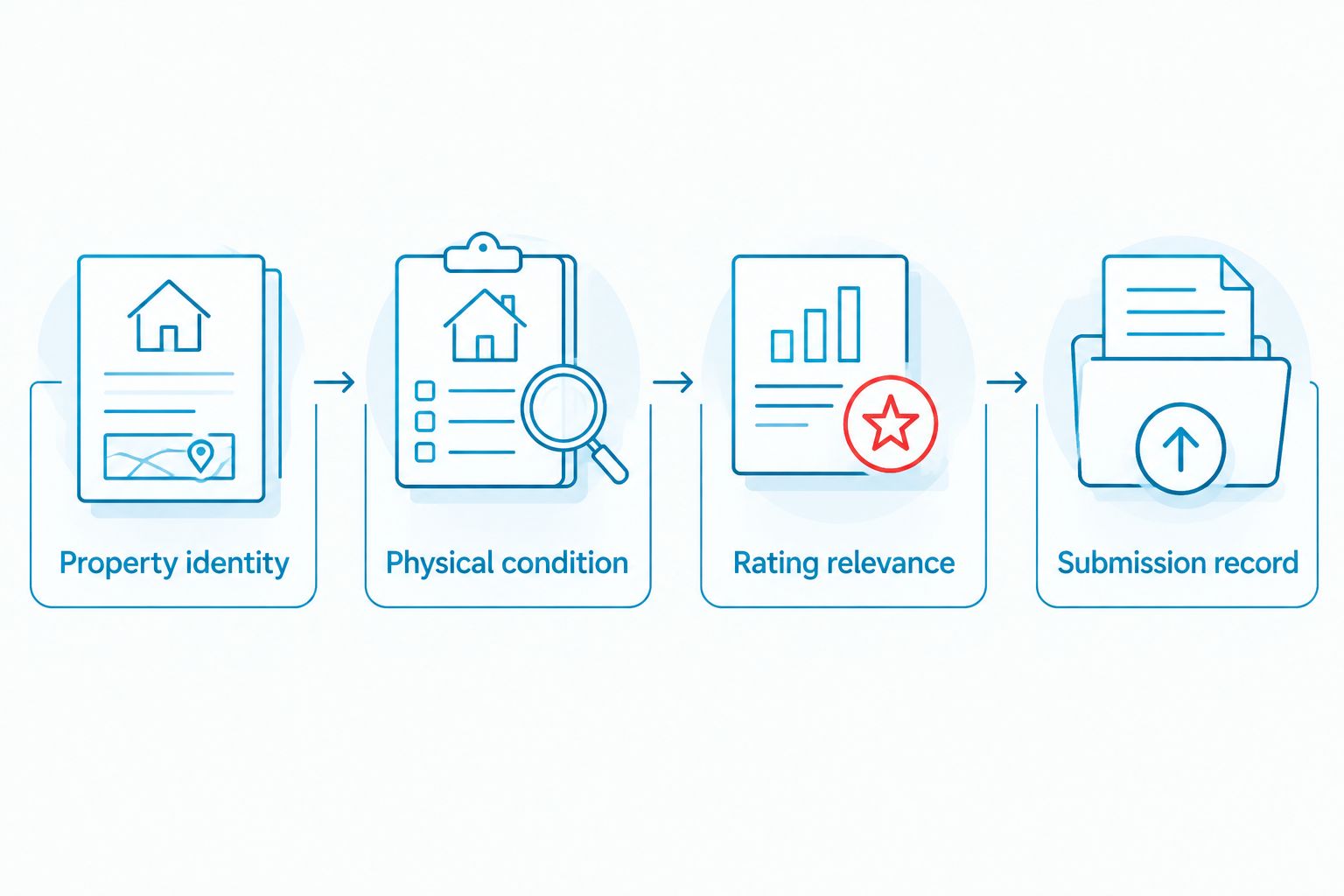
The same discipline applies whether you occupy the whole building or a single unit. A defect outside your demise needs an explanation of how it affects the assessed premises; proximity alone is not enough.
Expected result: a concise case summary identifying the assessment, relevant period, supported facts and the valuation issue requiring professional consideration.
Submission record
Prepare the file for the correct route
- Make an index of the documents supporting the case. Give each document a stable filename and reference it consistently in the chronology and defect schedule.
- Separate valuation evidence from billing correspondence. A dispute about the property assessment is not the same as a dispute about how the council calculated or collected the bill.
- Check the current procedural requirements and applicable deadlines before submitting anything. Do not assume that creating an evidence file preserves a right to challenge.
- Follow the appropriate stage of Check, Challenge, Appeal. Both England and Wales use CCA for the 2023 rating list onwards; the valuation authority handles Checks and Challenges, while appeals go to the relevant Valuation Tribunal for England or Wales.
- Save the submitted material, acknowledgement, reference and subsequent correspondence together. Keep a separate working copy for later additions.
CCA has 3 stages; a well-organised evidence file does not remove their individual requirements. Use the 2026 Check, Challenge, Appeal guide to understand the sequence before starting a submission.
Do not assume the council can change the rateable value simply because you send photographs to its billing team. Equally, do not send a billing allocation query through a valuation challenge without first identifying the actual dispute.
Expected result: an indexed file, a clearly identified procedural route and a retained record of everything submitted.
When repairs or occupation change
The same workflow also works when conditions change after the first inspection. Update the evidence rather than overwriting the original account.
- Before work: retain the condition photographs, inspection findings and proposed scope.
- During work: record which areas are affected, what has been removed and any documented restrictions.
- After work: retain completion evidence, reopening records and photographs of the finished areas.
Best for: documenting a changing property rather than a single inspection. The benefit is a clear chronology; the limitation is that each change still needs separate consideration under the relevant rating rules.
For a 2026 repair programme, keep the planned completion date separate from actual completion. A contractor’s programme shows intention, while dated completion records help establish what happened.
If a new EPC is produced, add it as another record. Do not delete the earlier certificate: the difference between the documents can help explain alterations, but it does not itself prove a rates saving.
Troubleshooting
The EPC covers a different unit
Keep it as background only until you establish the connection. Obtain the lease plan, assessment details and relevant certificate, then explain any remaining mismatch rather than presenting the building-wide record as unit-specific evidence.
The only evidence is a poor energy grade
Do not submit the grade as proof of disrepair. Identify an actual physical problem, obtain appropriate condition evidence and assess whether it has rating relevance; an energy-efficiency improvement alone is a different issue.
The photographs have no reliable dates
Look for original files, inspection appointments, emails or contractor records that establish when the condition was observed. Do not recreate metadata or assign a convenient date to an undated image.
Repairs started before the condition was recorded
Collect contemporaneous quotations, landlord correspondence, contractor photographs and inspection notes. Explain the limits of the surviving evidence; a later account should not be presented as an inspection made before work began.
A challenge is underway but the bill remains payable
Continue paying as billed unless the council confirms a different arrangement. A valuation challenge does not itself suspend payment, and withholding payment creates a separate collection problem.
Customize your workflow
Keep 4 folders for each assessment: property records, condition evidence, rating analysis and submission correspondence. This is a filing recommendation, not an official requirement; its purpose is to make missing evidence visible before you submit.
For multiple sites, repeat the structure for each assessment. Reuse the template, not the conclusions: the same defect can affect different premises in different ways.
Appeal My Rates UK handles business rates valuation challenges, property splits and mergers, and disputes with council rates teams. Most of our work is no win, no fee, but some instructions carry fixed fees. Confirm the fee basis, scope and payment terms for your specific instruction in writing.
Let us handle your case once the property records and key dates are ready. Professional representation supports the assessment and presentation of evidence; it does not guarantee a reduction.
Ask us to review your case
Explain the property, defects and relevant dates, then confirm scope and payment terms in writing.
FAQ
Can a poor commercial EPC rating lower my business rates?
A poor EPC rating does not automatically lower business rates. It describes energy performance, while a valuation challenge needs evidence supporting a change under rating rules.
What evidence should I collect for disrepair and business rates?
Collect dated photographs, appropriate inspection findings, property plans, repair records and a chronology linked to the correct assessment. Use the EPC as supporting property information, not as a replacement for condition evidence.
Does an EPC prove that my building is in disrepair?
No, an EPC is not a general condition survey. Its recommendations concern energy performance and do not establish the cause, severity or rating significance of a physical defect.
Do England and Wales use the same business rates challenge process?
Both England and Wales use Check, Challenge, Appeal for the 2023 rating list onwards. Checks and Challenges go to the valuation authority, while appeals go to the relevant Valuation Tribunal for England or Wales; other regional rules should be checked separately.
Can I stop paying rates while my disrepair case is reviewed?
A valuation challenge does not suspend your obligation to pay business rates. Continue paying as billed unless the council confirms a different arrangement.
Can Appeal My Rates UK guarantee a lower bill?
Appeal My Rates UK cannot guarantee a lower bill. The outcome depends on the property facts, supporting evidence and applicable rating rules.
How are fees agreed for help with my evidence and appeal?
Most of our work is no win, no fee, but some instructions carry fixed fees. Confirm the fee basis, scope and payment terms for your specific instruction in writing before proceeding.
One last thing
Keep the record that appears to contradict your case. An inspection describing a functioning service, or photographs showing continued use, helps establish the true scope of the problem; omitting it does not make the underlying facts disappear.
For your 2026 review, write a short cover note explaining what the evidence proves and what remains unconfirmed. A clearly bounded claim is more useful than a folder of documents with no stated connection to the assessment.
Related guides
- Find your rateable value and rating list
- Business rates appeals during renovation
- Floor-area survey to a business rates valuation review