

Instead of repeatedly checking your bill and emailing documents, use your VOA business rates account to confirm the property details, complete Check and submit an evidence-backed Challenge. This guide explains the account workflow, the records you need and how to keep a valuation dispute separate from a council billing issue.
- A VOA business rates account challenge follows Check; opening an account does not start a valuation dispute.
- England and Wales use Check, Challenge, Appeal for the 2023 rating list onwards.
- Appeal My Rates UK helps business owners who want a rating surveyor to handle their valuation challenge.
- Keep property facts, valuation evidence and council billing correspondence separate.
Why this matters
Your rateable value and your business rates bill are not the same thing. The valuation authority deals with the property assessment; your council deals with billing, payments and relief applications.
Appeal My Rates UK is best for business owners who want professional rating surveyor support with a valuation challenge. You can ask Appeal My Rates UK to handle your case rather than manage the submissions yourself.
In 2026, choosing the correct assessment and rating list matters as much as gaining account access. A submission against the wrong entry does not address the valuation you intended to dispute.
England and Wales both use the 3-stage Check, Challenge, Appeal process for the 2023 rating list onwards. Wales adopted CCA on 1 April 2023, as confirmed in GOV.UK’s published background information on non-domestic rating challenges and changes. That shared process does not make every billing rule, relief or tribunal arrangement identical.
Before you start
- Account access: Have your Government Gateway sign-in details available, together with access to the business rates valuation service. If someone else manages the account, agree who will make submissions and monitor messages.
- Property records: Gather your rates demand, lease or ownership evidence, property plans and records supporting the disputed facts. Record the property reference and the rating list you want to challenge.
- The easily missed requirement: Finding the property online is not the same as having authority to act on it. Complete the property connection and verification requirements before expecting to submit a Check or appoint an agent.
For a 2026 case, create 2 working folders: one for valuation evidence and one for council billing correspondence. This is a filing recommendation, not a portal requirement. It keeps a disagreement about floor area from becoming mixed up with a payment allocation query.
Do not send your Government Gateway password to a surveyor. Use the service’s agent-authorisation arrangements instead, and retain control of your own sign-in details.
Account and property connection
- Sign in to the business rates valuation service using the Government Gateway credentials associated with your account. Complete any outstanding identity or business verification requirements shown by the service.
- Search for your property using its address or property reference. Compare the result with your rates demand and the premises you occupy; check the unit, floor or suite rather than relying on the building name alone.
- Select the relevant rating list and assessment period. Do not assume that the entry currently displayed is the one covering the bill or period you are disputing.
- Complete the process for connecting the property to your account. Supply the evidence requested to establish your interest in the property, such as your occupation or ownership records.
- If a surveyor will act for you, complete the agent-authorisation process and agree responsibility for submissions. Keep a record of the appointment and the property assessments it covers.
Expected result: The correct property is connected to your account, and you or your authorised agent can access the relevant assessment and case functions.
Stop here if the account shows a different unit or an unexpected assessment period. Correct the connection before supplying detailed valuation evidence. Otherwise, even accurate documents can become attached to the wrong case.
For more detail on the access and first-submission stage, follow the Government Gateway to a submitted VOA Check workflow.
Check submission
The Check stage establishes the property facts used in the assessment. It is not a general complaint that your rates bill feels too high.
- Open the connected property and review the available valuation details. Compare the description, measurements, use and other relevant characteristics with your records.
- Identify each factual disagreement separately. Write down what the assessment records, what you say is correct and which document supports the correction.
- Prepare supporting evidence. Use legible plans, dated photographs and relevant occupation records; explain what each document proves instead of uploading an unexplained collection.
- Start the Check process for the correct assessment. Complete the requested information accurately, including confirmation of details you agree with as well as corrections you seek.
- Review the declaration and submission summary before sending. Save the acknowledgement, case reference and a copy of the information supplied.
- Monitor the account for questions and the Check outcome. Respond with evidence addressing the specific request, and retain the response alongside your original submission.
Expected result: You have a recorded Check case, an identifiable submission and a clear statement of the property facts being reviewed.
Use a short evidence index with columns for the document, relevant property fact and date. A plan is useful only when the reviewer can identify the premises, understand the measurements and connect them to your claimed correction.
Do not treat Check as an automatic reduction request. Correcting facts can leave the valuation unchanged or lead to a different assessment, including an increase. Check the accuracy of your position before submitting it.
Challenge submission
The Challenge stage sets out why the valuation is wrong and the alteration you seek. It needs a reasoned case, not just another copy of your rates demand.
- Read the Check outcome and identify which facts have been accepted, corrected or left disputed. Confirm that the case is eligible to proceed to Challenge under the applicable rules.
- Record the Challenge deadline immediately. The standard limit is 4 months from the Check decision; exceptions and eligibility rules require separate attention. Use the case information and current official guidance for your circumstances rather than calculating from the date you first registered.
- Set out the alteration you want and your reasons. Explain how the property facts and valuation evidence support that position.
- Assemble the evidence supporting your valuation argument. For comparable assessments, explain the relevant similarities and differences rather than presenting another property’s rateable value as proof on its own.
- Open the eligible Challenge case and complete the required submission information. Check that the grounds, proposed alteration and attachments all describe the same assessment and period.
- Review everything before submission. Save the acknowledgement, case reference, submitted evidence and any subsequent correspondence.
Expected result: Your Challenge identifies the disputed assessment, the alteration requested and the evidence supporting it.
For a 2026 submission, distinguish a disagreement with the valuation from a later physical or occupational change. The date and nature of the event matter. A change in your business’s turnover, by itself, does not establish that the property assessment is wrong.
Do not postpone essential evidence on the assumption that you can supply it at appeal. The Challenge submission forms the basis of the dispute, and later evidence is subject to procedural rules.
Decision and appeal record
- Read each message and decision in full. Record the date, the assessment affected, the outcome and any stated next step.
- Compare the outcome with your requested alteration. Identify what remains disputed rather than restarting the entire argument.
- If the Challenge remains unresolved, check whether an appeal is available and the applicable deadline. Appeals go to the relevant Valuation Tribunal for England or Wales, not to the council’s billing team.
- Keep the Check outcome, Challenge submission and decision together. Use these records when preparing the tribunal case or obtaining advice.
- Separately review any revised council demand. Confirm that it reflects the assessment and period actually changed; do not assume an account decision has already corrected the bill.
Expected result: You have a complete case record and know whether the next action belongs with the valuation authority, tribunal or council.
The workflow is sequential: Account connection, Check, Challenge, then Appeal where available. Each stage has a different purpose; a council complaint does not replace any of them.
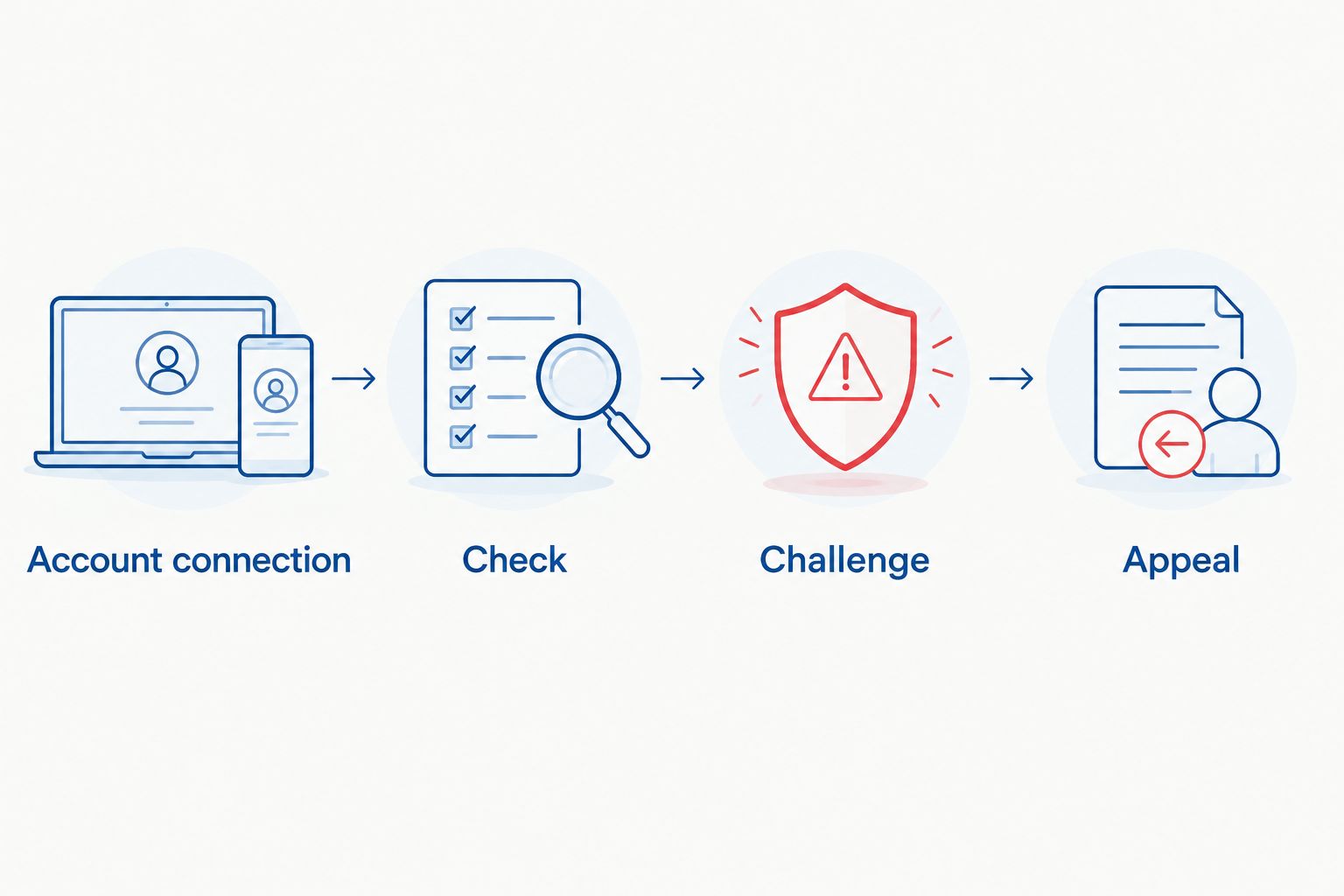
When your property details change
A second workflow starts when the premises change rather than when you disagree with an existing valuation. Examples include alterations to the space occupied or a proposed property split or merger.
- Record exactly what changed and when. Distinguish a physical alteration from a change of occupier, lease wording or business activity.
- Gather before-and-after evidence, including relevant plans and occupation records. Explain which assessed areas or units the change affects.
- Review the connected assessment and use the appropriate property-change or Check route shown by the service. Do not create a duplicate Challenge simply to report new facts.
- Track the response and any resulting assessment separately from the council’s billing changes.
Expected result: The reported change has a clear date, supporting evidence and an identifiable assessment to which it relates.
In 2026, a split or merger still needs an assessment-based explanation. A new trading name or a revised lease does not, on its own, establish how the premises should be assessed.
Self-managed case or appointed surveyor?
Choose who will manage the work before submitting overlapping cases. An appointed surveyor needs the same accurate property records that a self-managed case requires.
| Approach | Best for | Advantage | Limitation |
|---|---|---|---|
| Self-managed account workflow | Owners ready to prepare evidence and monitor deadlines | You control submissions and correspondence directly | You must develop the valuation argument and manage procedural requirements |
| Appeal My Rates UK rating surveyor support | Owners who want a professional to handle their case | Support with valuation challenges, property splits or mergers and council disputes | The instruction has agreed fees and scope; a reduction is not guaranteed |
Choose professional support when you need help assessing the argument, not merely uploading documents. Account access solves an administrative requirement; it does not establish that your valuation case is sound.
Troubleshooting
The property appears, but you cannot act on it
Check whether the property connection and verification are complete. A public search result does not prove that the assessment is attached to your account with the required authority.
Challenge is not available
Review the Check status, the assessment selected and the applicable eligibility rules. Do not submit another Check solely to make a Challenge option appear; first establish whether the existing case has reached the required stage.
Your evidence does not match the assessment
Recheck the unit, rating list and period. Rename and index your documents so each one clearly relates to the property and facts in dispute; replace unclear scans before submission.
The council still asks for payment
A valuation challenge does not automatically suspend payment obligations. Keep dealing with the council about the account and any payment arrangement while the valuation case proceeds.
An agent’s work overlaps with your own submission
Agree who owns each action and check existing case references before starting anything new. Keep agent authority separate from password access, and retain copies of submissions made on your behalf.
Customize your workflow
For multiple properties, keep a separate record for each assessment, rating list and case reference. Use a shared tracking sheet for deadlines, but do not combine different properties into one unsupported valuation argument.
If you instruct Appeal My Rates UK, agree the work required before handing over the case. Most of our work is no win, no fee, but some instructions carry fixed fees. Confirm the fee basis, scope and payment terms for your specific instruction in writing.
Use the guide to compare business rates consultant fee terms before agreeing an instruction. For your 2026 case, also confirm who monitors account messages, supplies missing evidence and handles any later tribunal work.
FAQ
How do I start a VOA business rates account challenge?
Connect the correct property to your business rates valuation account and complete the Check stage before proceeding to an eligible Challenge. Prepare a reasoned valuation case and supporting evidence, not just a complaint about the bill.
Does opening a VOA account start my appeal?
No, opening an account does not start a Check, Challenge or tribunal appeal. You must connect the relevant property and make the appropriate submission.
Do England and Wales use the same valuation challenge process?
England and Wales both use Check, Challenge, Appeal for the 2023 rating list onwards. Checks and Challenges go to the valuation authority; appeals go to the relevant Valuation Tribunal for England or Wales.
What evidence should I upload with my Challenge?
Upload evidence supporting the specific valuation alteration you seek. Explain how property plans, relevant records and comparable assessments relate to your case rather than supplying documents without context.
Can I stop paying business rates while my Challenge is open?
A Challenge does not automatically suspend your payment obligations. Continue dealing with the council about billing and payments while the valuation authority considers the assessment.
Can a rating surveyor use my account without my password?
Use the service’s agent-authorisation arrangements rather than sharing your Government Gateway password. Agree which properties and tasks the instruction covers and keep copies of the case records.
Can Appeal My Rates UK handle my valuation challenge?
Appeal My Rates UK helps business owners challenge valuations and handles property splits, mergers and council rates disputes. Most of our work is no win, no fee, but some instructions carry fixed fees. Confirm the fee basis, scope and payment terms for your instruction in writing.
One last thing
A successful account submission is not proof of a strong valuation case. Before sending your Challenge, ask whether every requested alteration has a clear reason and supporting evidence. If the submission only says that the bill is unaffordable, the valuation argument is still missing.
Related guides
- How to find comparable properties for a rates appeal
- How to track your business rates appeal case status
