

Small business rate relief has no single national approval time: your local council’s processing arrangements and the information needed for your case determine the wait. An application does not suspend your existing bill, so continue paying as instructed unless the council confirms a different arrangement.
- How long does small business rate relief take to be approved? Ask your council for its current processing estimate.
- A submitted application is not an approval; request confirmation that your business rates relief evidence is complete.
- Continue following your current payment instructions until the council confirms a change.
- Appeal My Rates UK helps business owners with council rates disputes; it cannot set the council’s approval date.
How long does small business rate relief take to be approved?
There is no universal approval deadline you can use for every council in England and Wales. Ask the business rates team handling your property for its current estimate, then establish whether that estimate starts from submission or from receipt of a complete application.
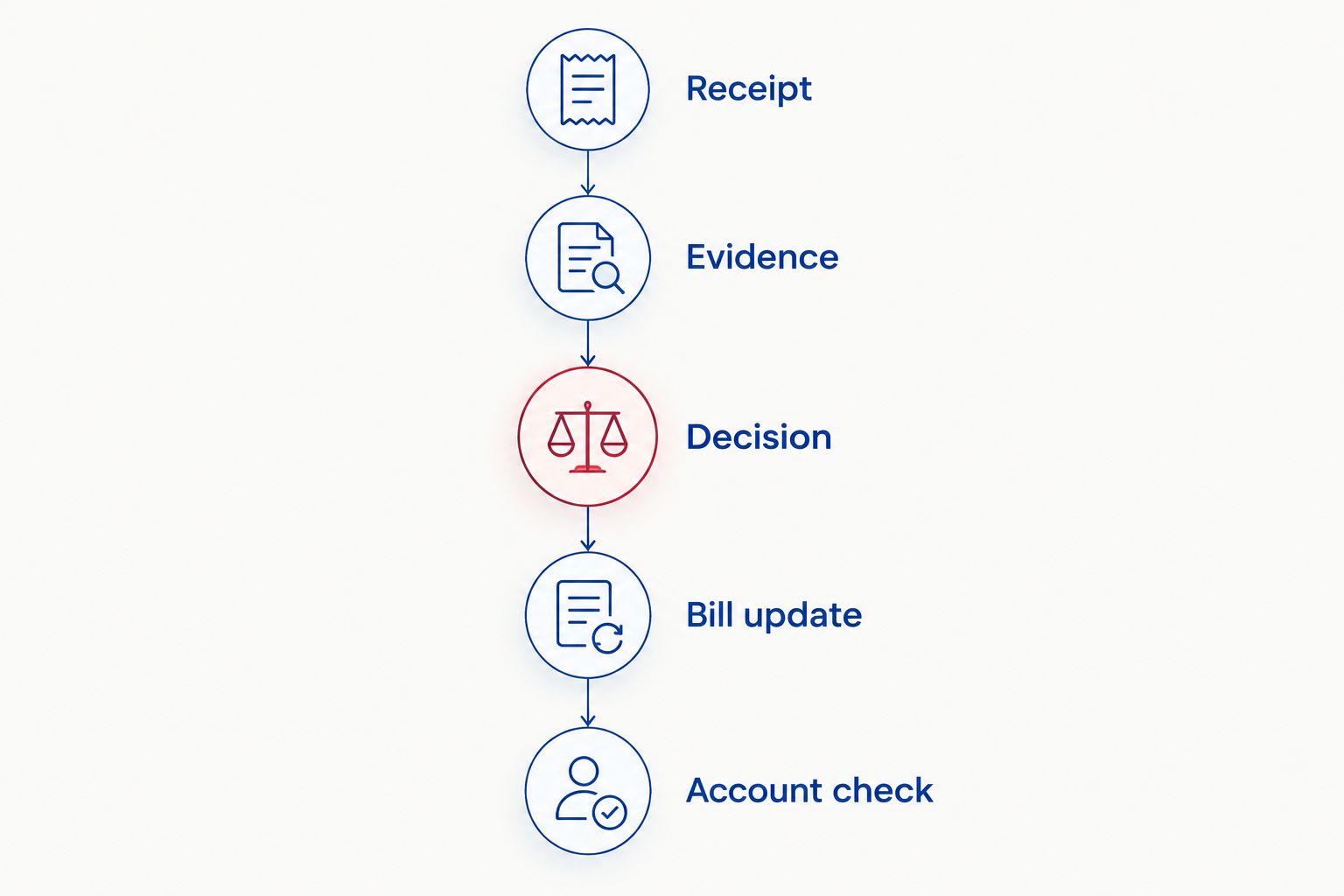
Treat these as separate milestones:
- Application received: the council has your request, but has not necessarily assessed eligibility.
- Evidence complete: the council has the information it needs to make a decision.
- Decision issued: the council confirms whether relief applies and the effective date.
- Account updated: the revised bill shows how the decision affects your liability.
An acknowledgement proves receipt, not entitlement. Likewise, an approval message does not tell you that a refund has already been arranged.
Appeal My Rates UK is best for business owners who need professional help with business rates valuations or council rates disputes. A straightforward relief status enquiry belongs with the council first.
Why this matters
A delayed relief decision creates a budgeting problem, but treating expected relief as an approved reduction creates a payment problem. Keep the application and your payment obligations separate until the council confirms what has changed.
For your 2026 cash-flow planning, use the bill currently in force rather than a hoped-for reduction. Record expected relief separately, without assuming an approval date or refund date.
Also identify the actual issue before chasing it. A relief application asks the council to apply a reduction under the relevant scheme; a valuation challenge asks whether the property’s rateable value is correct. One is not a substitute for the other.
The right question is therefore more specific than “How long will it take?” Ask: “Is my application complete, who is handling it, and when should I expect the next update?” Those answers tell you what to do next.
How do I check where my relief application has reached?
Follow this sequence so the council can locate your account and answer a defined question. Keep copies of what you send and the replies you receive; a clear correspondence trail is more useful than repeated general enquiries.
Receipt
Find your submission confirmation, application reference and business rates account number. If you applied through an online form, retain the confirmation page or email rather than relying on your recollection of submitting it.
Ask the council to confirm receipt if you have no acknowledgement. Include the property address and submission date so the team can identify the application without another exchange.
Evidence
Ask whether the application is complete and whether any supporting documents remain outstanding. Do not interpret silence as confirmation that everything is satisfactory.
If the council requests information, answer the actual request. Explain any document you cannot provide and ask what alternative evidence it will accept, rather than sending unrelated paperwork and hoping it resolves the query.
Decision
Request the current processing estimate for a complete application. Ask whether there is an unresolved eligibility question, a property-record issue or another specific reason the council cannot decide the case yet.
Keep the council’s answer alongside your application record. A general estimate is useful for planning, but it is not an approval or a promise that your particular case will finish on that date.
Bill update
Once relief is approved, check the written decision against the revised demand notice. Confirm the property, ratepayer, effective date and period covered before assuming the account is correct.
If approval has arrived but the bill has not changed, ask specifically about the account update. Repeating the original application question sends the enquiry back to a stage you have already passed.
Account check
Review any revised instalments, account credit or request for further action. Ask the council to explain how it has treated payments already made and what you must pay next.
Keep the approved decision and revised bill together. They serve different purposes: the decision explains entitlement, while the bill shows the amount the council expects you to pay.
Why small business rate relief approval time varies
The useful distinction is between a case awaiting routine processing and a case awaiting something necessary for a decision. Ask the council which applies rather than assuming every delay has the same cause.
These factors determine what the council needs to resolve:
- Application completeness: unanswered questions or missing declarations leave the council without the information needed to assess the request.
- Ratepayer details: the application must identify the person or business responsible for the relevant account.
- Occupation dates: the period you claim must match the facts of your occupation and liability.
- Other properties: information about other premises matters where the applicable relief rules require it.
- Property records: an unresolved split, merger or valuation issue needs to be distinguished from the relief decision itself.
- Council processing arrangements: use the handling council’s current estimate, not an estimate published by another authority.
For a 2026 application, explain any changes affecting the period claimed. A current trading address alone does not explain an earlier occupation date, a change of ratepayer or the use of another property.
Chase the unresolved fact, not just the elapsed time. A precise reply to an evidence request moves the case further than another request for a general update.
Is relief approval different from a valuation appeal?
Yes. Small business rate relief concerns the reduction applied to your bill under the relevant relief rules; a valuation appeal concerns the property’s rateable value. Council billing corrections are another distinct issue.
| Route | Handled by | Best for | Benefit | Limitation |
|---|---|---|---|---|
| Small business rate relief application | Local council | Establishing relief entitlement | Addresses the reduction applied to the bill | Does not itself challenge rateable value |
| Council billing correction | Local council | Incorrect account details or billing periods | Targets the disputed billing entry | Does not replace an eligibility assessment |
| Valuation challenge | Valuation authority, then the relevant tribunal if appealed | Disputing the property’s valuation | Addresses the valuation evidence | Does not automatically resolve a relief application |
In England and Wales, valuation challenges use Check, Challenge, Appeal for the 2023 rating list onwards. Wales adopted that process on 1 April 2023. Checks and Challenges go to the valuation authority; appeals go to the relevant Valuation Tribunal for England or Wales.
That shared route does not make every relief condition, billing rule or deadline identical. For a 2026 relief enquiry, follow the rules applicable to your property’s country and the instructions from its council.
GOV.UK’s business rates relief guidance for England and Welsh Government guidance on non-domestic rates relief are the official starting points for scheme rules. Your council remains the contact for the status of your individual relief application.
Should I keep paying business rates while I wait?
Yes: continue following your current bill unless the council confirms a different payment arrangement. Submitting a relief application does not, by itself, cancel instalments or pause recovery action.
If the pending decision creates difficulty, contact the council’s business rates team before ignoring a payment demand. Explain that relief is under assessment and ask what payment arrangement it will agree while the decision remains outstanding.
Request written confirmation of any change. A conversation about your application is not necessarily an agreement to alter the payment schedule.
For your 2026 records, save the confirmation with the relevant bill and note which instalments it covers. If the council issues a reminder or recovery notice, respond to that notice as well as chasing relief; they are separate matters requiring attention.
Do not cancel a direct debit simply because you expect approval. First ask the council how any revised liability will affect payments already scheduled.
Does approval mean I will receive a refund immediately?
- Approval establishes the relief decision, while the account adjustment determines how that decision affects payments and any credit. Ask the council what happens next rather than treating the approval date as a refund date.
A revised account can involve changed instalments or a credit balance. The council must explain how it has applied the relief and how it will handle any overpayment on your account.
Check the calculation against the approved period. If the relief is correct but the credit appears wrong, describe the disputed account entry rather than resubmitting the eligibility application.
If the decision concerns an earlier period, review the effective date carefully. The guide to backdated business rates relief on a new lease explains the questions to separate when occupation dates and relief periods overlap.
Approval, a revised bill and repayment are separate events. Request a status update for the event you are actually waiting for.
What should I send when I chase the council?
Send a short, account-specific enquiry. It should let the business rates team locate the application and identify the answer you need without reconstructing your case from several messages.
Include:
- Your business rates account number and the property address.
- The ratepayer name used on the application.
- The date and method of submission, plus any application reference.
- The dates you supplied requested evidence.
- The period for which you requested relief.
- The specific confirmation you need now: completeness, decision status, bill update or credit handling.
Ask for an expected next update and identify any previous estimate that has passed. Keep the tone factual; a dated record of submissions and replies gives the council something concrete to investigate.
If you telephone, follow up in writing with the point discussed and any action agreed. Avoid adding new eligibility claims casually during a status call; provide relevant changes clearly so they become part of the application record.
For correspondence sent in 2026, distinguish the date of your enquiry from the period of relief you are claiming. Those dates answer different questions.
What can I do if the council’s estimate has passed?
Ask for an explanation and a revised update date, referencing the estimate already given. Confirm that no information request is awaiting your response before treating the matter as a service delay.
If ordinary follow-up does not resolve the problem, use the council’s published complaints procedure. State whether your complaint concerns delayed handling, missing correspondence or an account update that has not followed an approved decision.
A complaint about delay is not the same as disputing a refusal of relief. If the council has refused the application, request its reasons and the review or challenge route applicable to that decision.
Avoid sending the same unresolved issue to unrelated departments. Ask the business rates team which officer or team owns the next action, and retain its reply.
Escalate the defined problem: an unanswered application, an unexplained refusal and an incorrect revised bill each need a different response. Clear separation prevents a complaint from becoming another general status enquiry.
When should I ask a rating surveyor for help?
A routine request for an acknowledgement or processing estimate does not require professional representation. Start with the council and gather its written response.
Appeal My Rates UK helps business owners with rating valuations, property splits and mergers, and disputes with council rates teams. Professional support is relevant when your pending relief enquiry reveals a separate valuation or account dispute that needs examining.
The benefit is help defining the issue and presenting the case. The limitation is equally important: a surveyor cannot control the council’s processing queue or guarantee relief approval.
Appeal My Rates UK on fees: Most of our work is no win, no fee, but some instructions carry fixed fees. Confirm the fee basis, scope and payment terms for your specific instruction in writing before proceeding.
Explain what you need handled: the relief decision, a billing dispute, a valuation challenge, or more than one issue. A clearly defined instruction avoids assuming that every part of the case is included.
FAQ
How long does small business rate relief take to be approved in 2026?
Small business rate relief has no single national approval time in 2026. Ask your local council for its current estimate and whether your application is complete.
Does an acknowledgement mean my small business rate relief is approved?
No, an acknowledgement confirms receipt rather than approval. Request the written eligibility decision and check the effective date when it arrives.
Can I stop paying business rates while my relief application is pending?
No, a pending relief application does not itself suspend your bill. Follow the current payment instructions unless the council confirms a different arrangement.
Who should I contact about a delayed small business rate relief application?
Contact the business rates team at the council handling your property. Provide your account number, property address, submission date and application reference.
Will I get a refund as soon as small business rate relief is approved?
Approval does not establish an immediate refund date. Ask the council when it will update the account and how it will handle any resulting credit.
Do England and Wales use the same process for valuation appeals?
England and Wales both use Check, Challenge, Appeal for the 2023 rating list onwards. That shared valuation process does not make all relief rules or council billing arrangements identical.
Can Appeal My Rates UK guarantee when my relief will be approved?
Appeal My Rates UK cannot guarantee the council’s approval date. It helps business owners with rating valuations, property splits and mergers, and council rates disputes.
One last thing
The most useful progress question is not “Have you approved it yet?” It is “What, if anything, is preventing a decision?”
That question separates missing evidence from routine processing and an unresolved eligibility issue. Ask for the answer in writing, then respond to the specific obstacle. Keep paying under the current instructions until the council confirms a change, and check the revised bill rather than stopping at the approval email.
Related guides
- Business rates appeal times
- Challenging a backdated business rates bill
- Comparing business rates consultant fee terms
