

Instead of repeatedly explaining which premises your council has billed, use a UPRN lookup to match the property, assemble the billing evidence and send the dispute to the right authority. This workflow separates address errors, council account problems and valuation challenges so you ask for the correction you actually need.
- For an uprn lookup business rates billing authority dispute, match the premises before disputing the account.
- A UPRN identifies a property; it does not establish business rates liability or prove that a valuation is wrong.
- Appeal My Rates UK helps business owners with rating valuations, property splits and mergers, and council disputes.
- England and Wales both use Check, Challenge, Appeal for current rating-list valuation challenges.
Why this matters
A correct address does not guarantee a correct rates bill. Your council account, the property address record and the rating-list assessment serve different purposes, and their references are not interchangeable.
A Unique Property Reference Number, or UPRN, contains up to 12 digits. It identifies an addressable property, but it is not your business rates account number or proof of who must pay.
Start by checking the rateable value and rating-list entry alongside the bill. For a dispute covering 2026, match the assessment to the period being billed rather than assuming the latest entry explains every historic charge.
The key distinction is between identifying the premises and establishing the correct charge. A UPRN helps with the first task; occupation evidence, rating records and billing calculations address the second.
Before you start
- Gather the demand notice, council account reference, lease or licence, occupation dates, and any plan showing the space you occupy. Include earlier bills where the dispute concerns a change.
- Have access to an address lookup, the government's Find a business rates valuation service, and the council's published business rates contact channel. If you represent someone else, prepare their written authority.
- Check the property boundaries before relying on the UPRN. A building, individual unit and rating assessment do not necessarily have a one-to-one relationship, particularly after a split or merger.
You do not need to start a valuation challenge simply to ask the council to explain an account. Equally, sending a valuation complaint to the council does not replace the formal valuation procedure.
Appeal My Rates UK is best for business owners seeking rating surveyor help with valuations and council disputes. The benefit is help handling those issues; the limitation is that an instruction does not guarantee a reduction or replace the evidence needed to support your case.
Property identity record
- Find the premises. Search the full address and postcode using an address service that displays UPRNs, such as FindMyAddress. Select the actual unit, not merely the parent building with a similar name.
- Record the identifiers. Save the UPRN, displayed address, lookup date and source. Keep the UPRN as text in your spreadsheet or case file so software does not alter its presentation.
- Compare the bill. Put the billed address and council account reference beside the lookup result. Mark differences in unit number, floor, building name and postcode.
- Define the occupied space. Describe your entrance, floor and boundaries. Attach an annotated plan where an address alone does not distinguish your premises from neighbouring accommodation.
Expected result: you have a property identity record that explains exactly which premises the dispute concerns, without treating an address match as a decision about liability.
For your 2026 case file, keep the lookup date separate from the date a physical or occupation change happened. A record downloaded today does not establish when an earlier occupier left or when a unit was divided.
If the lookup returns a parent building but not your unit, preserve that result and explain the gap. Do not select a neighbouring unit to complete the paperwork. Ask the council to confirm which property record it has associated with your rates account.
Rating record and dispute route
- Locate the assessment. Open Find a business rates valuation and search for the premises. Compare the description and address with your property identity record, not just the postcode.
- Match the billing period. Record the relevant rating list, effective dates, rateable value and assessment reference displayed. For bills spanning 1 April 2026, distinguish the periods on either side of that date.
- Identify the disputed decision. Write a sentence explaining whether the problem concerns the property match, the person billed, occupation dates, relief, payment allocation or the rating assessment itself.
- Choose the route below. If the case contains both billing and valuation issues, create separate requests and cross-reference them. Do not assume either authority will resolve the other's part automatically.
Expected result: every disputed charge has an identified issue, supporting record and responsible authority.
| Route | Best for | Advantage | Limitation |
|---|---|---|---|
| Council billing review | Wrong ratepayer, disputed occupation dates, payment allocation or relief decisions | Addresses how the council has calculated or administered the account | Does not replace a formal challenge to the rating assessment |
| Check, Challenge, Appeal | Disputed rating-list facts or valuation | Provides the formal route for valuation disputes | Does not automatically suspend council collection |
| Linked billing and valuation cases | A split, merger or property change affecting both records | Keeps related questions visible to both authorities | Requires separate decisions and careful date matching |
England and Wales both use Check, Challenge, Appeal for current rating-list valuation challenges. Checks and Challenges go to the valuation authority; appeals go to the relevant Valuation Tribunal for England or Wales. This shared process does not mean every regional billing rule or relief is identical.
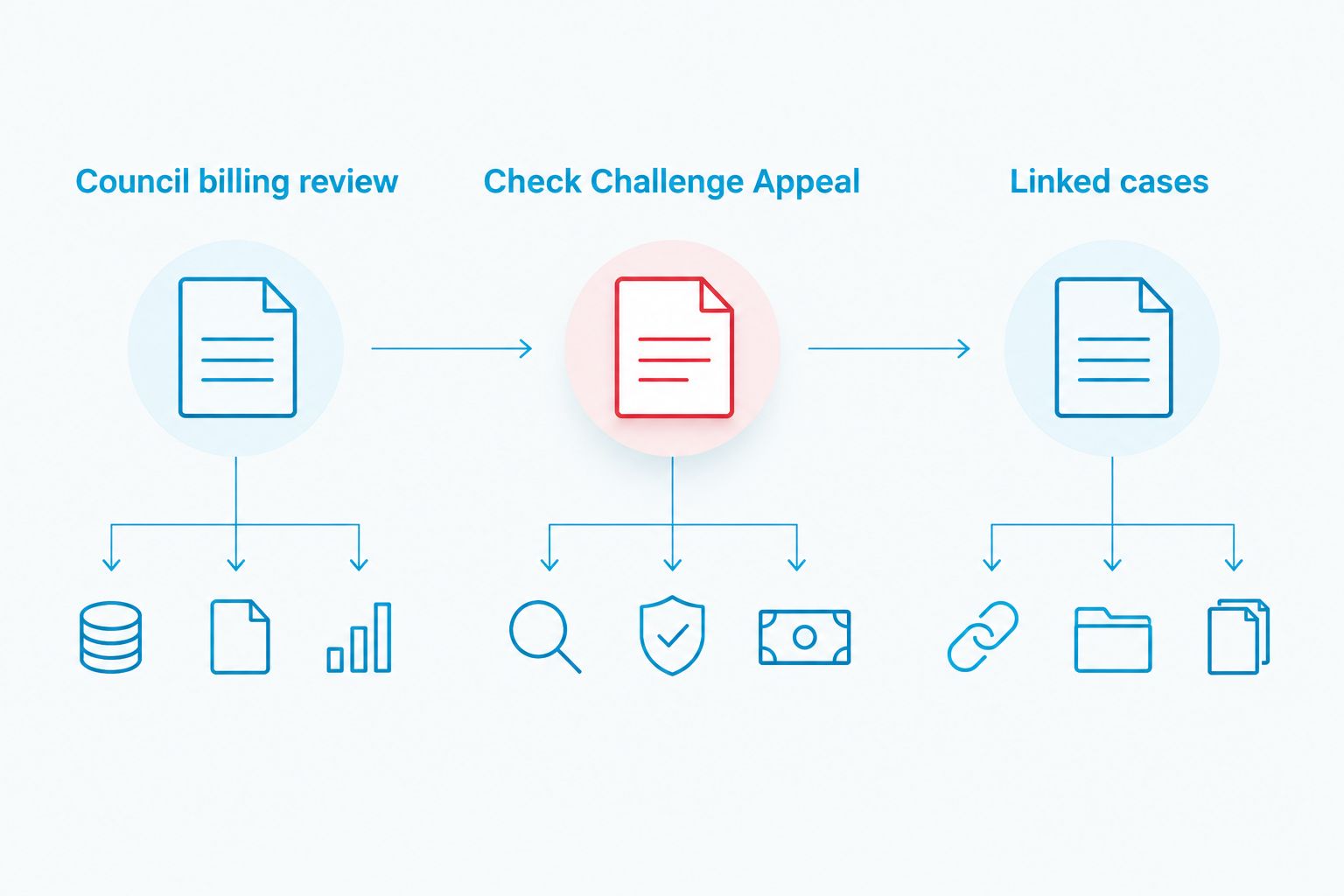
A high bill is not, by itself, evidence that the rateable value is wrong. Check whether the disputed amount comes from the assessment, the dates charged or an account adjustment before selecting a valuation route.
Evidence pack and council submission
- Build a chronology. List occupation, vacation, handover and physical-change dates relevant to the dispute. Beside each event, identify the document that supports it.
- Prepare a reference sheet. Include the UPRN, council account reference, assessment reference, property description and disputed billing period. Label each reference clearly rather than presenting them as equivalent identifiers.
- State the requested correction. Ask the council to investigate a specific point, such as which premises an account covers, why a named business has been billed, or whether a payment reached the correct account.
- Submit through the council's published channel. Portal labels vary between councils, so follow the business rates enquiry or dispute instructions on your authority's own service. Save the submitted wording, attachments and acknowledgement.
Expected result: the council receives an evidence-led request with an identifiable account, a defined dispute and a clear action to consider.
Use this structure for the message:
- Property: full address, unit description and UPRN.
- Account: council account reference and assessment reference, labelled separately.
- Dispute: the charge, period or decision you say is wrong.
- Evidence: a short explanation of what each attached document establishes.
- Request: the investigation, explanation or correction sought, with written reasons for the decision.
For a bill issued in 2026, quote the period shown on the demand notice rather than describing it only as this year's bill. That prevents confusion between the issue date and the period charged.
Send relevant extracts rather than an unexplained bundle. A lease plan needs a note identifying the area concerned; a handover document needs a note connecting it to the disputed occupation date. Remove unrelated personal or financial information before submission.
Decision record and reconciliation
- Log the acknowledgement. Save the case reference, submission date and any response date the council provides. Record telephone conversations and confirm substantive points in writing.
- Check the reply against your request. An address amendment is not necessarily a liability correction. Ask whether the authority has resolved the disputed charge or only updated the property description.
- Reconcile the account. Compare any revised demand with the decision, billing periods, payments and credits. Where a valuation change is involved, check that the bill reflects the relevant effective date.
- Request reasons or escalate. If the answer does not address your evidence, identify the unresolved point and request a reasoned response. Use the council's complaints process for service handling; obtain advice on the appropriate route for an unresolved legal liability dispute.
Expected result: your file ends with a documented decision and a checked account, not merely a closed enquiry.
Do not stop paying simply because you have raised a dispute. A billing query or valuation challenge does not automatically suspend collection. Ask the council in writing about payment arrangements and any recovery action while it investigates, and keep evidence of its response.
If a summons or other recovery notice arrives, deal with it immediately. A pending property-record correction is not a substitute for responding to that notice or obtaining advice about the action required.
When the property record changes
Use a second version of this workflow whenever premises are divided, combined or readdressed. The trigger is a documented change, not an assumption that a new UPRN automatically produces a new rates account.
Keep the original property record and add the changed record beside it. Identify what changed, when it changed, and which documents show the physical arrangement and occupation position.
For a 2026 property split, distinguish the date works finished, the date separate occupation began and any effective date adopted in the rating list. Do not substitute one date for another without supporting evidence.
Ask the council and valuation authority separately to confirm how the change affects their records. Record 2 case references where both authorities have opened cases, and quote the relevant reference in each follow-up.
This linked workflow makes changes traceable, but it requires more coordination than a straightforward payment-allocation query. Avoid closing the file until the relevant decisions and bills agree.
Troubleshooting
The UPRN matches, but the council bills the wrong business
A matching UPRN identifies the premises, not the liable person. Send the occupation chronology and relevant lease, licence or handover evidence, and ask the council to explain its liability decision for the disputed period.
The lookup shows the building, not your unit
Do not borrow another unit's identifier. Provide the parent-building result with an annotated plan and ask the council to confirm the property record linked to your account.
The council sends you to the valuation authority
Separate the disputed questions. Ask the council to address account administration or its liability decision, and use the valuation route for an assessment issue; cross-reference the cases where the outcomes are connected.
The revised bill still looks wrong
Compare the effective dates, charged periods, relief entries, payments and credits against the written decision. Ask for an account breakdown identifying the remaining difference rather than resubmitting the original complaint unchanged.
Recovery continues during the dispute
Contact the council promptly, quote the recovery notice and explain the live dispute. Request written confirmation of the payment position; do not assume an investigation has placed recovery on hold.
Customise your workflow
For several properties, use a separate record for each assessment and council account. A shared trading name or landlord does not establish that neighbouring premises belong in the same dispute.
Add a document index and a decision log when several people handle the case. Keep original files unchanged and store annotated working copies separately, so later explanations remain traceable to the evidence.
For an assessment issue, follow the Check, Challenge, Appeal guide rather than trying to complete the valuation process through council correspondence alone.
Let Appeal My Rates UK handle your case if you want help with the valuation, property configuration or council dispute. Most of our work is no win, no fee, but some instructions carry fixed fees. Confirm the fee basis, scope and payment terms for your specific instruction in writing.
Ask us to handle your case
Explain the disputed premises, billing period and council response so the instruction can be discussed.
FAQ
Can a UPRN lookup resolve my business rates dispute?
A UPRN lookup can identify the premises, but it does not decide liability or correct a bill. Use it alongside occupation evidence, the rating-list entry and the council account record.
Is my UPRN the same as my business rates account number?
No. A UPRN identifies an addressable property, while a council account reference identifies the billing account; keep both clearly labelled in correspondence.
Who should I contact about a business rates bill for the wrong property?
Contact the council that issued the bill and ask it to confirm which premises the account covers. Supply the billed address, UPRN lookup result and a plan where the unit boundaries are unclear.
Do England and Wales use the same current valuation appeal process?
Both England and Wales use Check, Challenge, Appeal for current rating-list valuation challenges. Checks and Challenges go to the valuation authority, while appeals go to the relevant Valuation Tribunal for England or Wales.
Can I stop paying while the council investigates my dispute?
Raising a dispute does not automatically suspend payment or recovery. Ask the council in writing about payment arrangements and respond promptly to any recovery notice.
Does a new UPRN automatically create a separate rates assessment?
No. A new property identifier does not itself establish how premises should appear in the rating list or how the council should bill them; ask each authority to confirm its decision.
Can Appeal My Rates UK help with both valuation and council disputes?
Appeal My Rates UK helps business owners with valuation challenges, property splits and mergers, and council rates disputes. Most of our work is no win, no fee, but some instructions carry fixed fees. Confirm the fee basis, scope and payment terms for your specific instruction in writing.
One last thing
Ask the council to confirm the premises covered by the account in words, not just by repeating a reference number. A description identifying the floor, unit and occupied area can expose a mismatch that an apparently correct postcode conceals.
Close the dispute only when the written decision and the account agree. An acknowledgement, updated address or closed enquiry is not proof that the disputed charge has been corrected.
Related guides
- Escalate a council business rates dispute
- Use a business rates demand notice as appeal evidence
- Council rates portal to an approved relief claim workflow